I have been collecting feather tattoo drawings for years, and the pattern is hard to miss: the feather designs that still look good five years later are the ones with fewer elements, not more.
Feathers are one of the most requested motifs for women, and also one of the easiest to over-complicate. Every charm, bead and bird you add is another line that has to hold its shape as the tattoo settles.
What follows is a working guide rather than a gallery dump — which drawing styles suit which placement, what your artist will quietly change about your reference, and where the design usually goes wrong. If you want a broader sweep of options first, our collection of women’s feather tattoo ideas covers more ground.
Every design below came from a drawing I have either worn, watched being tattooed, or talked through with an artist. I have flagged the ones that need a skilled hand.
Which Feather Tattoo Style Is Right for You?
Style matters more than subject here. The same feather drawing behaves very differently depending on how it is rendered.
| Style | Best Size | Ages Like | Choose It If |
|---|---|---|---|
| Fine line | 2–5 inches | Softens noticeably; may need a touch-up in a few years | You want something quiet that reads as jewellery, not artwork |
| Blackwork / ornamental | 4–8 inches | Very well — solid black holds its edge longest | You want the design still legible from across a room in ten years |
| Dotwork | 3–7 inches | Well, if the dots are spaced properly rather than crowded | You want texture and depth without heavy black |
| Watercolour | 4–7 inches | The softest edges fade first; usually the shortest-lived | You love the look now and accept future touch-ups |
| Black & grey realism | 5–10 inches | Good at size; poorly if squeezed too small | You want a feather that looks like an actual feather |
In my experience the two most regretted choices are fine line pushed too small and realism pushed too small. Both fail the same way — detail collapses into a grey smudge.
What Actually Makes a Feather Drawing Work on Skin
A feather on paper and a feather on skin are not the same drawing. Paper holds hairline gaps forever; skin does not.
Ink spreads slightly under the surface for the life of a tattoo. Lines placed close together will eventually touch, which is why an artist may widen the gaps between your barbs even when your reference looks perfect.
The single biggest predictor of how a feather ages is the space between its lines, not the quality of the drawing. Every experienced artist I have asked has said some version of this.
Placement drives the rest. A feather is long and narrow, so it wants a long, narrow stretch of body — forearm, spine, calf, ribs. Squeezing one onto a rounder area works, but the drawing has to be redesigned rather than shrunk, which is also true of most small meaningful tattoos for women.
And feathers curve. A dead-straight feather looks stiff on a limb that is anything but straight, so most good drawings carry a gentle S-curve through the shaft.
Feather Tattoo Drawings for Females Worth Stealing
These are grouped by the problem they solve rather than by prettiness. Take the structure, not the exact drawing — your artist will want room to adapt it.
1. The Whimsical Feather with Hearts, Stars and Charms
This is the design most people picture first: a soft feather with small hearts, stars or charms drifting off the barbs.
It works because the small elements break up the silhouette, so the tattoo does not read as one solid shape. That keeps it feeling light.
The risk is clutter. When I have seen this design go wrong, it is almost always because five charms were used where two would have done the job.
Ask your artist to draw the feather first and add elements last. If the feather looks unfinished without them, the feather itself needs work.
Best at four to six inches on a forearm or the back of the calf, where there is room for the charms to breathe.
2. Mandala and Ornamental Feathers
Here the vane is filled with mandala geometry, lace patterning or repeating ornamental shapes rather than natural barbs.
This is the most durable feather drawing on the list. Ornamental work is built from solid black and deliberate negative space, both of which age well.
It also demands the most skill. Symmetry is unforgiving, and a mandala that is even slightly off-centre is obvious forever.
Look specifically for healed photos of ornamental work in an artist’s portfolio, not fresh ones. Fresh ornamental tattoos almost always look sharp; healed ones tell you the truth.
Expect a longer sitting than the size suggests — packing black takes time, and rushing it is how patchy fill happens.
3. Feather and Floral Combinations
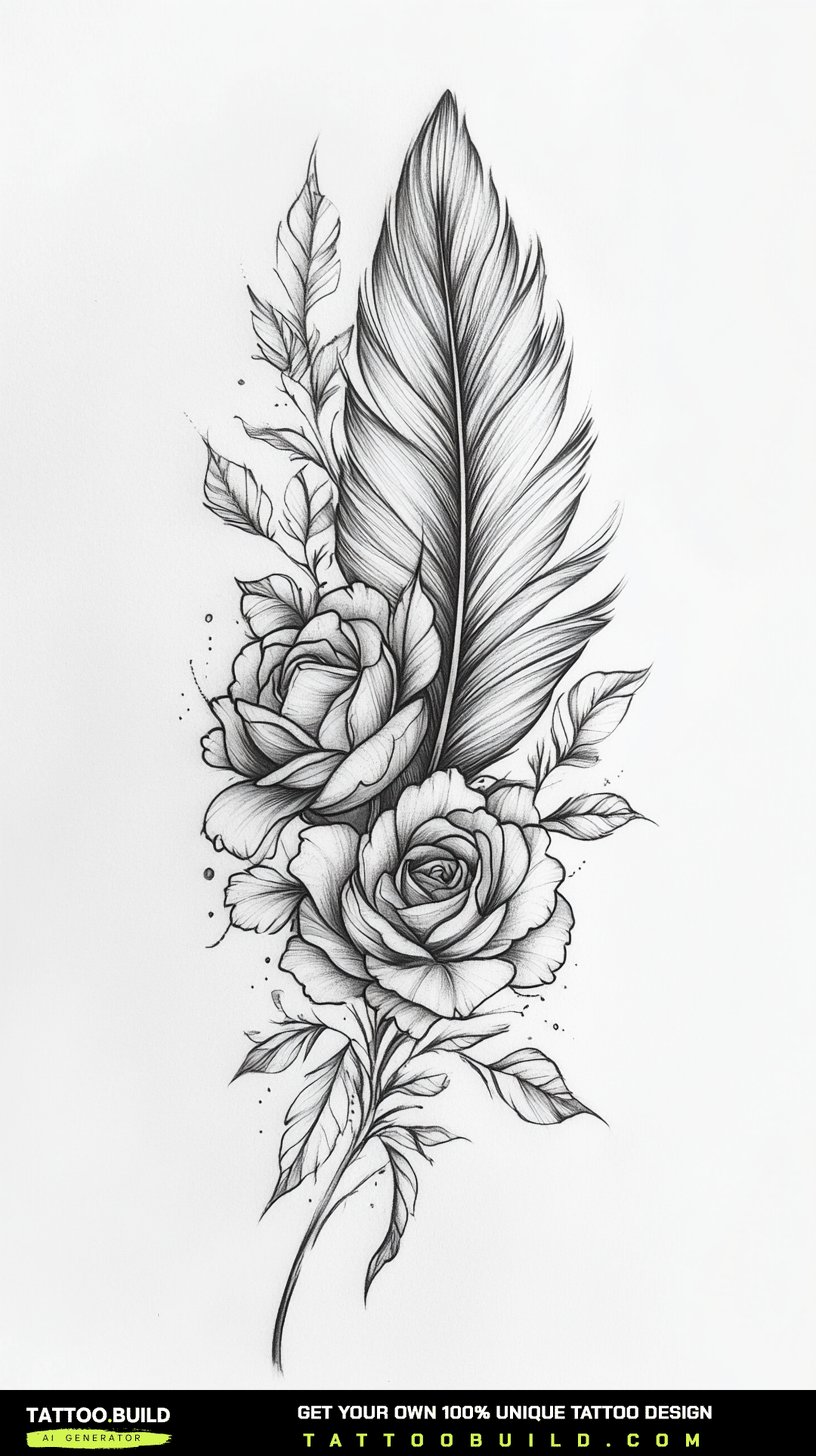
Roses, lavender, wildflowers and trailing vines are the most common additions, usually growing out of the quill or replacing part of the vane.
The pairing works because a feather is all straight parallel lines and a flower is all curves. The contrast stops either one from looking flat.
The version I like most is the half-and-half: feather at the top, blooms dissolving out of the bottom third. It gives the design an obvious focal point.
If you are leaning heavily floral, it is worth looking at how flower ankle tattoo designs handle the same problem of fitting organic shapes to a narrow space.
One honest caution: flowers add colour temptation. A colour rose beside a black feather can look excellent, or it can look like two separate tattoos that happen to touch.
4. Feathers Turning Into Birds
Birds lifting off the tip of a feather is the most recognisable feather tattoo of the last decade, and the most likely to be dismissed as generic.
It has lasted because the meaning is legible at a glance — something breaking away and moving on. That is not a small thing.
The way to keep it from looking stock is the birds themselves. Most stencils use identical silhouettes at three sizes; a good artist will vary the wing positions so they read as birds in different moments of flight.
Three birds is the usual count. Beyond five, they stop reading as a flock and start reading as scattered marks. If bird symbolism is the real draw, our guide to different bird tattoo meanings is worth a read first.
This design suits a vertical placement — spine, outer forearm, ribs — because the birds need somewhere to travel.
5. Minimalist and Fine Line Feathers
Stripped to an outline and a handful of barbs, often only two or three inches long.
These are the most requested feather drawings from women getting a first tattoo, and I understand why — they are quiet, quick, and easy to place.
The trade-off is honest and worth stating plainly: fine line tattoos soften faster than anything else on this list. Thin lines spread, and a design built entirely from thin lines has nothing to fall back on.
That is not an argument against them, just an argument for realistic expectations and a touch-up budget. The same applies to most fine line spine tattoo designs.
Keep the barb count low. When I have seen small fine line feathers fail, it is because thirty tiny barbs were drawn where twelve would have held their separation.
6. Dreamcatcher and Bohemian Feathers
Feathers hanging from a hoop, wrapped with beads, thread and spiral detail — the boho treatment.
This is a larger commitment than most people expect. A dreamcatcher with three feathers is realistically a half-day design, not an afternoon add-on.
It is also the design with the most cultural weight attached to it. Dreamcatchers originate with the Ojibwe people, and it is worth reading about that background before committing — our dreamcatcher tattoo guide goes into more detail.
Design-wise, the hoop is what holds it together. A slightly irregular, hand-drawn hoop looks better on a curved limb than a mechanically perfect circle.
Thigh, outer shoulder and upper back suit it best. Anywhere narrower and the hanging feathers get compressed.
Variations Worth Considering
If none of the above is quite it, these are the adjustments I see most often.
Negative Space Feathers
Instead of drawing the feather, the artist blacks out the area around it and lets skin form the shape.
Striking, and it ages unusually well because there are no fine lines to spread. It is also close to permanent — solid black is the hardest thing to cover or remove later.
Script Paired With a Feather
A short line of text running alongside the shaft rather than across it, so the two elements do not fight.
Keep it genuinely short. Long quotes force the lettering smaller than it should be, and small script is the first thing to blur.
Feathers Scaled for the Wrist or Ankle
A feather can absolutely work small, but it has to be redrawn rather than reduced — fewer barbs, thicker lines, simpler tip. The same principles behind wrist tattoos for females apply directly.
Ask for the stencil to be placed and photographed before any needle touches skin. Wrists and ankles curve sharply, and a feather that looked straight on the stencil sheet often is not.
Feather and Butterfly Combinations
A butterfly lifting off the barbs is a softer alternative to birds, and carries a similar transformation meaning — the butterfly tattoo ideas collection has more on that symbolism.
One butterfly is usually enough. Two competes with the feather for attention.
Placement, Sizing and Aftercare
Sizing first: measure the space with a tape before you settle on a design. Most people underestimate how much length a feather needs, and a rushed compromise at the shop is how designs get squashed.
Healing is straightforward if you follow your artist’s instructions rather than internet advice, but the basics are consistent — keep it clean, keep it moisturised, keep it out of direct sun, and do not pick at it. The American Academy of Dermatology publishes plain guidance on caring for tattooed skin.
Take reactions seriously. Spreading redness, heat, pus, or a rash appearing days or weeks later is not normal healing — see a doctor, not a forum. Mayo Clinic lists the specific risks worth knowing about, including allergic reactions to pigment that can surface long after the tattoo has healed.
Ink itself is worth a thought. The FDA notes that tattoo inks are not approved the way drugs are, so ask your artist what they use and whether they have had reports of reactions to it. Any good artist will answer without hesitating.
Long term, sunscreen does more to preserve a feather tattoo than any aftercare product. UV exposure is what fades a design fastest once it is healed — and nothing on this page is medical advice, so take health questions to a professional.
Common Mistakes — and What to Do If You’re Still Not Sure
The most common mistake is bringing a reference image and asking for it exactly. Artists draw better when they are given a direction and some freedom.
The second is choosing a placement for how it photographs rather than how it fits. Ribs photograph beautifully and hurt considerably; that is a fair trade only if you have decided it is.
The third is booking with whoever is available. Feather work rewards specialists, and a fine line artist and an ornamental artist are not interchangeable.
If you are still undecided, it usually helps to look sideways rather than harder. Wing tattoo ideas solve a similar problem at a larger scale, and if the appeal is really the freedom symbolism, a bird chest tattoo may get you there more directly.
And there is no deadline. A design you still want in six months is a design worth booking.
Frequently Asked Questions
Where do feather tattoos hurt the least?
In my experience the outer forearm, outer thigh and calf are the most comfortable spots for a feather, because they have more muscle and fewer nerve endings close to the surface. Ribs, spine, sternum and the top of the foot are consistently the hardest. Pain is personal, though, so treat any ranking as a rough guide rather than a promise. If you are worried, start somewhere forgiving and work up.
How long does a feather tattoo take?
A small fine line feather is usually well under an hour. A detailed ornamental or mandala feather typically runs three to five hours, and a full dreamcatcher with multiple feathers is often a full day or split across two sittings. Ask for a time estimate when you book, since it drives the cost more than the size does.
Do feather tattoos fade faster than other designs?
Not because they are feathers, but because feather drawings often rely on thin, closely spaced lines, and that style fades fastest. A blackwork or dotwork feather ages about as well as any other solid design. Sun exposure and placement matter more than subject — hands, feet and inner wrists wear faster wherever the design comes from.
What does a feather tattoo mean for a woman?
There is no single meaning, and anyone insisting otherwise is overselling it. The most common associations are freedom, resilience, and remembering someone who has died, and feathers turning into birds usually signal moving on from something. The meaning that matters is the one you attach to it.
Should I get a feather tattoo in colour or black and grey?
Black and grey is the safer long-term choice — it holds up better and is easier to touch up or rework later. Colour, particularly watercolour, looks striking early and generally needs more maintenance. If you want colour, keep it to one accent element rather than the whole feather, which tends to age better and looks more deliberate.
Quick Summary
- Space between lines predicts how a feather ages more than drawing quality does.
- Fine line reads beautifully but softens fastest — budget for a touch-up.
- Ornamental and blackwork feathers are the most durable option here.
- Feathers want long, narrow placements: forearm, spine, calf, ribs.
- Small feathers must be redrawn with fewer barbs, never just shrunk.
- Keep added elements — charms, birds, flowers — to two or three at most.
- Check healed portfolio photos, not fresh ones, before booking.
- See a doctor for spreading redness, heat, pus or a delayed rash.