A feather is one of the few tattoo subjects that works at almost any size, on almost any part of the body, in almost any style. That flexibility is exactly why so many women end up with a feather tattoo that looks generic — the shape is forgiving enough that a mediocre design still “works,” so nobody pushes it further.
I have spent a long time looking at feather tattoos, both in portfolios and on real healed skin, and the difference between the ones that still look good after five years and the ones that turn into a grey smudge comes down to two things: line spacing and placement.
This guide walks through the placements that suit the shape, the styles that hold up, and the specific choices I would make if I were booking one tomorrow. If you want more reference material to bring to a consultation, our collection of feather tattoo drawings for females is a good place to start.
Every photo below is a real design, and I have tried to say something useful about each one rather than just calling it “beautiful.”
Which Feather Tattoo Style Is Right for You?
There is no single best style — but there is a best style for a given size and placement. Here is how the four most common approaches actually compare.
| Style | Best At This Size | Placements That Suit It | How It Tends to Age |
|---|---|---|---|
| Fine line | Small to medium — roughly 3 to 6 inches | Inner forearm, spine, ribs, ankle | Softens noticeably; thin barbs can blur together if packed too close |
| Black and grey realism | Medium to large — 6 inches and up | Upper back, outer arm, thigh | Holds well when the artist leaves real gaps between strands |
| Dotwork / stippled | Small to medium | Forearm, shoulder blade, calf | Very forgiving — dots spread evenly rather than bleeding into lines |
| Watercolour / colour | Medium | Upper arm, shoulder, thigh — anywhere sun-protected | Fades fastest; needs a black or grey structure underneath to survive |
If you are torn, the honest answer in most cases is dotwork or black and grey. They are the two that need the least maintenance.
What Feather Tattoos Actually Mean
Feathers carry meaning mostly because of what they do rather than what they are — they belong to something that flies, and they fall away without the bird noticing.
The most common readings are freedom, lightness, and moving on from something. A feather that has already dropped implies a release rather than a loss, which is why it shows up so often as a memorial piece.
There is also a travel and journey reading, where the feather stands in for a path rather than a destination. I have seen this done well with a single feather placed vertically, following the direction of the limb.
Feathers hold specific ceremonial significance in many Indigenous cultures, particularly eagle feathers in North America, where they are earned rather than decorative. If that meaning is what draws you, it is worth reading about the specific tradition rather than borrowing the visual, and worth talking it through with your artist.
Beyond all of that, plenty of people simply like the shape. That is a legitimate reason, and no artist I have spoken to thinks less of it.
Women’s Feather Tattoo Ideas by Placement
Placement does more work than style here. A feather is a long, narrow, tapering shape, so it looks natural on long, narrow, tapering parts of the body — and awkward almost everywhere else.
Forearm Feather Tattoos
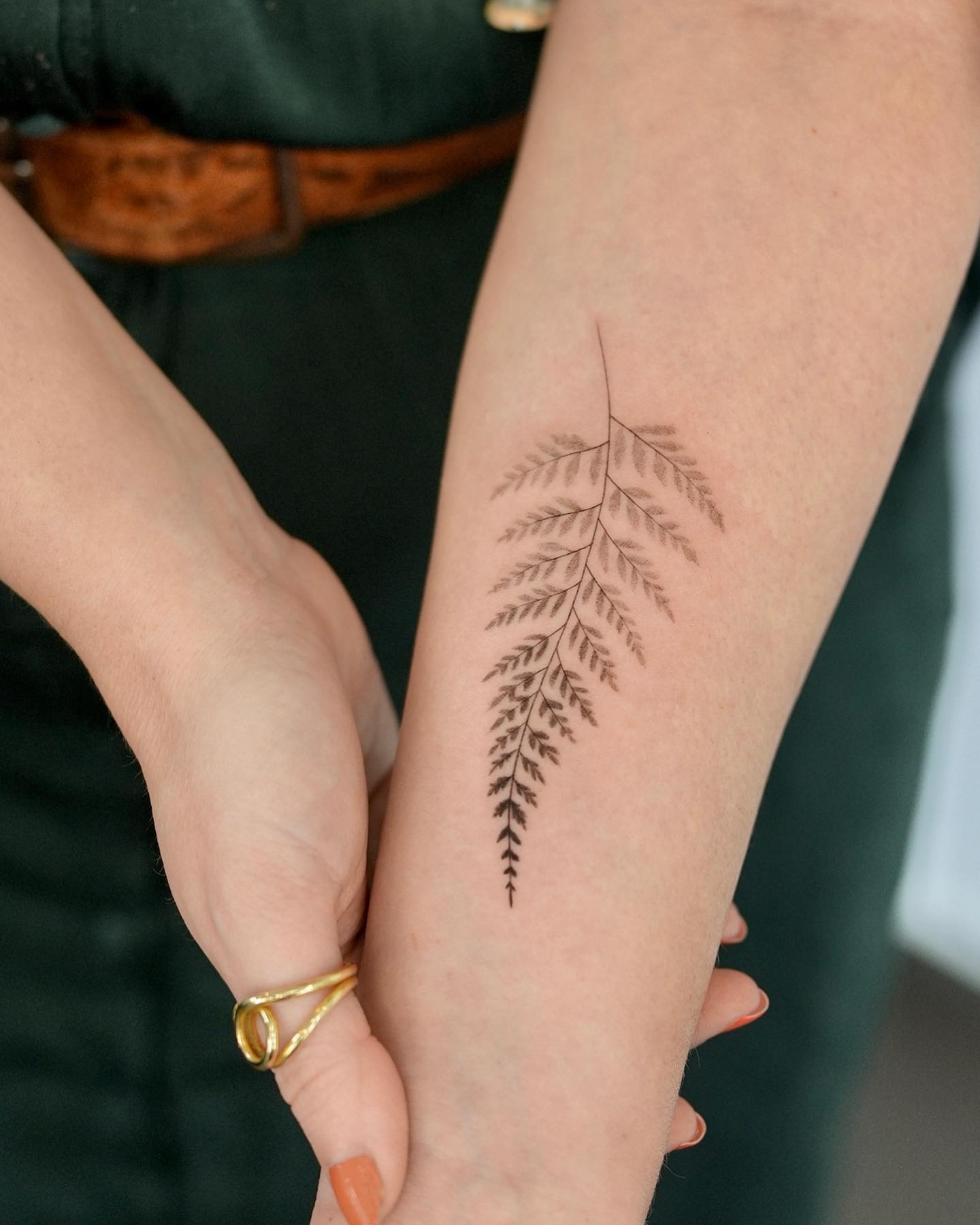
The forearm is the placement I recommend most often for a first feather. The shape of the limb matches the shape of the design, so the tattoo sits along the arm rather than across it.
Inner forearm is softer to sit through and keeps the piece semi-private; outer forearm shows more and holds ink slightly better over time because it takes less rubbing from sleeves and bags.
Size-wise, four to six inches is the sweet spot. Below about three inches the barbs start to merge, and you lose the thing that makes a feather look like a feather.
For more options in this area, our guide to forearm tattoo ideas for females covers what else works in the same space.
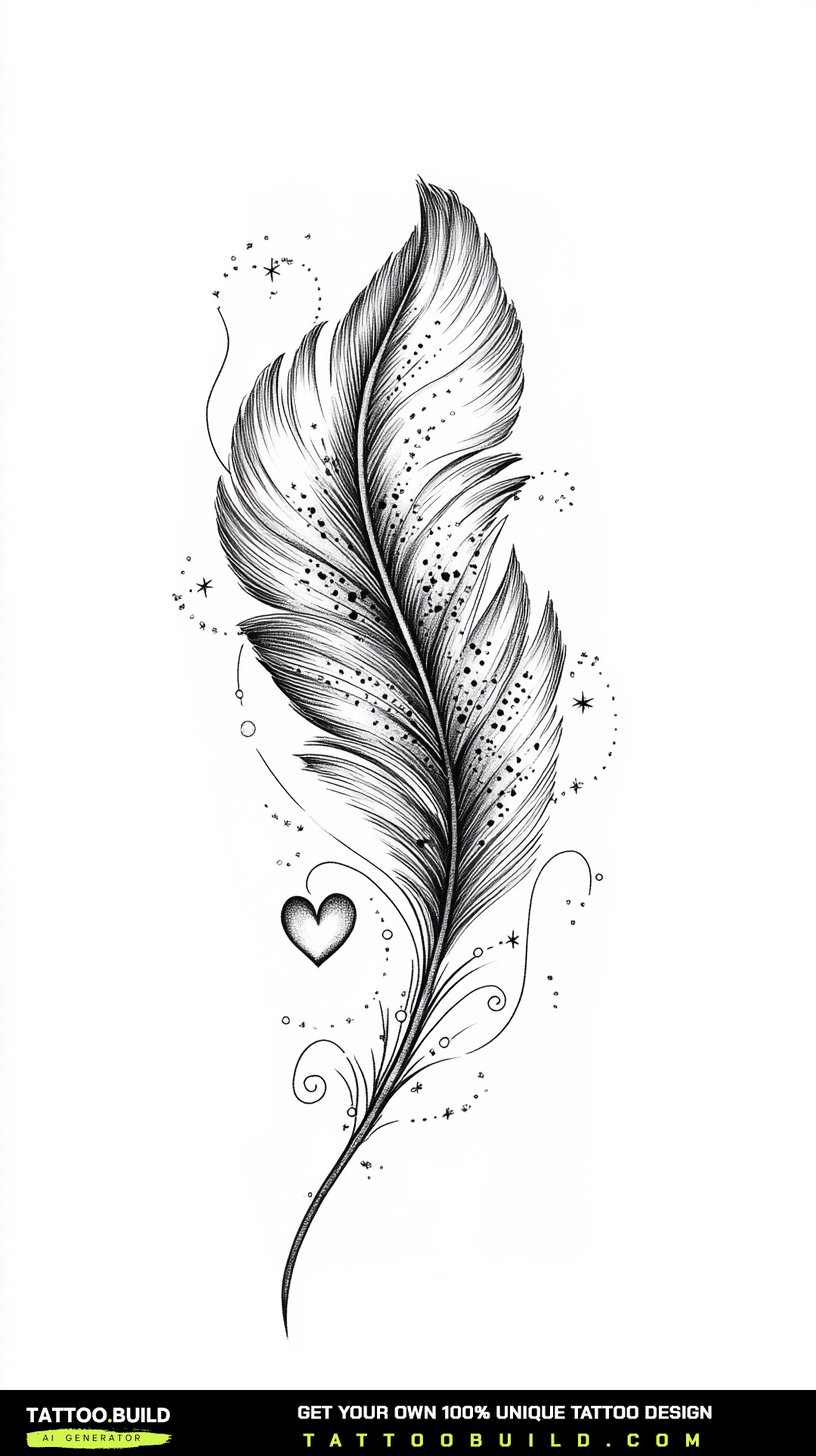
The version below leans into stippling — small dots scattered around the quill, with a slightly traditional weight to the outline.
I like this approach for anyone worried about ageing, because dots hold their shape far better than hairline strokes.
Upper Back Feather Tattoos
The upper back gives you the most usable canvas, and it is the only placement where a genuinely large, detailed feather makes sense.
With that much room, an artist can leave visible skin between the barbs. That negative space is the single biggest predictor of whether a detailed feather still reads as a feather in ten years.
It is also easy to cover, which matters more than people expect — a few of the women I have talked to about back pieces chose that placement specifically for work reasons.
The trade-off is that you will never really see it yourself without two mirrors.
A narrower back feather is a good compromise if a full shoulder-width piece feels like too much.
It keeps the length and the taper but sits in a single column, which also makes it cheaper and shorter to sit through.
Shoulder and Shoulder Blade Feathers
The shoulder is a curved surface, and a feather curves naturally, so the two get along better than most subject-placement pairings.
The key is that the feather should follow the curve of the deltoid or the shoulder blade rather than being laid flat over it. When it is laid flat, it looks like a sticker.
Shoulder tattoos also age fairly well because the area sees less sun than a forearm and less friction than a hand or foot.
If you are weighing this placement, shoulder blade tattoo ideas for women is worth a look for how other subjects handle the same curve.
Here the feather wraps over the blade, tapering as it reaches the edge of the shoulder.
Every artist I have asked about this placement says the same thing: get it stencilled while you are standing up, not lying down, or the curve will be wrong.
Spine Feather Tattoos
Of all the placements, the spine suits a feather best. The quill runs down the vertebrae and the barbs fan out symmetrically on either side — the anatomy does half the design work for you.
It is also, in my experience and in most artists’ pain charts, one of the sharper areas to sit through, because the needle is working directly over bone with very little padding.
Expect to break it into sessions if you want the full length from nape to mid-back. Sitting through a spine piece in one go is possible but rarely pleasant.
Our roundup of spine tattoo ideas for women has more on how this placement behaves with different designs.
The black and grey version sits between the shoulder blades rather than running the full spine, which is a sensible first step.
You can always extend downward later — adding to a vertical piece is far easier than adding to a horizontal one.
Upper Arm Feather Tattoos
The upper arm is the compromise placement: visible in a t-shirt, hidden in anything with sleeves, and comfortable enough that most people sit through it easily.
It also takes medium-sized work well. A five to seven inch feather fits the outer arm without needing to wrap.
Loose strands at the base of the feather are the detail I would ask for here — they break up the hard outline and stop the design from looking like a stencil.
Ink on the outer upper arm does get real sun exposure in summer, so this is a placement where sunscreen genuinely changes how it looks in five years.
The second version keeps the same idea at a slightly smaller scale, with tighter linework near the quill.
Notice how the strands separate rather than touching — that spacing is deliberate, and it is what will keep the piece legible.
Coloured and Watercolour Feathers
Colour opens up peacock, jay, and macaw feathers, which have patterns no blackwork piece can match.
The catch is durability. Colour, and blues and greens in particular, fade faster than black, and watercolour styles that skip a dark structural outline tend to lose their shape first.
If you want colour, I would ask the artist to build a black or deep grey skeleton underneath and lay the colour over it. When the colour softens, you still have a feather.
The watercolour tattoo ideas collection shows how other subjects handle the same trade-off.
Feather Tattoo Variations Worth Considering
If a plain feather feels too simple, these are the additions that actually improve the design rather than crowding it.
Feather Dissolving Into Birds
The classic: the tip of the feather breaks apart into a handful of small birds flying away.
It works when the birds are few and small. Once there are more than five or six, they stop reading as birds and start reading as smudges — and they are usually the first part to blur as the tattoo ages.
Feather With a Name or Date
Common for memorial pieces, and effective when the lettering sits alongside the quill rather than inside the barbs.
Text placed over the feather itself almost always loses legibility first, because both elements are competing for the same fine detail.
Dreamcatcher Feathers
Feathers hanging from a hoop remain a popular request, and the format suits a thigh or an outer arm where there is vertical room.
It is worth knowing that dreamcatchers originate with the Ojibwe people, so it is a design many people prefer to research before committing. If it appeals, dreamcatcher tattoos for females shows the range of how it is being done.
Feather and Florals
Pairing a feather with small flowers — usually something delicate like baby’s breath or a single peony — softens the design and adds width to what is otherwise a very narrow shape.
This is the variation I would suggest if you like the feather but find a single one too sparse for the space you are filling.
How to Get a Feather Tattoo That Ages Well
Ask to see healed photos, not fresh ones. A fresh fine-line feather looks incredible on every artist’s feed; the same piece at two years old is the honest test, and a good artist will have those photos.
Push for larger than you think you need. Almost every regret I have heard about a feather tattoo is that it was done too small, and the barbs closed up into a solid grey shape as it settled.
Skin usually looks settled on the surface within two to three weeks, but the deeper layers keep healing for a couple of months, so judge the final result late rather than early. Follow your artist’s aftercare instructions, and the American Academy of Dermatology’s guidance on caring for tattooed skin is a reliable general reference.
If you are choosing between placements partly on how much it will hurt, our tattoo pain chart gives a realistic sense of the difference between an outer arm and a spine.
On safety: if a tattoo stays red, swollen, or painful beyond the first few days, or you develop a rash or bumps in the ink months later, see a doctor rather than waiting it out. The FDA’s fact sheet on tattoos and permanent makeup covers the reactions worth knowing about. Nothing in this article is medical advice, and never attempt to tattoo or remove a tattoo yourself.
Still Not Sure? Common Feather Tattoo Mistakes
The most frequent mistake is packing the barbs too tightly. It looks rich on paper and turns into a solid block on skin.
The second is choosing a placement because it is trendy rather than because it fits the shape. A feather across the collarbone, for example, has to be shortened so much that it stops looking like a feather at all.
The third is going too small for the level of detail requested. If you want visible individual strands, you need the size to carry them — there is no way around it.
If the feather itself is what you are unsure about, wing tattoo ideas covers a related shape with more visual weight, and fine line tattoo ideas is worth browsing if it is the delicate style rather than the subject that appeals to you.
Frequently Asked Questions
How much does a feather tattoo usually cost?
It depends far more on size, detail and your artist’s rate than on the subject itself. A small fine-line feather is typically a shop-minimum or near-minimum piece, while a detailed back or spine feather is priced by the hour and often spans multiple sessions. Rates vary widely by city and by artist experience, so the only reliable number is the quote you get at a consultation. I would treat any online average as a rough starting point rather than a budget.
Where does a feather tattoo hurt the least?
The outer upper arm and the outer forearm are usually the most comfortable placements for this shape, because there is more muscle and fat between the needle and the bone. The spine, ribs and the top of the foot sit at the other end of the scale. Pain is individual, though, and plenty of people find a spine piece more manageable than expected. Eating beforehand and booking a shorter first session both help more than most people realise.
Do fine line feather tattoos blur over time?
Some softening is normal for any tattoo, and fine line work shows it soonest because there is less ink holding the shape. Whether it blurs badly depends mostly on how much space the artist left between the strands and how well the piece is protected from sun. In my experience, a fine line feather with generous spacing still looks clean years later, while a tightly packed one does not. Sunscreen on the area is the single easiest thing you can do about it.
What size should a feather tattoo be?
For a design with individually visible barbs, four inches is a sensible floor and five to seven inches is comfortable. Below about three inches, ask your artist to simplify the design rather than shrink it — a stylised feather at small scale ages much better than a detailed one. Larger pieces on the back or thigh can run ten inches or more. Your artist will usually have a strong opinion here, and it is worth listening to.
Can a feather tattoo cover an existing tattoo?
Sometimes, but a feather is a difficult cover-up subject because it is narrow and relies on light areas and negative space. Cover-ups generally need a design that is darker and denser than what is underneath, which works against everything a feather does well. A cover-up specialist can tell you quickly whether it is realistic for your specific piece. If it is not, laser lightening first is the usual route — and that is a clinical procedure, not a DIY one.
Quick Summary
- Feathers suit long, narrow placements — forearm, spine, upper arm and upper back are the strongest fits.
- The spine is the most flattering placement for the shape and one of the sharper ones to sit through.
- Spacing between the barbs matters more than the number of barbs; packed detail closes up as the tattoo settles.
- Dotwork and black and grey are the most forgiving styles over time; watercolour needs a dark structure underneath.
- Four to seven inches is the practical size range for a feather with visible individual strands.
- Ask any artist for healed photos rather than fresh ones before you book.
- Meaning is flexible — freedom, release and journeys are the common readings, and liking the shape is reason enough.
- Sunscreen and following your artist’s aftercare do more for longevity than any style choice.