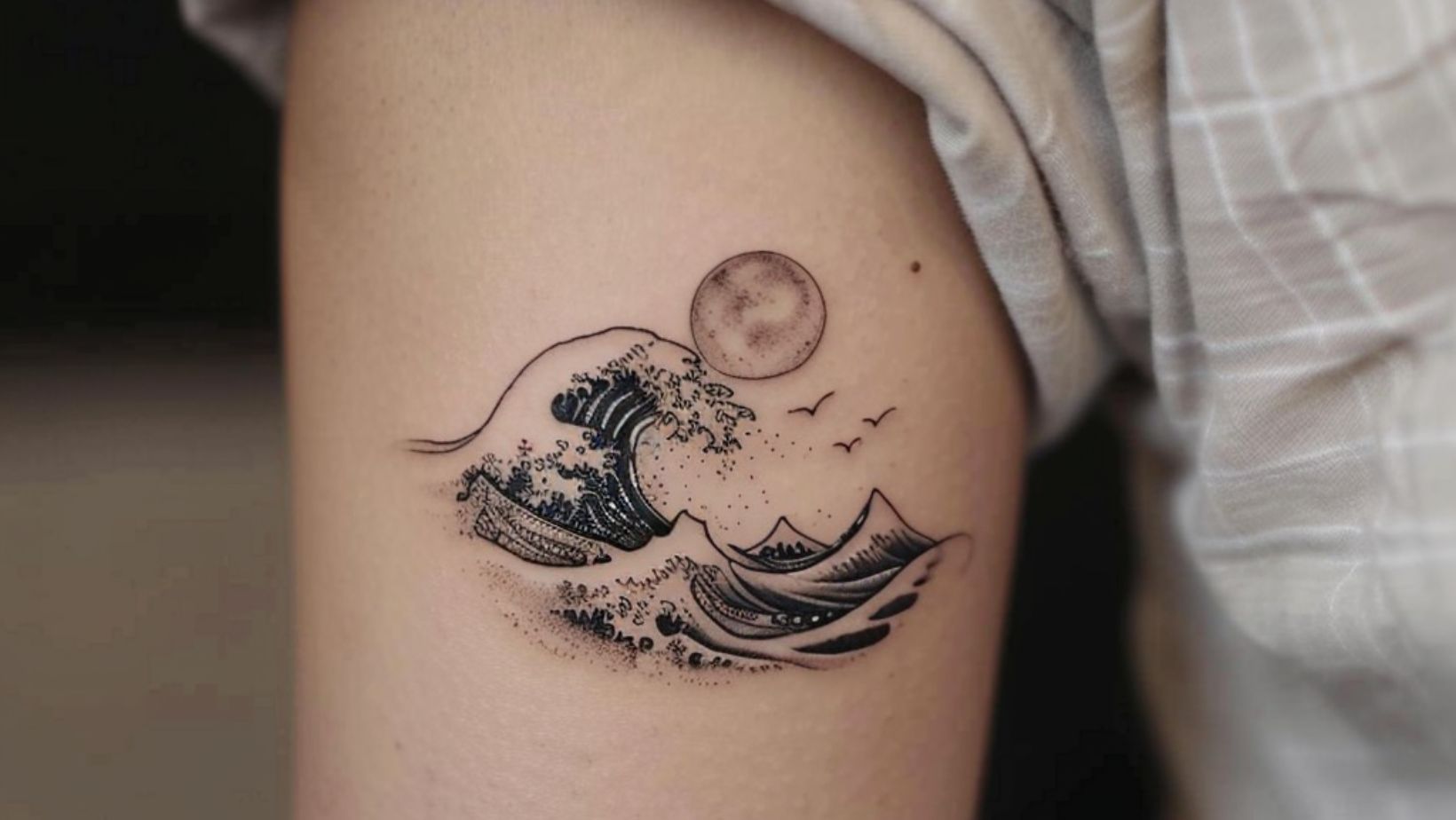
The first wave moon tattoo I ever watched being tattooed took four hours, and almost two of those went into a single crescent. A wave moon tattoo pairs the ocean’s motion with the moon that moves it, and it usually reads as a symbol of change you cannot control but can learn to ride.
That is the short answer. The longer one is more interesting, because the two symbols do not just sit next to each other — they explain each other.
I have spent a lot of time looking at ocean-themed work, and the wave-and-moon pairing keeps coming back for a reason. It carries weight without needing an explanation tattooed underneath it.
Below is what the design actually means, how the main styles differ, where it sits best on the body, and the design ideas I would show an artist. If you are still deciding between symbols, our wider guide to moon tattoo ideas is a good place to browse first.
Which Wave Moon Tattoo Style Is Right for You?
Style changes this design more than size does. The same crescent and wave can look like a sailor’s badge or a whisper, depending entirely on how it is drawn.
| Style | Best Size | How It Ages | Suits You If |
|---|---|---|---|
| Fine line | 2–4 inches | Softens fastest; thin lines can blur within a few years | You want something quiet and closely detailed |
| Bold blackwork | 4–8 inches | Holds up longest; heavy lines stay readable for decades | You want it legible from across a room |
| Japanese-influenced | 6 inches and up | Excellent, because the style is built around bold outlines | You love curling, stylised water |
| Dotwork / stippled | 3–6 inches | Middling; dots can merge as skin settles | You want texture in the moon rather than solid black |
| Watercolor | 4–7 inches | Fades soonest of all; usually needs touch-ups | You want colour and accept the upkeep |
| Neo-traditional | 5–8 inches | Very well, thanks to strong outlines and saturated fill | You want illustrative weight and some colour |
If you are torn, bold blackwork is the safest long-term choice and fine line is the prettiest on day one. Both are valid — they just age differently.
For a closer look at the delicate end of that range, our fine line tattoo ideas guide shows how those thin lines behave over time.
What the Wave and Moon Symbolize Together
Take the two apart and they are ordinary symbols. The wave is movement, force, the sea. The moon is time, cycles, night.
Put them together and something more specific appears: the moon is the reason the wave behaves the way it does. Tides are driven by the gravitational pull of the moon and, to a lesser degree, the sun, as NOAA’s tides tutorial explains.
That is the whole design in one sentence. Something distant and steady is quietly governing something close and chaotic.
Most people I have talked to about this tattoo did not arrive at it through mythology. They arrived at it through a period of their life that felt like weather — and liked that the design admits the weather has a rhythm.
It is worth saying plainly: there is no fixed, traditional meaning here. The wave-and-moon combination is a modern pairing, and what it means is mostly what you decide it means.
Wave Moon Tattoo Meanings, Interpreted
These are the readings that come up most often. They overlap, and most people land on two or three at once.
1. Journey and Transformation
This is the most common reason people give me. The wave is the crossing; the moon is what you navigate by.
It works especially well for people marking a move, a career change, or the end of a long stretch of something difficult. The design does not celebrate arrival — it acknowledges motion.
A rising crescent behind a cresting wave reads as forward motion, while a setting moon behind flat water reads as something closing. Artists will usually build that distinction into the composition if you ask for it.
2. Connection to Nature
For surfers, sailors, divers and people who simply grew up near water, the meaning is less abstract. It is a place, not a metaphor.
I have seen versions where the wave is drawn from a specific break the wearer knows, and the moon is just the sky above it. Those tend to be the ones people are most attached to years later.
If that is your angle, bring reference photos of real water rather than tattoo flash. Artists draw better waves from the actual sea than from other people’s tattoos. Our collection of ocean tattoo ideas covers the broader category.
3. Harmony and Balance
Water and sky, motion and stillness, chaos and order — the pairing is naturally balanced, and plenty of people choose it for exactly that.
Circular compositions lean hardest into this reading. Enclosing both elements in a ring makes them feel like halves of one thing rather than two objects in a scene.
When I have watched artists design these, the balance usually comes from giving each element roughly equal visual weight — a heavy moon over a thin wave tips the whole thing, and not always in a way you notice until it is healed.
4. Feminine Energy and Intuition
The moon has long been associated with feminine symbolism across a range of cultures, and that association carries into modern tattooing.
In practice this shows up as design choices rather than a different symbol: thinner linework, a smaller crescent, softer water, sometimes a few stars.
I would not treat that as a rule. Plenty of the most delicate wave moon tattoos I have seen are on men, and plenty of the boldest are on women. The style is a preference, not a gender.
5. Cycles, Tides, and Emotional Rhythm
This is the reading I find most honest, and it is the one people tend to grow into rather than start with.
Tides come in and go out on a schedule. So, roughly, does how you feel — and a tattoo that says “this passes and returns” is more durable than one that says “I am fixed now.”
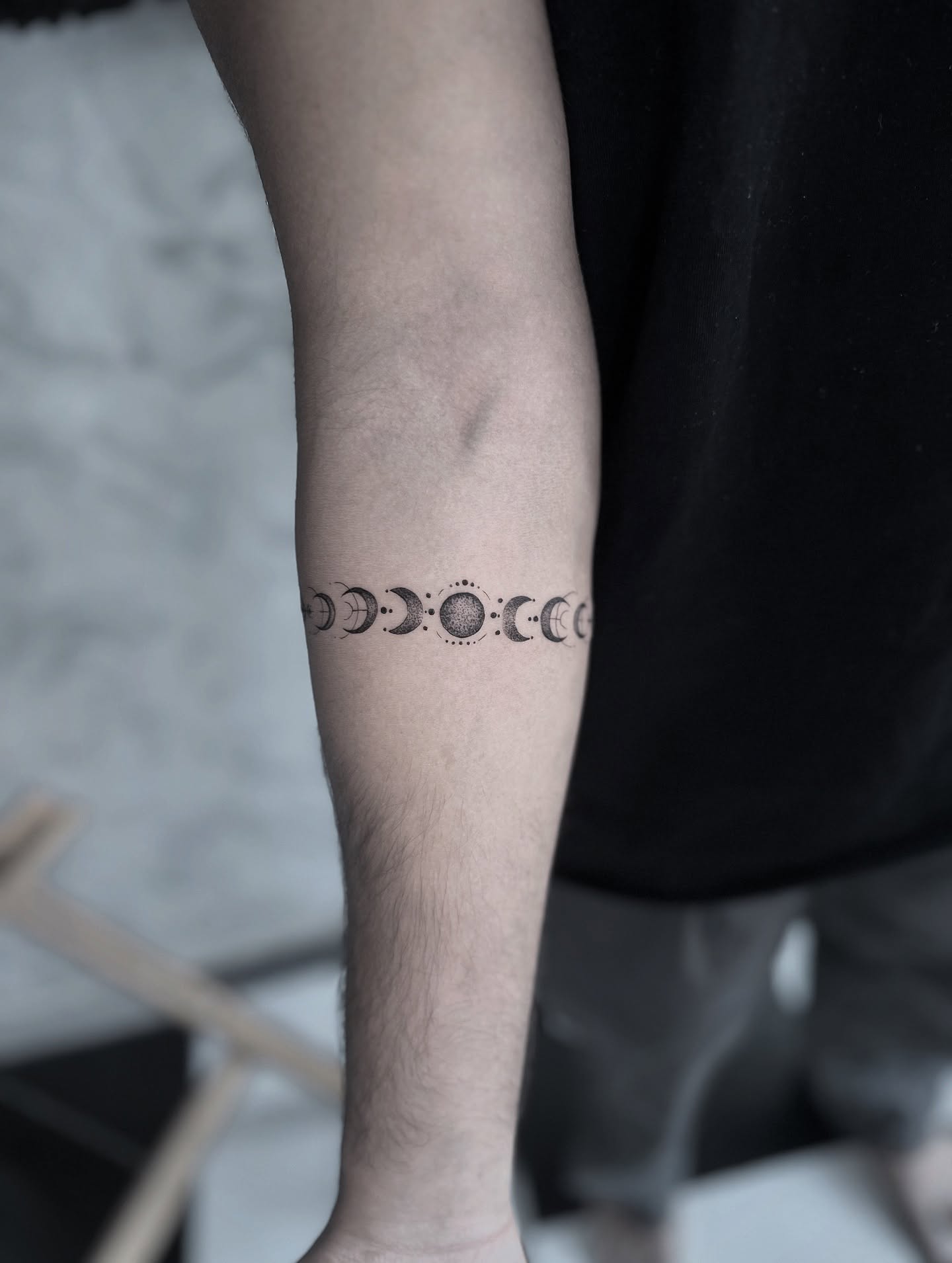
Adding moon phases along the wave is the clearest way to make this explicit. If that appeals, our moon phase tattoo ideas guide covers how those sequences are usually laid out.
6. Guidance and Direction
Before instruments, the moon and stars were how you knew where you were at night. That history is why the moon reads as a guide rather than just decoration.
People who want this reading emphasised usually ask for the moon positioned high and slightly off-centre, with the wave beneath it and open space between.
It pairs naturally with other navigational symbols. A compass rose is the most common addition, though it changes the tattoo from atmospheric to explicitly directional — see our notes on compass tattoo meaning before combining them.
7. Protection and Letting Go
The sea takes things away. That is not a gentle idea, but it is part of why people get this tattoo after a loss.
Memorial versions often keep the design almost unchanged and just add something small — a date in the water, initials worked into the foam, a single star.
I would keep those additions genuinely small. Text inside a wave is one of the first things to blur as a tattoo settles, because the surrounding linework crowds it.
Placement and Style Variations
A wave is a horizontal shape and a moon is a round one. Placement is mostly about finding somewhere that flatters both.
Forearm and Wrist
The inner forearm is the default for good reason — it is a long, gently curved panel that suits a wave running along it.
Wrists work for small versions, but they are tighter than they look, and a design that shrinks below roughly two inches starts losing its internal detail.
Both spots are on the lower end of the pain range for most people, though the inner wrist is noticeably sharper than the forearm. Our guide to the most painful tattoo spots gives a fuller picture.
Shoulder, Spine, and Back
The shoulder cap is the best placement for a circular composition, because the curve of the muscle holds a round design cleanly.
A spine placement flips the design vertical — moon at the top, water falling away beneath it — which reads differently and looks striking, but hurts considerably more.
Upper back gives you the most room. If you want a full seascape rather than a symbol, this is where it goes.
Ribs, Ankle, and Thigh
Ribs suit long horizontal waves and are among the more painful spots on the body. Worth knowing before you book four hours.
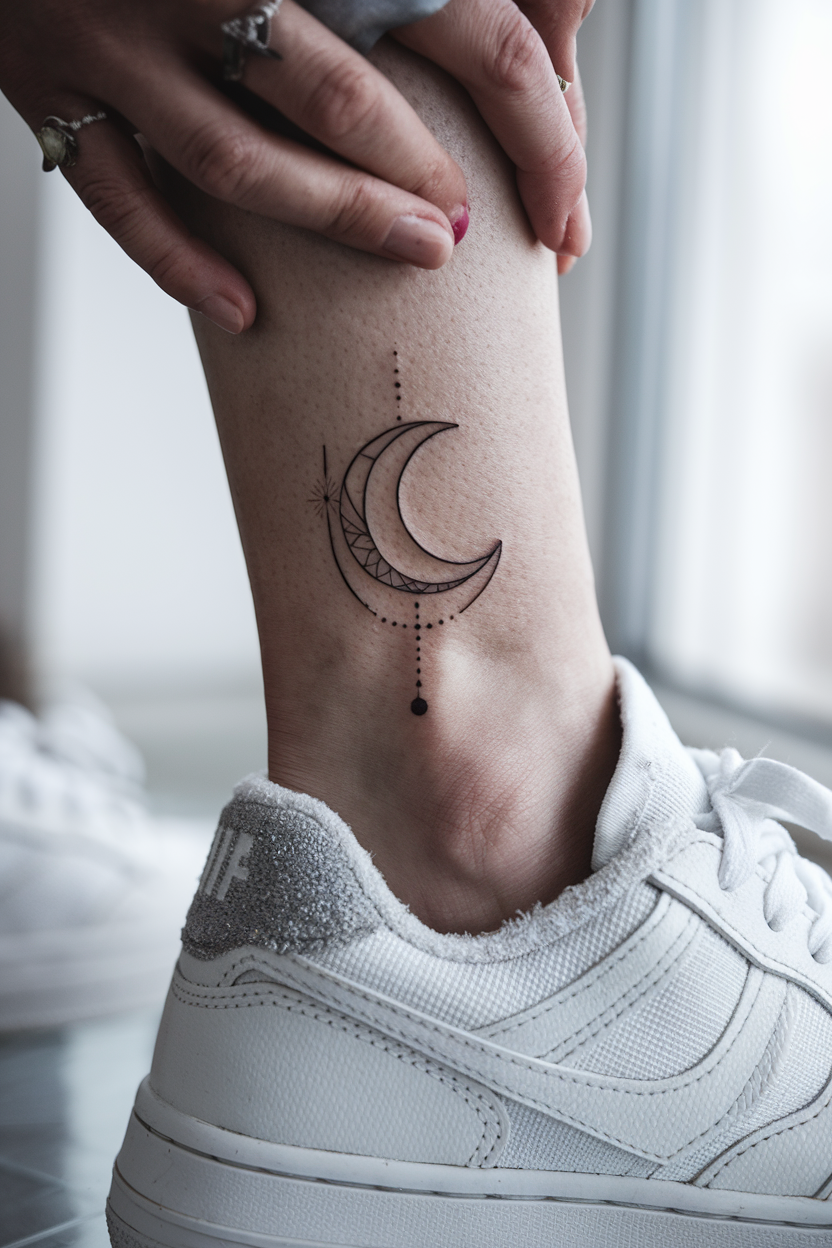
Ankles take small designs well but sit in a high-friction zone — socks, shoes, swelling — so healing usually needs more patience than a forearm does.
The outer thigh is underrated here. It is flat, roomy, low on nerve endings, and easy to keep covered while it heals.
Wave Moon Tattoo Design Ideas
These are the compositions that keep proving themselves. Bring two or three to a consultation rather than one — artists design better with a range than with a single fixed image.
Bold Linework and Blackwork
Heavy outlines, solid black moon, stylised water. This is the version that will still read clearly in twenty years.
It is also the most forgiving of placement and of sun exposure. If you are only getting one tattoo, this is the version I would point you toward. See more in our linework tattoo ideas collection.
Circular and Framed Compositions
Enclosing the scene in a ring turns it into an emblem. It also solves the composition problem, because the circle tells the wave where to stop.
Ask for the ring to be a consistent weight. An uneven circle is the single most visible flaw in this style, and it is very hard to correct later.
Dotwork and Textured Moons
Stippling the moon instead of filling it solid gives the design a softer, almost printed quality, and lets you suggest craters without drawing them.
It takes longer than solid fill and costs accordingly. Ask to see healed dotwork specifically — it is a technique where the difference between a specialist and a generalist shows up years later.
Minimal and Single-Line Versions
The smallest versions reduce the whole idea to one continuous line — a curve that becomes a wave at one end and a crescent at the other.
These are quick, cheap and easy to place. They are also the ones most likely to need a touch-up, because there is no surrounding detail to hide a soft line. Browse our minimalist tattoo ideas if this is the direction you are leaning.
Alternatives and Variations Worth Considering
Adding the Sun
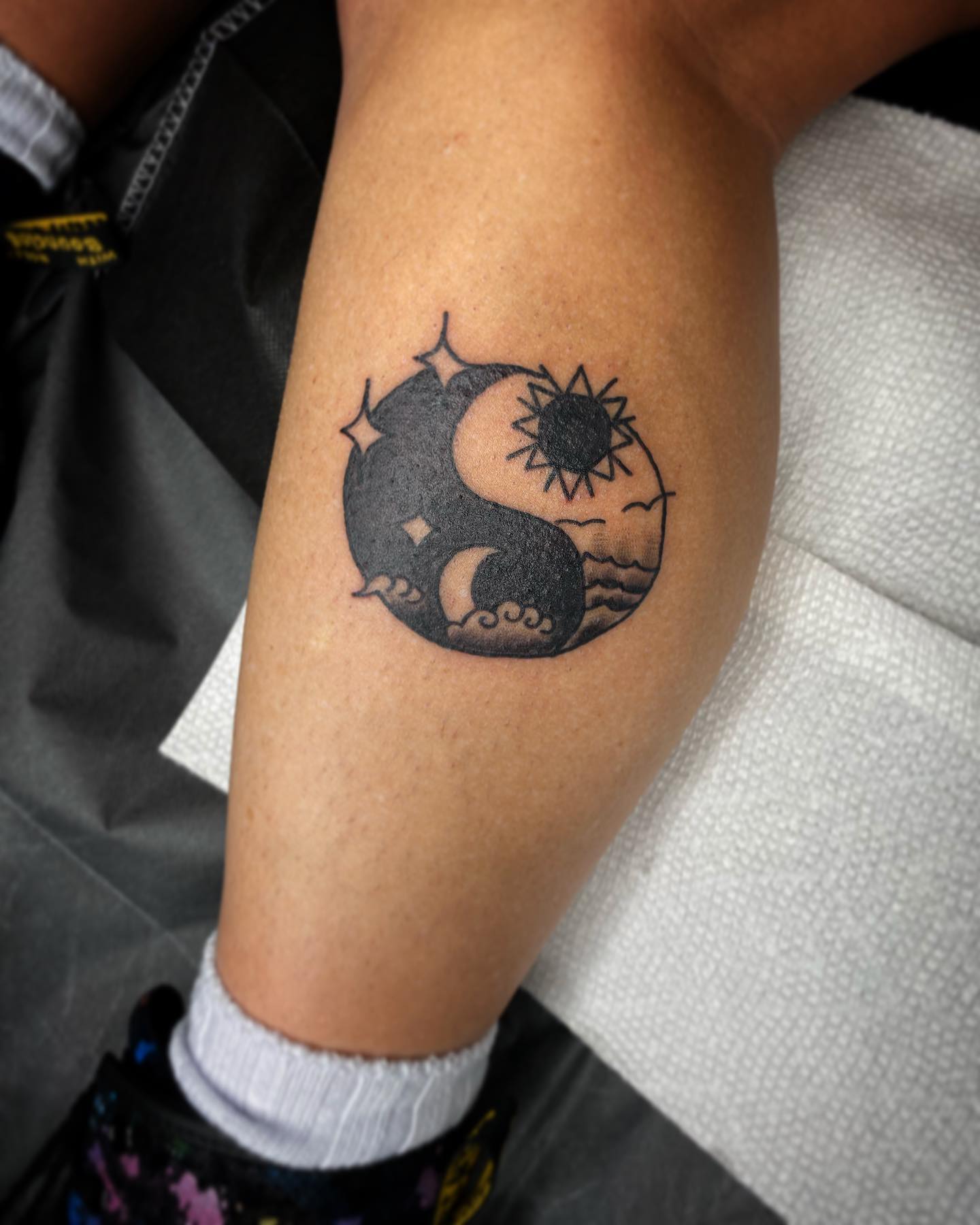
A sun-and-moon pairing over water shifts the meaning from tides to full cycles — day and night rather than ebb and flow. It needs more space to work. Our sun and moon tattoo ideas cover the combination properly.
Adding Stars or Constellations
A few scattered stars soften the design and fill awkward negative space. A full constellation makes it personal but crowds the composition quickly — pick one or the other, not both. The wider celestial tattoo ideas guide has examples of both approaches.
Marine Life Inside the Wave
A whale tail, a turtle silhouette or a small shark worked into the water is common and generally reads well, as long as the creature stays subordinate to the wave rather than competing with it.
Negative-Space Moons
Instead of tattooing the moon, the artist tattoos around it and leaves bare skin as the crescent. It is elegant, and it holds up well — but it only works on a solid black background, so it commits you to a heavier tattoo.
Tips and Aftercare for a Wave Moon Tattoo
Take the stencil placement seriously. Ask to see it in a mirror, move the limb, and look at it from the angle other people will see it from — not just looking down at your own arm.
Follow the aftercare instructions your artist actually gives you, since they know their equipment and their ink. As a general baseline, the American Academy of Dermatology recommends keeping new work clean, using a water-based moisturiser rather than petroleum-based products, and protecting healed tattoos with broad-spectrum SPF 30 or higher.
Sun is the main long-term threat to this design, and it is a design people often get precisely because they spend time outdoors. Sunscreen once it is healed is not optional if you want the linework to stay crisp.
Stay out of pools, lakes and the ocean until the tattoo is fully healed — usually two to four weeks for the surface, longer underneath. Submerging fresh work is a genuine infection risk, not a superstition.
Allergic reactions and infections do happen, and they are not something to manage from a search result. If you see spreading redness, swelling that worsens after a few days, discharge, or a rash, contact your artist and see a doctor or dermatologist. The FDA’s consumer guidance on tattoo safety covers what can go wrong and why professional inks and sterile practice matter. Nothing here is medical advice, and no home remedy substitutes for a clinician.
Common Mistakes to Avoid
Going too small is the most common one. A design with a wave, a moon and shading inside both needs room; under about two inches, those elements start merging as the tattoo settles.
Bringing a Pinterest screenshot and asking for it exactly is the second. Reputable artists will redraw rather than copy, and the redrawn version is almost always better suited to your body.
Choosing a style your artist does not specialise in is the third. Fine line, dotwork and Japanese-influenced water are genuinely different disciplines, and the portfolio should show healed examples of the one you want.
Overloading the design is the mistake people regret longest. A wave, a moon, a compass, stars, a date and a quote is four tattoos sharing one space.
Frequently Asked Questions
What does a wave moon tattoo mean?
Most commonly it represents change, cycles and the pull between things you control and things you do not. The moon drives the tides, so pairing the two suggests a rhythm underneath apparent chaos. People also choose it for a connection to the ocean, for balance, or as a memorial. There is no single fixed traditional meaning — it is a modern pairing, and the reading is largely yours to set.
Is a wave moon tattoo good for a first tattoo?
It is a reasonable first tattoo if you keep it simple and put it somewhere forgiving, like the forearm or outer thigh. A medium-sized blackwork version is straightforward for most competent artists and heals predictably. Very small fine-line versions are riskier as a first piece, because they leave less margin for how your skin takes ink. Sitting time for a simple design is usually one to three hours.
Where does a wave moon tattoo look best?
The inner forearm is the most popular placement because its length suits a horizontal wave. Shoulder caps work best for circular compositions, and the spine suits vertical designs where the moon sits above falling water. Ankles and wrists work for small versions but limit detail. Outer thigh is the most comfortable option if you want size without much pain.
Does a wave moon tattoo fade quickly?
That depends almost entirely on line weight, placement and sun exposure rather than the subject itself. Bold blackwork holds for decades with reasonable care, while fine line and watercolor versions soften noticeably sooner and often need touch-ups. Hands, feet and other high-friction areas fade fastest. Daily sunscreen on healed work is the single most effective thing you can do.
Can I combine a wave moon tattoo with other symbols?
Yes, and it combines more easily than most designs because the water and sky give you natural places to add things. Compasses, stars, moon phases, marine animals and small dates all work. The constraint is space rather than meaning — pick one addition, give it room, and let the wave stay the dominant shape. Two or more additions usually make the tattoo harder to read at a glance.
Quick Summary
- A wave moon tattoo usually means change, cycles and riding what you cannot control — the moon moves the tide, and the tide moves you.
- There is no fixed traditional meaning; it is a modern pairing, so the reading is yours to decide and worth deciding before you book.
- Bold blackwork ages best, fine line looks best on day one, and watercolor needs the most upkeep.
- Keep it at least two to three inches — smaller than that and the wave, moon and shading start merging as it heals.
- Inner forearm suits horizontal waves, shoulder caps suit circular compositions, spine suits vertical ones, outer thigh is the most comfortable.
- Add one element at most — a compass, stars, moon phases or a small date — and let the wave stay the dominant shape.
- Stay out of open water for two to four weeks while it heals, and use SPF 30 or higher on it forever after.
- If something looks infected or reacts badly, call your artist and see a doctor — do not troubleshoot it yourself.