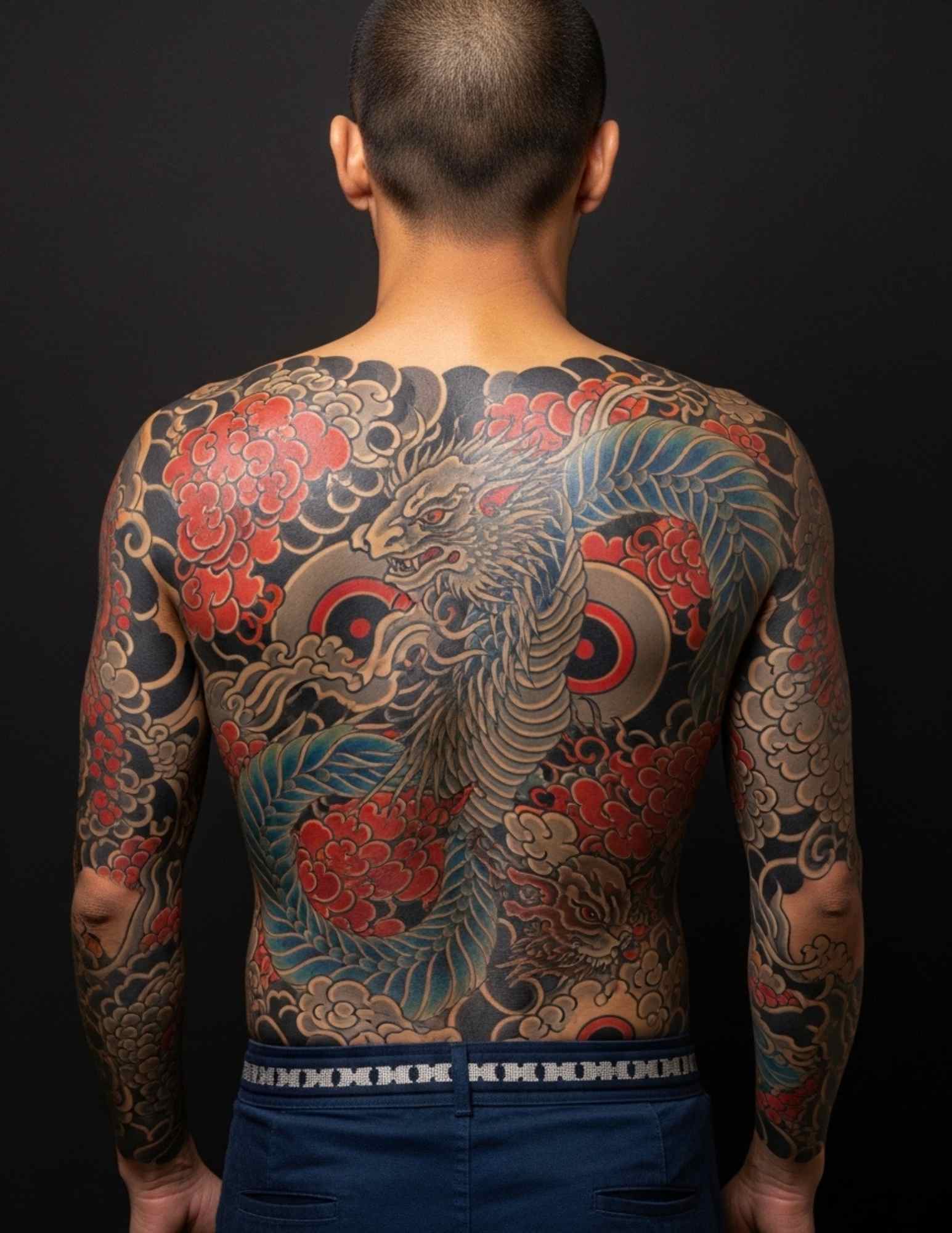
I have sat in on a lot of consultations over the years, and the memorial ones are different. People arrive with a phone full of photos and no idea what they want. The mistake almost everyone makes is designing around the death instead of around the person.
A RIP tattoo is not a headstone. It does not have to state dates, it does not have to say “rest in peace,” and it does not have to look sad to work.
The pieces that hold up years later tend to be the specific ones — her handwriting, his terrible recipe card, the bird she swore was her mother. The generic ones — clouds, wings, a name in a font nobody chose — are the ones people quietly cover later. If you are still deciding on an angle, our wider guide to memorial tattoo ideas is worth reading alongside this one.
Below are 18 directions, from photorealistic portraits to marks so small only you would know what they mean. Every one of them has been done well by someone, and a few of them are much harder to do well than they look.
Which RIP Tattoo Style Is Right for You?
This is the comparison I end up drawing on paper for people, so it may as well be written down.
| Approach | Best if you want | Typical size & placement | The honest catch |
|---|---|---|---|
| Portrait | Their actual face | Palm-sized or larger; forearm, upper arm, thigh | A specialist artist and a genuinely sharp photo, or it ages badly |
| Name or lettering | No ambiguity at all | Two to six inches; inner forearm, collarbone, ribs | Fine script thickens over the years, so leave the letters room |
| Their handwriting | Something only they could have made | Two to five inches; wrist, forearm, over the heart | You need a clean original to scan, and thin strokes need spacing |
| Symbol (dove, rose, wings) | Memorial that reads as art first | Three inches to full back piece | Common imagery, so the execution has to carry it |
| Dates or numerals | Something small and private | One to four inches; wrist, ankle, ribs, finger | Check every numeral twice before the needle touches skin |
| Object they owned | A memorial nobody else can copy | Two to eight inches; anywhere | Needs an artist who can draw from a reference, not a flash sheet |
What Actually Makes a Memorial Tattoo Work
Every artist I have asked about memorial work says a version of the same thing: the piece has to survive the grief it was made in.
Grief is loud in the first year and quieter after that. A design built entirely around the worst month of your life can become hard to look at once the worst month is behind you — which is why so many artists gently suggest waiting a few months before booking anything permanent.
The second factor is legibility over time. Ink spreads slightly in the skin across decades, so hair-thin lettering, tiny dates and micro-detail portraits all soften. Scale the design up slightly beyond what looks right on paper and it will still read at twenty years.
The third is placement. Somewhere you can see it — inner forearm, wrist, thigh — makes the tattoo a daily object. Somewhere you cannot — back, ribs, shoulder blade — makes it something closer to private. Both are valid, and people rarely think about the difference beforehand.
And if the loss is recent enough that the decision feels urgent rather than considered, that urgency is worth noticing. Our grief tattoo ideas guide covers the same ground from the emotional side, and grief support organisations such as the Hospice Foundation of America are a better first stop than a tattoo studio if you are still in the early weeks.
18 RIP Tattoo Ideas
1. Portrait
A photorealistic rendering of their face, worked in black and grey by an artist who does realism and little else.
This is the hardest tattoo on the list to get right. The likeness lives in millimetres — the set of the mouth, the space between the eyes — and an artist who is excellent at traditional or neo-traditional work may still not be the right person for it.
In my experience the photograph matters as much as the artist. A sharp, well-lit image with visible detail in the eyes gives an artist something to work from; a compressed phone screenshot of a screenshot does not.
Expect a large piece — palm-sized at minimum — and often more than one session. Anything smaller loses the features it needs to stay a likeness.
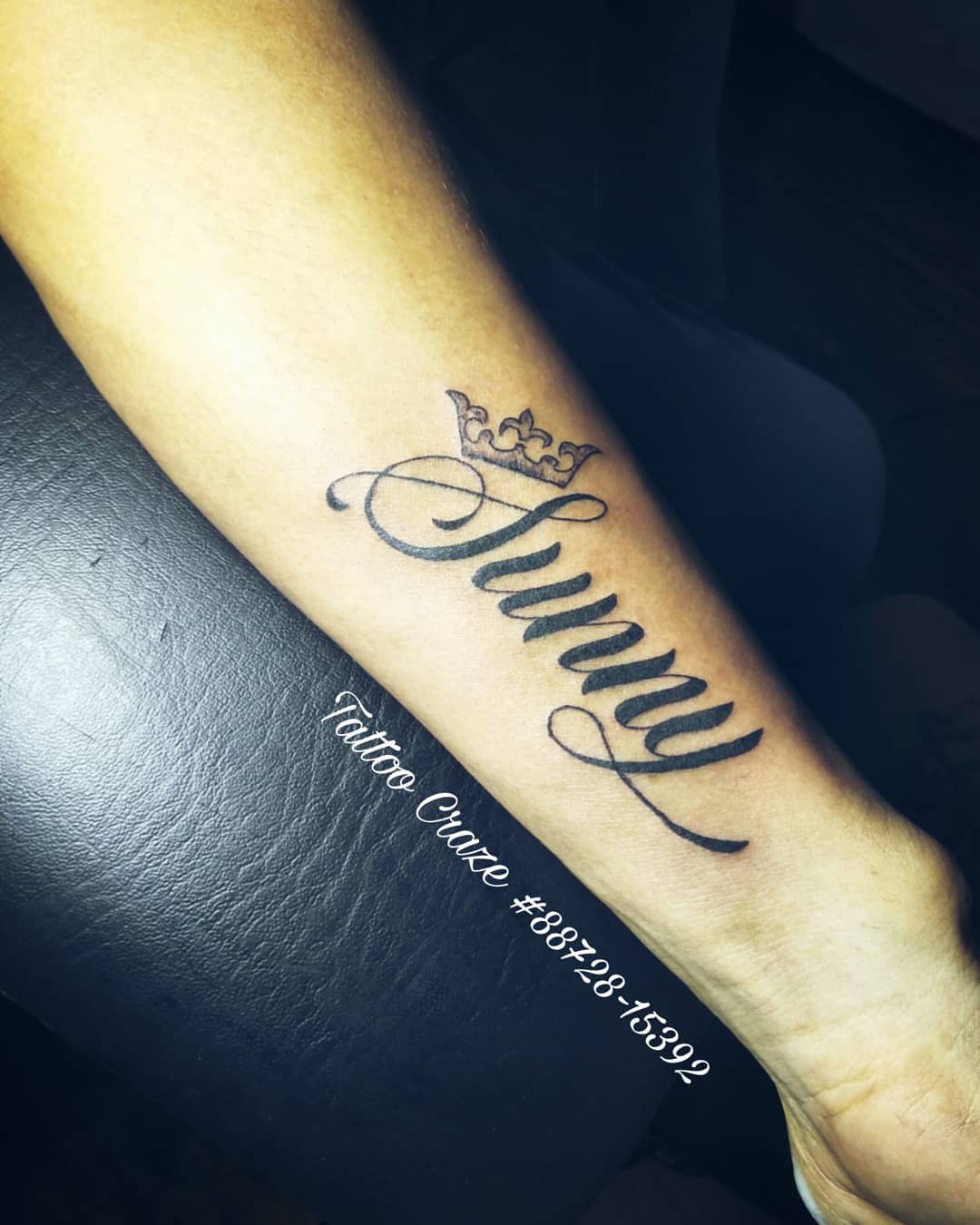
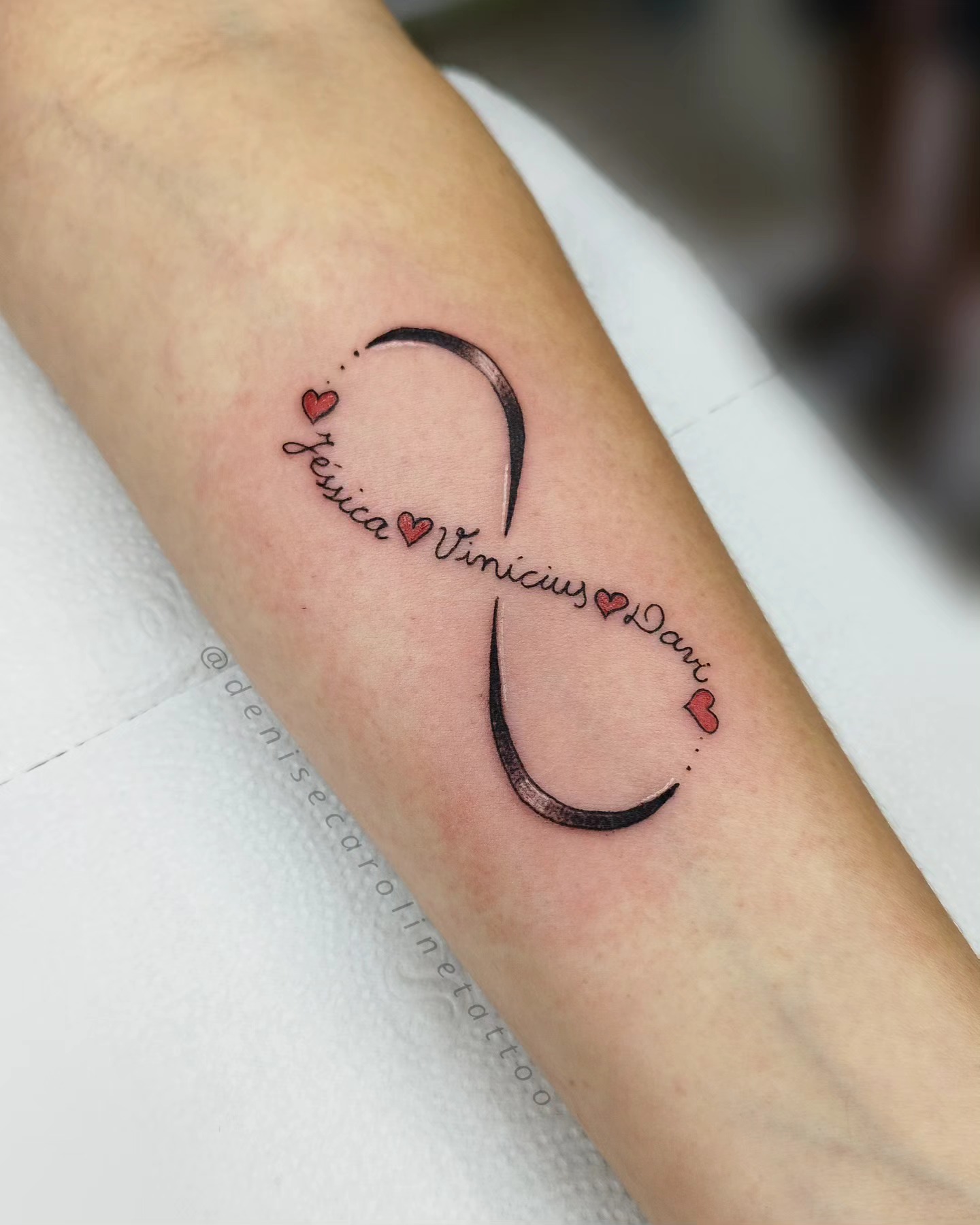
2. Name in Script
Their name, in an elegant hand, sometimes with dates beneath it and often with nothing else at all.
There is no symbolism to decode here, which is the appeal. Anyone who reads it knows exactly what it is.
The thing to get right is the lettering weight. Very fine script looks beautiful in the healed photo on the artist’s page and considerably less crisp after fifteen years of the ink settling. A script artist who works specifically in lettering will pick a weight that holds.
Inner forearm, collarbone and over the ribs are the placements I see most. Our guide to name tattoo ideas covers font choices and spacing in more depth.
3. Handwriting Tattoo
Not a font. Their actual handwriting — a signature, the end of a birthday card, a note left on a counter.
This is the idea I recommend more than any other, because it cannot be replicated. The uneven baseline and the odd way they crossed a t are theirs, and nobody else’s tattoo will look like it.
Practically: find the cleanest original you have, scan it flat rather than photographing it at an angle, and bring the file to the studio. A good artist will trace it faithfully instead of tidying it up.
One caution. Pen strokes are often thinner than tattoo needles can hold cleanly, so ask the artist whether the piece needs to be scaled up a little to keep the letters from closing in on themselves.
4. Birth and Death Dates in Roman Numerals
Two dates, set in Roman numerals, usually stacked or separated by a small dash or dot.
Numerals do something plain dates cannot — they turn information into ornament, so the tattoo reads as a design rather than as a record.
They are also quieter. Most people who see XI·IV·MCMLII on a wrist will not stop to decode it, which suits anyone who does not want to explain their grief to strangers.
Proofread obsessively. I have heard more than one story about an incorrect numeral that nobody caught until the piece was healed. Write it out, have someone else check it, then check it once more against the stencil. More layouts in our Roman numeral tattoo ideas guide.
5. Fingerprint
Their fingerprint, reproduced as tattooed line work — sometimes plain, sometimes shaped into a heart or a small outline.
A print is the one mark that belonged to exactly one person. As memorial objects go it is hard to beat for specificity.
Funeral homes will often take a print at the time of arrangements, and many families have one without realising it. If you do not, an old document or an inked card may still exist.
The catch is the same as with handwriting: fingerprint ridges are extremely fine. Most artists will simplify slightly and size the piece up so the pattern still reads once it settles. That simplification is a feature, not a compromise.
6. Dove
A dove in flight, usually black and grey, occasionally carrying an olive branch.
The dove has been doing funerary work for a very long time — it appears on gravestones across centuries of Christian and pre-Christian tradition — and that history is exactly why it reads instantly.
It is also, being honest, one of the most common memorial designs there is. If you want it to feel like yours rather than like a flash sheet, the execution has to carry it: real feather structure, considered negative space, a composition that is not simply a bird floating on an arm.
Works small on a wrist or forearm, and scales well into a larger chest or shoulder piece alongside other elements.
7. Their Favourite Flower
The flower they grew, the one they always bought, the one that was in the house when you were small.
Floral memorials do something clever: they carry the meaning without announcing it. Nobody looking at a peony on a forearm assumes grief, and you are not asked about it at work.
Botanical accuracy is worth paying for. An artist who has drawn the specific flower before will get the petal structure right, and a vaguely floral shape is much less satisfying to live with than a recognisable species.
Black and grey keeps it sombre; full colour keeps it alive. I have seen both work, and the choice usually says more about the person wearing it than about the person being remembered.
8. Broken Clock at the Time of Death
A clock face, hands stopped at a specific time, sometimes with the glass cracked or the casing broken open.
It is a blunt image and it is meant to be. The clock fixes one moment and declines to say anything about what came before or after.
Some people set the hands to the time of death; others set them to a birth, a wedding, or the last conversation. The tattoo looks identical either way, which gives you a way to keep the meaning private.
Clocks carry a lot of detail — numerals, gears, hands — so they need room. Anything under about three inches tends to lose the mechanism. See our clock tattoo ideas for composition options.
9. Cardinal Bird
A red cardinal, perched or in flight, often on a bare winter branch.
The association comes from North American folk belief — the idea that a cardinal appearing is a visit from someone who has died. It is folklore rather than formal symbolism, and that is part of the appeal for people who want a memorial with no religious framing.
Because the meaning is cultural rather than universal, it splits audiences neatly. People who know the belief recognise it immediately; everyone else sees a bird.
This is one of the few memorial designs that genuinely needs colour. A black and grey cardinal loses the single detail the whole image rests on.
10. Their Handwritten Recipe
An actual recipe card, in their handwriting, tattooed as it was written — smudges, abbreviations, wrong measurements and all.
This is a memorial and an inheritance at the same time. You keep the instructions and the hand that wrote them in one object.
It tends to want a decent amount of space, because a recipe is a block of text rather than a line of it. Forearm, outer thigh and upper back are the placements that handle it best.
Some people tattoo only the title line and the first ingredient, which keeps the handwriting and drops the bulk. In my experience that edit works better than shrinking the whole card until it is unreadable.
11. Angel Wings
A pair of wings, usually across the upper back or the shoulder blades, occasionally with a name or dates between them.
Wings are the default memorial image, and defaults become defaults for a reason — the meaning needs no explanation in almost any context.
The risk is exactly that ubiquity. A pair of generic feathered wings is the piece most likely to feel anonymous ten years on.
If you want them, go large enough for real feather structure and individual shading, and consider asking the artist to build in something specific: their initials worked into the primaries, or a species of bird that actually meant something rather than a stock angel silhouette.
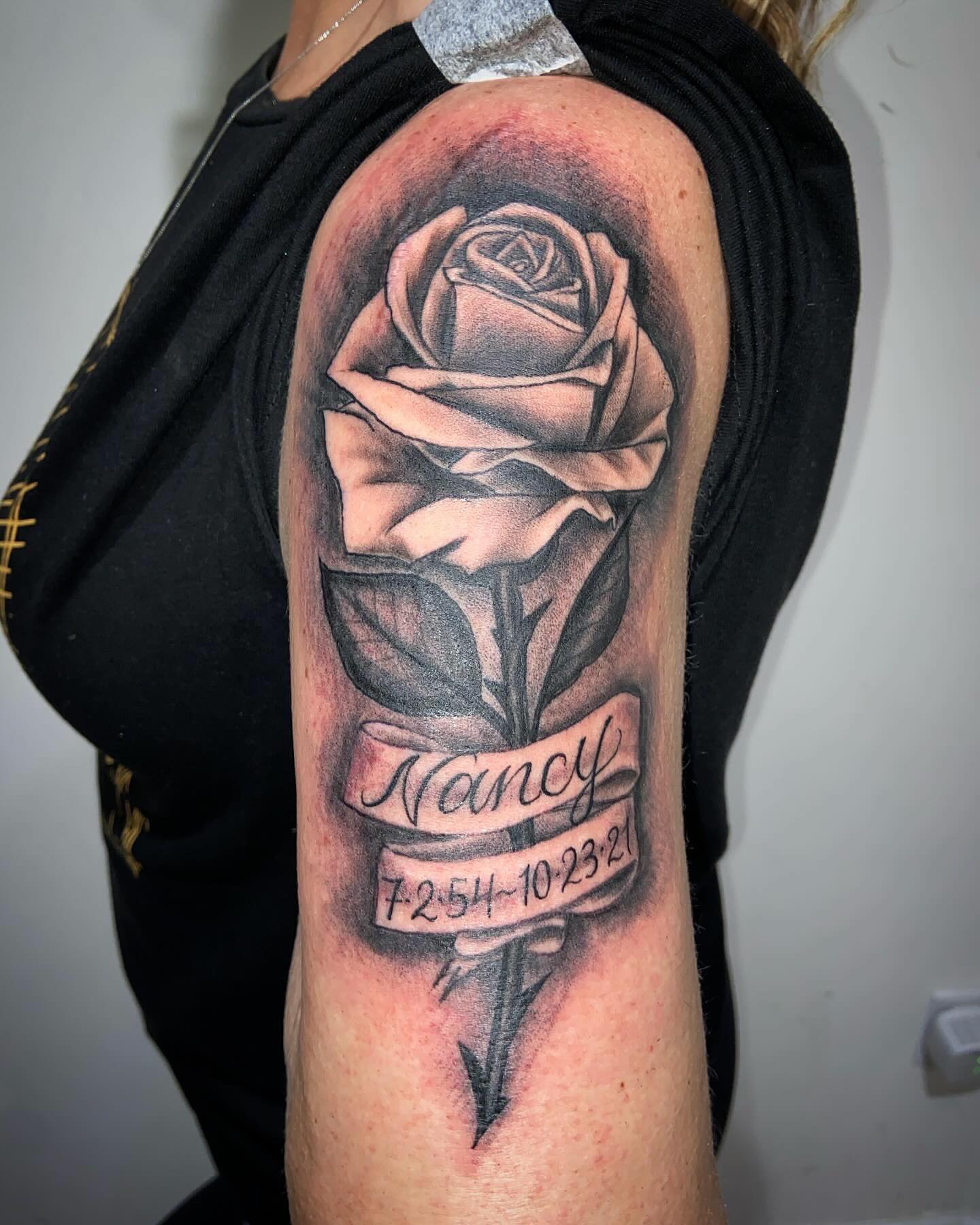
12. Rose with Name Banner
A rose with a ribbon banner across it, their name lettered inside the banner.
This is the oldest memorial format in Western tattooing. Sailors were getting versions of it a century ago, and the traditional style — bold outline, limited palette, heavy black shading — is built to stay legible for decades.
That durability is the real argument for it. American traditional work was designed around how ink behaves in skin over a lifetime, and it holds up better than almost anything else on this list.
It reads as a tattoo rather than as a picture, which some people want and others do not. There is no halfway version of this style.
13. Semicolon Memorial
A small semicolon, often on the wrist, sometimes worked into a name or a date.
The semicolon was adopted as a symbol by mental health awareness campaigns, marking a sentence the author could have ended and chose to continue. Used as a memorial, it acknowledges how someone died without spelling it out.
It is small, quick and inexpensive, and it is understood immediately by people who know the symbol and invisible to everyone else. That combination is the whole point.
If you are carrying this kind of loss, please talk to someone as well as getting tattooed — organisations like The Dougy Center exist specifically for grieving families, and a tattoo is a marker rather than a form of support. Our semicolon tattoo guide has more designs.
14. Their Birth Flower
The flower traditionally assigned to their birth month — carnation for January, violet for February, and so on through the year.
Birth flowers solve a problem people often have with memorial tattoos: they want something floral and personal but have no idea which flower to choose. The calendar chooses for you.
They also combine well. Two or three birth flowers arranged together can hold a whole family, which is a neat way to build one memorial piece over several years rather than accumulating separate tattoos.
Some months have more tattooable flowers than others, and a good artist will say so honestly rather than forcing a difficult shape. The full list is in our birth flower tattoo ideas guide.
15. Lighthouse or Beacon
A lighthouse, usually with its beam drawn, often on rock with water below.
The meaning here is guidance rather than mourning — the person who showed you where the shore was. For a parent, a grandparent or a mentor, that framing often fits better than anything funerary.
It also reads as a maritime tattoo to anyone who does not know the story, so it carries a memorial without looking like one.
Lighthouses are detailed architecture and want a reasonable amount of skin: forearm, calf and outer thigh all work. Our lighthouse tattoo ideas guide covers styles from traditional to black and grey realism.
16. Their Favourite Place
The landscape they loved — a coastline, a mountain ridge, the view from a particular window — rendered as a scene.
Places carry people surprisingly well. A memorial does not have to show a face or a name to be unmistakably about someone, and a specific horizon line often is.
This works best when the location is genuinely specific. A generic mountain range is decoration; the actual outline of the ridge behind their house is a memorial.
Bring photographs, and ideally more than one angle. Landscape tattoos live or die on whether the artist can find a composition that works in a tattooable shape, and that is much easier with real reference.
17. Memorial Candle
A single lit candle, sometimes with a date on the holder, sometimes with wax running.
The candle is an old and almost universal image for a life and its ending, and it has the advantage of being simple enough to work at small sizes where a portrait or a landscape could not.
It suits people who want something unmistakably memorial without anything religious attached — though it sits comfortably alongside religious imagery too if that is the intention.
Small candles work beautifully on the inner arm, ankle or ribs. Larger versions with dripping wax and elaborate holders can anchor a bigger composition.
18. Their Own Words
Something they actually said — the phrase they used constantly, the advice they gave, the line they answered the phone with.
Quotations from books and songs are common on memorial tattoos and usually the weakest option, because the words belonged to someone else first.
The line they said is stronger precisely because it is small and unremarkable. “Call your mother” or “that’ll do” carries more of a person than a poem they never read.
Keep it short. Long text needs a big canvas and a lettering specialist, and in my experience the pieces people are happiest with a decade later are the four-word ones.
Variations Worth Considering
A few structural choices that change how any of the designs above land.
Ashes Mixed Into the Ink
Some studios will blend a very small quantity of cremated remains into the pigment. It is legal in most places and offered by a limited number of artists.
It also carries a real infection and reaction risk that ordinary tattooing does not, because the material is not sterile pigment. If you are considering it, ask the artist exactly how the ash is processed and sterilised, and take a doctor’s view seriously rather than only the studio’s.
Matching Family Pieces
Siblings or a whole family taking the same design, or complementary parts of one design, turns a memorial into something shared.
The practical advice is to have one artist do all of them where possible. Matching tattoos drawn by different hands rarely match as closely as everyone expected.
Negative Space and Blackwork
A name or a shape left as bare skin inside a block of solid black is a striking way to handle a memorial, and it ages unusually well because there is no fine detail to lose.
It is a large commitment in terms of coverage, and it is essentially impossible to cover later, so it suits people who are certain.
Designing for Additions
If you expect to lose other people — and over a long enough life everyone does — it is worth asking the artist to compose the first piece so it can be extended.
A single flower placed with deliberate space beside it becomes a family bouquet twenty years later. A flower tattooed tight against the elbow does not.
Getting a Memorial Tattoo: Practical Advice
Choose the artist before you choose the design. An artist whose healed portfolio is full of the style you want will improve your idea; an artist working outside their style will execute it competently and no better.
Ask to see healed photographs, not fresh ones. Fresh work looks sharp on everybody. Healed work at two or three years is the only honest evidence of how a piece holds, and any artist worth booking will have some.
Expect to be emotional in the chair. Several artists have told me that memorial sessions run longer than the same design would otherwise, because people need breaks. Book a session with slack in it, eat properly beforehand, and bring someone if that helps.
Aftercare is ordinary tattoo aftercare and there is no memorial-specific version of it: keep it clean, follow the studio’s written instructions, keep it out of the sun, and do not pick. Surface healing typically takes around two to three weeks; the deeper layers take a couple of months to settle. The FDA’s tattoo and permanent makeup fact sheet covers the risks worth knowing about, and anything that looks infected — spreading redness, heat, pus, fever — is a doctor’s appointment rather than a question for the internet.
Common Mistakes and What to Do Instead
The most common one is booking too soon. There is no rule about timing, but decisions made in the first few weeks are made by a version of you that is not thinking clearly, and permanent is a long time.
The second is choosing scale by price. Memorial tattoos get shrunk to fit a budget more often than any other category, and a portrait squeezed into two inches is money spent on something that will need reworking.
The third is over-loading the design. Name, dates, wings, a rose, a quote and a clock in one piece is six ideas fighting for the same skin. Pick the one that matters most and let the artist compose around it.
Still not sure which direction fits? Our guide to memorial tattoo ideas for mom covers the case most people ask about, and it is a useful sanity check on scale and placement before you book anything.
Frequently Asked Questions
How long should I wait after a death before getting a RIP tattoo?
There is no correct interval, and plenty of people are glad they went within weeks. That said, most artists I have spoken to quietly prefer clients who have had a few months, because the design tends to be steadier and less centred on the death itself. If you are unsure, book the consultation now and the session later — the conversation with the artist is often the part that clarifies what you actually want. Nothing about the design gets worse for waiting.
Do RIP tattoos have to include the words “RIP” or the dates?
No, and most of the strongest ones do not. A memorial tattoo is defined by what it means to you, not by whether a stranger can identify it as a memorial. Handwriting, a flower, a landscape or a fingerprint all carry the person without stating the fact of their death. Adding dates is a choice about how public you want the meaning to be.
How much does a memorial tattoo cost?
It depends entirely on size, detail and the artist’s rate, which varies enormously by city and by reputation. A small piece of lettering or a fingerprint is usually a single short session; a black and grey portrait is typically several hours and sometimes multiple sittings. The useful advice is to get a quote from the specific artist you want rather than budgeting from an average, and to size the tattoo for the design rather than for the number.
Can I use my phone photo for a portrait tattoo?
Sometimes, but the quality ceiling of the tattoo is set by the quality of the reference. An artist needs visible detail in the eyes, clear separation between light and shadow, and enough resolution to zoom in. A screenshot of a social media post that has been compressed several times usually is not enough. Send the artist your best two or three options before booking and let them tell you which one they can work from.
Is it safe to mix cremated ashes into tattoo ink?
It is done, and some studios offer it, but it is not the same procedure as an ordinary tattoo. The material is not manufactured sterile pigment, so there is a genuine risk of infection, granuloma or a foreign-body reaction that standard tattooing does not carry. If you want to pursue it, ask the artist precisely how the ashes are processed and sterilised, and talk to a doctor first rather than relying only on the studio’s reassurance.
Quick Summary
- Design around the person, not around the death — specific beats symbolic almost every time.
- Handwriting, fingerprints and recipe cards are the least copyable memorials available.
- Portraits need a realism specialist and a genuinely sharp reference photo, plus real size.
- Scale fine lettering and thin detail up slightly; ink spreads over decades.
- Symbols like doves, wings and roses read instantly but live or die on execution.
- Proofread dates and Roman numerals three times, with someone else checking.
- Choose the artist first, judge them on healed work, and let them compose the design.
- Leave space in the composition if you may want to add to the piece later.