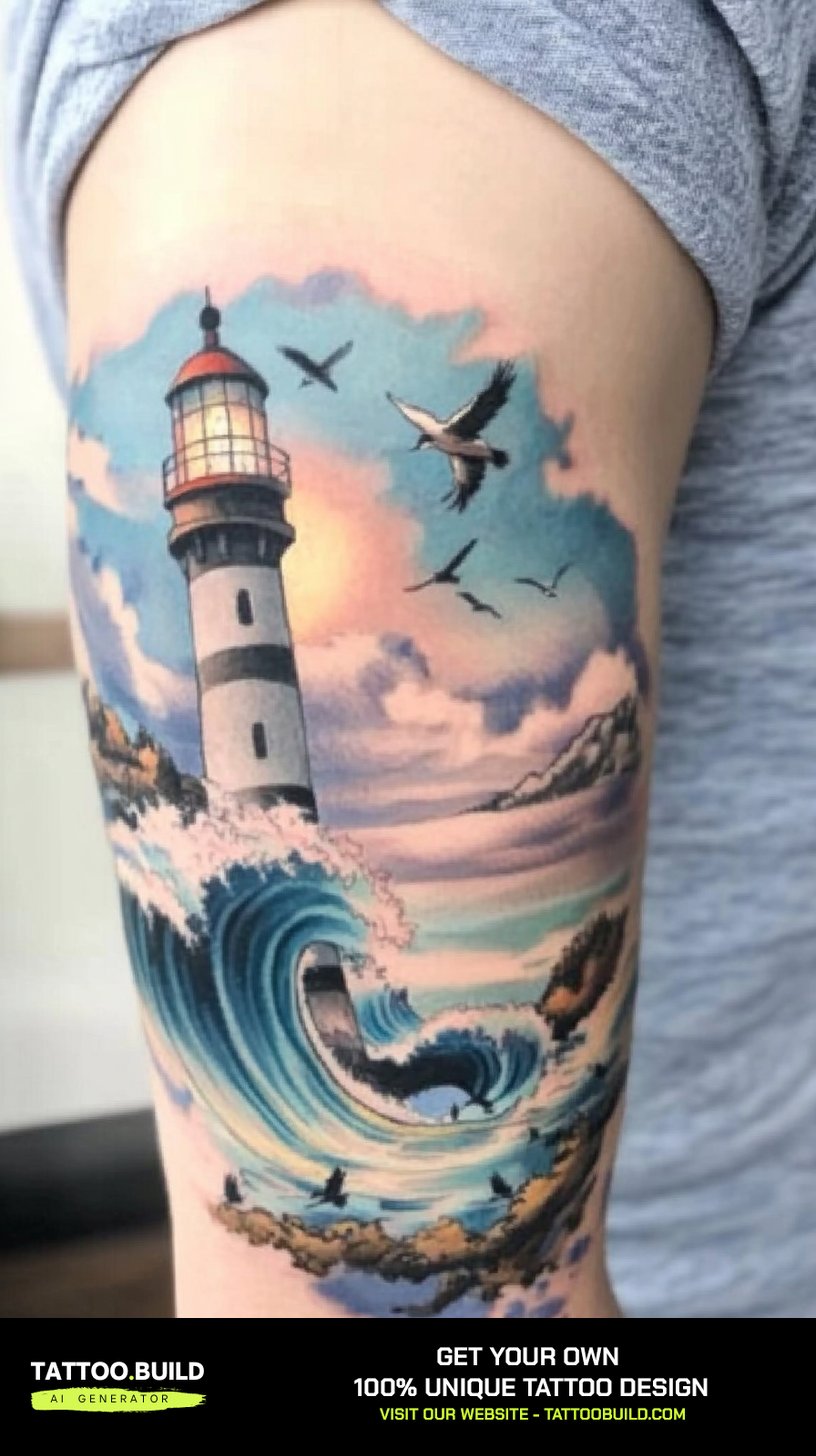
I have been collecting and writing about lighthouse tattoos for years, and the same thing happens every time I bring one up in a shop: the artist leans in. A lighthouse is one of the few tattoo subjects that reads as both a landscape and a symbol, which is why it survives at almost any size and in almost any style.
A tower, a beam, a horizon line. That is the whole vocabulary, and it is enough to carry a memorial piece, a sobriety marker, a family tribute, or simply a love of the coast.
What follows is a working guide rather than a gallery caption. I have grouped the ideas by style and placement, because in my experience that is the order artists actually think in when they sit down to draw one.
If you already know you want heavy black outlines and a limited palette, you can skip ahead to the traditional lighthouse tattoo section — that is where most first-timers land.
Which Lighthouse Tattoo Style Is Right for You?
Every artist I have asked draws lighthouses differently, and the style you pick decides more about how the tattoo ages than the placement does.
| Style | Smallest size that works | How it ages | Best for |
|---|---|---|---|
| American traditional | About the size of a playing card | Excellent — bold lines hold shape longest | First tattoos, outer arm, calf |
| Black and grey realism | Palm-sized and up | Good, though fine grey wash softens over years | Upper arm, shoulder, back |
| Fine line / minimalist | Two fingers wide | Needs the most care; thin lines blur soonest | Inner forearm, ribs, ankle |
| Watercolour / illustrative | Palm-sized and up | Colour softens; usually wants a black anchor | Thigh, shoulder cap, outer arm |
| Neo-traditional | Hand-sized | Very good — outlined colour holds well | Thigh, chest, half sleeve |
| Large seascape | Half sleeve or bigger | Depends entirely on contrast planning | Sleeves, back pieces, leg panels |
If you are torn between two rows, in most cases the honest tiebreaker is your placement, not your taste. A rib piece and a thigh piece simply cannot hold the same amount of detail.
What a Lighthouse Tattoo Actually Means
The short version: guidance through something you could not control. That is the meaning almost everyone I have spoken to lands on, even when they arrive at the shop with a different story.
Lighthouses were built to mark danger, not safety. The tower stands where the rocks are, which is a more interesting symbol than it first appears — it says the hazard is real and you can still get through it.
For that reason the design shows up often as a recovery tattoo, a memorial for someone who steadied a difficult stretch, or a marker after a move, an illness, or a career change.
There is also a straightforwardly maritime reading. Coastal families, navy and coast guard service, fishing communities and sailors have used the motif for well over a century, and it sits naturally alongside rope, wave and ship tattoo designs work.
If you want the engineering and history behind the symbol, the general history of lighthouses is a genuinely good rabbit hole — Fresnel lenses, keeper logs and all. Knowing which era of tower you like makes the reference photo conversation much shorter.
Lighthouse Tattoo Ideas by Style
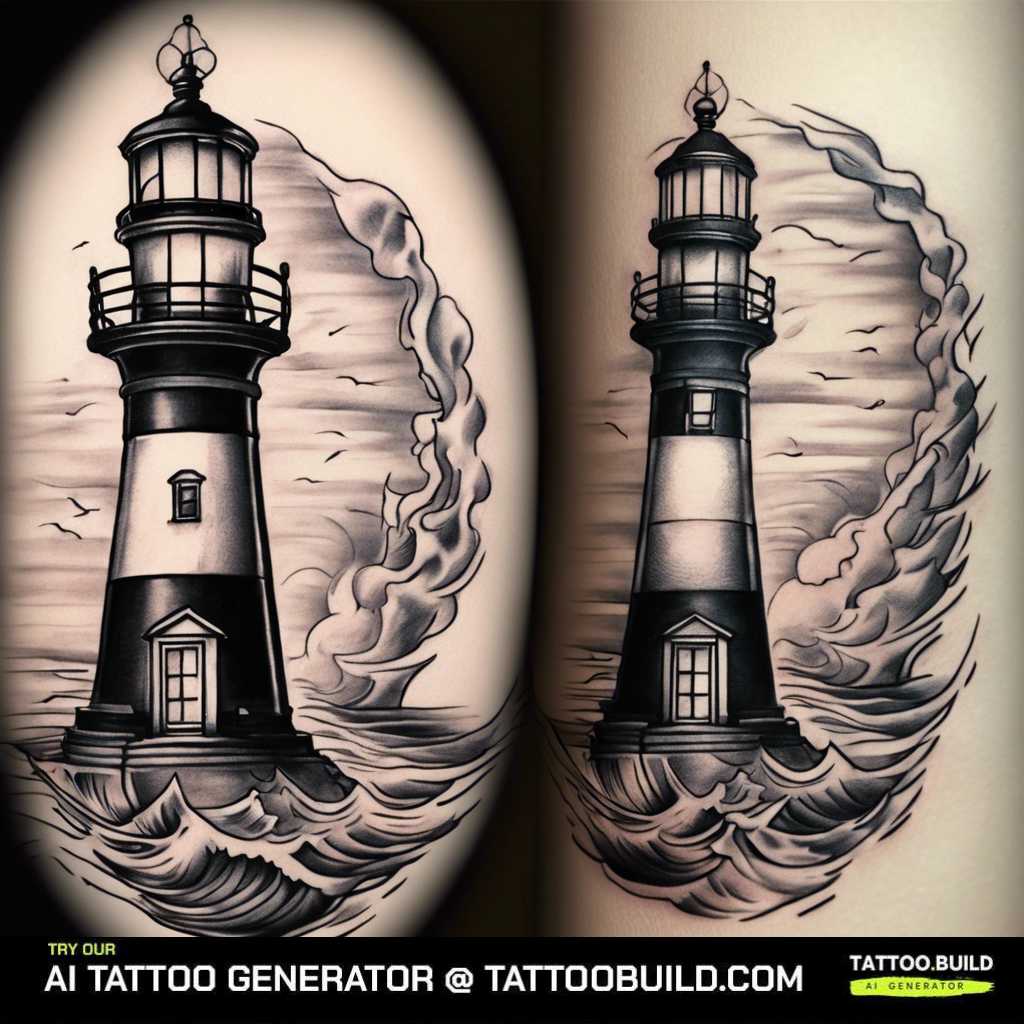
American Traditional Lighthouse Tattoos
This is the version I recommend most often, and it is not a compromise choice. Bold outlines, a tight palette of red, yellow, green and black, and shapes simplified until they read from across a room.
Traditional is the only style where the tattoo will look almost identical in twenty years. The heavy linework acts as a frame that holds the colour in place as the skin changes.
Typical framing devices: rolling waves at the base, a banner with a name or date, seabirds for negative space, and a sun or storm cloud behind the lantern room.
When I tested reference images with three different artists, all three redrew the tower shorter and wider than the photo. That is deliberate — traditional flattens perspective so the silhouette stays legible.
Black and Grey Lighthouse Tattoos
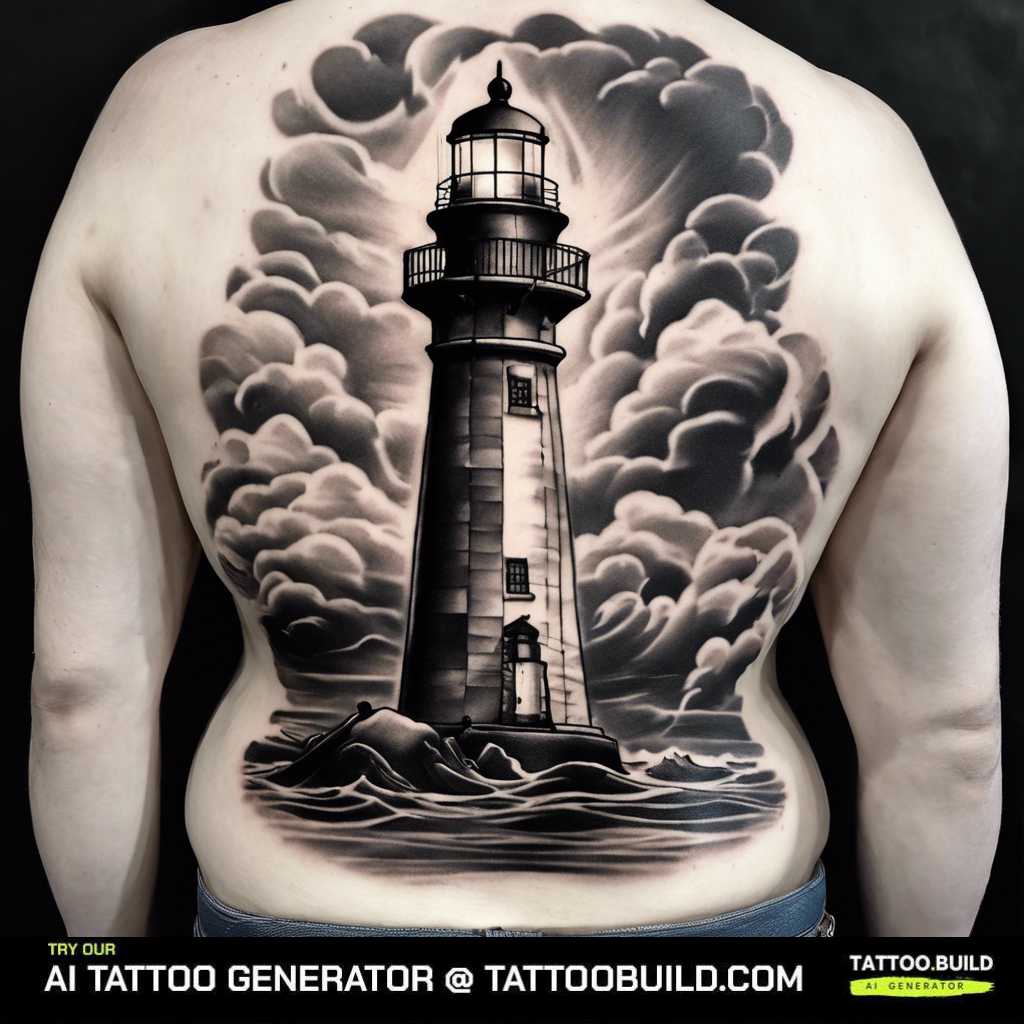
Black and grey is where the drama lives. Stormy skies, wet stone, spray coming off the rocks — none of it needs colour to land.
The trade-off is honest: soft grey wash is the first thing to soften over the years. Ask your artist to keep some genuinely black anchors in the composition rather than letting the whole piece sit in mid-grey.
In my experience this style rewards size. A black and grey lighthouse tattoo at palm scale can hold weathered stonework and surf; the same design at two inches turns into grey mush within a few years.
Placement-wise, the outer upper arm and shoulder are the two spots I see it work most reliably, because both give you a flat-ish canvas and a natural vertical.
Fine Line and Minimalist Lighthouse Tattoos
A lighthouse strips down better than most subjects. Three lines for the tower, a triangle of light, a wave — done.
The catch is that fine line work is the least forgiving choice on this list. Thin single-needle lines placed close together will migrate and merge over time, so leave more space between elements than looks right on paper.
I have seen the beam handled two ways that both hold up: as two clean diverging lines with nothing inside them, or as a soft dotwork gradient. Solid grey fill inside the beam tends to blur first.
This is the style that works at inner forearm scale or on an ankle, and it pairs neatly with a small compass or wave if you want a matched set.
Watercolour and Illustrative Lighthouse Tattoos
Watercolour lighthouses lean on the one thing the subject already has: a light source. A sunset or aurora behind the tower gives the artist somewhere obvious to put the colour.
My standing advice is to insist on a black or heavily outlined structural element somewhere — usually the tower itself. Pure watercolour with no black anchor is the version people most often come back to have reworked.
Colour choices that I keep seeing hold up well: deep teal into orange, indigo into pale gold, and a muted grey-green that reads as North Atlantic rather than tropical.
Large-Scale Seascapes and Sleeves
Once you go past a half sleeve, the lighthouse stops being the subject and becomes the focal point of a scene.
The composition problem is real: a tower is a hard vertical, and an arm is a cylinder. Good artists solve it by wrapping the water and clouds around the limb and keeping the tower on the flattest plane.
Plan the whole sleeve before the first session, even if you only book the lighthouse. I have watched more than one person paint themselves into a corner by tattooing a horizon line at an angle that nothing else could match.
Common companions in these pieces: a ship on the horizon, a rope border, a compass rose, and dense wave work filling the negative space.
Silhouette and Negative Space Designs
A solid black lighthouse against untouched skin is the most underrated version of this tattoo.
It sidesteps the ageing problem almost entirely — there is no fine detail to lose — and it photographs well on every skin tone I have seen it on.
The design usually works best inside a shape: a circle, an arch, or a torn-paper edge, with the beam cut out as bare skin rather than added as ink.
Geometric and Frame-Based Lighthouse Tattoos
Putting the tower inside a hexagon, a diamond or a thin circular frame turns a landscape into a badge.
This is the approach I would suggest for anyone who wants a lighthouse but dislikes how scenic tattoos can look pasted on. The frame gives it a deliberate edge.
Keep the frame line noticeably heavier than the interior lines. If they are the same weight, the whole thing flattens out as it settles.
Variations Worth Considering
If the standard tower-and-beam composition is not quite it, these are the directions I most often see people take instead.
A Real, Named Lighthouse
Tattooing a specific tower — one from your coastline, or one you visited with someone — changes the piece from a symbol into a record. Bring several photos in different light.
Lighthouse With Coordinates
Latitude and longitude under the tower is a clean way to make it personal without a name or date. Double-check the numbers yourself; script errors are the most common permanent mistake I hear about.
Lighthouse and Wave Combinations
Pairing the tower with a Hokusai-style wave gives you movement against the vertical. It reads well on a calf or the outer thigh.
Feminine and Floral Interpretations
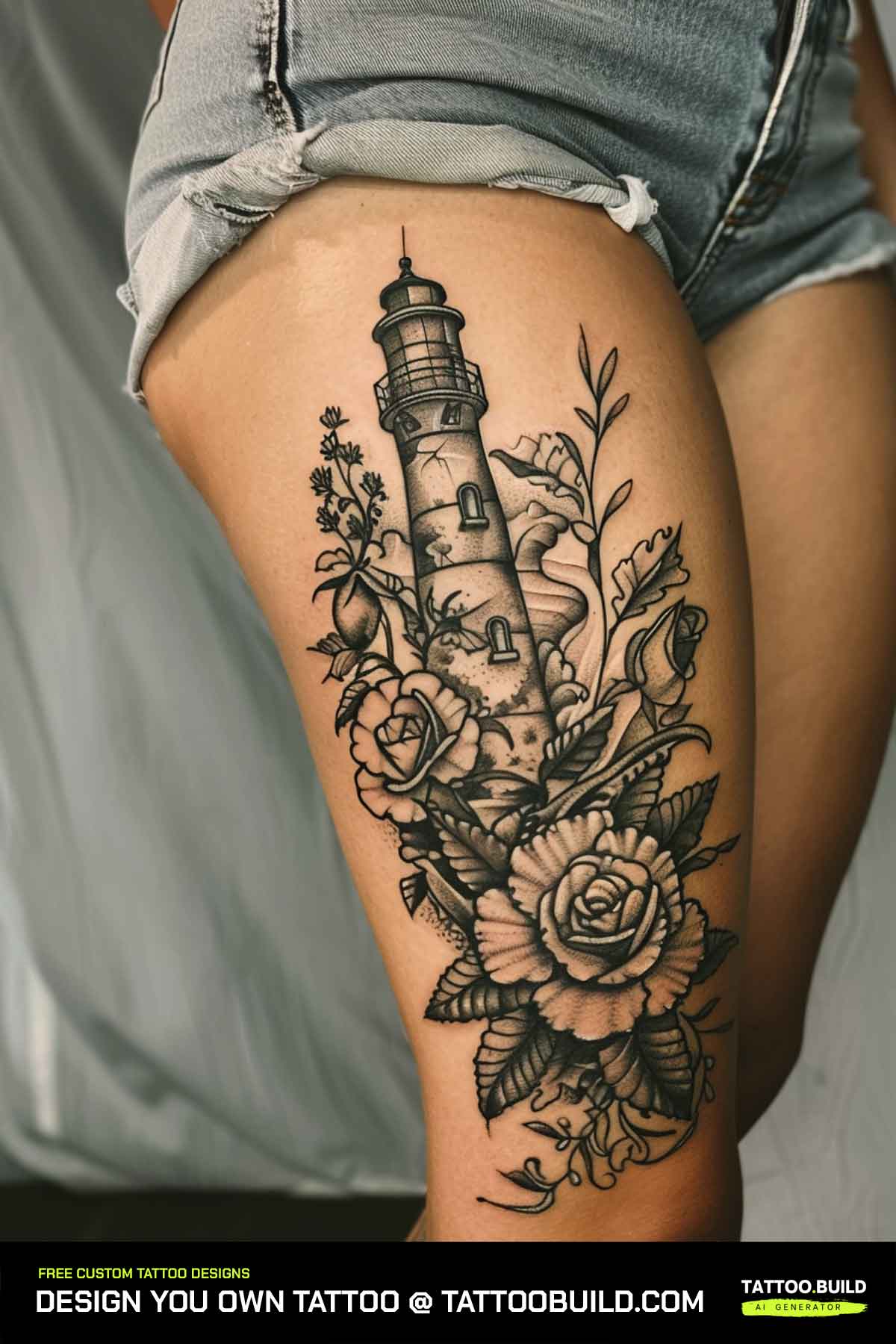
Wrapping the base in wildflowers or seagrass softens the architecture considerably. There is a whole set of lighthouse tattoo ideas for women that lean this way, and they tend to sit better on the sternum, ribs and thigh.
Miniature Matching Pieces
Two small towers, or one tower split between two people, works for family and partner tattoos. Keep both simple — matched fine line pieces age at different rates on different bodies.
Planning, Sessions and Aftercare
Bring reference for the feeling as well as the object. Photos of the sky and sea you want are often more useful to an artist than five pictures of towers.
Expect a palm-sized black and grey lighthouse to take a single sitting of a few hours, and anything approaching a half sleeve to be booked across multiple sessions with healing time between them. Your artist’s estimate beats mine — they can see the skin.
For healing, follow the specific instructions your artist gives you, since they know the products they used. The general standard most shops work from is close to what the American Academy of Dermatology publishes: keep it clean, keep it moisturised, and keep it out of the sun.
Sun is the single biggest threat to a lighthouse tattoo, and it is also the tattoo most likely to be on display at the beach. Once fully healed, sunscreen on it is not optional if you want the greys and colours to hold.
On safety: infections and allergic reactions to tattoo ink are uncommon but real, and pigment reactions can appear weeks or months later. The US Food and Drug Administration has a plain-language overview. If you see spreading redness, swelling that worsens after a few days, fever, or a rash in the tattoo, see a doctor rather than waiting it out — this article is not medical advice.
Common Mistakes — and What to Do If You Are Still Not Sure
The mistake I see most: choosing a design at a size the design cannot survive. A detailed realism piece shrunk to fit a wrist is not a smaller version of that tattoo, it is a different and worse one.
Second: too many elements. Lighthouse, ship, compass, anchor, rope, banner and waves in one hand-sized piece leaves nothing for the eye to rest on.
Third: copying another person’s tattoo line for line. Bring it as reference by all means, but let your artist redraw it for your body — and for their own sake as well as yours.
Still deciding? It usually helps to look at the neighbouring motifs and see which one you keep coming back to. Start with compass tattoo meanings, then what an anchor tattoo symbolises, then a broader sweep of ocean tattoo ideas.
Frequently Asked Questions
What does a lighthouse tattoo symbolise?
Most commonly it stands for guidance, hope and staying steady through a difficult stretch. Because lighthouses were built to mark dangerous water rather than safe water, the symbol also carries an acknowledgement that the hazard was real. Many people choose it as a recovery marker or a memorial for someone who helped them through something. There is also a simple maritime reading for people with coastal, fishing or naval ties.
Where is the best place on the body for a lighthouse tattoo?
The design is a strong vertical, so it suits vertical placements: the forearm, outer upper arm, calf, spine and the outer thigh all work well. The forearm is the most popular choice I see because it gives good length without demanding a huge commitment. Larger scenic versions belong on the back, thigh or as part of a sleeve. Ribs and ankles can work but usually only for simplified or fine line designs.
How small can a lighthouse tattoo be?
A simplified outline can work at roughly two fingers wide, but only if the artist leaves generous space between the lines. Anything with realistic stonework, gradient skies or fine rope detail needs to be at least palm-sized. In my experience the most common regret with small lighthouse tattoos is detail that merged together after a few years. When in doubt, go one size up rather than one size down.
Do lighthouse tattoos age well?
It depends almost entirely on style and size rather than the subject. Bold traditional and solid silhouette versions hold their shape for decades; fine line and soft grey wash versions soften sooner and may want a touch-up. Sun exposure is the biggest single factor you actually control. Daily sunscreen on a healed piece makes a noticeable difference over years.
Should I get my lighthouse tattoo in colour or black and grey?
Black and grey suits stormy, atmospheric and realistic designs and tends to be the safer long-term choice. Colour is worth it when the light itself is the point — sunsets, auroras and warm lantern glows really do need it. If you want colour, ask for a strong black or outlined structure underneath so the piece still reads once the colour softens. Your artist can show you healed work in both, which is far more useful than fresh photos.
Quick Summary
- A lighthouse tattoo reads as guidance through danger — the tower marks the hazard, not the safe water.
- American traditional is the most durable style and the easiest first lighthouse tattoo to commit to.
- Black and grey gives you storms and stonework but needs palm-size or larger to stay legible.
- Fine line and minimalist versions work small, provided you leave extra space between the lines.
- Watercolour is worth it when the light is the point — but keep a black or outlined structure underneath.
- Vertical placements suit the design best: forearm, outer arm, calf, spine and outer thigh.
- Plan the full composition before the first session if the piece may grow into a sleeve.
- Sunscreen on the healed tattoo is the single most effective thing you can do to preserve it.