A lighthouse is a strange thing to want on your body until you understand what it does. It does not move, it does not rescue anyone, and it does not ask for anything — it simply keeps burning so other people can find their way home.
That is the whole appeal of a lighthouse shoulder tattoo, and it is why this design has quietly stayed popular while trend styles have come and gone.
I have spent a lot of time looking at these pieces, and the shoulder turns out to be one of the best places on the body for them. The deltoid is a rounded, sloping surface, which means a tall vertical tower and a horizon line can both sit on it without fighting each other. Most other shoulder tattoo subjects have to be bent to fit — a lighthouse does not.
Below are ten designs worth studying, plus the practical side almost nobody tells you about beforehand: placement, pain, cost, healing, and which styles actually survive a decade on that particular patch of skin.
Which Lighthouse Style Is Right for You?
Before picking a scene, pick a style. In my experience this single decision affects how the tattoo looks in ten years far more than the subject does.
| Style | Best For | Typical Size | Ages Well? | Watch Out For |
|---|---|---|---|---|
| Black & grey realism | Detailed scenes with sky and sea | 5–8 inches | Very well | Soft grey wash can fade lighter than expected |
| Fine line | A first tattoo, subtle placement | 2–4 inches | Moderately | Thin lines blur; keep detail minimal |
| American traditional | Bold, readable, nautical feel | 4–6 inches | Best of any style | Limited realism, stylised shapes |
| Neo-traditional | Colour with strong structure | 5–7 inches | Well | Needs an artist who specialises in it |
| Watercolour | Sunset and sky effects | 4–7 inches | Least predictably | Ask for black linework underneath |
| Illustrative / etching | Vintage engraved look | 4–6 inches | Well | Dense hatching can fill in over time |
If you are torn, look at a decade-old example of each in person before deciding. Healed work tells you more than a fresh photo ever will, which is also true of watercolour tattoo styles generally.
What a Lighthouse Tattoo Actually Means
The short version: guidance, endurance, and finding your way back. The longer version is more personal than that, and it is worth thinking through before you commit.
Lighthouses were built to mark danger, not safety. The light is not saying “come here” — it is saying “the rocks are here, steer around them.” A lot of people choose this design for exactly that reading: a warning they survived and now carry.
Others read it as steadfastness. The tower stays put through every storm and does its job regardless of who is watching. Every person I have spoken to with a large lighthouse piece has connected it to a period where staying put was the hard part.
There is a strong maritime-family tradition too. Coast Guard families, fishing families, and people who grew up on a coastline often pick a specific real lighthouse rather than a generic one. The United States Lighthouse Society keeps historical records and photographs of individual towers, which is a genuinely useful starting point if you want yours to be accurate.
And some people simply like the shape. That is a legitimate reason. You are allowed to get a tattoo because it looks good, and plenty of the best lighthouse tattoo designs were chosen that way.
10 Lighthouse Shoulder Tattoo Ideas Worth Stealing
Each of these solves a different design problem. Read them as approaches rather than as images to copy exactly — a good artist will want to redraw the idea for your body.
1. Seaside Sentinel — the cliffside scene
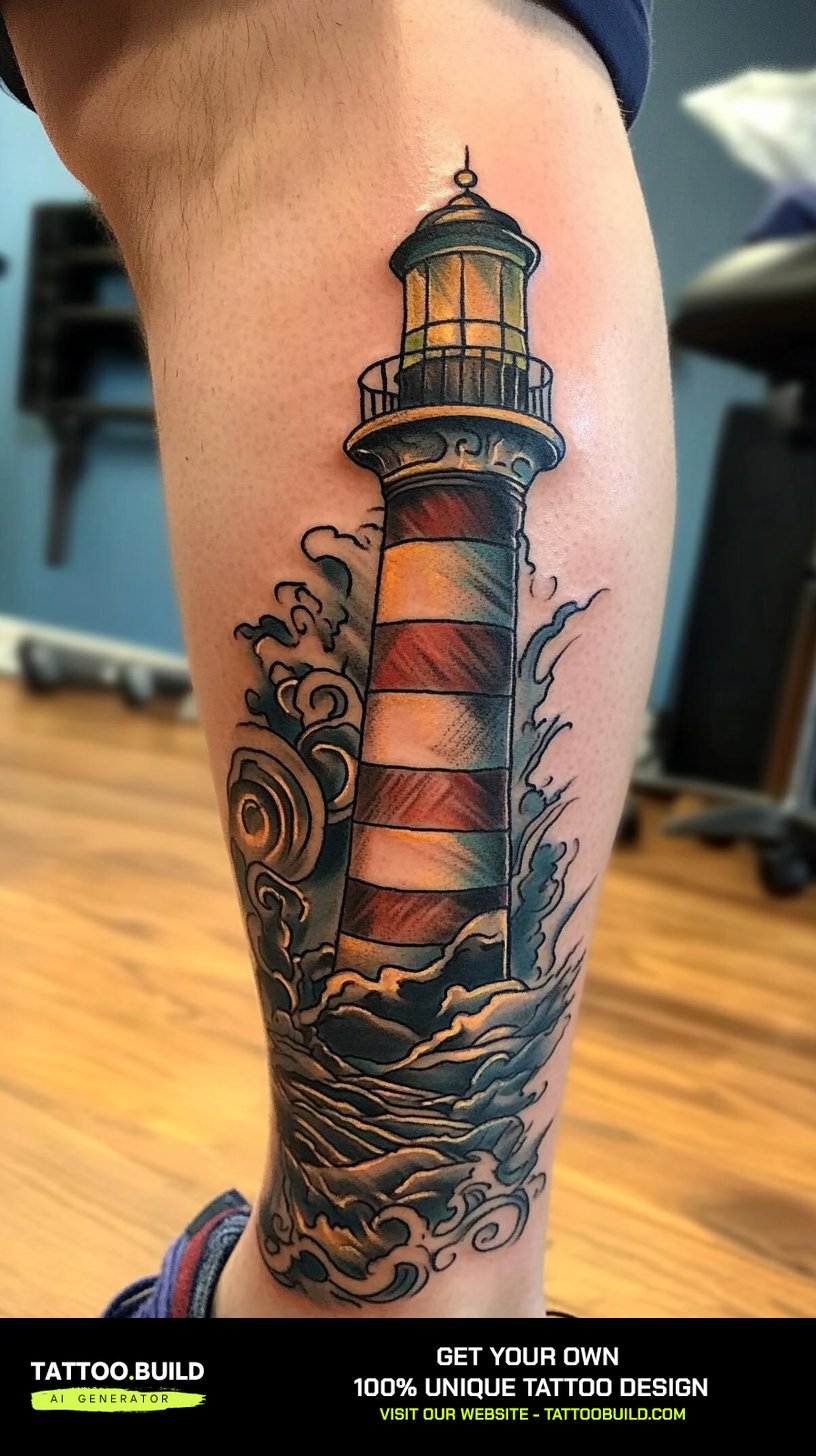
A sturdy tower on a rugged cliff, its beam cutting through blue-inked waves, with a single pine tree tucked in at the side.
What makes this one work is the pine. It breaks up an otherwise symmetrical composition and adds a sense of place — this is a northern coastline, not a generic one.
The colour is rich enough that the beam genuinely reads as glowing against the skin, which is hard to pull off. It also wraps the shoulder rather than sitting flat on it, so the waves follow the muscle instead of arguing with it.
Ask your artist to map the wave line to your deltoid curve before stencilling — this is the detail that separates a wrap-around piece from a sticker.
2. Maritime Monochrome — black and grey restraint
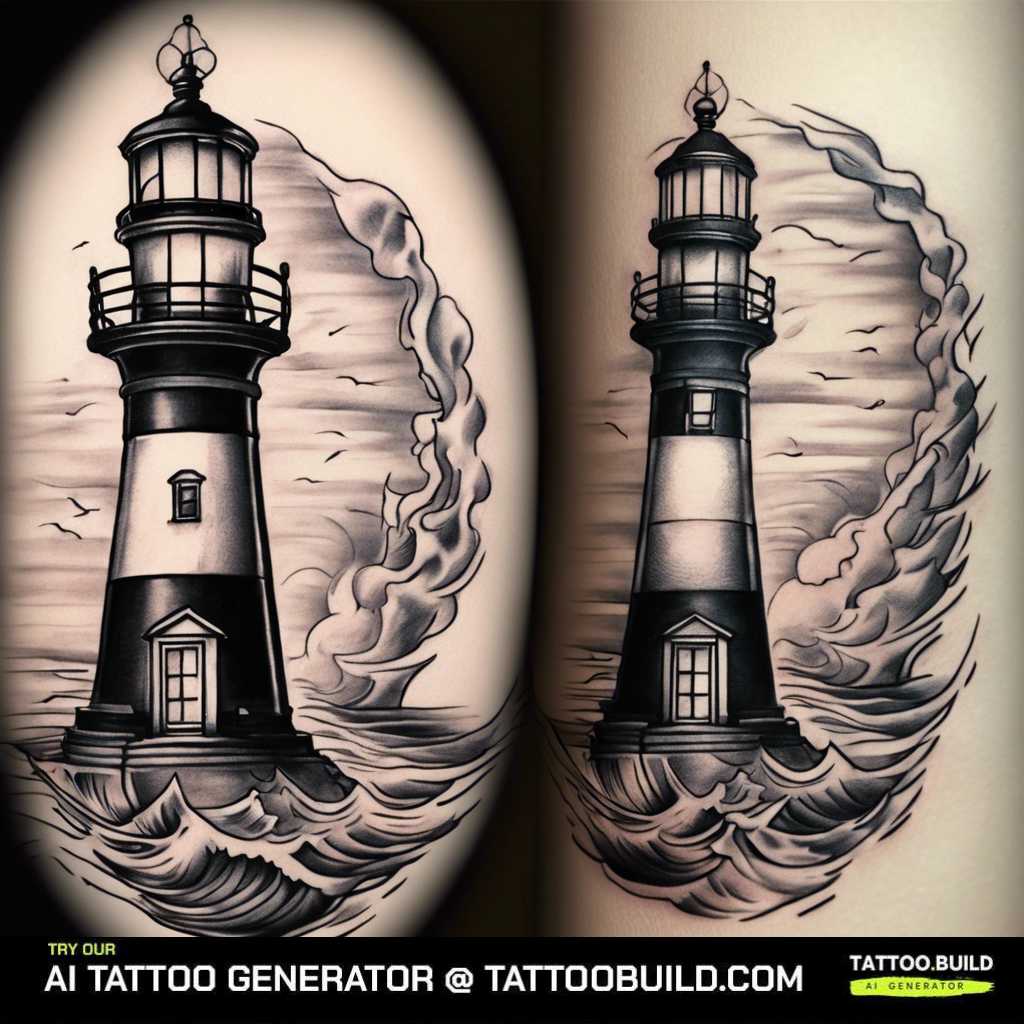
A resolute tower in black and grey, birds overhead, and calm water sketched in smooth, unhurried lines.
This is the version I recommend most often to people who are nervous about ageing. There is no colour to shift, and the smooth grey wash keeps the piece soft without relying on fine detail.
Birds are doing real work here: they fill dead sky space and give the eye somewhere to travel. Compare this approach with other black and grey lighthouse tattoos and you will notice the good ones almost always have something in the sky.
3. Harbor Watch — bold lines, high contrast
A commanding tower over swirling seas, with a small sailing ship braving the waves and birds lifting off toward the light.
Everything about this one is built for readability. Heavy outlines, high contrast, no delicate shading to lose.
The ship is small on purpose. It gives scale to the tower and turns a static image into a story — someone is out there, and the light is for them.
If you like this energy, it sits very close to traditional ship tattoo designs in construction, and the two combine well on a shoulder-to-bicep run.
4. Floral Beacon — softening the tower
A vibrant tower surrounded by lush pink and orange blooms, standing beside a small keeper’s cottage with seagulls overhead.
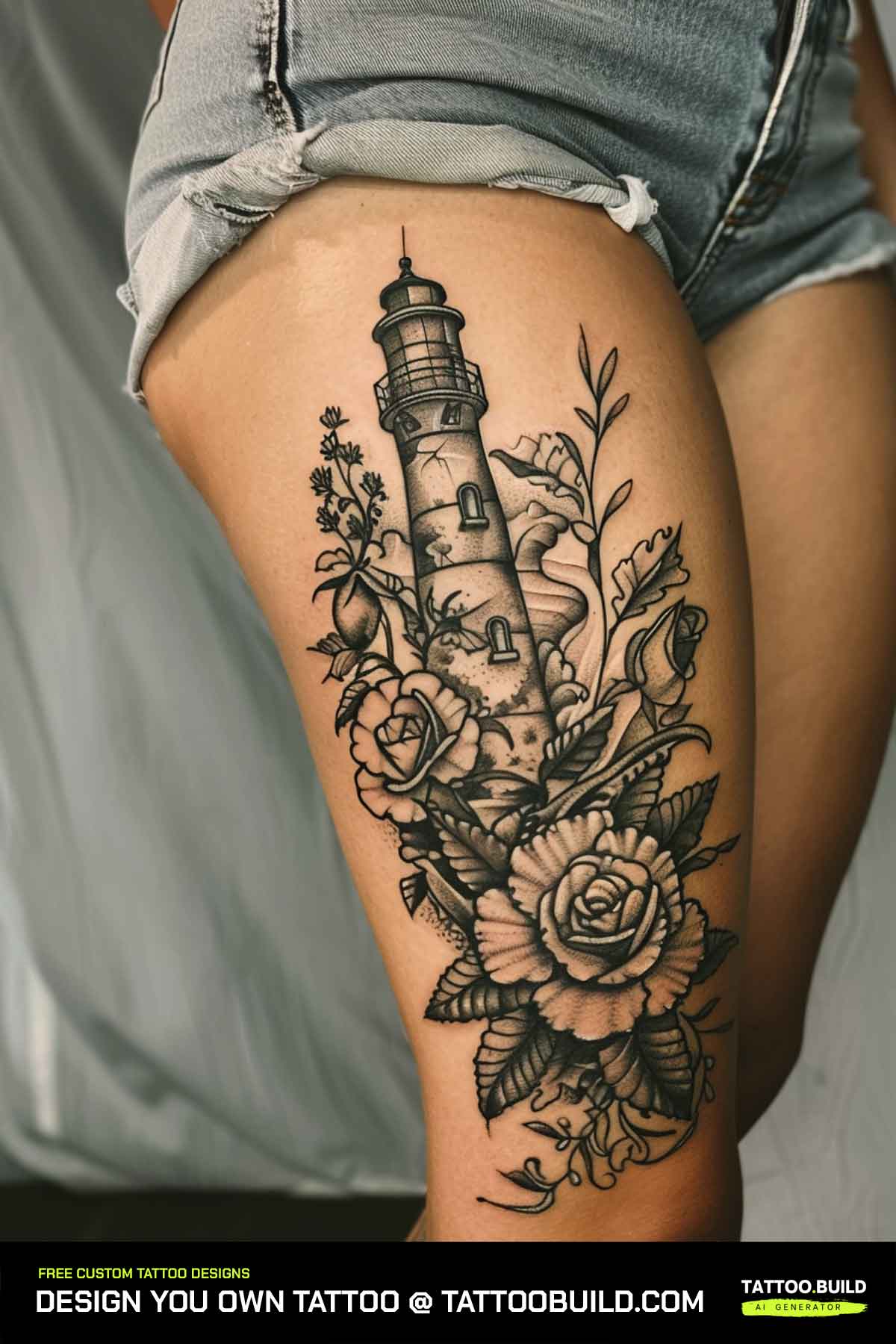
Flowers solve a specific problem: a lighthouse is a hard vertical cylinder, and hard verticals can look stiff on a rounded shoulder.
Putting blooms at the base gives the design an organic foundation and lets the artist blur the outer edge instead of ending it abruptly. Warm flower tones against cool sea tones also do most of the colour balancing for you.
This trick is used constantly in floral shoulder tattoos, and it works on nearly any rigid subject.
5. Stormy Serenity — contrast as the concept
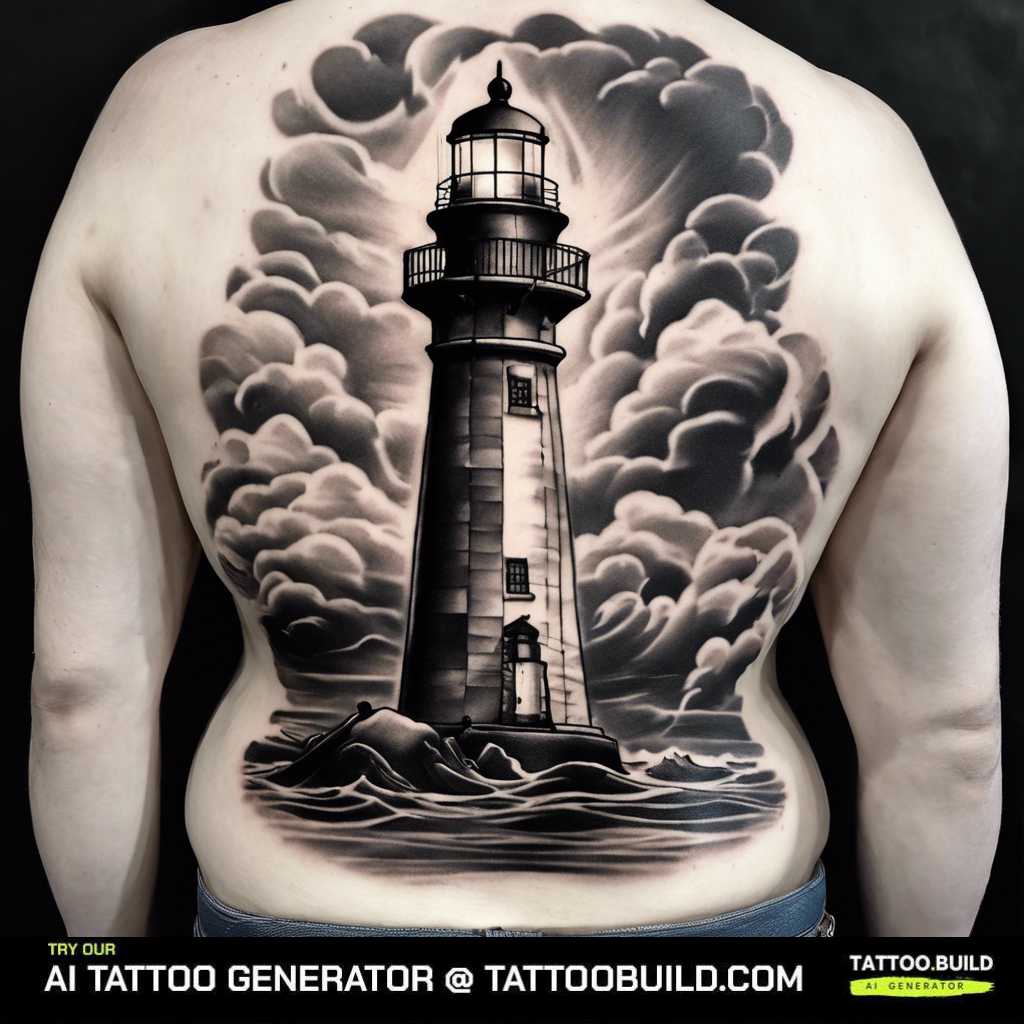
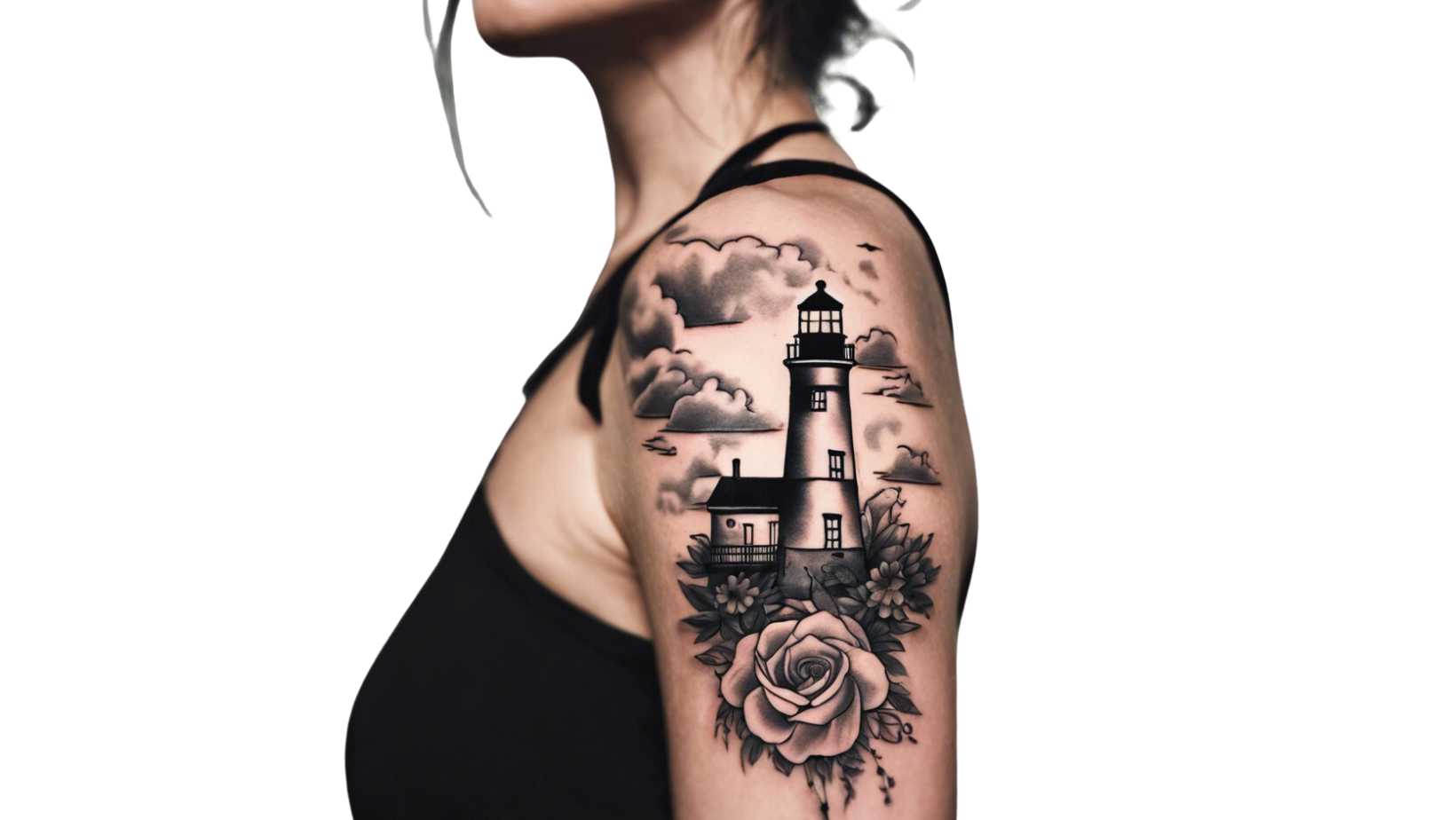
A tower and keeper’s house holding firm under heavy storm clouds, with a single large rose anchoring the bottom of the composition.
The whole piece is built on one tension: chaos above, calm below. That is a stronger idea than most tattoo scenes have.
Working entirely in greys gives it a timeless, almost photographic feel. In my experience these grey-wash storm pieces need a proper touch-up appointment around the one-year mark, because the lightest greys settle much softer than they look on day one.
Budget for that touch-up when you plan the tattoo, not after.
6. Twin Beacons — the two-shoulder design
Matching towers on each shoulder, mirrored, with a shared sea and a single moody sky connecting them across the back.
This is the most ambitious idea on the list and the one most likely to go wrong if it is not planned as a single drawing from the start.
Tattooed piecemeal, the two sides will never quite match — horizon lines drift, and the shoulders sit differently when you stand naturally. Every artist I have asked about mirrored work says the same thing: draw it as one piece, then split it into sessions.
Expect at least two sittings, and expect to sleep awkwardly for a week after each.
7. Dusk Beacon — colour done carefully
A tower against a glowing sunset, clouds in blue and orange, sand and gentle surf below.
Sunset pieces are the most requested colour version and the most misunderstood. The oranges and warm yellows are usually the first colours to soften over the years, especially on a shoulder that catches sun.
That is not a reason to avoid it. It is a reason to ask for solid black structure underneath the colour so the design still reads once the warm tones mellow. The US Food and Drug Administration also notes that tattoo inks are not pre-approved the way drugs are, so it is fair to ask your artist which brands they use.
Long-term, sunscreen on healed work is the single best thing you can do for a colour piece — the same advice applies to any ocean-themed tattoo.
8. Monochrome Beacon — the beginner-friendly one
A towering striped lighthouse in black and grey, light on duty at the top, calm ruled sea below and sun rays peeking from behind cloud.
If this is your first tattoo, start here. The stripes give texture without demanding fine detail, and the limited palette means fewer passes over the same skin.
Smaller sittings also mean less swelling, and swelling on the shoulder is what makes the second half of a long session hurt.
Scaled down, this design sits comfortably among small shoulder tattoo ideas without losing what makes it a lighthouse.
9. Evening Light — the full narrative scene
A proud tower against a setting sun, guarding rough seas, seabirds circling, a ship on the horizon and waves genuinely breaking against the rocks.
This is the most content-dense piece here, and it needs real estate. Squeezed under about five inches, the ship and birds will merge into noise within a few years.
The shading is what carries it — the time-of-day effect only works because the artist controlled the gradient carefully across a large surface.
Designs at this scale often become the anchor of a larger sleeve. Many of the best lighthouse tattoo ideas for women start exactly this way and grow outward over a couple of years.
10. Safe Passage — the beam as a focal path
A tall beacon with its light shining directly over a sailboat below, birds etched into a subtly graded sky.
The clever part is the beam. By pointing it at the boat, the artist gives your eye a route through the tattoo — tower, beam, boat — instead of leaving it to wander.
Any lighthouse design improves the moment the light is aimed at something. An unaimed beam is just a bright triangle.
Variations Worth Considering
If none of the ten fit exactly, these adjustments come up most often in consultations.
A real lighthouse instead of a generic one
Bring reference photos of an actual tower — the stripe pattern, gallery railing and lantern shape differ enormously between them, and the accuracy is usually the part people are proudest of later.
Pairing it with a compass
Two guidance symbols in one piece can be redundant, but done well the compass sits behind the tower as a background element rather than competing with it. Worth reading up on what a compass tattoo means before combining them.
Vertical run down the arm
Instead of a scene on the deltoid, run the tower from the shoulder cap down toward the bicep. This suits tall, narrow designs and gives the beam somewhere to go.
Engraved or vintage-map treatment
Hatched linework and a faded chart background give an antique feel. It borrows heavily from traditional lighthouse tattoo drawings and holds up well over time.
Adding a date or coordinates
Coordinates of a specific coastline are a common addition. Keep text well away from the tower itself so it does not blur into the linework as both age.
Placement, Pain, Cost and Healing
The shoulder is generally considered one of the more forgiving placements. There is muscle underneath, the skin sits away from bone across most of the deltoid, and it is easy to keep covered at work.
It is not painless. The outer deltoid is usually the easiest part; the closer the design creeps to the collarbone, the armpit, or the top of the shoulder blade, the sharper it gets. Most people describe the outer shoulder as a manageable ache rather than the sharp scrape you get over bone.
On cost, a piece like these usually lands in the multi-hour range rather than a quick sitting, and hourly rates vary hugely by city and artist. Ask for a quote at consultation and ask whether a touch-up is included — many artists include one, and it is worth knowing up front.
Healing takes roughly two to three weeks on the surface and a few months underneath. Keep it clean, keep it moisturised lightly rather than heavily, do not pick at it, and keep it out of the sun and out of pools. The American Academy of Dermatology publishes clear aftercare guidance, and it is worth reading before your appointment rather than after.
Follow the aftercare your own artist gives you — they know what ink and technique they used. And if you see spreading redness, heat, pus, or you develop a fever, that is a doctor visit, not a forum question. Nothing in this article is medical advice.
Common Mistakes and How to Avoid Them
Going too small is the mistake I see most. A lighthouse scene has a tower, a horizon, water and usually a sky — four layers of information. Under about four inches, something has to go.
Choosing the artist by price rather than portfolio is a close second. Look specifically for healed photos in the style you want, not fresh ones under a ring light.
Cramming in extra elements is the third. Anchors, ships, roses, compasses and coordinates are all good ideas individually, and terrible ones all at once.
Still deciding? It helps to browse adjacent subjects before committing — what an anchor tattoo symbolises covers a lot of the same nautical ground, and classy shoulder tattoo ideas is useful if you are unsure about scale.
Finally, sit with the design for a few weeks. Nothing about a lighthouse tattoo is urgent, and the whole point of the symbol is patience.
Frequently Asked Questions
How painful is a lighthouse shoulder tattoo?
For most people the outer shoulder is one of the more tolerable spots on the body, because there is muscle beneath the skin and little direct contact with bone. Pain generally increases as the design moves toward the collarbone, the armpit, or the top of the shoulder blade. Sessions for a detailed scene often run several hours, and the discomfort usually comes more from swelling and fatigue late in the sitting than from the needle itself. Eat beforehand, stay hydrated, and tell your artist if you need a break.
How big does a lighthouse shoulder tattoo need to be?
A simple single tower can work at two to four inches, but a full scene with water, sky and a ship usually needs five inches or more to stay readable as it ages. The reason is detail density: fine elements sitting close together tend to soften and merge over the years. If you want a small piece, simplify the design rather than shrinking a complex one. Your artist can tell you the minimum size their particular linework will hold.
Which style will age the best?
American traditional and bold black and grey generally hold up best over decades, because they rely on strong outlines and high contrast rather than fine detail. Fine line and watercolour styles can look beautiful when fresh but usually need touch-ups sooner. Colour work in warm tones tends to soften first, especially on skin that gets regular sun exposure. Whatever style you choose, solid black structure underneath is what keeps the design readable long term.
Can I get a specific real lighthouse tattooed?
Yes, and it is often the more meaningful option. Bring clear reference photographs showing the stripe pattern, lantern room and surrounding structures, because these details vary a lot between real towers. Historical societies and archives are good sources for accurate images of older lighthouses. Your artist will usually redraw the reference to suit your body rather than copying it exactly, and that is normal.
How do I stop my lighthouse tattoo from fading?
Sunscreen on fully healed skin is the single most effective habit, since ultraviolet exposure is the main cause of long-term fading. Keeping the skin moisturised helps it look better day to day, and avoiding sun and water entirely during the initial healing weeks protects the ink while it settles. Most tattoos benefit from a touch-up at some point, particularly colour and soft grey wash. Ask your artist about their touch-up policy at the consultation.
Quick Summary
- The shoulder suits a lighthouse better than most placements — the deltoid’s curve lets a tall tower and a horizon line coexist.
- Pick your style before your scene; it matters more for how the tattoo ages than the subject does.
- Black and grey and American traditional are the safest long-term bets; watercolour is the riskiest.
- Aim the beam at something — a ship, a boat, the horizon — to give the design a focal path.
- Flowers or waves at the base soften the tower’s hard vertical line on a rounded shoulder.
- Full scenes need roughly five inches or more; below that, simplify rather than shrink.
- Plan mirrored twin-shoulder designs as one drawing, then split them across sessions.
- Expect two to three weeks of surface healing, budget for a touch-up, and see a doctor for any sign of infection.