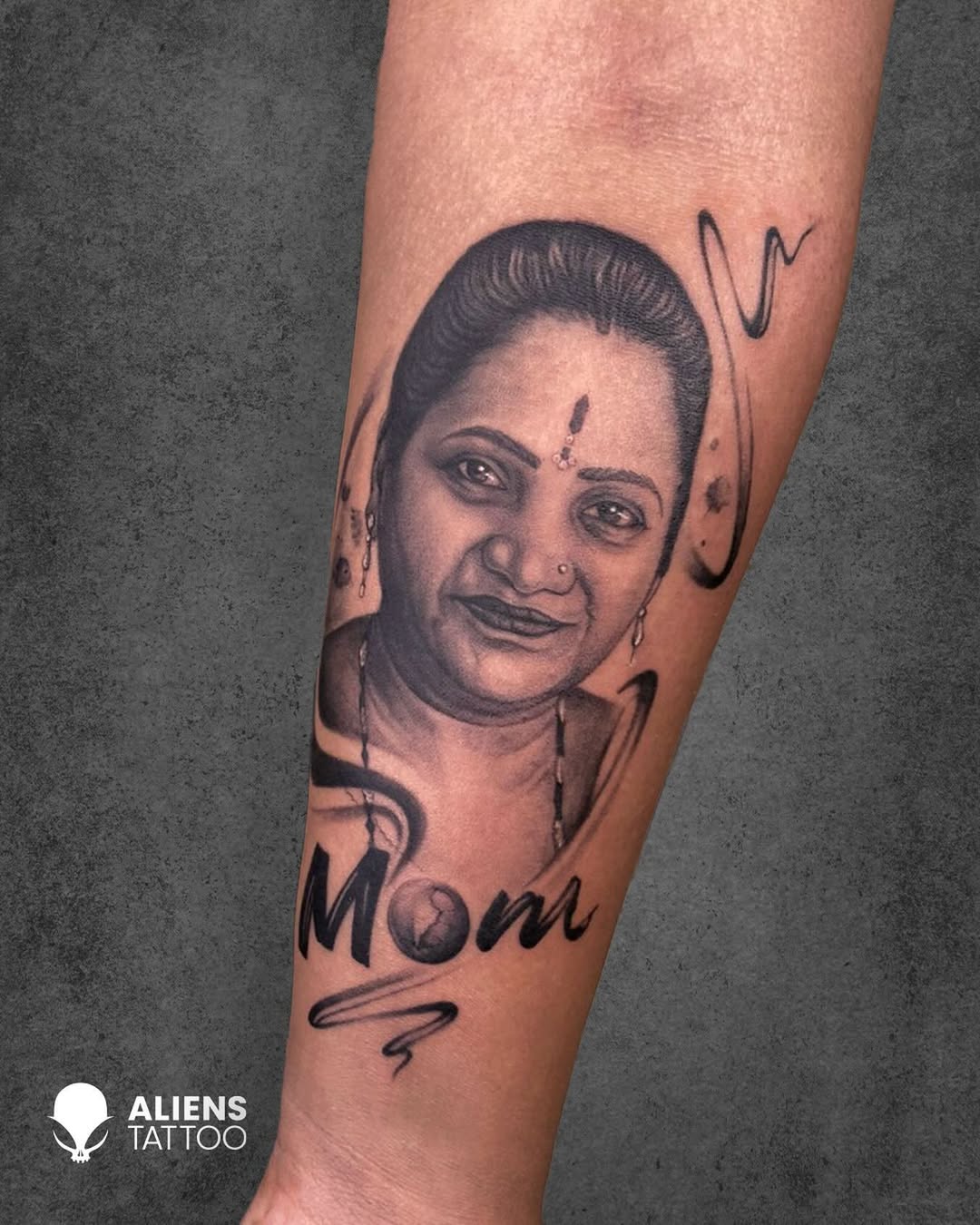
I have sat with a lot of people planning a tattoo, and the memorial pieces for a mother are the ones where the conversation slows down. A memorial tattoo for mom is not decoration and it is not closure — it is a way of keeping the relationship visible on a body that has to carry on without her.
The people I have talked to about these tattoos almost never describe them as sad. They describe them as steadying. Something they can look at in a supermarket queue or a hospital waiting room and feel briefly accompanied.
What follows is 21 directions worth considering, drawn from designs I have watched artists build and from the questions that come up again and again in the chair. Some are literal, like her handwriting. Some are quiet, like a set of coordinates nobody else can read. If you are still in the earliest and rawest part of this, the broader guide to grief tattoo ideas covers the wider ground before you narrow down to a single design.
I will also be honest about what these tattoos do not do, because a lot of writing on this subject oversells them.
Which Memorial Approach Is Right for You?
Five broad approaches cover most memorial tattoos for a mother. They differ less in meaning than in cost, session length, and how well they hold up over the years.
| Approach | Typical session | How it ages | Best if |
|---|---|---|---|
| Her handwriting | 30–90 minutes | Fine lines soften; thin loops can blur over decades | You have a card, note, or signature to work from |
| Portrait | 4–10 hours, often split across sittings | Good in the hands of a specialist; unforgiving otherwise | You have a sharp, well-lit photograph and a realism artist |
| Floral / botanical | 2–5 hours | Very well — bold shapes stay readable | She had a flower, a garden, or a birth month you want to use |
| Dates, names, lettering | 30–90 minutes | Depends entirely on size; tiny text closes up | You want something small, legible, and easy to place |
| Symbol (wings, butterfly, bird) | 1–4 hours | Strong, especially with solid black or bold colour | You would rather not explain the tattoo to strangers |
If you are torn, the honest tiebreaker is not meaning. It is whether you want a tattoo that invites questions or one that quietly does not.
What Actually Makes a Memorial Tattoo Work
The memorial tattoos that hold up over time tend to share one quality: they contain something specific that could only have come from her.
A generic rose with a generic banner reading Mom is a fine tattoo. But in my experience it fades from meaning faster than a crooked line of her own handwriting, because the handwriting is evidence and the rose is a category.
Specificity also protects you from a problem nobody warns about. Grief changes shape. The imagery that feels right three weeks after a loss is often not the imagery that feels right three years later — but a detail that was genuinely hers survives that shift, because it was never about the stage of grief you were in.
The second thing that matters is legibility at real size. Every artist I have asked says the same thing about memorial work: clients ask for it smaller than it should be, because they want it discreet. A date in 4 mm lettering on a wrist will not read as a date in fifteen years.
Give the design room to survive. Slightly larger and slightly bolder is almost always the version you will still be glad of later.
Ideas 1–5: The Most Personal Marks
1. Her Handwriting
This is the one I recommend most often, and the one people most often cry about in the chair. A birthday card, a recipe card, a note left on a fridge — any surviving sample can be scanned and traced into a stencil.
Artists generally want a flat, high-resolution photograph of the original taken in daylight, not a phone snap at an angle. The line weight of a ballpoint pen translates well to fine-line work; a pencil sample usually needs redrawing.
Keep the imperfections. The wobble in the letters is the point. When I have seen these cleaned up and made uniform, they stop looking like hers and start looking like a font.
2. Her Birth Flower and Yours
Two blooms, intertwined, one for her birth month and one for yours. It reads as botanical art to anyone who does not know, which is exactly why many people choose it.
It also scales beautifully — the same concept works as a two-inch piece on a forearm or a full half-sleeve. Our guide to birth flower tattoo ideas lists the traditional flower for each month if you are not sure which is hers.
3. Portrait
The most direct option and by some distance the hardest to execute. A portrait tattoo lives or dies on the artist, not on the idea.
Look for someone whose healed portrait work you can see — not fresh photos taken an hour after the session, which always flatter. Ask specifically to see pieces that are two or more years old.
Expect to travel for the right artist and expect a waitlist. This is not the piece to book locally because it is convenient.
4. Her Dates
Birth and passing, usually separated by a dash or a small heart. Simple, fast, and one of the least expensive memorial tattoos you can get.
Some people find the second date too blunt to look at daily and choose to ink only her birthday. That is a completely legitimate choice and one I have seen people relieved they made.
5. “Mom” in Her Script
If she ever signed a card Mom or Love, Mum, that single word is already a complete tattoo.
It is small, it is cheap, it takes under an hour, and it is unrepeatable. For anyone hesitant about a first tattoo, this is the lowest-commitment entry point into memorial work.
Ideas 6–11: Symbols That Stand In for Her
6. Her Favourite Flower
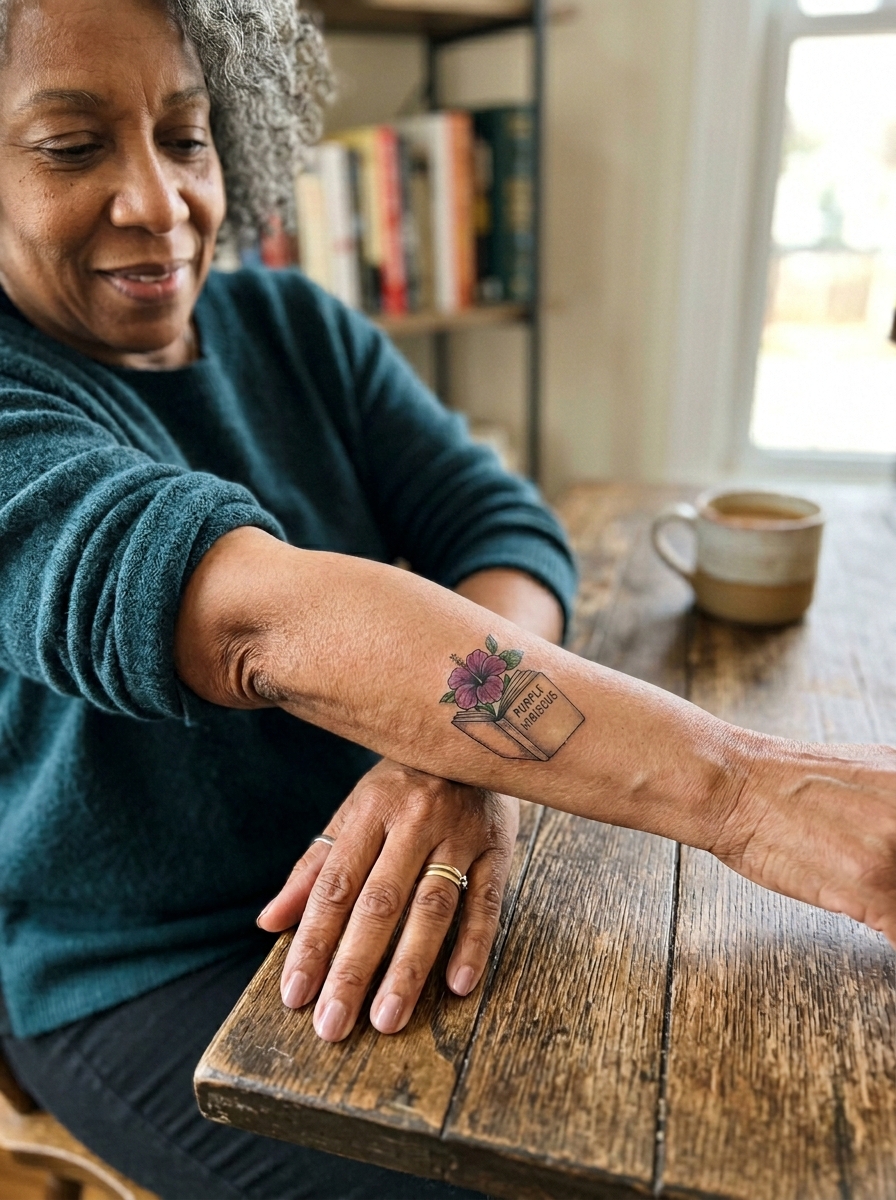
Not a symbolic flower — the actual one she grew, bought, or kept on the windowsill.
Floral work is also among the best-ageing tattoo subjects there is, because the forms are organic enough that softening over time reads as natural rather than as damage.
Bring a photograph of the specific variety if you can. There is a real visual difference between a garden rose and a tea rose, and a good artist will care about it.
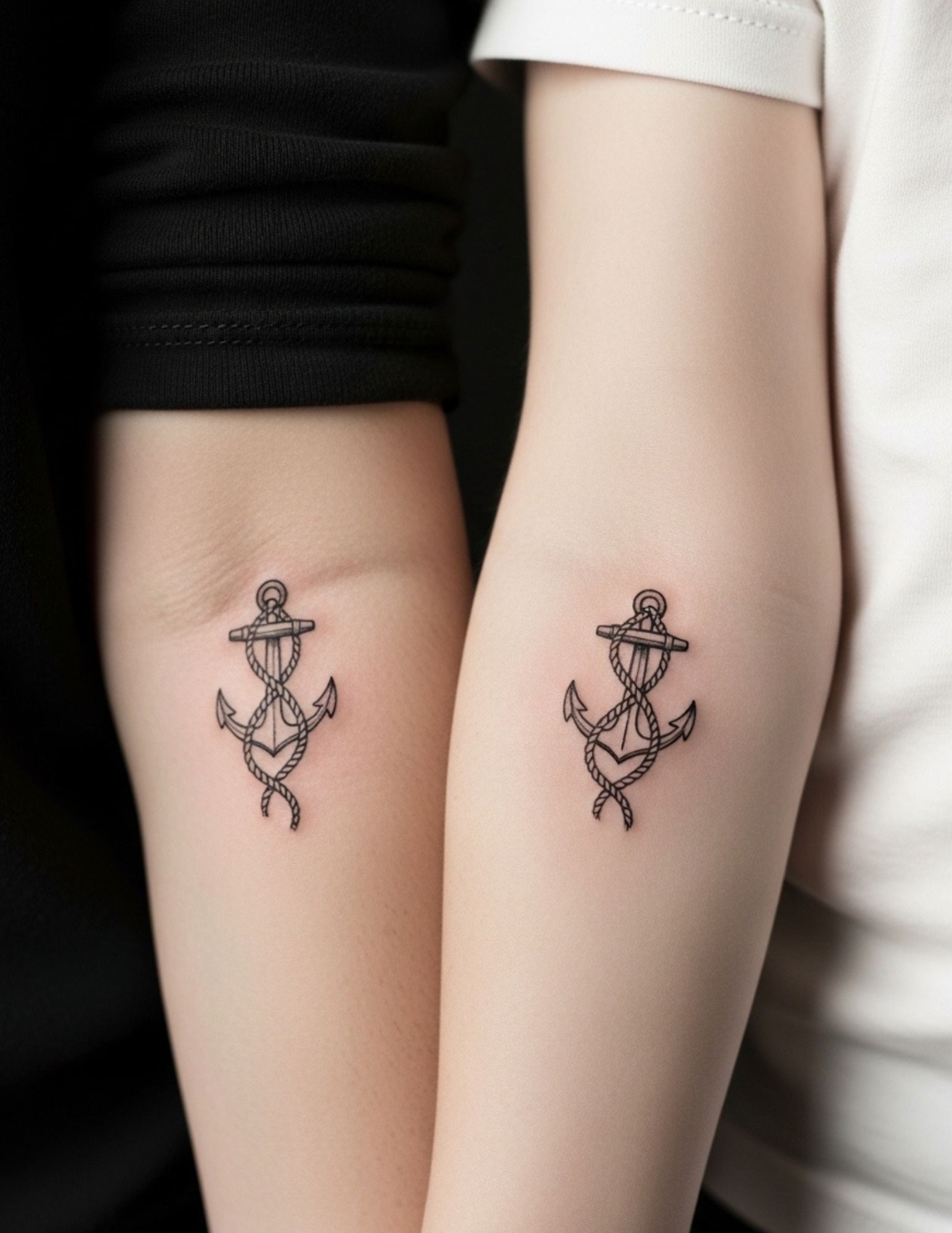
7. Infinity with Her Name
A familiar design, and one I will be honest about: the infinity symbol is heavily used and can date a tattoo to the decade it was made.
Where it works is when the name itself carries the piece and the loop is thin, small, and secondary. Where it struggles is when the symbol dominates and the name becomes a caption.
8. Angel Wings
Wings carry an unmistakable memorial meaning without requiring a name or a date. For people who want the tattoo to be private, that ambiguity is the appeal.
They range from a pair of small feathered outlines behind an initial to full back pieces. Placement on the shoulder blades is traditional but by no means required — there are more options in our wing tattoo ideas collection.
9. Her Favourite Quote
The rule I would apply: use something she actually said, not something she would have agreed with.
A line from a song she played constantly, an expression she used when you were ill, a piece of advice she repeated until it annoyed you. These age far better than inspirational quotations that could belong to anyone.
Watch the length. Long passages need a long, flat area of skin — the inner forearm, the ribs, the spine — and they need larger lettering than most people budget space for.
10. Hummingbird
Hummingbirds appear in memorial work constantly, often because a family has come to associate one at the feeder with a person who has died.
They also happen to be excellent tattoo subjects: compact, dynamic, and readable in either fine black linework or full colour. There is a wider set in our hummingbird tattoo ideas guide.
11. Her Zodiac Sign
Either the glyph or the constellation, both of which are small, geometric, and easy to place almost anywhere.
The constellation version is the more subtle of the two — to a stranger it is a scatter of dots and thin lines, which is precisely the point.
Ideas 12–16: Details Only You Would Recognise
12. Sunflower
Sunflowers turn up in memorial tattoos more than almost any other bloom, and they are structurally well suited to it: bold petals, a heavily textured centre, strong silhouette.
That bold shape is what makes them age well. For variations in colour, size, and placement, see our sunflower tattoo ideas collection.
13. Coordinates of Her Home
Latitude and longitude for the house you grew up in, the hospital where she was born, or the place she was happiest.
Completely opaque to everyone else. Check the figures carefully before the stencil goes on — a transposed digit is a permanent error, and I have heard of it happening.
14. Mother and Child Symbol
Usually a continuous single line forming two figures, or two abstract shapes nested together.
It is a modern, minimal style that photographs well and heals cleanly, though very thin single-line work does soften noticeably over ten or fifteen years. Ask your artist to weight the line slightly heavier than the drawing looks on paper.
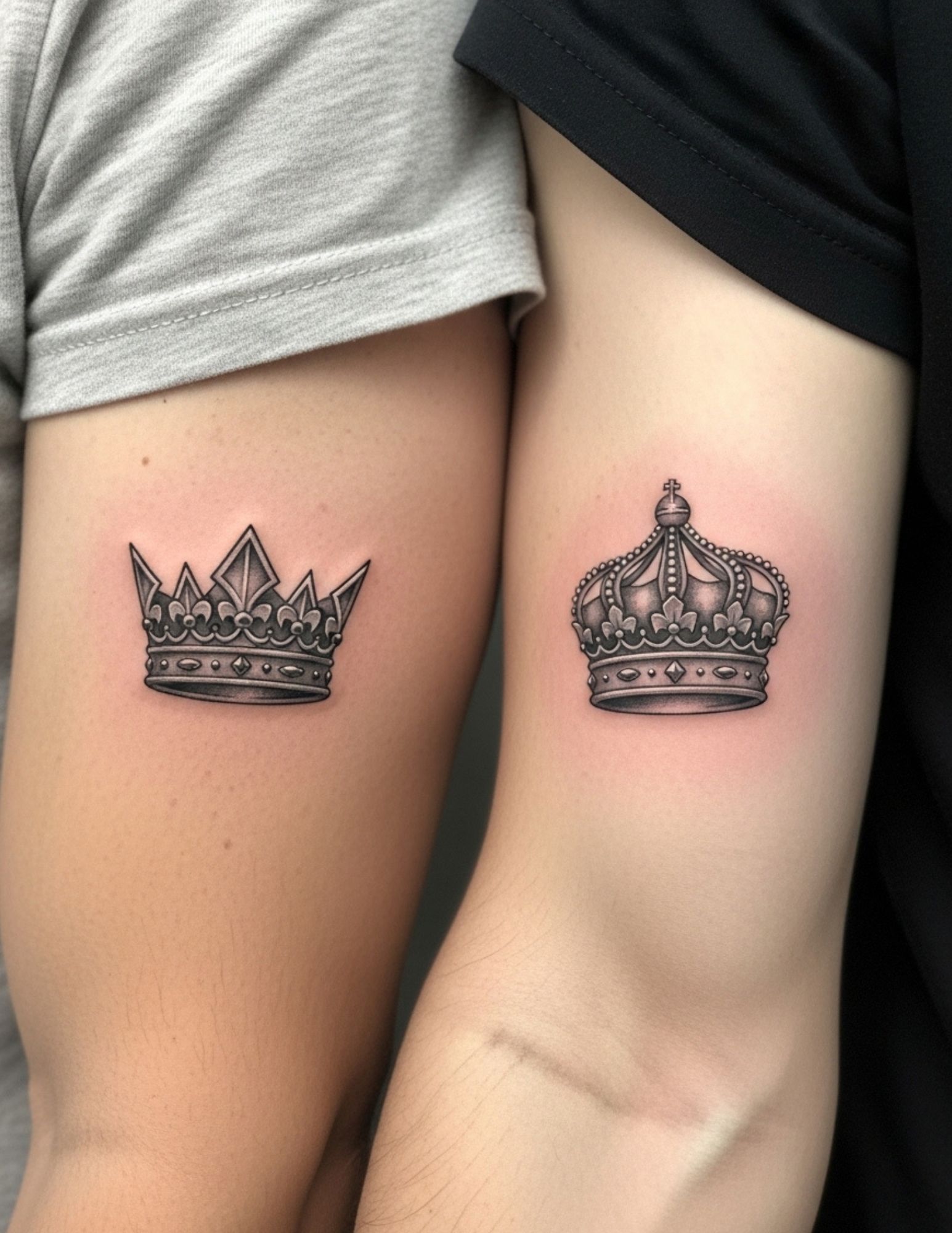
15. Crown
A small crown above her initial, drawing on the familiar idea of a mother as the head of the family.
It is compact enough for a finger, a wrist, or behind the ear, and the solid geometry holds its shape as it ages.
16. Her Fingerprint
If a print was taken — some hospices and funeral homes offer this, and some families have one from an old document — it can be reproduced as a tattoo.
The ridges need to be tattooed larger than life size to stay legible, so expect the finished piece to be noticeably bigger than an actual fingertip. Some people set it inside a heart outline; most do not need to.
Ideas 17–21: Carrying Her Forward
17. Butterfly with Her Name
The butterfly is the most common memorial symbol in Western tattooing, which is both its weakness and its strength — it is instantly understood.
To avoid a generic result, push the styling somewhere specific: a particular species, an ornamental treatment, heavy black shading rather than outline. Our butterfly tattoo ideas guide shows how differently the same subject can be handled.
18. Cardinal Bird
In parts of North America there is a widely held folk belief that a visiting cardinal represents a family member who has died, and it shows up constantly in memorial tattoos.
The red is the draw and also the maintenance issue: red pigment sits in the skin differently from black, and colour work generally needs sun protection to stay vivid. Ask your artist how their reds have healed on skin like yours.
19. “Until We Meet Again”
Script lettering with an ongoing rather than final tone. People choose phrasing like this when a closing statement feels wrong to them.
Script needs length. The inner forearm, the collarbone, the ribs, and the spine all give a natural line to follow; a curved placement like the shoulder cap will distort the letterforms.
20. Her Name and a Semicolon
The semicolon marks a sentence the author could have ended and chose to continue. Attached to her name, it reads as a life that carries on through the people left.
It carries a second, well-established association with mental health and suicide awareness, which is worth knowing before you commit — the background is covered in our semicolon tattoo ideas guide.
21. The Last Thing She Said
If you were there, and if the words were good ones, they can be the whole tattoo.
I would add one caution I have heard from more than one artist: give this one time. Final words carry enormous weight in the first months and occasionally settle differently after a year. Nothing is lost by waiting.
If You Are Not Ready for Something Permanent
There is no obligation to mark a loss on your skin, and there is no deadline for deciding.
Trial it in henna or a temporary print
Having the design printed as a temporary transfer and living with it for a fortnight tells you things a drawing on paper cannot — mainly whether you want to see it every day.
Jewellery instead of ink
Handwriting engraves onto a pendant as readily as it tattoos onto skin, and it can be taken off on the days you need a break from it.
A shared family design
Siblings sometimes take one design and split it, or get the same small mark in different placements. It works best when everyone chooses freely; a memorial tattoo agreed to under family pressure is a bad tattoo.
A word on ashes in ink
People do ask about mixing cremated remains into tattoo ink. Many reputable artists decline, because it is not a sterile, regulated pigment and it carries a real risk of infection and long-term reaction.
If you are considering it, raise it with a professional artist and with your doctor first rather than with anyone offering to do it informally. This article is not medical advice.
Choosing the Artist and Caring for the Tattoo
Match the artist to the style, not to the location. A brilliant traditional artist is not automatically the right person for a fine-line signature, and a fine-line specialist is not the person for a portrait.
Ask to see healed work in the specific style you want. Fresh photographs taken minutes after a session hide almost everything that goes wrong later.
Tell the artist what the piece is for. Most will give a memorial consultation more time, more care, and a gentler pace on the day — and a good one will tell you honestly if the design will not survive at the size you are asking for.
For healing, follow the aftercare instructions your artist gives you over anything you read online, and keep the new tattoo out of direct sun. The American Academy of Dermatology publishes general guidance on caring for tattooed skin, and the US Food and Drug Administration has a plain-language fact sheet on tattoo inks and reactions. If you develop spreading redness, swelling, heat, or a rash around the tattoo, see a doctor rather than waiting it out.
Still Not Sure? The Mistakes Worth Avoiding
Going too small is the most common regret I hear, and it is almost always driven by wanting the tattoo to be discreet. Discretion is better solved by placement than by shrinking the design.
Booking too fast is the second. There is no benefit to getting it done inside the first month, and there is real benefit to having sat with the design for a while.
Choosing an artist on price for a portrait is the third, and it is the only one on this list that is genuinely difficult to fix afterwards.
If you want to look sideways at the subject before deciding, mother and daughter tattoo ideas covers designs made while she is still here, and meaningful forearm tattoos is a useful survey of placement if you have settled on the meaning but not the spot.
Frequently Asked Questions
How long should I wait before getting a memorial tattoo for my mom?
There is no correct interval, and people get these anywhere from days to decades afterwards. What I would say is that nothing is lost by waiting and something can be lost by rushing, particularly with a design chosen in the first raw weeks. If you feel certain now and you would have felt certain a year ago, that is a good sign. If the design keeps changing week to week, give it more time.
What is the best placement for a memorial tattoo?
The inner forearm is the most common choice, because you can see it yourself without a mirror and it is easy to cover with a sleeve. Script and dates need a long flat run of skin; portraits need a broad area like the upper arm, thigh, or back. Avoid hands, fingers, and feet for detailed work, as those areas fade and blur faster than most people expect.
Can a tattoo artist work from a photograph of her handwriting?
Yes, and it is routine work for most artists. Send a flat, well-lit, high-resolution photograph of the original taken straight on rather than at an angle. Ballpoint and marker samples translate most cleanly; faint pencil often needs to be redrawn, so ask your artist before you assume a sample will work.
How much does a memorial tattoo for mom cost?
It depends entirely on size, style, and the artist’s rate, which varies hugely by city and by reputation. A small handwriting piece or a set of dates is usually a single short session at a shop minimum; a realistic portrait is a multi-hour or multi-session commitment and priced accordingly. Ask for a quote at the consultation rather than over message, since artists need to see the design and placement to price it honestly.
Is it strange to get a memorial tattoo years after the loss?
Not at all, and in my experience the later ones are often the most considered. Some people need a decade before they want to mark it, and some are prompted much later by a milestone birthday or a child of their own. The timing does not make the tattoo more or less meaningful.
Quick Summary
- Her handwriting is the strongest single option, because it is specific and cannot be reproduced by anyone else.
- Specificity beats symbolism — the flower she actually grew outlasts a flower chosen for its meaning.
- Size it slightly larger than feels comfortable; going too small is the most common regret.
- Portraits depend almost entirely on the artist, so look at healed work that is two or more years old.
- Coordinates, constellations, and dates give you a memorial nobody else can read.
- Colour work like a cardinal needs sun protection to stay vivid over the years.
- There is no deadline. Waiting a year costs nothing and often improves the design.
- Follow your artist’s aftercare advice, and see a doctor for any spreading redness, swelling, or rash.