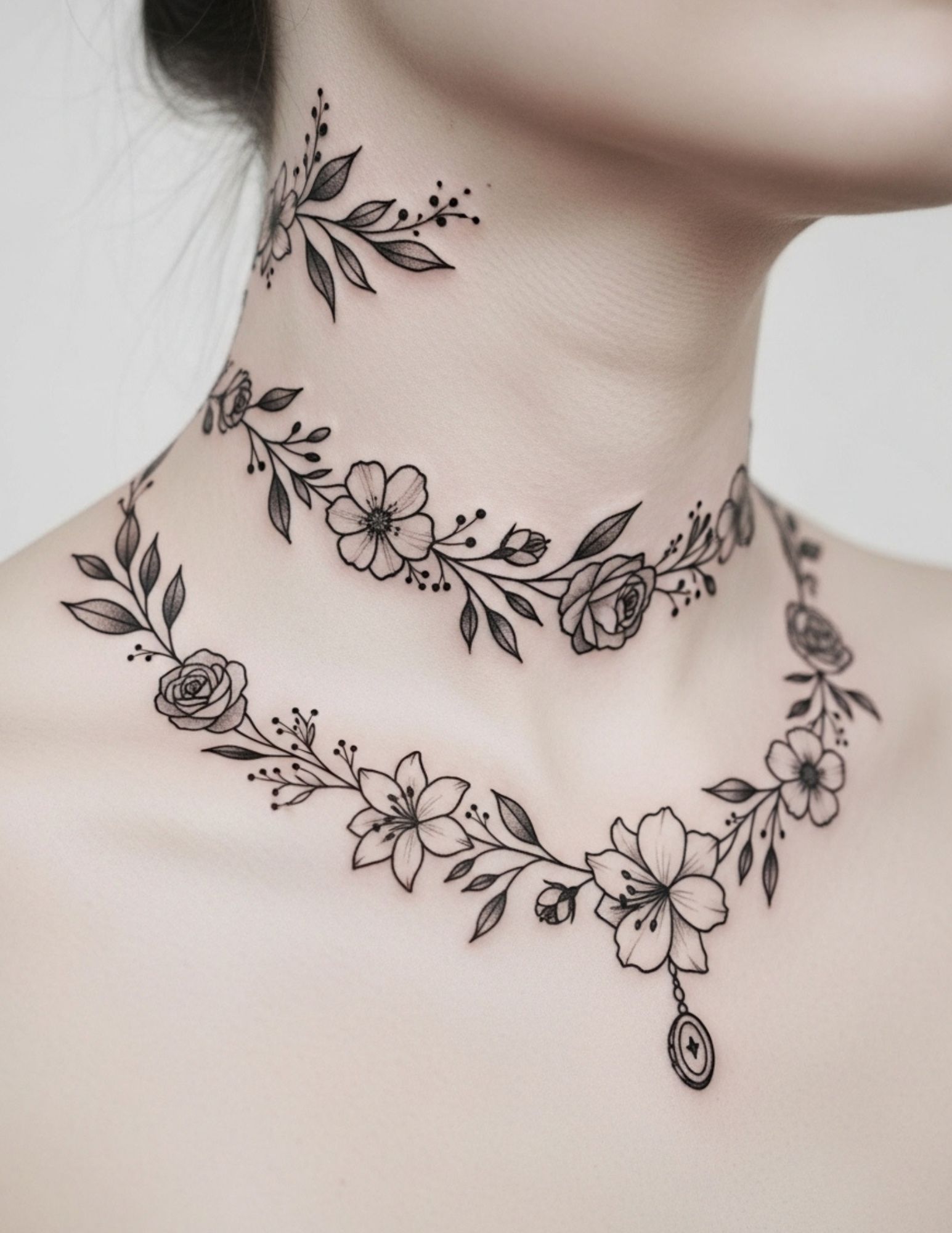
The first necklace tattoo I watched being stencilled took the artist longer to place than to tattoo. She moved the transfer four times, had the client stand, sit, turn her head, and shrug, and only then committed. A necklace tattoo lives or dies on placement, because the collarbone is one of the few areas of the body that visibly changes shape every time you move.
That is the whole appeal and the whole difficulty. A chain drawn across the clavicle reads as real jewellery precisely because it follows a moving line — and a chain drawn a centimetre too high reads as a scar.
What follows is 20 designs I have either seen healed in person or discussed at length with artists who specialise in them, grouped so you can compare the jewellery-replication styles against the botanical and ornamental ones. If you are still deciding on the zone rather than the design, the wider collarbone tattoo ideas guide covers placement first.
I have flagged, honestly, which of these hold up over ten years and which need a touch-up sooner than anyone tells you at the consultation.
Which Necklace Tattoo Style Is Right for You?
Four broad approaches cover almost every necklace tattoo I have seen. They differ less in looks than in how they age.
| Style | Best for | Typical sitting | How it ages | Watch out for |
|---|---|---|---|---|
| Fine line jewellery | Chains, gems, pearls, charms | 1–3 hours | Softens fastest; hairlines thicken | Touch-ups sooner than you expect |
| Botanical garland | Flowers, vines, daisy chains | 2–4 hours | Forgiving — softening reads as organic | Crowded blooms merging into a smudge |
| Ornamental blackwork | Collars, lace, pattern work | 3–6 hours, often split | Holds shape longest of the four | Visibility — hardest to cover at work |
| Script at the collarbone | A word or short phrase | 45–90 minutes | Depends entirely on letter spacing | Thin connecting strokes closing up |
If you want one honest shortcut: pick botanical or blackwork if you never want to think about it again, and fine line if you accept a touch-up every few years as part of the deal.
What Makes a Necklace Tattoo Read as Real Jewellery
The illusion is not about detail. It is about drape.
Real jewellery hangs. It obeys gravity, sags slightly between the shoulders, and sits a fraction lower at the centre than at the sides. Every convincing necklace tattoo I have seen reproduces that curve; every unconvincing one is drawn as a straight horizontal band.
The second factor is where the design stops. Real chains disappear behind the neck. A tattoo that tapers or fades toward the shoulders reads as jewellery, while one that terminates abruptly mid-clavicle reads as a decorative stripe. Artists who work in jewellery-style tattooing treat that termination point as the hardest part of the design.
Third is line weight. A chain rendered at one uniform thickness looks printed. Varying weight slightly — heavier where the chain would catch light, lighter where it turns away — is what sells the three-dimensional read.
Skin is not a jewellery box. The collarbone gets sun, stretches, and moves constantly, so a design that depends on a perfect hairline to work is a design that depends on maintenance.
20 Necklace Tattoo Ideas
These run from literal jewellery replication to designs that only borrow the position. Most are fine line work, but the blackwork entries deliberately are not.
1. Fine Chain with Pendant
A delicate chain following the collarbone with a single pendant at the centre: a small cut stone, a teardrop, or a plain geometric shape.
This is the design most people walk in asking for, and the one I would recommend to anyone getting their first neck-area piece. It is small enough to sit in a single short session and simple enough that a good artist can adjust the drape live on the skin.
The trade-off is longevity. Chain links drawn at hairline weight will thicken over the years until the individual links close up into a solid line. Ask your artist to space the links slightly wider than looks right on paper — that gap is what keeps it reading as a chain a decade later.
2. Floral Garland Necklace
A continuous garland of small flowers along the collarbone, stems connecting each bloom into a botanical chain.
Every artist I have asked about longevity pushes clients toward this one. Because the design has no mechanical repetition to preserve, the inevitable softening of fine lines makes it look more organic rather than less correct.
Keep the blooms deliberately separated. The most common failure I see is a garland packed so tightly that after five years the flowers read as one continuous grey band. Two to three millimetres of clear skin between blooms is not a stylistic choice, it is structural.
3. Botanical Vine Collar
A vine with leaves and small buds circling the lower neck rather than sitting on the clavicle.
The vine collar solves a problem the chain designs cannot: the neck is a cylinder, and a chain drawn on a cylinder has to distort to look right from the front. A vine has no expected geometry, so distortion never registers as error.
It hurts more than the collarbone versions. The lower neck sits over thin skin and close to bone and windpipe, and in my experience clients describe it as sharp rather than dull. Plan a session with breaks built in.
4. Diamond Tennis Necklace
A continuous row of small faceted stones following the collarbone, each rendered with enough internal line work to suggest a cut gem.
This is the most technically demanding of the jewellery replications. Even spacing is everything — the human eye catches an irregular gap in a repeating row instantly, while it forgives an irregular flower petal without noticing.
When I have seen this done well, the artist drew the stones slightly larger at the centre and smaller toward the shoulders, mimicking how a real tennis necklace appears in perspective. A row of identically sized stones is the tell that a design was traced rather than composed.
5. Layered Chain Necklace
Two or three chains at staggered lengths, replicating the layered jewellery look in a single piece.
Layering gives you variety without the commitment of a large ornamental design: a plain fine chain, a slightly longer one with a charm, perhaps a third with beads.
Two strands is usually the practical limit. Three begins to occupy enough vertical space on the chest that it stops reading as jewellery and starts reading as a chest piece, and it multiplies the healing surface in an area that already rubs against every collar you own.
6. Beaded Necklace
Beads rendered as a continuous string of small circles or ovals along the collarbone.
The bead format adapts to whichever tradition matters to you — trade beads, prayer beads, or a plain contemporary strand — without needing the design to be culturally specific if you would rather it were not.
Beads age better than chain links because a circle that thickens is still a circle. This is the design I suggest when someone wants the jewellery look but hates the idea of returning for touch-ups.
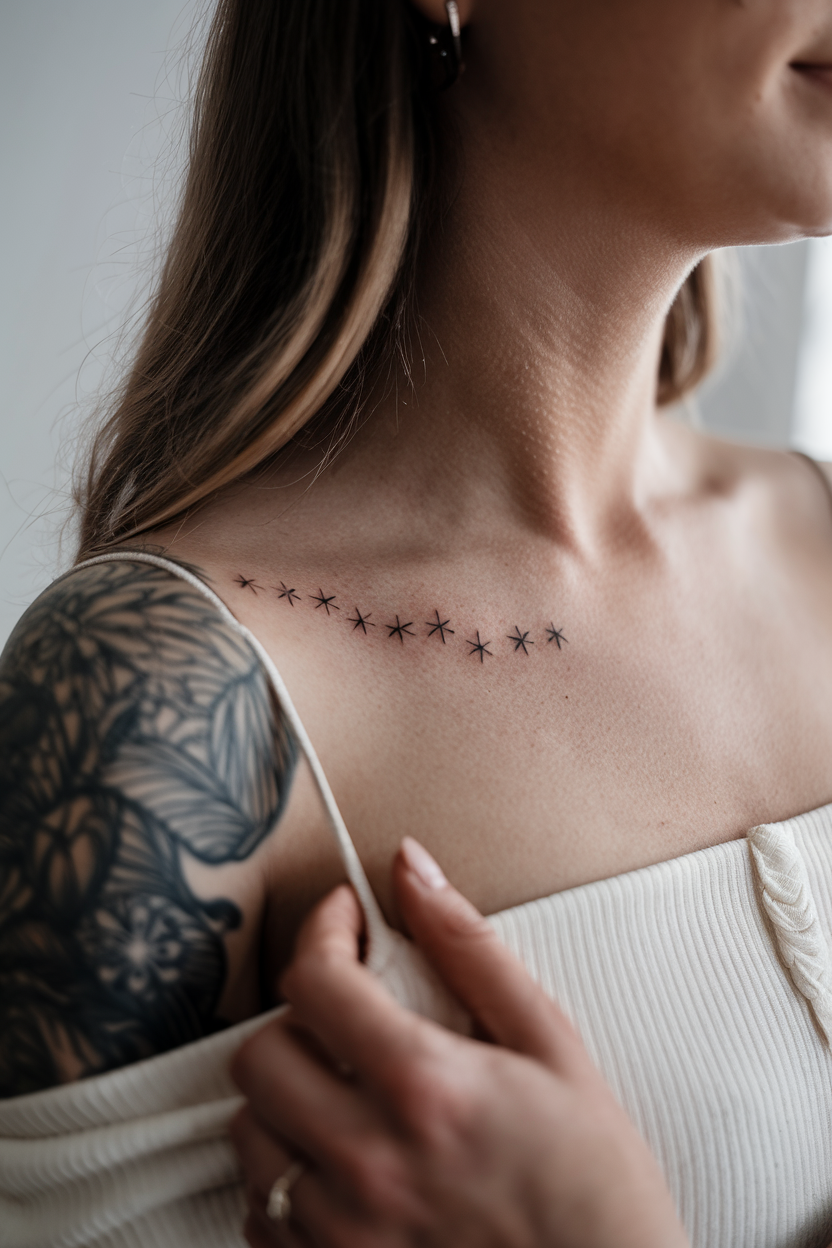
7. Star and Moon Charm Necklace
A fine chain carrying crescent moon, star, and small celestial charms spaced along its length.
Charms are the easiest way to make a chain personal without adding a literal name or date. They also break up the repetition that makes plain chains hard to keep legible. If the symbolism is the draw rather than the jewellery format, the broader celestial tattoo ideas collection covers the same imagery at other placements.
Keep charms to three or fewer. Beyond that they compete with each other and the composition loses its centre.
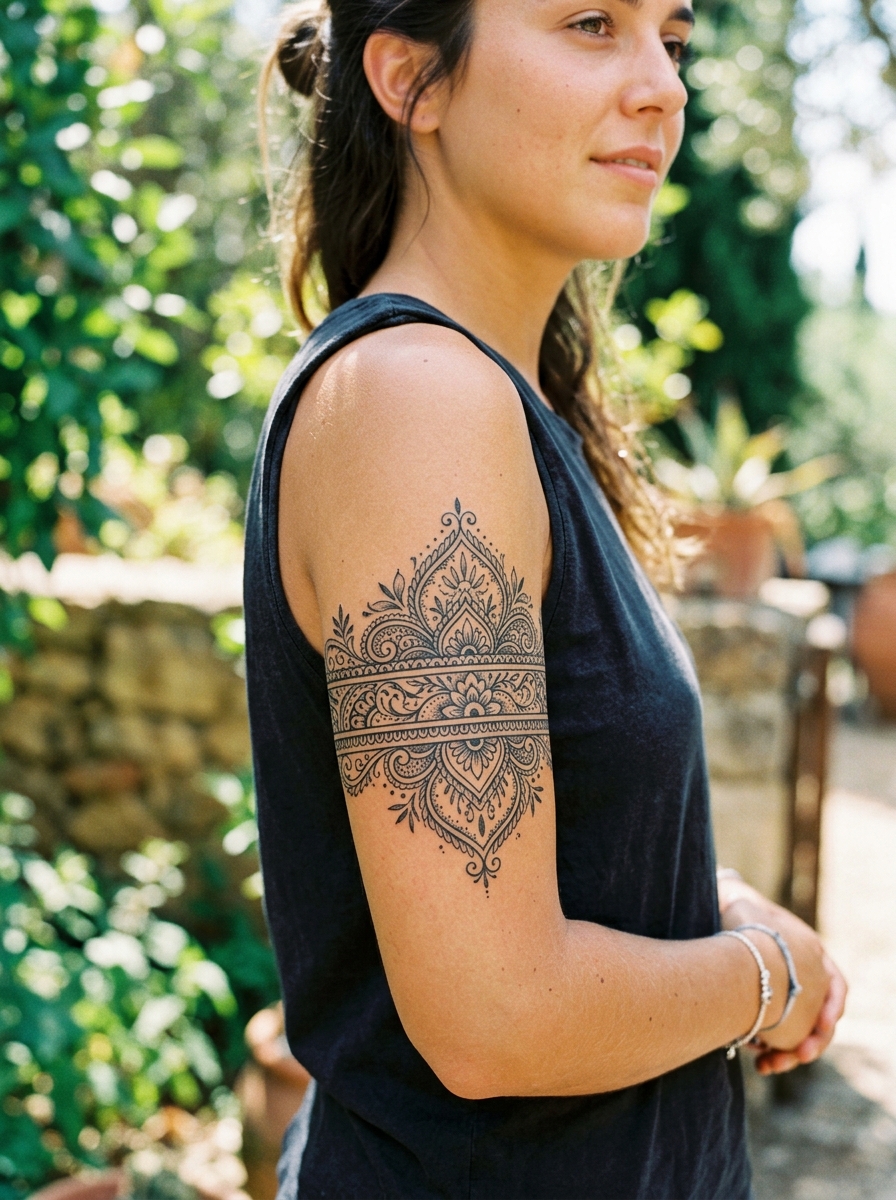
8. Ornamental Blackwork Collar
An elaborate patterned collar circling the lower neck, drawing on lace, Moroccan geometry, or textile motifs.
This is the entry on the list that is not pretending to be jewellery. It is a statement piece, closer in spirit to ornamental tattooing than to a chain, and it announces itself in a way no fine line design does.
It is also the one that holds up best over decades, because solid black mass and confident negative space survive the spreading that destroys hairlines. Budget several hours and expect it to be split across sessions.
9. Pearls on a String
A pearl strand in fine line, each pearl given enough soft shading to suggest a round, lit surface.
Pearls are the one jewellery form where outline alone will not work. Without shading they flatten into a row of circles indistinguishable from beads.
The associations are specific — classic, formal, traditionally feminine — and part of the appeal for many people is the tension between that formality and the permanence of ink. It is a knowing design, and it reads that way.
10. Single Strand with Focal Pendant
One clean strand along the collarbone carrying a single meaningful pendant: a cross, a key, an initial, a symbol.
Stripping the design to one line and one object puts all the weight on the pendant’s meaning. Nothing decorative competes with it.
In my experience this is the necklace tattoo that people are still happy with longest, because the part that matters is the part that is large enough to survive. The chain can soften and the piece still works.
11. Mandala Pendant Necklace
A fine chain leading to a detailed circular mandala centred at the chest.
The mandala gives the composition a focal point and a reason for the eye to travel down the chain. It also lets you carry a large, intricate motif without needing a large, intricate placement — if you like the form, the lotus mandala tattoo ideas guide shows how the same geometry scales up.
Ask for the mandala to be drawn slightly larger than feels necessary. Dense circular geometry at small scale is the classic candidate for internal detail closing up within a few years.
12. Lace Choker Tattoo
A lace-inspired band around the lower neck, with scallops and delicate repeating geometry.
This is the hardest design here to get right and the easiest to over-detail. Lace as a reference material contains more information than skin can hold at that scale, so the artist’s real job is deciding what to leave out.
Look specifically for healed lace work in a portfolio, not fresh photographs. Fresh lace looks extraordinary on almost anyone’s Instagram; healed lace separates the specialists from everyone else.
13. Daisy Chain
Small daisies linked stem to stem, exactly as they are threaded by hand.
The daisy chain is the oldest necklace form on this list and the least like jewellery. It carries childhood, summer, and something made to be temporary — which is the quiet joke of putting it on permanently.
Keep the internal flower detail minimal. A daisy needs a centre and a ring of petals; anything more and the individual flowers stop being readable at collarbone scale.
14. Crystal and Gemstone Necklace
Mixed crystals and cut stones at varying sizes, rendered with facet detail along the collarbone.
Varying the stone sizes is what separates this from the tennis necklace. Irregularity is the point, so the even-spacing problem disappears entirely.
It suits people who would rather reference natural stone than fine metal. The facets need real line-weight variation to read as three-dimensional — flat facets look like a row of polygons.
15. Snake Chain Necklace
A snake coiling along the collarbone or around the neck, functioning as both animal and chain.
The ambiguity is the design. A viewer sees jewellery first and the serpent a moment later, and the coil naturally follows the curve of the neck without any forcing.
This one wants a slightly heavier line weight than the rest of the list. A snake drawn at hairline weight loses the sense of mass that makes it read as a body rather than a wire.
16. Lotus Garland
Linked lotus blooms following the collarbone, connected by decorative stems.
Flower garlands worn at the neck are a real, living tradition across South and Southeast Asia, which gives this design a reference point outside a jeweller’s window. Worth knowing what you are borrowing from before you commit to it.
Consistency matters more than in a mixed floral garland. Because every bloom is the same flower, any variation in size or angle reads as a mistake rather than as variety.
17. Initial and Heart Charm Necklace
A fine chain carrying a small initial alongside a simple heart charm.
The charm format lets several meaningful elements hang from one chain without the design becoming visually complex — an initial for a child or partner, a heart, perhaps a birthstone shape.
Initials are the one element I would size up deliberately. Letterforms at small scale lose their internal counters — the enclosed spaces in an a or e — faster than almost anything else, and a filled-in letter is unreadable.
18. Feather and Bead Necklace
Beads along the strand with small feathers hanging at intervals, creating downward movement from a horizontal line.
The combination has strong associations with specific Indigenous jewellery traditions as well as with a broader boho aesthetic. If the former is your reference, it is worth researching the specific tradition and talking to your artist about it rather than lifting the visual language wholesale.
Feathers age reasonably well as long as the barbs are drawn as a few decisive strokes rather than many fine ones.
19. Geometric Chain
A chain built from repeating triangles, diamonds, or hexagons rather than conventional links.
Geometric links read as contemporary fine jewellery, and they age better than round links because the eye accepts a slightly thickened triangle without noticing the change.
Precision matters at the joints. Where two shapes meet is where the ink pools during healing, so the artist should leave a deliberate gap at those junctions rather than closing them.
20. Collarbone Script
A word or short phrase in script following the collarbone line, occupying the position a necklace would.
This is not jewellery imagery at all, but it belongs on the list because it solves the same problem — it uses the collarbone as a line to be followed rather than as a surface to be filled.
Spacing is the entire craft here. Script that looks elegantly tight fresh will close into an illegible band within a few years, and adding a fraction of a millimetre between letters is the single adjustment I would push any artist to make.
Variations on the Necklace Format
If the neck itself is the obstacle rather than the design, the same idea transfers cleanly to three other placements.
The Bracelet Version
Every design on this list works around a wrist at roughly half the scale. Visibility is easier to control, the pain is lower, and the healing is simpler — though the wrist’s constant flexing means fine lines there soften at a similar rate. The bracelet tattoo format is the most common alternative people land on after deciding against the neck.
The Anklet
An ankle chain takes the same drape logic and applies it to a joint that moves in one plane rather than three. It is the least visible option and, in my experience, the least likely to be regretted for professional reasons.
Back-of-Neck Clasp Detail
A small clasp or a few links tattooed at the nape, with nothing at the front. It is the subtlest possible version of the idea: a necklace implied rather than drawn, visible only when your hair is up.
Half Necklace
A design occupying one side of the collarbone only, fading out toward the sternum. It halves the sitting time and the cost, and it sidesteps the symmetry problem entirely — asymmetry cannot be uneven if it is asymmetric by design.
Practical Advice Before and After
Stand up for the stencil. Every good placement I have watched was checked with the client upright and again seated, because the clavicle’s apparent curve changes noticeably between the two. If your artist stencils you lying down and does not re-check, ask them to — and expect the collarbone to sit uncomfortably high on most tattoo pain charts, because the skin there is thin and directly over bone.
Wear something with a wide neckline to the appointment and bring a second top for afterwards. A healing collarbone tattoo rubs against every crew neck and every bra strap, and friction during the first fortnight is the main cause of patchy healing in this area.
Sun is the long-term enemy. The upper chest catches more direct sun than almost anywhere else on the body, and fine line work fades under UV faster than heavy black. Daily sunscreen on a healed necklace tattoo is not fussiness, it is the difference between a five-year and a fifteen-year touch-up cycle — the American Academy of Dermatology sets out the general aftercare and sun-protection guidance worth following.
On safety: follow your artist’s aftercare instructions rather than anything you read here, and see a doctor promptly if you develop spreading redness, swelling that worsens after the first few days, pus, or a fever — those are signs of infection, not of normal healing. Reactions to specific pigments, most often reds, can also appear weeks or months later. The US Food and Drug Administration publishes a plain-language summary of the known risks. Never attempt to tattoo or remove a tattoo yourself — both carry real infection and scarring risk and belong with licensed professionals.
Still Not Sure? Common Mistakes to Avoid
Choosing the design before choosing the artist. Necklace tattoos are a specialisation, and the right person for a lace choker is rarely the right person for a botanical garland.
Judging a portfolio on fresh photographs. Ask specifically for healed work at the collarbone or neck, ideally two years old or more. An artist who has it will be glad to show you; an artist who does not will change the subject.
Going too small and too fine because it looks delicate in the studio. This is the mistake I see most often. If you are drawn to the restraint rather than the jewellery imagery specifically, the minimalist tattoo ideas guide covers designs built to stay small successfully.
Underestimating visibility. A lower-neck design is not coverable with a shirt, and that is a lifestyle decision rather than an aesthetic one. Reading through neck tattoo ideas before booking is worth an hour of your time.
Frequently Asked Questions
Do necklace tattoos hurt more than other placements?
The collarbone is generally rated among the more painful areas because the skin is thin and sits directly over bone, with very little fat to cushion the needle. The lower neck tends to be described as sharper still, and closer to the nerve-dense areas that make people flinch. That said, most necklace designs are small, so the sitting is usually short — often under two hours for a fine chain. Pain tolerance varies enormously between individuals, so treat any ranking as a rough guide rather than a prediction.
How long does a necklace tattoo last before it needs a touch-up?
It depends far more on line weight and sun exposure than on the design itself. Fine line chains and gem work commonly need attention within a few years, because hairlines spread and the upper chest catches heavy UV. Heavier blackwork and botanical designs frequently go a decade or more without intervention. Ask your artist directly what they expect for the specific piece you are getting, and take diligent sunscreen use as the single biggest variable you control.
Will a necklace tattoo look odd if I also wear real jewellery?
In practice most people wear both and it reads as intentional layering rather than conflict. The one combination that tends to look cluttered is a real chain sitting at the same drop as a tattooed one, because the eye cannot resolve which is which. Choosing a tattoo that sits noticeably higher or lower than your everyday necklace avoids the problem completely. Several artists I have spoken to design around a client’s existing favourite piece for exactly this reason.
Can a necklace tattoo be covered up or removed later?
Cover-ups on the collarbone are harder than on most placements, because the area cannot easily accommodate the larger, darker design a cover-up usually requires. Laser removal is possible and fine line work generally responds reasonably well, but it takes multiple sessions spread over months and results vary with ink colour and skin tone. Neither is a reason to avoid the tattoo — it is a reason to be certain about the design first. Consult a licensed removal practitioner rather than relying on at-home products, which can scar.
How much should I expect to pay?
Pricing varies so widely by city, artist demand, and shop minimum that any single figure would mislead you. As a rough structure: a simple fine chain is typically a shop-minimum or short-hourly job, while an ornamental blackwork collar is a multi-hour, sometimes multi-session commitment priced accordingly. Get a written quote at consultation, and treat an unusually low price for intricate fine line work as a warning rather than a bargain.
Quick Summary
- Placement beats design. Have the stencil checked standing and seated before anything permanent happens.
- Drape is the illusion. A necklace tattoo that curves and sits lower at the centre reads as jewellery; a straight band does not.
- Botanical and blackwork age best. Fine line chains and gems are beautiful but assume a touch-up cycle.
- Leave gaps on purpose. Space between links, blooms, and letters is what keeps the design legible in ten years.
- Ask for healed portfolio work at the collarbone or neck, two years old or older — not fresh photographs.
- Sunscreen daily once healed. The upper chest takes more UV than almost anywhere, and UV is what fades fine lines.
- Consider the visibility honestly. Lower-neck designs cannot be covered by a collar, and that is a lifestyle decision.
- See a doctor, not a forum, for spreading redness, worsening swelling, pus, or fever during healing.