I have sat in on more memorial consultations than any other kind of appointment, and the pattern is always the same. A grief tattoo is not really about the design — it is about giving the loss somewhere to live that is not only inside your head.
People arrive with a folded photograph, a birthday card, a screenshot of the last text message. Almost none of them arrive with a design.
That is the right way round. The strongest pieces I have watched get tattooed started as an object someone could not throw away, and the artist worked backwards from it into linework.
This guide walks through twenty directions that actually hold up years later, what each one costs in time and pain, and the practical questions worth settling before you book. If you want a broader look at the category first, our memorial tattoo ideas guide covers the wider ground. The most requested of all of them is handwriting.
What Makes a Grief Tattoo Different
Most tattoos are chosen. A grief tattoo is usually assigned to you by something that happened, which changes almost everything about how you should approach it.
The first difference is timing. There is no medical reason to wait, but the design you want three weeks after a funeral is often not the design you want eight months later, and I have seen far more regret about rushing than about waiting.
The second is reference material. A decorative tattoo can be redrawn endlessly; a memorial piece frequently depends on one blurry photo or one signed birthday card, so the quality of what you bring in sets the ceiling on the result.
The third is legibility to other people. Some pieces announce themselves — a portrait, a full set of dates — and some are completely private, and that choice determines how often you will be asked to explain yourself in a supermarket queue.
The fourth is that grief keeps moving. A tattoo freezes one version of how you felt, which is precisely why most artists I know steer clients toward symbols and objects rather than toward text describing an emotion.
Which Grief Tattoo Approach Is Right for You?
Nearly every memorial piece falls into one of four approaches. This is the comparison I sketch out for people who cannot decide.
| Approach | Typical Sitting | How Private It Is | Ages Well? | Best If |
|---|---|---|---|---|
| Traced handwriting | 30–60 minutes | Semi-private | Yes, if lines are not hairline thin | You have a card, note or signature |
| Symbolic object | 1–3 hours | Fully private unless explained | Yes, with solid black weight | You want no questions from strangers |
| Realistic portrait | 4–12+ hours, often multiple sessions | Public and obvious | Only with a specialist and good scale | You have a sharp, well-lit photograph |
| Data or coordinates | 30–90 minutes | Completely private | Yes, if lettering is not micro-sized | A date, place or sound matters more than a picture |
None of these is more serious than the others. In my experience the people happiest ten years on are the ones who picked the approach that matched how much they wanted to talk about it.
20 Grief Tattoo Ideas That Turn Loss Into a Tribute
1. Handwriting of the Person You Lost
This is the single most requested memorial tattoo I have seen, and it is the one people cry over on the table.
You need a clean source: a signed card, a recipe, a note on the back of a photo. A scan at 600 dpi beats a phone photo taken at an angle every time.
Ask your artist to keep the natural inconsistency — the wobble, the odd slant, the way they crossed a t. Cleaning it up is the mistake, because the imperfection is the likeness.
Do not let anyone tattoo it hairline thin. Handwriting done in a very fine single-needle line can blur into a smudge over the years, so a slightly heavier line weight is the safer call for anything you intend to keep readable.
2. Their Fingerprint
A fingerprint is a strange and quietly powerful thing to carry, because no two exist twice.
Funeral homes will often take a print on request, and some will already have one on file — it is worth asking early rather than assuming the moment has passed.
The design decision that matters is density. Rendered as fine dotwork or short broken lines it stays readable; rendered as dozens of tight concentric hairlines it tends to close up into a solid oval within a few years.
I have seen these done small on an inner forearm and large across a shoulder blade, and honestly the larger version holds detail far better.
3. Birth and Death Dates
Dates are the most literal option and, for a lot of people, the most grounding one.
Roman numerals soften the headstone feeling that plain digits can carry, though they get long fast — a date like 23/11/1954 becomes a substantial band of text.
A dash between two dates does a great deal of work with very little ink. Some people tattoo only the birth date, which reads as celebration rather than record.
Check the numerals twice before the stencil goes on. Numerical errors are the most common memorial tattoo mistake I have come across, and they are miserable to fix.
4. Birth Month Flower
A birth month flower encodes the date without printing it, which suits anyone who wants the meaning without the explanation.
The associations are broadly settled — carnation for January, violet for February, daffodil for March, and on through the year — and our birth flower tattoo ideas guide lays out the full set.
These combine beautifully. Two or three birth flowers gathered into one small bouquet can hold a whole family, living and lost, in a single piece.
Fine botanical linework is the usual style, but a bolder illustrative version will stay crisp for longer if you want one design to outlast the rest.
5. Their Favourite Flower or Plant
This is the option people land on when the birth flower simply is not the flower.
The tomato plant someone grew every summer, the orchid they refused to let die, the roses that were always in the hallway — specificity is what makes these work.
Black and grey shading tends to age more gracefully than heavily saturated colour on botanical work, particularly on areas that catch sun.
Ask for one detail that only you would notice: a broken stem, a specific number of blooms, a leaf that curls the wrong way.
6. A Line They Always Said
Everyone has one. The phrase they used answering the phone, the thing they said instead of goodbye, the joke they wore out.
Keep it short. Three to six words in a legible size will outlast a full sentence squeezed into the same space, and text is the element most likely to blur with age.
Script in their own handwriting beats any font, so combine this with idea one if you have a sample of the phrase written down.
Punctuation and quotation marks are worth a conversation with your artist. Quote marks make it read as their voice; leaving them off makes it read as yours.
7. A Portrait
Portraits are the highest-risk memorial tattoo and the highest reward when they land.
Two things decide the outcome, and neither is your budget: the reference photograph and the specialist you choose. A sharp, evenly lit, front-facing image gives an artist something to work with; a dim group shot cropped and enlarged does not.
Scale is the other non-negotiable. Faces need room for the tonal transitions that create a likeness, and shrinking a portrait to fit a wrist is how you end up with a stranger on your arm.
Look specifically for an artist whose healed portrait work you can see — not fresh photographs taken an hour after the session, which always look better than the settled result.
8. Their Pet, or the Pet You Lost
Grief for an animal is real grief, and memorial pet tattoos have become one of the most common pieces walking through the door.
A pet portrait is far more forgiving than a human one, because fur and markings read as likeness in a way that facial tone does not.
A paw print, a collar tag with the name, or a single ear outline all work if a full portrait feels like too much. Our dog tattoo ideas collection has plenty of scaled-down options.
Actual paw print impressions can be tattooed directly, though they often need cleaning up — a real print is usually messier than people expect.
9. The Semicolon
The semicolon marks a place where a writer could have ended a sentence and chose to continue it. Project Semicolon adopted it as a symbol connected to mental health, and it is often worn both by survivors and by people remembering someone lost to suicide.
It is a small, quick tattoo, frequently placed on the wrist, finger or behind the ear, and our guide to what the semicolon tattoo means covers its history in more depth.
Be aware that this one is widely recognised, so it invites conversation from strangers in a way that a private symbol does not. Some people want exactly that; others find it exhausting on a bad day.
If you are carrying this kind of loss, or struggling yourself, talking to someone is worth more than any tattoo. In the US and Canada the 988 Suicide & Crisis Lifeline is available around the clock.
10. Coordinates of a Place That Mattered
Coordinates are the most private memorial you can wear. To everyone else it is a string of numbers.
The house they lived in, the hospital where you said goodbye, the beach where the ashes went, the pub you always met at — any of these work, and our coordinate tattoo ideas guide shows how people format them.
Typewriter and small-caps lettering suit this best. Avoid anything scripted, because degrees and minutes symbols become unreadable in cursive.
Pull the exact figures from a map application and check them against the stencil, since a single transposed digit relocates your memorial to a field in a different country.
11. Their Zodiac Sign or Constellation
A constellation is another way to carry a birthday without writing it down.
The dot-and-line rendering is clean, small, and works almost anywhere on the body — behind the arm, along a collarbone, on a rib.
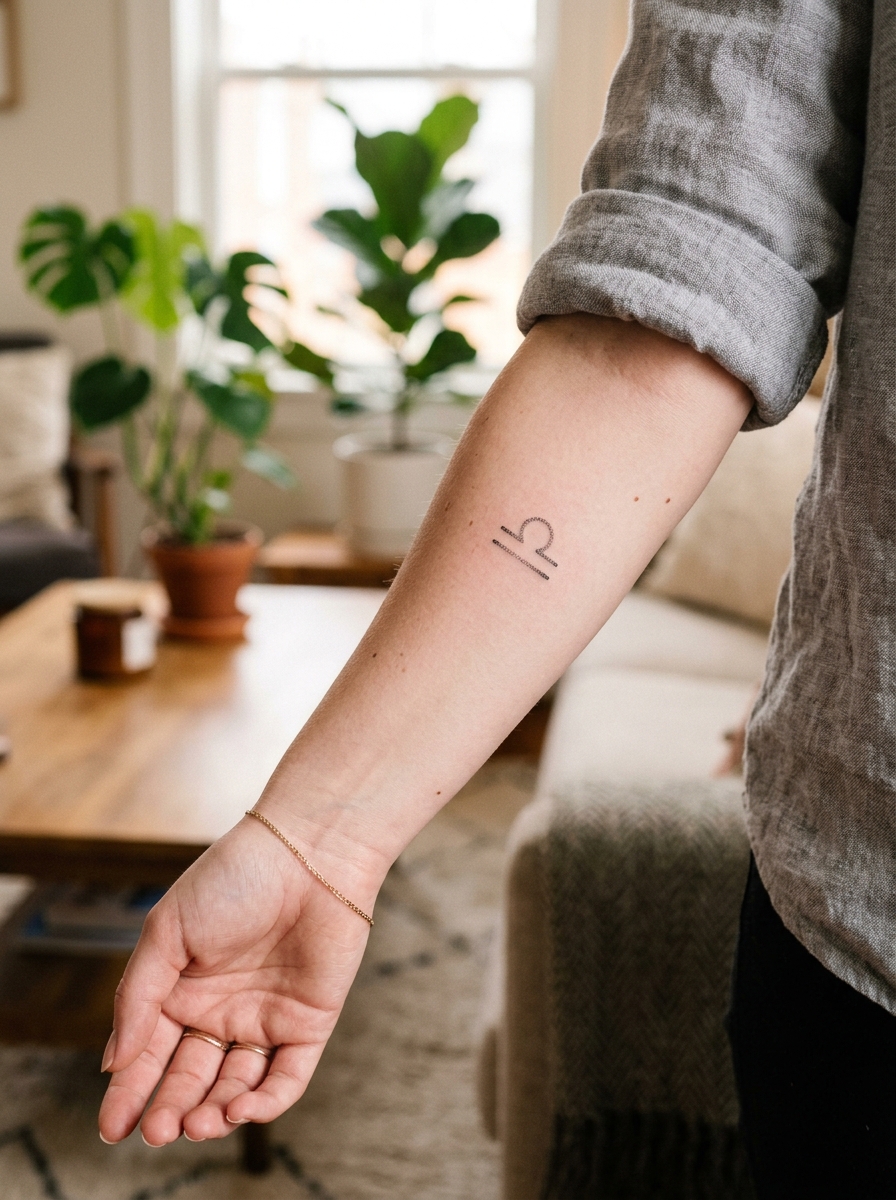
The glyph version is even more compact if you prefer a symbol to a star map.
One caution I always give: keep the dots reasonably substantial. A constellation made of pinprick dots can fade unevenly, leaving lines that lead nowhere.
12. Angel Wings
Wings are among the oldest memorial motifs and remain popular for a reason — they carry the meaning without needing a face.
They demand space. Feather detail on a small pair of wings collapses into grey mush, so the back, shoulder blades or upper arm are the honest placements.
Adding initials, a halo or a date between the wings personalises what is otherwise a generic symbol.
Across styles, the same motif can be handled very differently, from soft feathered realism to heavy blackwork silhouettes.
13. A Hummingbird
In several folk traditions hummingbirds are described as visitors carrying messages from the dead, which is why they turn up so often in memorial work.
They also suit almost every style. Fine-line, traditional, watercolour and blackwork versions all read clearly at a modest size.
A hummingbird paired with the flower they loved makes a natural composition, and it doubles the personal content without doubling the size.
Our hummingbird tattoo ideas guide is worth a look for wing positioning, which is what separates a good one from a stiff one.
14. Infinity Loop With a Name
The infinity symbol has been heavily used, but weaving a name through the loop turns it from a stock design into a specific one.
The trick is proportion. The name should form part of the loop rather than sitting inside it, or the whole thing reads as a sticker with text stuck on top.
Ask for the name in their handwriting if you have it. That single change lifts this idea considerably.
A plain name on its own remains a strong option, and lettering weight matters more than the font you pick.
15. A Tree With Its Root System
Family tree pieces work because the roots carry the emotional weight, not the branches.
Initials can be hidden in the root structure or the canopy, letting one tattoo hold several people without listing them.
This is a piece that benefits from scale — a calf, thigh, forearm or back panel gives the branches somewhere to go.
Our tree of life tattoo guide runs through the symbolism if you want the design to carry more than family history.
16. Their Voice as a Soundwave
A soundwave tattoo converts a short recording — a voicemail, a laugh, three words — into a printed waveform.
Some studios pair this with an application that plays the audio back when you point a phone at the tattoo. Be realistic about that: the ink is permanent, the application company might not be.
The waveform itself is the tattoo. Choose a clip whose shape is visually interesting, because a flat monotone recording produces a flat, dull line.
Back up the original audio file in at least two places before your appointment. The tattoo is a reminder of the recording, not a replacement for it.
17. A Butterfly
Butterflies carry transformation and passage, and they are common enough in memorial work that nobody will interrogate you about it.
The design range is enormous, from single-needle realism to bold traditional. Our butterfly tattoo ideas guide covers the styles side by side.
A frequently used variation places a small initial, date or flower within the wing pattern, so the symbol stays subtle while the meaning is exact.
If you go for a realistic species, pick one that actually lives where they did. It is a small detail that people notice years later.
18. A Candle or Flame
A flame reads as vigil rather than mourning, which is why some people prefer it to more obviously funereal imagery.
It stays legible at small sizes, and it works in solid black, in fine line, or with a single spot of colour.
A candle with a specific number of flames can quietly count the people you are remembering.
Placement on the inner arm or inner wrist keeps it somewhere you can look at deliberately rather than somewhere it catches you off guard.
19. Their Initials
Initials are the quietest option on this list and the easiest to live with.
Two or three letters on a finger, behind an ear, on the inside of a bicep — small, fast, and completely unreadable to anyone who is not looking for them.
Finger placements are the exception to the rule that small is simple. Hands and fingers reject ink more readily than most areas and commonly need touching up, so budget for that.
Serif lettering usually holds its shape better than very thin sans-serif at tiny sizes.
20. An Object They Loved
This is the category that produces the most unusual and most personal pieces I have seen: a cassette tape, a specific brand of cigarette lighter, a wrench, a teacup with a chip in it.
The rule is that it should be their version of the object, not a generic one. The chip in the cup is the whole point.
Photograph the object from several angles before your consultation, including anything worn or broken about it.
If you are unsure of anything on this list, this is the direction to push. Objects date less than symbols, and they almost never feel borrowed.
Variations Worth Considering Before You Commit
The twenty ideas above are starting points. These four variations change how any of them function.
Matching Pieces Across a Family
Siblings, parents and close friends often get versions of the same design rather than identical copies, which lets each person choose their own placement and size.
One shared element — the same signature, the same flower, the same date — is enough to connect them. Identical tattoos on people with very different bodies rarely look identical anyway.
Adding to an Existing Tattoo
If you already have work in progress, a memorial element can be built into it rather than started fresh, and that often produces a better composition than a floating standalone piece.
Talk to the artist who did the original if you can. Matching line weight and shading style across artists is genuinely difficult.
Negative Space and Hidden Elements
A name can be carried in the gap between two shapes, or a date in the spacing of a pattern, so the tattoo shows nothing to a casual glance.
This asks more of the artist than it looks like it does, so bring it up at the consultation rather than on the day.
Ink Mixed With Cremation Ashes
Some studios offer tattoos using ink blended with a small amount of cremated remains, usually described as commemorative or morning glory ink.
Be careful here. This is not a regulated practice, sterility varies enormously between providers, and introducing any foreign material under the skin carries a real risk of infection or a lasting lump of scar tissue. Most artists I have spoken to decline it outright.
If it matters to you, discuss it with both a reputable studio and a doctor first, and treat any studio that waves the risks away as an answer in itself.
Timing, Placement and Aftercare
There is no correct waiting period, but there is a useful test: can you describe the tattoo you want without describing how you feel today? If not, give it a few more weeks.
Placement decides how often you meet the tattoo. An inner forearm is something you look at deliberately; a shoulder blade is something you mostly forget about, and both of those are legitimate choices for different people.
Expect a memorial session to be emotionally heavier than a normal one. Eat properly beforehand, bring someone if you think you might need them, and tell your artist in advance — most will book extra time and take breaks without being asked.
Healing is standard: keep it clean, keep it out of the sun, do not pick, and follow the specific aftercare your artist gives you over anything you read online. Our tattoo healing stages guide sets out the normal week-by-week timeline. If you see spreading redness, increasing pain after the first few days, or any discharge, that is a doctor visit rather than a forum question — the Mayo Clinic overview of tattoo risks explains what to watch for, and the FDA fact sheet on tattoo inks is worth reading on ink safety.
Common Mistakes, and What to Do Instead
The most frequent one is proofreading. Dates, spellings and coordinates should be checked by two people against the stencil, on the day, before any needle touches skin.
The second is choosing an artist by price or availability rather than by portfolio. Memorial work is unusually unforgiving, and a portrait specialist and a fine-line specialist are not interchangeable.
The third is going too small. Almost every memorial tattoo I have seen regretted was regretted for being too small, not too large, because detail crammed into a tiny footprint is exactly what blurs first.
The fourth is filling the entire design with meaning until nothing is left to look at. A tattoo that tries to include the dates, the name, the flower, the portrait and the quote usually ends up saying less than one well-chosen element.
Still not sure which direction fits? Browsing adjacent categories helps more than staring at the same saved images — our small meaningful tattoos collection is a good place to look for restrained options.
Frequently Asked Questions
How long should I wait after a death before getting a memorial tattoo?
There is no medical or practical rule, and plenty of people get one within weeks and never regret it. That said, most artists I have spoken to gently suggest waiting a few months, because early grief tends to push people toward designs that describe the pain rather than the person. A useful test is whether you can explain the tattoo you want without explaining how you feel today. If the design still makes sense to you after two or three months, it will probably still make sense in ten years.
Can a tattoo artist copy handwriting from a photo of a card?
Usually yes, provided the photo is sharp and taken square-on rather than at an angle. A flatbed scan is much better than a phone photo, and most artists will ask for the highest resolution file you can produce. If the original writing is very faint, the artist may need to redraw it rather than trace it, which changes the character slightly. Bring the physical item to the consultation if it still exists, because it is far easier to work from.
Do memorial portrait tattoos really look like the person?
They can, but only with the right artist, the right reference and enough space on the body. A portrait specialist working from a sharp, evenly lit photograph at a decent scale can produce a genuine likeness; the same artist working from a dark group photo shrunk onto a wrist usually cannot. Always ask to see healed portrait work rather than fresh photographs, since fresh tattoos flatter the artist. If you cannot find a specialist you trust, a symbolic piece is a better outcome than a poor portrait.
Is it safe to mix cremation ashes into tattoo ink?
It is not a regulated practice and it carries real risk, including infection and permanent lumps of scar tissue where the material sits under the skin. Sterility varies widely between the studios that offer it, and many professional artists decline it entirely. If you are seriously considering it, speak to both a reputable studio and a doctor before booking, and treat any studio that dismisses the risks as a warning sign. A small vial of ashes kept somewhere safe carries the same meaning without the medical question.
What is the least noticeable placement for a grief tattoo?
Inner bicep, ribs, the back of the upper arm and the shoulder blade all sit under normal clothing and are easy to keep private at work. Fingers, hands and the neck are the opposite — highly visible, and in the case of fingers, more prone to fading and touch-ups. Inner forearm is the middle ground most people choose, because it is easy to cover with a sleeve but easy to look at when you want to. Consider how often you want to explain it before you decide.
Quick Summary
- Start from an object you cannot throw away — a card, a photo, a recording — rather than from a design you found online.
- Handwriting, fingerprints and dates are the most requested memorial pieces, and all three depend on the quality of your source material.
- Decide early how public you want it: portraits and full dates invite questions, coordinates and initials do not.
- Give text and fine detail enough size and line weight to survive; too small is the most common regret.
- Check every date, spelling and coordinate against the stencil twice, with a second pair of eyes, before the needle starts.
- Choose the artist by healed portfolio work in the exact style you want, not by price or by who can fit you in this week.
- Treat ash-mixed ink as a medical question, not a design one, and speak to a doctor as well as a studio.
- There is no deadline. A few months of thinking has never made a memorial tattoo worse.