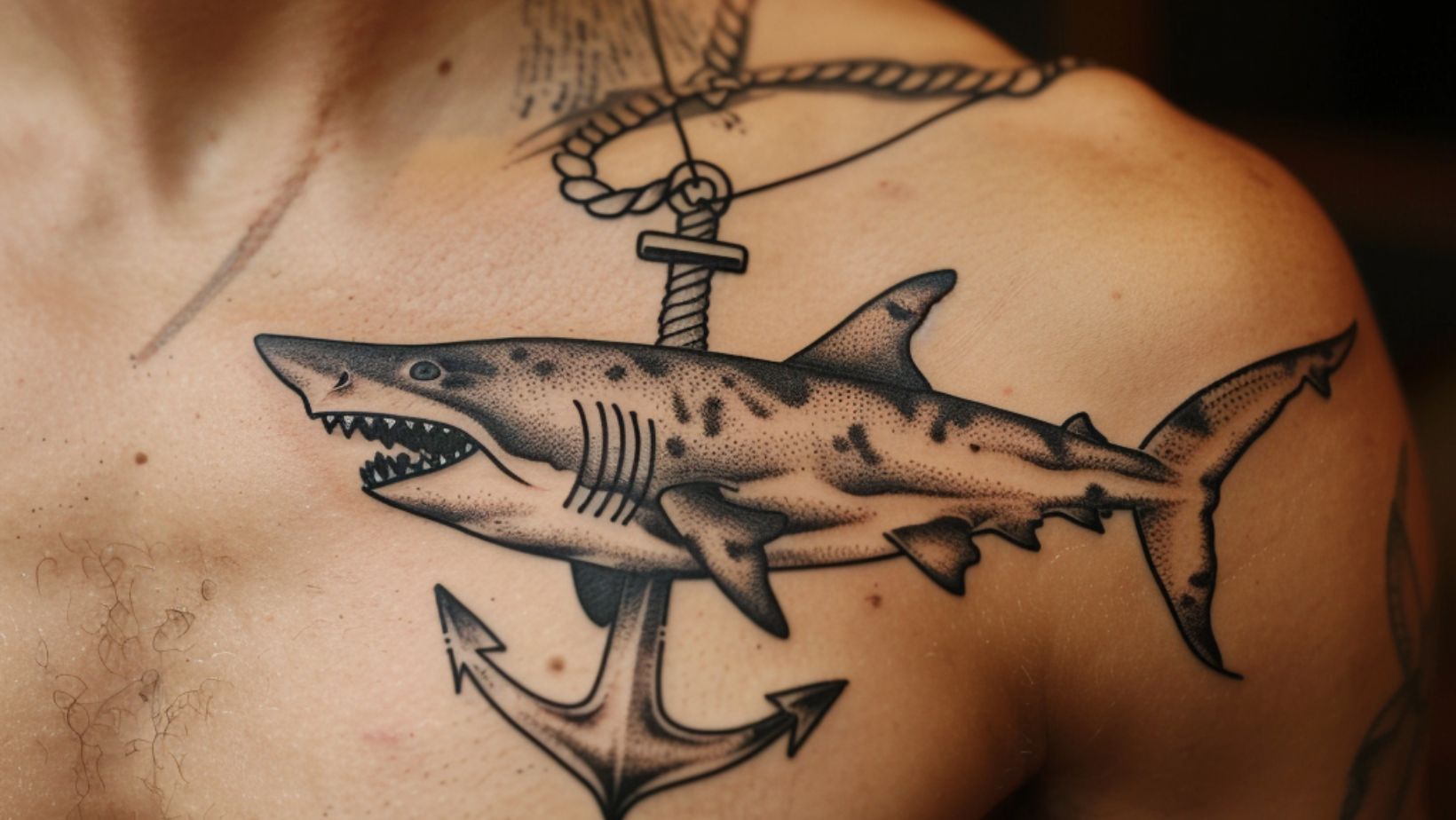
A shark and anchor tattoo is a deliberate contradiction: the most restless animal in the water pinned next to the one object built to stop movement entirely. That tension is the whole point of the design.
I have watched this combination come up in consultations for years, and the reason people choose it is almost never “I like sharks.” It is usually that they have been through something and came out still standing.
In this guide I will go through what each half actually symbolizes, how the two read together, which styles hold up over a decade, where on the body the design works, and the practical things worth knowing before you sit down. If you are still deciding between subjects, it is worth skimming broader shark tattoo ideas first to see how the animal is handled on its own.
Everything below comes from what I have seen on healed skin and from what artists tell me when I ask why a piece aged the way it did.
Which Shark and Anchor Style Is Right for You?
Style matters more than subject here. The same shark and anchor can look like a 1940s sailor tattoo or a soft illustration depending entirely on how it is drawn.
| Style | Best For | Typical Size & Sitting | How It Ages |
|---|---|---|---|
| American Traditional | Anyone who wants it readable from across a room | 4–6 in, one 2–4 hour session | Best of the group — heavy lines and flat color hold their shape for decades |
| Neo-Traditional | More detail in the shark without losing boldness | 5–8 in, 3–5 hours | Very good, though the finer interior detail softens sooner than the outline |
| Black and Grey | Realistic water, depth, a moodier feel | 6–10 in, often 2 sessions | Good if the artist keeps real contrast; light grey washes can fade toward flat |
| Fine Line / Minimal | Small, discreet placements | 2–4 in, 1–2 hours | Weakest of the group — thin lines spread, so expect a touch-up eventually |
| Blackwork / Woodcut | Graphic, engraving-style look | 4–8 in, 2–4 hours | Strong, as long as the hatching is not packed too tightly |
If nothing here fits, borrowing structure from a compass tattoo meaning piece is a common workaround — the composition problems are nearly identical.
Why the Shark and Anchor Pairing Works
Most two-subject tattoos fail because the elements say the same thing twice. A shark and an anchor do the opposite.
One is predatory, fast and unpredictable. The other is heavy, static and entirely dependent on staying put. Put together, they stop being two symbols and become a single statement about holding a position under pressure.
There is also a real historical thread underneath it. Anchors and sea creatures were staples of the sailor tattoo tradition that spread through port towns in the nineteenth and twentieth centuries, where the imagery marked experience at sea rather than personal metaphor.
That lineage is why the design still looks correct in bold traditional linework — it is being drawn in roughly the visual language it came from.
In my experience the people who are happiest with this tattoo years later are the ones who picked it for the contrast, not for the shark. The ones who only wanted a shark usually wish they had gone bigger on the animal and skipped the anchor.
What a Shark and Anchor Tattoo Means
The honest answer is that meaning is personal and no single reading is authoritative. That said, a handful of interpretations come up again and again.
Strength and Resilience
The shark carries the strength half. It is not strength as aggression so much as strength as capability — an animal that is entirely competent in an environment that would kill most things.
Every artist I have asked about this design describes the shark the same way: it has to look like it is moving, or the whole meaning collapses.
People often choose it after a period where they had to keep functioning through something difficult. The shark is the part of them that kept swimming.
If that reading is what draws you, ask for a shark mid-turn rather than in profile. A flat side view reads as a specimen illustration; an angled body reads as an animal that is going somewhere.
Stability and Staying Grounded
The anchor is the counterweight. Historically it is the object that keeps a ship in place when conditions say it should be somewhere else.
As a tattoo it usually means a person, a place, a set of values, or a commitment that stopped the wearer from drifting. Sometimes it is a family member. Fairly often it is sobriety.
The full symbolic range is worth reading properly, and what an anchor tattoo symbolizes covers the religious and maritime layers I am compressing here.
An anchor that is not touching anything looks unfinished. Rope, chain, waves or a seabed line all give it something to be anchored to, and the design reads better for it.
Balance Between Risk and Safety
This is the interpretation I hear most from people in their thirties and forties. The shark is the appetite for risk; the anchor is the thing that stops that appetite from becoming self-destruction.
Neither element wins in a good composition, which is why I push back when someone wants a tiny anchor tucked behind a huge shark. That drawing says something different from what they are describing.
A workable balance is usually the shark occupying slightly more visual space, with the anchor holding the strong vertical line down the middle.
Maritime Heritage and Life at Sea
For navy veterans, commercial fishermen, divers and people who grew up on the coast, this design is often literal rather than metaphorical.
When I have tattooed or consulted on pieces for people with actual sea service, the details matter enormously — anchor type, rope lay, whether the stock is wooden or iron.
If that is your background, bring photographs. Artists cannot invent the correct anchor for your era or service, and getting it wrong is the kind of thing you notice every day afterward.
A ship tattoo designs piece sits naturally alongside this one if you plan to build out a maritime sleeve later.
Survival and Coming Through Something
Sharks are old, adaptable animals, and that alone gives the tattoo a survival reading for a lot of wearers.
Combined with an anchor, the story becomes specific: not just surviving, but surviving without losing your footing.
I have seen this chosen to mark recovery, the end of a long illness, leaving a bad situation, and coming home from deployment. In every case the anchor was doing the emotional work and the shark was doing the visual work.
Protection and Loyalty
A smaller but consistent reading treats the shark as a guardian rather than a threat — something dangerous that is dangerous on your behalf.
Paired with an anchor’s associations of steadfastness, the design becomes about loyalty to people rather than resilience alone.
Names, dates and banners are usually added when this is the intent. Keep the text short; long banners force the artist to shrink the subjects.
Best Placements for a Shark and Anchor Tattoo
Placement decides how large the design can be, how much detail survives, and how much it will hurt. It deserves as much thought as the drawing.
Upper Arm
The upper arm is the default for good reason. It gives the anchor a natural vertical run and lets the shark curve around the muscle.
It is also one of the more forgiving spots for pain, and the skin there tends to hold ink well over time.
Expect roughly a four to six inch piece to fit comfortably on most adults without wrapping.
Forearm
The forearm is the most visible option and the one people choose when the tattoo is meant to be seen daily.
The narrow shape suits a vertical anchor with the shark crossing diagonally. Wide, horizontal compositions fight the limb and rarely look right.
Sun exposure is the real consideration here — forearm pieces fade faster than covered ones unless you are consistent with sunscreen.
Calf
The calf takes detail well and gives you room for rope, waves and a background without crowding the subjects.
It sits in the middle of the pain range for most people, and it is easy to cover or show depending on the day.
Back
On the back the design stops being an icon and becomes a scene. This is where full ocean backgrounds, surface light and multiple sharks become possible.
Plan for multiple sessions and a real budget. A back piece at this scale is rarely a single sitting.
The trade-off is obvious: you will almost never see it yourself.
Ribcage
The ribs are the most painful of these options for most people, and I would not recommend them as a first tattoo. The most painful tattoo spots guide breaks down why bony areas with thin skin hurt the way they do.
What you get in return is a placement that follows the body’s own lines unusually well — an anchor running with the ribs looks intentional in a way it does not elsewhere.
Keep the linework a little heavier than you think you need. Rib tattoos are notorious for softening as they heal.
Chest and Sternum
A chest placement centers the anchor over the sternum with the shark sweeping across one pectoral. It is symmetrical, traditional and easy to conceal.
Sternum work is sharp but usually short. The outer chest is considerably easier.
Shark and Anchor Tattoo Design Ideas
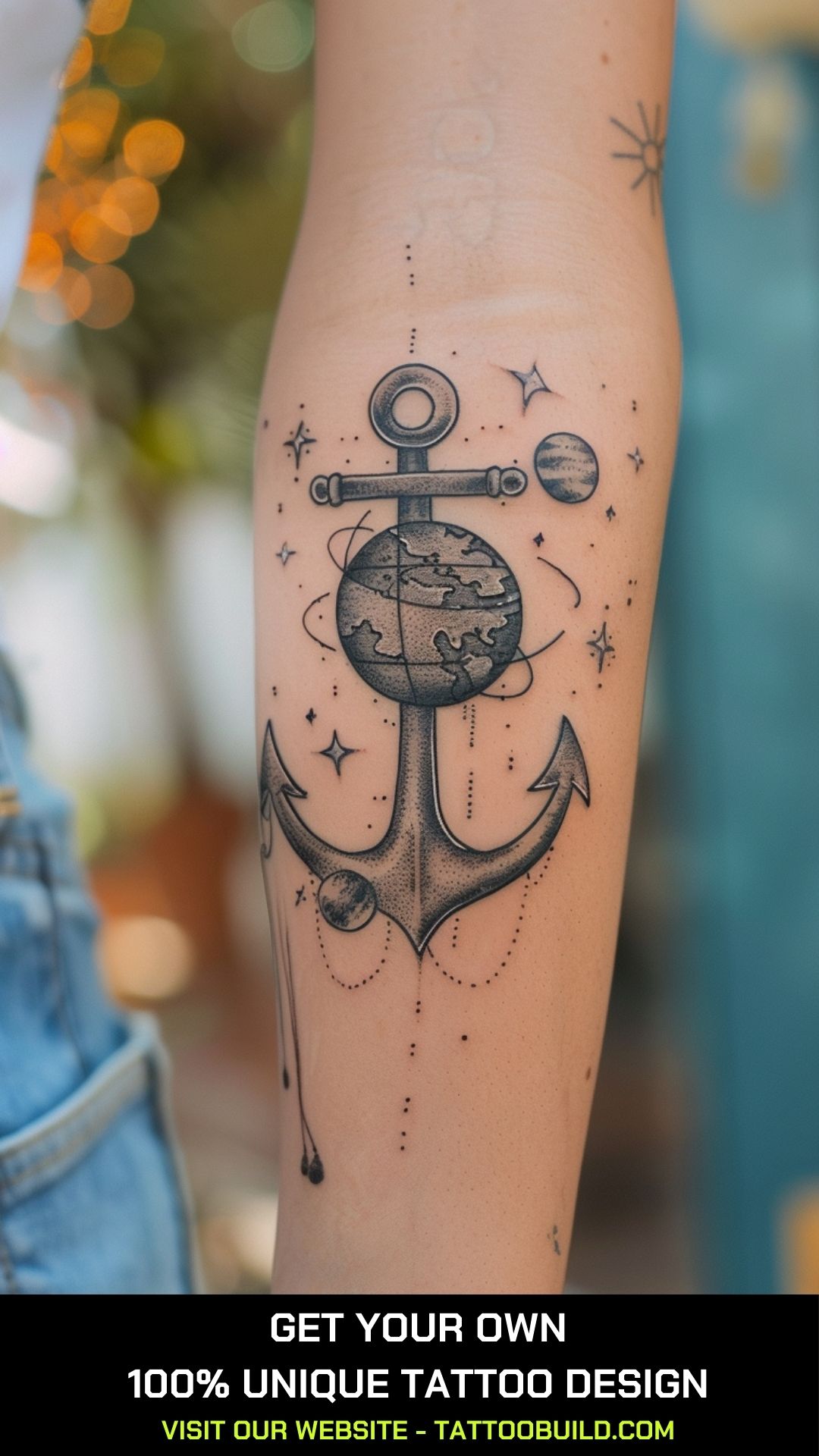
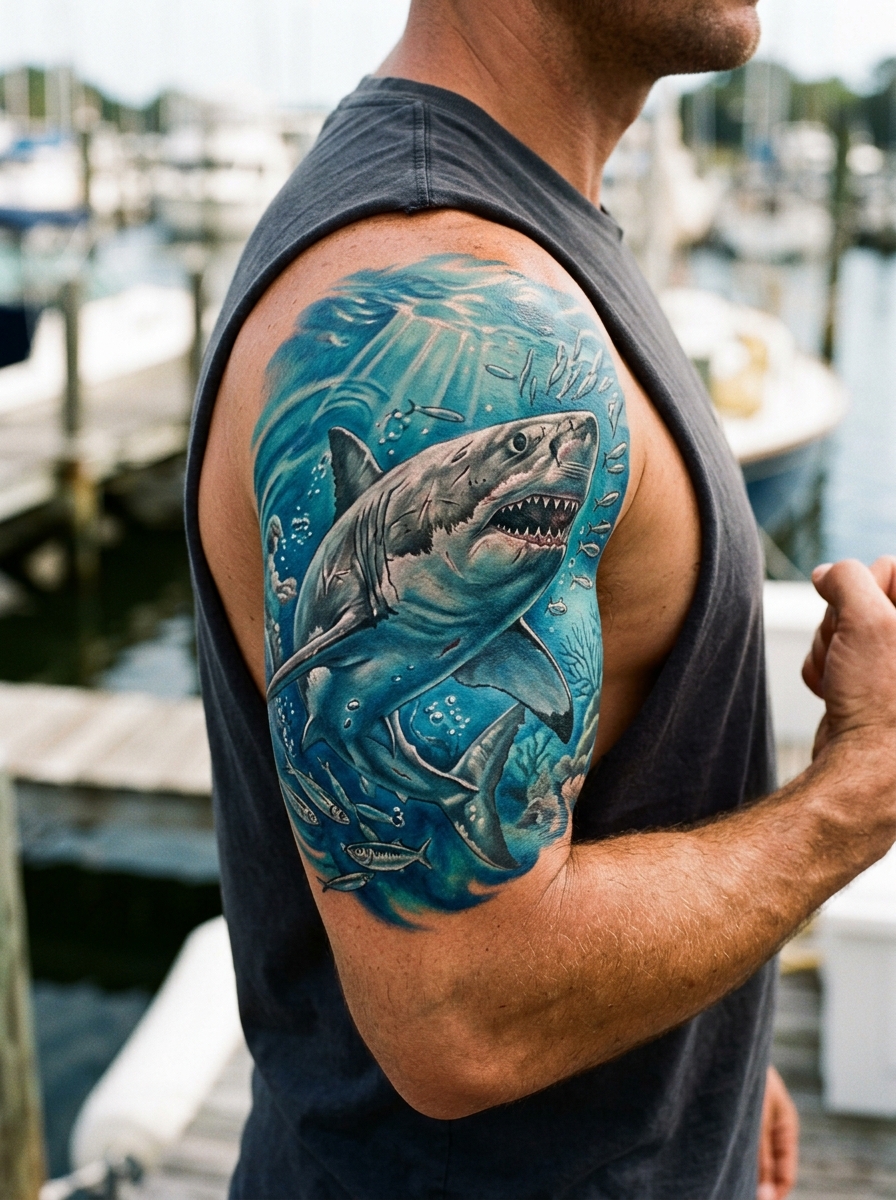
These are real pieces rather than digital mockups, which is the useful part — you are seeing how the design behaves on skin.
Look at line weight before you look at subject matter. That is what separates the pieces that will still read in fifteen years from the ones that will not.
Notice how the strongest compositions give the shark somewhere to go. A shark that appears parked next to an anchor loses the tension the design depends on.
The traditional add-ons — banners, nautical stars, rope, swallows — are optional, but they anchor the piece stylistically to its sailor-flash origins.
If you like the water in these but not the shark, ocean tattoo ideas is a better starting point for a wave-led design.
Variations and Alternatives Worth Considering
Not everyone needs the literal pairing. A few adjacent options solve the same brief.
Anchor with Rope Only
Dropping the shark and building the piece around a rope-wrapped anchor keeps the stability meaning and simplifies the composition considerably.
This ages exceptionally well because there is less fine interior detail to blur.
Shark with Waves Instead of an Anchor
If the shark is what you actually want, waves give it context without a second subject competing for attention.
It also frees the artist to make the animal much larger within the same footprint.
Anchor with a Compass or Lighthouse
Swapping the shark for a compass or lighthouse changes the story from resilience to direction — being guided rather than being tested.
Both pair with an anchor more comfortably than a shark does, because neither one needs to look like it is moving.
Traditional Swallow Added
A swallow is the other great sailor motif and slots into a shark and anchor piece without much redrawing.
It historically marked distance sailed, which gives the composition a third layer of maritime meaning.
Practical Tips Before and After You Get It
Bring reference for the anchor specifically. Most people arrive with shark photos and no opinion on the anchor, then are surprised when it does not look like what was in their head.
Ask your artist to size the piece so the rope detail is at least a few millimetres wide at its narrowest. Rope is the first element to blur when a design is shrunk, and it is the detail people most regret losing.
Book a consultation rather than a same-day appointment for anything larger than the palm of your hand. Two-subject compositions genuinely benefit from a drawing you have seen in advance.
For healing, follow the aftercare your artist gives you rather than advice from the internet, including mine — they know what they used on you. Our general tattoo aftercare guide covers the usual timeline, but it is a supplement, not a substitute.
If you develop spreading redness, heat, pus, or a fever, that is a matter for a doctor and not a tattoo forum. The Mayo Clinic outlines the infection and allergic-reaction risks worth knowing, and the U.S. Food and Drug Administration covers ink safety concerns. Never attempt to treat or remove a tattoo yourself.
Still Not Sure? Common Mistakes to Avoid
Going too small is the mistake I see most often. A shark, an anchor, rope and water is a lot of information for a three-inch space.
The second most common is choosing a style based on a photo of a fresh tattoo. Fresh work always looks crisper than healed work, and fine line pieces flatter themselves badly at that stage.
The third is skipping the background entirely. Without water, the two subjects float on skin with nothing tying them together.
Take the time to look at adjacent designs before committing — a traditional swallow tattoo guide is a good next stop if you are thinking about adding traditional elements around the piece.
Tired of boring tattoo ideas online?
Get a one-of-a-kind design with Tattoobuild’s AI tattoo design generator tool. Here is how it works:
- Open the studio: Head to our website and try a design or choose a plan.
- Describe your dream tattoo: Tell the AI the subject, style and placement — the more detail, the better.
- Get instant designs: The AI generates tattoo concepts based on your description.
- Take it to your artist: Use the result as reference so you and your artist start from the same picture.
Frequently Asked Questions
What does a shark and anchor tattoo mean?
It most commonly represents the balance between strength and stability — the shark standing for resilience, drive and the ability to keep moving through difficulty, and the anchor standing for grounding, loyalty and staying rooted. Together they usually mark someone who came through a hard period without losing their footing. It also carries a straightforward maritime meaning for people with sea service or coastal roots. As with any tattoo, the meaning that matters most is the one the wearer assigns to it.
Is a shark and anchor tattoo only for sailors?
No. The imagery comes out of sailor tattoo tradition, but it has been worn far outside that context for a long time. Plenty of people choose it purely for the symbolism of resilience and stability. If you do have naval or maritime service, it is worth getting the anchor type historically accurate, because that detail will matter to you later.
How much does a shark and anchor tattoo usually cost?
It depends heavily on size, style, your artist’s rate and your city, so any single number would be misleading. A small traditional piece is typically a one to two hour job, while a detailed back piece runs across multiple sessions. Most artists charge either an hourly rate or a flat price quoted after seeing the design. Ask for a written quote at consultation rather than guessing from online figures.
Which style holds up best over time?
American traditional generally ages best, because heavy outlines and flat, saturated color keep their shape as ink naturally spreads under the skin. Neo-traditional is close behind. Fine line and very light grey washes are the most likely to need a touch-up within several years. In my experience the single biggest factor is line weight, not style name.
Does the shark have to be a great white?
Not at all, and choosing a different species often makes the piece more personal. Hammerheads give a distinctive silhouette that reads well at smaller sizes, tigers and bulls suit heavier traditional linework, and whale sharks work for a gentler feel. Tell your artist which species you want early, since the body shape changes the whole composition.
Quick Summary
- A shark and anchor tattoo pairs opposites — motion and stillness — and that contrast is the design’s whole point.
- The shark usually carries strength, drive and resilience; the anchor carries grounding, loyalty and staying rooted.
- The imagery descends from sailor tattoo tradition, which is why bold traditional linework suits it best.
- American traditional and neo-traditional age most reliably; fine line pieces will likely need a touch-up.
- Upper arm, forearm and calf are the easiest placements; ribcage hurts most; the back allows a full scene.
- Size the piece so rope and water detail stays readable — going too small is the most common regret.
- Bring reference for the anchor, not just the shark, and book a consultation for anything larger than your palm.
- Follow your artist’s aftercare instructions, and see a doctor for spreading redness, pus or fever.