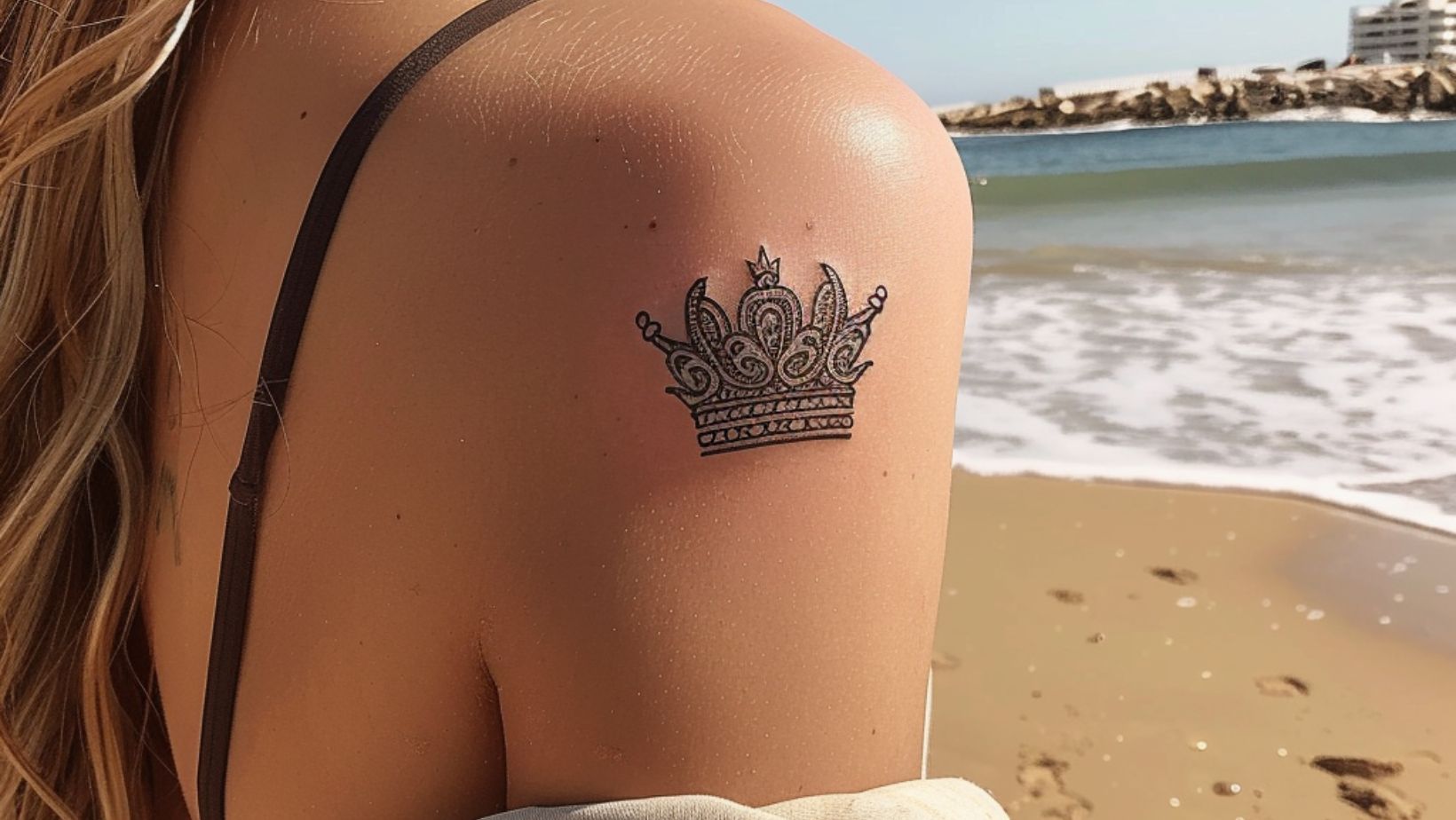
A crown tattoo used to mean a big, shaded, jewel-heavy piece sitting across a forearm. That is not what people ask me about anymore. The version that has taken over is the minimal crown tattoo: five or six clean lines, no shading, small enough to hide under a watch strap.
I have watched this design get requested more than almost any other small symbol, and the reason is simple. A crown carries real meaning without needing to be explained, and stripped down to line work it stops looking like a costume prop and starts looking like jewellery.
Below are ten minimal crown designs I keep coming back to, plus honest notes on placement, pain, cost and how these age. If you are still browsing broadly, our minimalist tattoo ideas guide covers the wider category.
Every photo here is a real minimal crown, not a digital mockup. Look at how little ink is actually on the skin in each one.
Which Crown Style Is Right for You?
Not every crown reduces well. Some shapes hold up at two centimetres and some turn into a smudge. Here is how the four main approaches compare in practice.
| Style | Smallest size that still reads | How it ages | Best suited to |
|---|---|---|---|
| Fine-line outline | About 2 cm wide | Softens noticeably; expect a touch-up in a few years | Wrist, ankle, behind the ear |
| Bold single-needle-free linework | About 2.5 cm wide | Holds far better; lines thicken but stay legible | Forearm, chest, upper arm |
| Solid blackwork silhouette | About 1.5 cm wide | The most durable of the four | Behind the ear, nape, finger |
| Crown with dots or a gem | About 3 cm wide | Dots can blur into the lines below them | Forearm, shoulder, back |
If you want the design to still look sharp in a decade without maintenance, the solid blackwork silhouette is the safest bet. Fine line is the prettiest option on day one and the least forgiving at year seven.
What a Crown Tattoo Really Means
The crown is one of the oldest status symbols humans have, and that history is exactly why it still works as a tattoo. It signals authority, but most of the people I have talked to are not claiming authority over anyone else.
They are claiming it over themselves. Sobriety, leaving a bad job, getting through a diagnosis, raising kids alone — the crown gets used as a marker that they came out the other side still in charge of their own life.
There is a second, older reading: the crown as something granted rather than taken. In Christian imagery it appears as a reward at the end of endurance, and some people choose it for exactly that reason. A crown with a small cross tucked into it is a common way to make that reading explicit.
Then there is the relationship meaning, which is where king-and-queen pairs come from. That version is much more specific, and it is worth knowing that it reads as coupled to most viewers. Our guide to king tattoo meaning and design goes deeper into that branch.
None of these meanings are locked in. A crown with no other elements is genuinely open, which is part of the appeal — it means whatever you decide it means, and nobody can correct you.
Minimal Crown Tattoo Ideas I Keep Coming Back To
These are the ten that hold up. I have sorted them roughly from smallest and most discreet to largest.
1. Fine-Line Crown Outline
This is the design most people picture when they say minimal crown: a single continuous contour, three or five points, nothing filled in.
The trick is in the point count. Three points read as playful and slightly cartoonish; five points read as formal and heraldic. I almost always steer people toward five, because three tends to look like a party hat once it softens with age.
Ask for the base bar to be drawn slightly thicker than the points. It gives the crown a visual foundation and stops the whole thing floating. A crown with a weak base is the single most common reason these designs look unfinished.
Fine line is worth understanding before you commit to it, because the style trades longevity for delicacy and not every artist is equally good at it.
2. Tiny Wrist Crown
The inner wrist is the placement I get asked about most, and for a crown it genuinely works. The area is flat, the skin is smooth, and a two-centimetre crown sits there without crowding anything.
The catch is that the inner wrist is a high-friction spot. Sleeves, watch bands and bag straps drag across it constantly, and fine lines there do lighten faster than the same lines on a forearm.
Placed on the outer wrist instead, the same design gets more sun but less rubbing. In my experience the outer wrist holds a crisp line slightly longer, though neither placement is a problem if you are willing to touch it up eventually.
If you are drawn to this spot, tiny wrist tattoo ideas shows how other small symbols sit in the same space.
3. Finger Crown Tattoo
A crown on the finger is the most jewellery-like version of this design, and it is also the one I warn people about the most.
Fingers reject ink. The skin regenerates fast, the sides get used constantly, and hand washing never stops. Every artist I have asked about finger work says the same thing: expect patchiness and expect a touch-up, sometimes more than one.
The designs that survive best on fingers are the simplest ones. A crown drawn as a solid black silhouette on the side of the finger, or as three heavy strokes across the base, will outlast a delicate outline every time.
Do not put a fine-line crown on a knuckle. It will blur within a year. Our finger tattoo ideas guide has more on what actually holds there.
4. Crown on the Chest
A small crown placed over the heart is one of the few minimal designs that gains meaning purely from where it sits.
The chest also gives you room to go slightly bolder without the piece becoming large. A crown three or four centimetres wide with confident lines reads as intentional on the chest, where the same size on a wrist can look oversized.
Pain is real here. The sternum and the area right over the collarbone are among the sharper spots on the body because there is so little between the needle and bone. The soft tissue an inch or two to either side is considerably easier.
Sit for the placement stencil rather than lying down. Chest skin shifts a lot between positions, and a crown stencilled flat can end up tilted when you stand up.
5. Crown Behind the Ear
Behind the ear is the most hideable placement on this list, which is exactly why people choose it. Hair down, it does not exist.
Because the space is small and curved, this is the one placement where I would push almost everyone toward solid blackwork rather than outlines. A filled silhouette at one and a half centimetres still reads clearly; an outline at the same size closes up.
The skin behind the ear is thin and sits directly over bone, so it stings sharply, but the session is short — usually well under half an hour for a piece this size.
Keep it at least a centimetre clear of the hairline. Hair growing through the edge of a tattoo makes the outline look ragged, and it makes the healing weeks more irritating than they need to be.
6. Ankle Crown
The ankle is the quiet alternative to the wrist. Same size range, same visibility when you want it, completely covered by a sock or a boot when you do not.
Placement matters more here than most people expect. Directly on the ankle bone hurts sharply and heals unevenly because the skin is stretched tight over bone. Two or three centimetres above it, on the softer inner or outer ankle, is easier on every count.
One practical warning from every healing story I have heard: shoes. A fresh ankle tattoo and a shoe collar that rubs the same spot is a recipe for a patchy heal, so plan for a week or two of low shoes or sandals.
Do not book an ankle piece the week before a holiday. Sand, pool water and direct sun are all off-limits while it heals.
7. Crown with Initials or a Name
Adding a letter under a crown is the most common way people personalise this design, and it is also where the most regret lives.
A single initial is low risk. It is small, it is ambiguous to strangers, and even if the relationship behind it changes, an isolated letter reads as a monogram rather than a declaration.
A full name is a different decision entirely. It is not that names are a mistake — a child or a parent is a permanent relationship — but it is worth being honest with yourself about which category yours falls into.
Typography is where these succeed or fail. Thin script under a thin crown blurs into one grey shape as it ages; a simple serif or a clean uppercase letter stays readable far longer. Lettering choices matter as much as the crown itself here.
Ways to Personalize Your Crown
If a bare outline feels too plain, these are the modifications that actually work at small scale.
Add a Gem or a Single Dot
One dot in the centre of the base bar is the cheapest upgrade available. It suggests a jewel without adding any real complexity, and a solid dot holds its shape as it ages far better than a tiny outlined diamond.
Three dots across the base also work, but keep them evenly spaced and reasonably far apart. Dots placed too close together merge into a single dash over time.
Matching King and Queen Crowns
The classic pair: a five-point crown for one person, a rounder tiara-style crown for the other. Placement usually mirrors — same spot on opposing wrists, or the same finger on opposite hands.
If you go this route, get them done by the same artist in the same session. Two artists drawing the same crown from the same reference will still produce visibly different line weights, and a mismatched pair defeats the purpose. There are more ideas in our matching tattoo ideas for couples guide.
Crown on the Back or Nape
The back of the neck gives a crown its most natural resting place — it sits exactly where a crown would sit on a head, just lower. It is also fully coverable by hair.
Between the shoulder blades, a small crown has more empty skin around it, so it can be sized up to four or five centimetres and still feel minimal. We cover the symbolism of this placement in crown tattoo on the back meaning.
Upper-Arm Placement
The outer upper arm is the most forgiving spot on the body for a small tattoo. Low pain, stable skin, easy to cover, easy to show.
It is also the placement I would recommend to anyone getting a first tattoo. There is no reason to make a small crown harder than it needs to be, and the arm lets you find out how you handle the needle before committing to a finger or a sternum.
Cost, Pain, and Aftercare
Most shops charge a minimum regardless of how small the design is, and a minimal crown will almost always fall inside that minimum. In the shops I have asked, that minimum typically covers setup, the stencil and the ink time for a piece under about five centimetres — you are paying for the artist opening a station, not for the square centimetres of skin. Our small tattoo cost guide breaks the numbers down further.
On pain: a minimal crown is a short sit. Behind the ear, on a finger and over the sternum are the sharp ones; upper arm, outer forearm and outer thigh are the mild ones. The most painful tattoo spots guide maps this out properly, and the honest summary is that anywhere over bone with thin skin will sting more.
Aftercare for line work is straightforward but not optional. Keep it clean, keep it lightly moisturised, do not pick the flakes, and stay out of pools, baths and direct sun until it has fully closed over — usually two to three weeks on the surface, longer underneath. The tattoo aftercare guide has the full routine, and the American Academy of Dermatology publishes clear, dermatologist-reviewed guidance on caring for tattooed skin.
If a healing tattoo becomes hot, swollen, increasingly painful after the first few days, or starts weeping anything cloudy, contact a doctor rather than your artist. That is a medical question, not a tattooing one, and it is not something to wait out. The same goes for any rash or raised reaction around the ink, which can signal a reaction to the pigment; the US Food and Drug Administration has consumer information on tattoo ink safety. Nothing in this article is medical advice.
Common Mistakes and How to Avoid Them
The first is shrinking a complex crown instead of choosing a simple one. Taking an ornate heraldic crown and scaling it to two centimetres does not make it minimal, it makes it muddy. A minimal design has to be drawn minimal from the start.
The second is ignoring line weight. A crown drawn entirely in one hairline thickness has no hierarchy, so the eye has nothing to land on. Varying the base bar even slightly fixes this instantly.
The third is picking a placement for how the photo will look rather than how the tattoo will live. Fingers and inner wrists photograph beautifully and wear the hardest.
The fourth is booking with an artist whose portfolio is all colour realism. Small clean line work is its own skill, and you want someone whose healed photos — not fresh photos — show crisp thin lines. Ask specifically for healed work.
Still weighing it up? Browse simple tattoo ideas for a broader look at what works at this scale.
Frequently Asked Questions
How much does a minimal crown tattoo cost?
Almost always the shop minimum, because the design is small enough that the minimum covers it. That figure varies a lot by city and by artist demand, so the only reliable answer is to ask the shop directly. Some artists charge a flat rate for small pieces instead of an hourly rate. It is worth asking whether a free touch-up is included, since fine-line work often needs one.
Does a minimal crown tattoo hurt?
Less than most people expect, mainly because it is over quickly. A small crown is usually a fifteen to forty-five minute appointment including setup. Placement matters far more than the design: behind the ear, on a finger and over the sternum sting sharply, while the upper arm and outer forearm are mild. Eat properly beforehand and avoid alcohol the night before.
Where is the best place for a small crown tattoo?
For a first tattoo, the outer upper arm or the outer forearm — low pain, stable skin, easy healing. For discretion, behind the ear or the nape of the neck. For visibility, the inner wrist, accepting that it will fade faster than most spots. Avoid fingers unless you genuinely accept that touch-ups are part of the deal.
How long does a minimal crown tattoo take to heal?
The surface usually closes within two to three weeks, with flaking and itching in the first one to two. The deeper layers take longer — commonly a couple of months before the skin is fully settled and the line work looks final. Do not judge how the tattoo turned out during the flaking stage, because it almost always looks patchier than the finished result.
Will a fine-line crown tattoo fade over time?
Yes, to some degree — all tattoos soften, and thin lines have the least ink to lose, so the change shows sooner. Sun exposure is the biggest accelerator, and high-friction placements like fingers and inner wrists are next. Daily sunscreen once healed makes a real difference. Plan on a touch-up at some point rather than treating it as a failure.
Quick Summary
- A five-point crown reads as formal and holds up better than a three-point crown, which tends to look like a party hat as it ages.
- Draw the base bar slightly heavier than the points — a weak base is the main reason these designs look unfinished.
- Solid blackwork silhouettes survive best at very small sizes; fine-line outlines look sharpest on day one and age the fastest.
- Upper arm and outer forearm are the easiest placements; behind the ear and the nape are the most hideable.
- Fingers and inner wrists photograph beautifully and wear the hardest. Expect touch-ups if you choose them.
- A single initial under the crown is low-risk personalisation; a full name is a much bigger commitment.
- Expect to pay the shop minimum, and ask whether a touch-up is included before you book.
- Keep it clean, moisturised and out of the sun while healing — and see a doctor, not your artist, if it becomes hot, swollen or increasingly painful.