Finger tattoos are the smallest commitment on your body and the loudest one in the room, because your hands are visible in almost every conversation you have. The design matters far less than whether the placement on your finger can actually hold ink for more than a year.
I have watched a lot of finger tattoos age, and the pattern is consistent: the ones that still look sharp after two or three years are simple, sit on the top of the finger, and were drawn slightly bolder than the client originally wanted.
The ones that blur into a grey smudge are usually the tiny scripts wrapped around the side of the finger, where the skin bends and rubs against its neighbour all day.
Below are more than 80 finger tattoo ideas, sorted by style and by who tends to ask for them, along with the honest maintenance conversation most galleries skip. If you want a broader shortlist first, our guide to beautiful small tattoo ideas covers placements that fade less.
Which Finger Tattoo Style Is Right for You?
Not every style survives the same way on a finger. This is roughly how the main options behave, based on what I keep seeing in healed photos and what artists tell me when I ask them directly.
| Style | Best placement on the finger | How it usually ages | Touch-up outlook |
|---|---|---|---|
| Bold simple icon | Top of the middle or ring finger | Softens but stays readable | Often none for 2–3 years |
| Fine line minimal | Top segment, away from the knuckle | Lightens noticeably in year one | Expect one touch-up |
| Tiny script or word | Top of the finger, never the side | Letters can close up and blur | The highest maintenance option |
| Ring band | Base of the ring finger | Patchy where the band wraps underneath | Regular top-ups on the underside |
| Dotwork and small shapes | Between the knuckles | Dots can spread slightly | Low, if the dots start large enough |
| Side-of-finger anything | Not recommended | Rubs against the next finger constantly | Frequent, and never quite the same |
Why Finger Tattoos Fade Faster Than Everywhere Else
The skin on your fingers renews quickly and is thin over the joints, so ink sitting near the surface gets pushed out faster than it would on a forearm.
Your hands also do everything: washing, gripping, sanitiser, sunlight, friction against pockets and steering wheels. That is constant low-grade abrasion on a healing tattoo.
Fading is not a sign your artist did something wrong. It is the normal behaviour of this placement, and any artist who promises a finger tattoo will look identical in five years is overselling it.
There is also the practical side: some artists will not tattoo fingers at all, and others will only do it with a signed acknowledgement that touch-ups are on you. That is a reasonable position rather than a red flag.
If you want the design without the maintenance, moving the same artwork to the wrist or the back of the hand solves most of it. Our roundup of female wrist tattoo ideas is a good place to compare.
Finger Tattoo Ideas for Everyone
These are the designs I see land well on almost any hand, regardless of style preference or existing tattoos.
1. Minimalist Lines
A single straight or curved line across the finger is the lowest-risk finger tattoo you can get. There is nothing inside it to close up.
Line weight is the whole decision here. A hairline stroke will look elegant on day one and ghostly by month eight, so ask your artist for the heaviest line you are still happy with.
In my experience the best versions sit on the middle segment of the finger and stop short of the knuckle crease, which keeps the line from breaking when you bend your hand.
Two parallel lines on adjacent fingers also reads well and gives you a little more visual weight without adding detail.
2. Tiny Symbols and Small Icons
Small icons work when they have space inside them. A tiny outlined shape with breathing room holds up; the same shape shrunk by half turns into a dot.
Popular choices are crosses, arrows, lightning bolts, small daggers and simple silhouettes. Every artist I have asked has said the same thing: pick one symbol, not three.
Ask for the design at roughly 20 percent larger than feels right on paper, because ink spreads slightly under the skin as it heals and small gaps disappear first.
Symbols also carry meaning without announcing it, which is part of why finger placement suits them so well.
3. Florals
Florals on fingers are usually a single stem, a sprig or one small bloom rather than a full flower head.
Sprigs of lavender, olive branches and simple wildflower stems work because they are mostly negative space with a few confident marks.
Where they go wrong is shading. Soft grey wash rarely survives on a finger and often heals patchy, so most artists will suggest outline only.
If you want something more detailed, running the stem down the side of the hand rather than the finger gives it a much longer life. Our birth flower tattoo guide has designs that scale well either way.
4. Tiny Animals
Animal designs are the most requested finger tattoos I come across, and also the most frequently over-detailed.
The successful ones are silhouettes or single-weight outlines: a bird, a cat, an elephant reduced to five or six strokes.
Anything with fur texture, eyes or fine feather detail will merge into a solid shape within a year or two. That is not always a bad outcome, but you should choose it deliberately.
Pick an animal whose silhouette is recognisable at thumbnail size. If you cannot tell what it is from arm’s length, it will not read on a finger.
5. Dots and Stars
Dotwork is quietly one of the best finger options, because a dot has no detail to lose.
Three small dots, a tiny constellation or a scatter across two fingers all age gracefully as long as the dots start out slightly larger than pinpricks.
Spacing matters more than size. Dots placed too close together will bleed into each other over time and turn into a smudge.
6. Crowns, Snakes and Statement Symbols
If you want the tattoo to be noticed rather than discovered, bolder statement pieces are the way to go.
Crowns, small snakes and simple geometric shields all use thick outlines, which is exactly what this placement rewards.
A snake curling down the length of the finger is one of the few designs that can use the whole finger without looking cramped, because the body is a single continuous line.
These are also the designs most likely to still look intentional after five years, even once the edges soften.
Finger Tattoo Ideas for Men
These lean bolder and heavier, which is genuinely an advantage on fingers. If you want more across the whole hand, our hand tattoo ideas for men covers how finger work fits with a larger piece.
7. Tribal Patterns
Geometric bands and tribal-inspired patterns suit fingers because they are built from solid black shapes with clear gaps.
Wrapping a pattern around the base of the finger like a ring is the most common version, and it looks deliberate even when part of it fades.
The underside of any wrapped band will always fade first, so plan for the visible top to carry the design.
If you are drawing on a specific cultural tradition, it is worth finding an artist who works within it rather than copying a pattern off a search results page.
8. Skulls and Crossbones
A small skull is a classic knuckle or finger piece, and the good ones are almost cartoon-simple.
Two eye sockets, a nose gap and a jaw line is all you need. Detailed anatomical skulls do not survive at this scale.
Solid black areas hold up better than shading, so ask for filled sockets rather than grey wash.
Skulls also pair well with a single word or date on the adjacent finger if you want a small set rather than one piece.
9. Barbed Wire
Barbed wire around a finger is having a long moment and it works structurally: a single line with small crossings at intervals.
Keep the barbs spaced widely. Crowded barbs turn into a thick unreadable band within a couple of years.
One wrap is almost always better than two. Double wraps look tight in the healed photos and muddy in real life.
10. Anchors
Anchors are one of the oldest small tattoo motifs and reduce beautifully to a stem, a crossbar and two curves.
They carry the traditional meaning of steadiness, and at finger scale they read as a shape long before anyone identifies the symbol.
Skip the rope. Wrapped rope detail is the first thing to disappear and it takes the anchor’s silhouette down with it.
11. Compass
A compass rose is more detail than most fingers can carry, but a four-point star version works well.
The trick is dropping the circular housing and the degree markings, leaving just the directional points.
Anything with concentric circles will close up, and the gap between the rings is usually the first casualty.
If you want the full detailed compass, our compass tattoo design guide shows placements that give it room to breathe.
12. Animal Silhouettes
Filled silhouettes are the single most reliable finger tattoo format I know of.
There is no internal detail to lose, so the design simply softens at the edges rather than degrading.
Giraffes, cats, birds and scorpions all work because their outlines are distinctive even when reduced to a solid shape.
If you want one finger tattoo that will still look good in a decade, this is the category to pick from.
Finger Tattoo Ideas for Women
These tend toward finer work, which means being more honest about touch-ups. Our collection of classy finger tattoos for women goes deeper on the delicate end of this range.
13. Delicate Florals
A single small bloom on the side of the index finger is one of the most requested designs there is.
Keep it to one flower and one leaf. Bouquets at this scale become an unreadable cluster.
When I have seen these age well, the artist used a slightly heavier outline than the reference photo and skipped shading entirely.
14. Hearts
A tiny heart outline is the most common first finger tattoo, and for good reason: it is instantly recognisable at any size.
Solid filled hearts age better than outlines, though outlines look softer while they are fresh.
Matching hearts on two people’s fingers are a genuinely lovely idea as long as both of you understand the fading. Our matching tattoo ideas guide has options that hold up better.
15. Sun, Stars and Moon
Celestial designs split neatly across two fingers, with a sun on one and a moon on the next.
Crescent moons are especially forgiving because a crescent is a single filled shape.
Sun rays need real gaps between them, otherwise the whole sun heals into a filled circle.
16. Butterflies
Butterflies are a difficult finger tattoo done well and an easy one done simply.
The version that survives is a small silhouette or a two-line outline, not a detailed wing pattern.
I have seen detailed butterfly finger tattoos look extraordinary at three months and unrecognisable at three years, which is a fair trade for some people and not for others.
17. Feathers
A feather running the length of the finger uses the shape of the placement well.
The spine of the feather is the part that lasts; the individual barbs will soften into a texture.
Ask for fewer, longer barbs rather than many short ones, and the design will read as a feather for far longer.
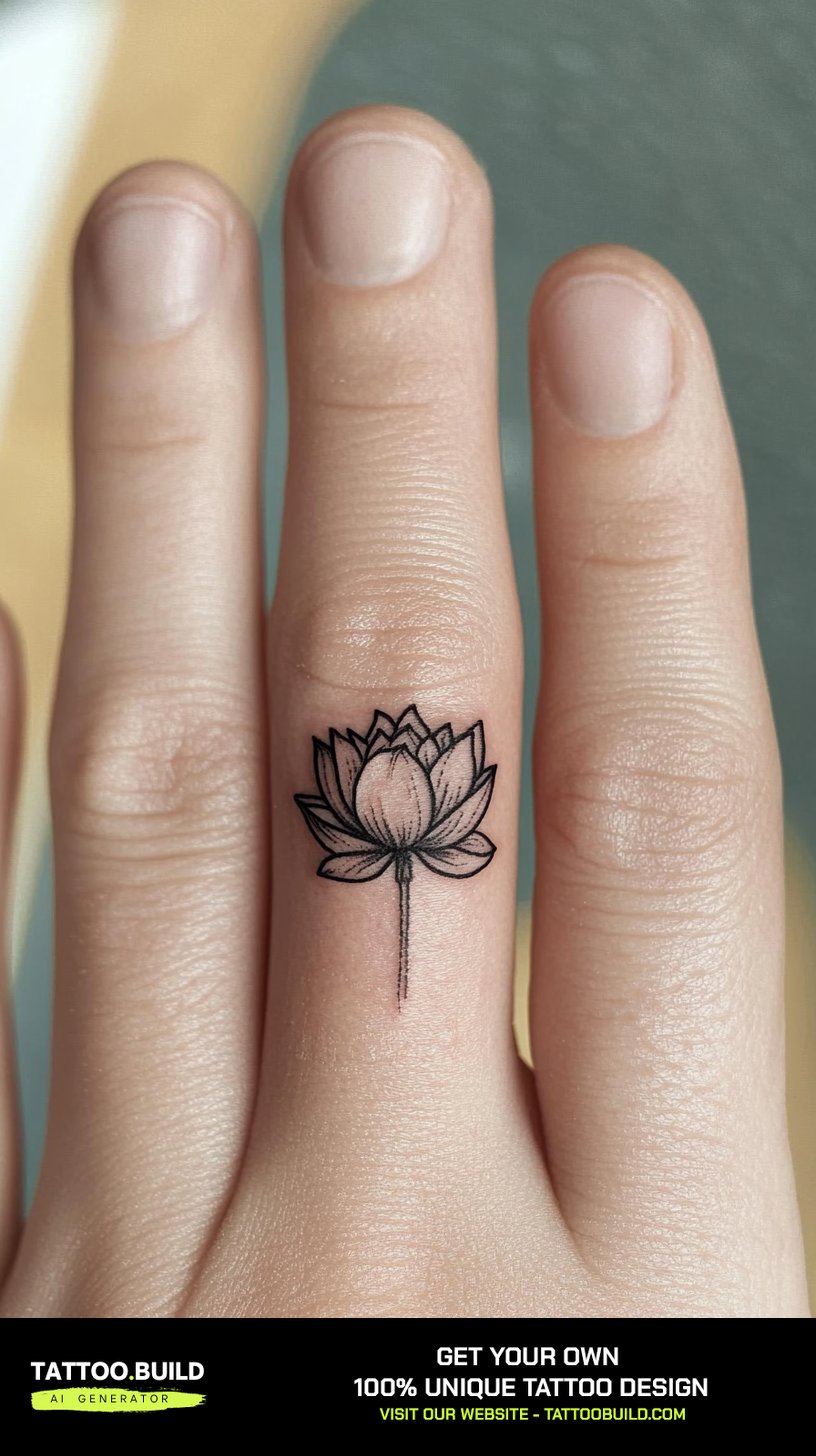
18. Lotus Flower
Lotus designs reduce well because the petals are big simple curves rather than fine detail.
A three-petal or five-petal version is usually enough to carry the meaning without crowding the finger.
If you want the full symmetrical lotus with layered petals, our lotus tattoo guide covers placements with more room.
19. Gemstones
Faceted gemstone designs are essentially geometry, which is why they work at this scale.
A diamond shape with three or four internal facet lines is the sweet spot.
Add more facets and you get a grey blob. The internal lines are what make it read as a gem, so they need space.
20. Tiny Birds
Two or three small birds in flight is a design that has never really gone out of style.
Each bird is two curved strokes, which is about as durable as fine line work gets.
Keep the birds far enough apart that they do not merge as the lines spread over the years.
21. Cursive Words and Script
Script is the highest-risk finger tattoo and also the most personal, so it is worth being clear-eyed about it.
Short words of four to six letters, in a wide open script, on the top of the finger, with generous letter spacing. That is the only version I would recommend.
The gaps inside letters like a, e and o are where script fails. Once those close, the word becomes a line.
Names, dates and single words all work under those rules. Anything longer belongs somewhere else on the body.
Finger Tattoo Aftercare and Practical Tips
Hands are washed constantly, which makes finger tattoos harder to heal than almost any other placement. Follow the aftercare your artist gives you rather than a generic routine from the internet.
The first two weeks decide most of the outcome. Keeping the area clean, avoiding soaking it, and not picking at flaking skin all matter more here than they do on a shoulder.
Practical adjustments that help: wear gloves for washing up and dirty work, keep hand sanitiser off the fresh tattoo, and use sunscreen on it once it is fully healed, because sun exposure on the back of the hands is relentless.
Expect to go back for a touch-up. Most artists include one free touch-up within a few months, and finger tattoos are the placement where you should actually take them up on it.
If you see spreading redness, swelling, heat, pus, or a rash developing around the tattoo, that is a matter for a doctor rather than a forum. General guidance on tattoo risks and skin reactions is available from the American Academy of Dermatology and the Mayo Clinic. Nothing in this article is medical advice.
Common Finger Tattoo Mistakes (and Still Not Sure?)
The mistake I see most often is choosing a design based on a fresh photo. Fresh finger tattoos look incredible; ask to see healed work from the same artist before you commit.
The second is going too small. Almost nobody regrets going slightly bigger on a finger, and plenty of people regret going smaller.
The third is picking the side of the finger for visibility. It rubs against the neighbouring finger all day and it is the fastest-fading spot on the hand.
Still weighing it up? Browsing more of one style usually settles it faster than more general advice. Try finger tattoo ideas for men for bolder work, or cute hand tattoos for women if you would rather move the design off the finger entirely.
Frequently Asked Questions
How long do finger tattoos last?
Most finger tattoos start showing noticeable fading within the first year, and many need a touch-up by year two. Bold, simple designs on the top of the finger last considerably longer than fine line work on the side. Nothing here is permanent in the way a forearm tattoo is permanent, so it is best to plan for maintenance rather than hope you get lucky. Your artist can give you a more specific expectation once they see your skin and the design.
Do finger tattoos hurt more than other placements?
Most people describe them as sharper than a forearm tattoo because the skin is thin and sits close to bone. The sessions are usually short, which helps a lot, and many small finger designs take under half an hour. Pain varies enormously between individuals, so someone else’s experience is a rough guide at best. If you are anxious about it, tell your artist and take breaks.
Why do some artists refuse to tattoo fingers?
Because the results are unpredictable and clients often blame the artist for fading that was always going to happen. Some studios will only tattoo fingers for clients who already have tattoos and understand the trade-off. It is a professional judgement rather than a sign of a bad artist. If one studio declines, ask them who in the area does finger work well.
What is the best finger for a first tattoo?
The top of the middle or ring finger tends to hold ink best, because it is flatter and takes less direct friction than the index finger or thumb. The side of any finger is the least reliable spot. Avoid placing anything directly over a knuckle crease if you want the design to stay unbroken. Your artist will usually have a strong opinion here, and it is worth listening to.
Can finger tattoos be removed or covered up?
Removal on fingers is possible but generally takes multiple laser sessions and results vary, so it is not a simple undo. Cover-ups are limited by how little space there is to work with, which usually means going bolder and larger. A consultation with a licensed removal clinic or an experienced cover-up artist will give you a realistic picture. Do not attempt any at-home removal method, as they can cause scarring and infection.
Quick Summary
- Go bolder than feels right. Line weight is the single biggest factor in how a finger tattoo ages.
- Choose the top of the finger over the side, where constant friction fades ink fastest.
- Silhouettes and dotwork are the most durable formats; fine script is the least.
- Keep internal gaps generous, because closed-up detail is the first thing to go.
- Skip grey shading on fingers; solid black and clean outline hold far better.
- Budget for at least one touch-up, and take the free one your artist offers.
- Ask to see healed finger work from your artist, not fresh photos.
- If any sign of infection appears, see a doctor rather than waiting it out.