A matching tattoo works when the two designs still make sense apart – and say something extra when they are side by side. That single test has saved every pair I have gone into a studio with from regretting the design six months later.
I have sat in on more of these appointments than I can count, usually as the friend holding the water bottle. The pairs who walk out happy are almost never the ones who picked a design that morning.
They are the ones who agreed on a style first, a size second, and only then on the actual image. If you are still at the browsing stage, the couple-focused matching designs are a good place to see how that plays out.
Below are the pairings I keep coming back to, what each one actually costs you in time and healing, and the mistakes I have watched people make more than once.
Which Matching Tattoo Style Is Right for You?
Style decides almost everything downstream – the sitting length, the price, and how the piece looks in ten years. This is roughly how the main options compare.
| Style | Typical sitting | Ages best when | Suits |
|---|---|---|---|
| Fine-line botanical | 1-2 hours | Kept at least 3 inches and off the hands | Friends, sisters, first tattoos |
| Ornamental / mandala | 3-5 hours | Line weights vary rather than all being hairline | Couples wanting something decorative |
| Blackwork portrait | 4-8 hours, often two sessions | Placed on the thigh, back or outer arm | People already carrying larger work |
| Micro symbol | Under 45 minutes | You accept a touch-up every few years | Anyone testing the idea cheaply |
| Soft colour sketch | 2-3 hours | Sun exposure is genuinely controlled | Pairs who want something less austere |
Why Matching Tattoos Are Harder to Get Right Than They Look
The design is the easy part. The difficulty is that two people have to live with one decision, on two different bodies, with two different pain thresholds.
Skin behaves differently from person to person. The same hairline rose can settle cleanly on one forearm and spread slightly on another, and no artist can fully predict which.
There is also the scale problem. A design drawn once and copied twice often needs redrawing for the second person, because arms, ribs and ankles are not interchangeable canvases.
The pairs who are happiest are the ones who briefed the artist on the meaning and let them handle the composition. Every artist I have asked prefers that to being handed a screenshot and told to copy it exactly.
And the honest part: relationships change. That is not an argument against matching work, but it is an argument for designs that stand on their own, which is why minimalist designs age so well in this category.
Matching Tattoo Ideas That Hold Up Over Time
These are grouped by style rather than by relationship, because the style is what determines whether the pairing still looks good years later.
Botanical Portraits That Face Each Other
Two profiles drawn from leaves and stems, angled so they look toward one another, are the design I have seen requested most in the last couple of years.
They work because the negative space between the two pieces does half the job. Stand apart and each reads as a standalone illustration; stand together and the gap becomes the point.
Ask for the linework at a medium weight rather than the finest possible needle. When I tested a hairline version on my own forearm, the thinnest strands were the first thing to soften.
Size matters more here than in most styles. Under about four inches the facial features lose definition quickly, and a portrait that has lost its features is just a shape.
Ornamental Mandalas and Compass Work
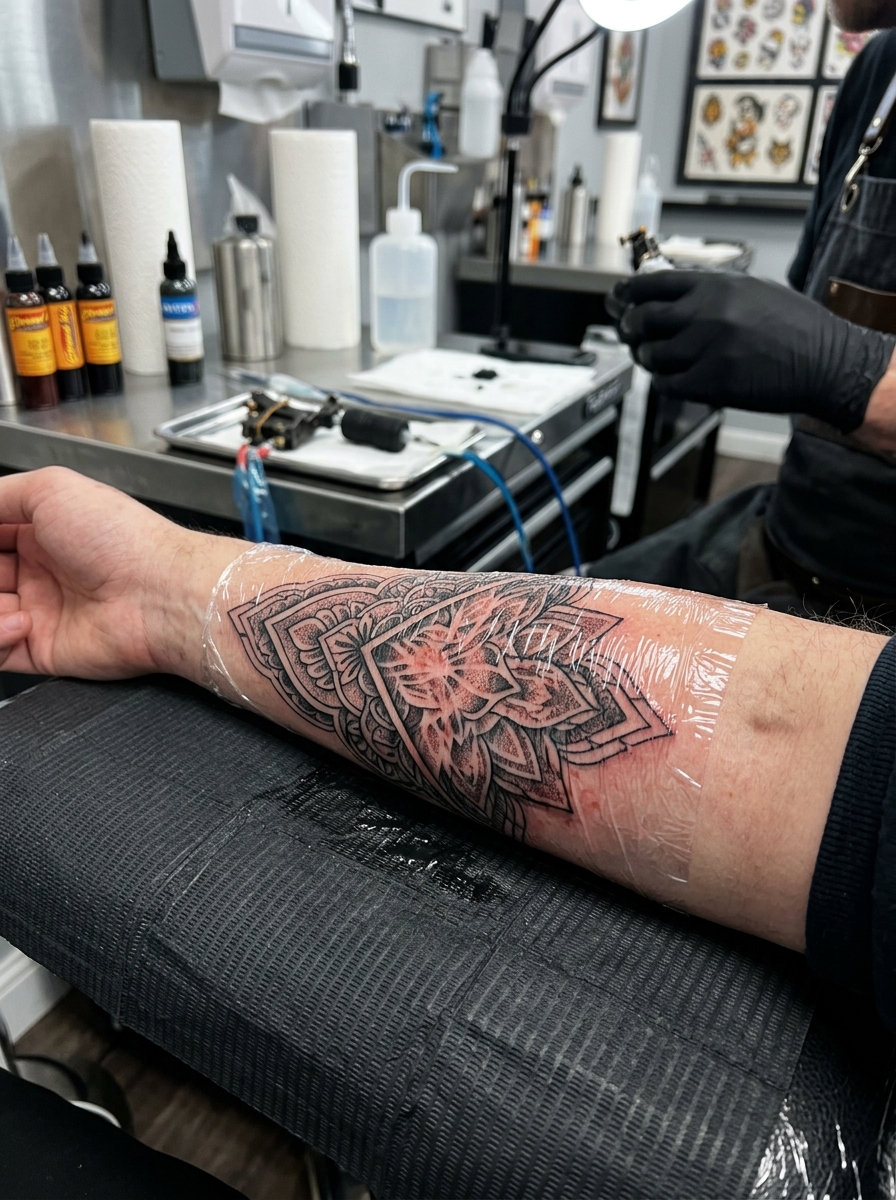
Mirrored mandalas on the inner forearms are the closest thing to matching jewellery, and they suit people who want decoration rather than a symbol.
Geometry is unforgiving. A wobble in a straight line or an off-centre circle is visible forever, so this is a style where the artist’s portfolio matters more than their price.
Budget for a longer sitting than you expect. The couples I have watched get ornamental forearm work were usually in the chair for four hours or more per person.
Compass and clock designs down the calf are the larger version of the same idea. They hurt more over the shin bone, and most people I know split them across two appointments.
Fine-Line Roses and Simple Florals
If you want the safest entry point, two rose stems is it. It is inexpensive, quick, and almost every competent artist can execute it well.
The variation that keeps it from feeling generic is direction. Have the stems drawn so they point toward each other when your arms are side by side.
I have also seen pairs give each rose a different number of leaves, or one bud and one open bloom, so the designs stay distinguishable up close.
Placement is usually the inner or outer forearm. The inner side hurts slightly more but keeps the piece out of direct sun, which matters for line retention.
Wildflowers and Sketch-Style Pairs
Sketch-style work keeps the drawn quality of the original artwork – visible construction lines, a little looseness, no attempt at perfect symmetry.
It suits people who find clean linework too clinical. It also forgives slight differences between the two tattoos, because the style was never meant to be exact.
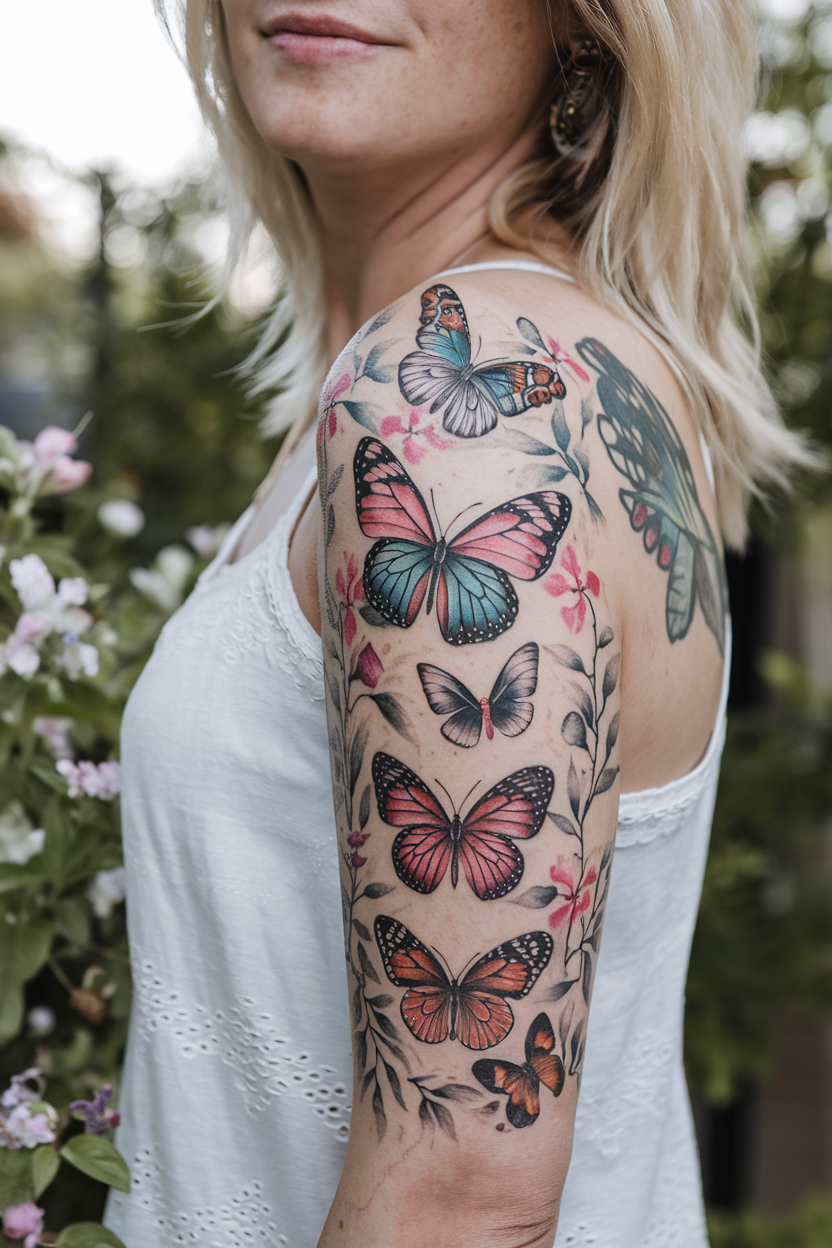
Soft colour appears most often in this category. Colour is not fragile, but it does respond to sun more than black does, so plan on sunscreen becoming a habit.
Wildflower stems are also the easiest design to extend later. Two people can add a flower each year without anything needing to be redrawn.
Symbolic Objects: Daggers, Feathers and Keys
Object-based pairings give you something to point at when someone asks what it means, which is more useful than it sounds.
Mirrored daggers wrapped in florals read as protective rather than aggressive, and they suit siblings as readily as couples – the sibling tattoo designs lean heavily on this.
Feathers are the softer version, and a small alteration to one of them – a nib, a different bird, a broken quill – is what stops the pair looking like clip art.
Heavier blackwork ages better than almost anything else here. The dense floral forearms I have seen at the ten-year mark still read clearly, where hairline work from the same period had softened.
One Illustration Split Across Two People
This is the most literal interpretation: a single artwork cut down the middle, half on each person.
It is also the riskiest, because the halves genuinely do not stand alone. Go in knowing that, or ask the artist to build each half so it still resolves as its own composition.
The version I would recommend is a portrait pair rather than a hard split – two related faces or flowers, drawn in one style, that simply belong to the same set.
Line-art couples surrounded by florals fall into this group. Keep them larger than feels necessary; thin lines crowded into a small area are the fastest route to a blurred piece.
If You Do Not Want Two Identical Tattoos
Identical is only one option, and in my experience it is not usually the best one. These are the alternatives I suggest first.
Same Style, Different Subject
Both people get work from the same artist in the same style, but the subjects differ – one wildflower, one fern, both drawn with the same hand.
They read as a set to anyone who looks closely and as personal pieces to everyone else. This is what most of the friends I know eventually chose.
Complementary Halves of a Phrase or Symbol
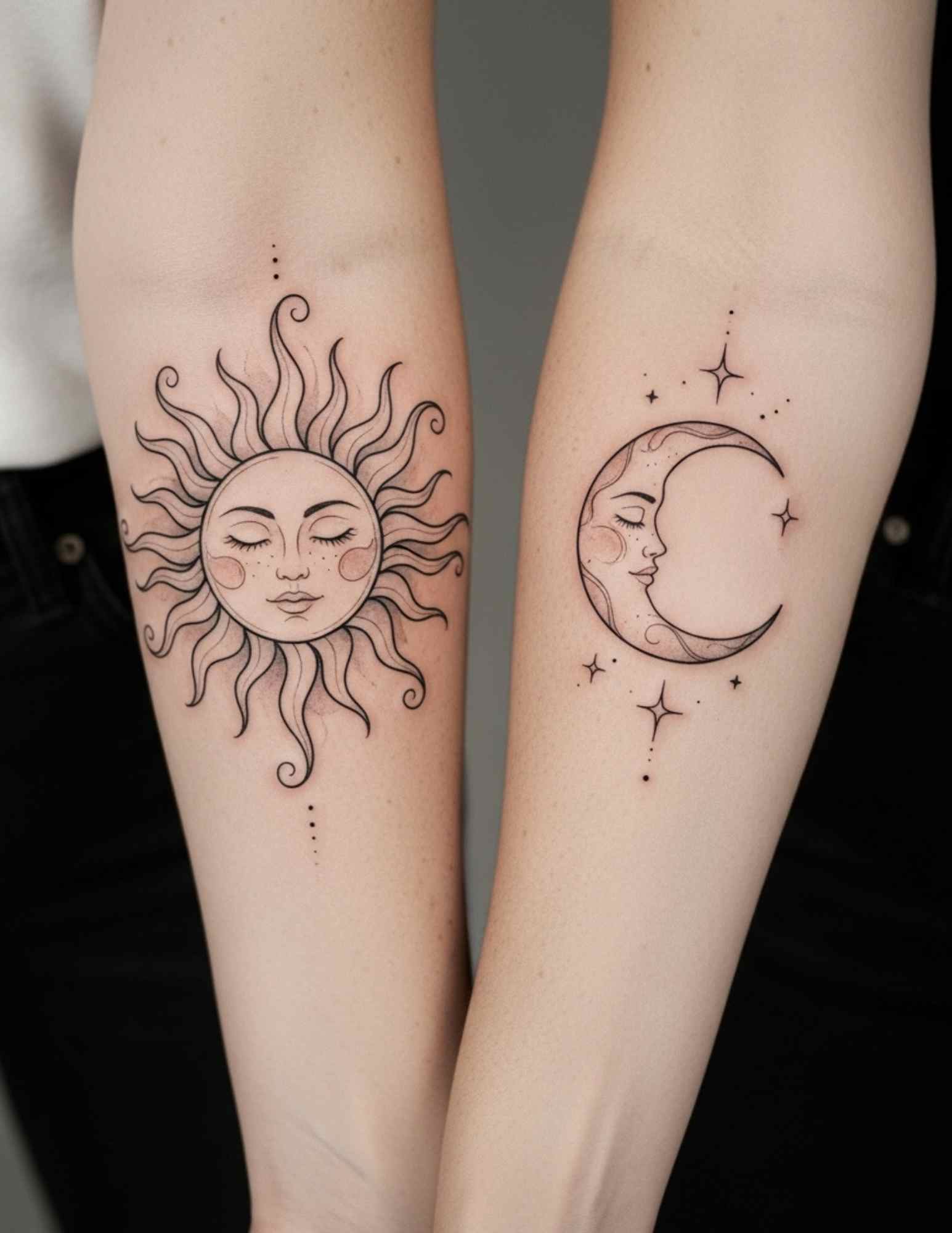
A sun and a moon, a lock and a key, two halves of a coordinate. Each carries meaning alone and gains a second layer alongside the other.
Keep the two pieces roughly the same size. A tiny key next to a large lock always looks like an afterthought.
Same Design, Different Placement
One design, executed twice, but placed to suit each body – forearm for one, ribs or ankle for the other.
This is worth considering if one of you has a job with a visible-ink policy. Finger placements look appealing for this but fade fastest of anywhere on the body.
Matched Scale Rather Than Matched Image
Two completely different subjects, drawn at the same size, in the same weight, in the same spot on each body.
It is the subtlest version of the idea and the one least likely to date. If budget is your constraint, the cost of a small tattoo makes this the cheapest route into a matching set too.
Placement, Pain and Aftercare
Pick placement before you finalise the drawing. A design sized for a forearm rarely transfers cleanly to a wrist, and the redraw usually happens on the day, in a hurry.
Bony areas hurt more – ribs, sternum, ankle, the top of the foot. Fleshier areas like the outer thigh and outer forearm are gentler, and both people being comfortable matters when you are sitting through two sessions.
For aftercare, follow the artist’s instructions over anything you read online, including this page. Most will tell you to keep the tattoo clean, use a thin layer of fragrance-free moisturiser, and leave the flaking skin alone. The American Academy of Dermatology publishes general guidance on caring for tattooed skin that is worth reading before your appointment.
Redness spreading outward, heat, swelling that increases after the first few days, pus or fever are not normal healing. See a doctor rather than asking the studio, and read the FDA’s consumer information on tattoo safety if you are weighing the risks in advance. Nothing in this article is medical advice.
Still Not Sure? The Mistakes I See Most
Booking the same day you decide. The pairs who regret their tattoo almost always compressed the decision into a single afternoon.
Choosing a design that only makes sense as a pair. If one of you moves, or the friendship changes shape, you both still own the tattoo.
Copying a photo exactly. Bring references for the mood and the style, then let the artist draw it – the result is better and the artist is more invested.
Going too small to save money. A design crowded into an inch of skin is the one most likely to need covering up later, and covering up costs more than doing it properly.
Not checking each other’s tolerance. One person happily sitting five hours and the other tapping out at ninety minutes is a real scenario I have watched play out.
If you are still narrowing things down, the best friend matching ideas and sister matching designs cover the two most common relationships for this, and family tattoo ideas widen it further.
Frequently Asked Questions
Do matching tattoos have to be identical?
No, and in my experience they usually should not be. Two pieces drawn in the same style, at the same size, by the same artist read as a set without either one depending on the other. That gives you a tattoo that still works if you are photographed alone. Identical designs are best kept for small, simple symbols where an exact copy is achievable.
How much do matching tattoos cost?
It depends on size, style and your artist’s rate, so ask for a quote rather than trusting a number online. Small fine-line pieces are usually a shop minimum job, while ornamental forearm work runs into multiple hours per person. Remember that you are paying for two tattoos, not one design. Some studios will quote a package rate for a pair booked together, so it is worth asking.
Where do matching tattoos last longest?
Areas with less friction and less sun exposure hold up best – the inner and outer forearm, the upper arm, the thigh and the back. Hands, fingers and feet fade fastest because the skin there renews quickly and takes constant wear. If you want a hand or finger placement, plan on touch-ups and accept that the piece will soften. Your artist will tell you honestly which placements they are willing to guarantee.
What if the relationship ends?
This is worth thinking about before the needle, not after. Designs that carry their own meaning – a flower, a symbol, a shared place – stay yours regardless of who else has one. Names and portraits are the hardest to live with afterwards and the most expensive to alter. Cover-ups are usually possible, but they cost more and constrain the new design.
Can two people get matching tattoos in one appointment?
Often yes, if the designs are small, though many artists prefer to book back-to-back slots rather than rushing. Larger ornamental or portrait work will almost certainly need separate sessions. Ask when you book, because a studio that has set aside a full day for you is far less likely to hurry the drawing. Sitting together also helps – the second person is calmer having watched the first.
Quick Summary
- Pick a design that each of you would still want if you were the only one wearing it.
- Agree on style first, then size, then subject – in that order.
- Fine-line florals are the cheapest and fastest entry point; ornamental work is the biggest commitment.
- Keep portraits and detailed illustrations at four inches or larger so the features survive.
- Forearms, upper arms and thighs hold detail longest; hands and fingers fade fastest.
- Same style with different subjects is usually a better idea than two identical copies.
- Brief the artist on the meaning and let them compose it rather than copying a screenshot.
- Follow your artist’s aftercare instructions, and see a doctor – not the studio – if healing looks wrong.