A crown tattoo on the back almost always means self-rule before it means royalty. The people I have watched sit for one are rarely claiming to be above anyone — they are marking the point where they took charge of their own life.
I have spent years looking at back pieces in studios and in artists’ portfolios, and the crown keeps showing up for the same handful of reasons: survival, faith, a partner, a parent, or a promise made to yourself.
The back is also the one canvas where a crown can be as small as a coin or as wide as your shoulders, which is why the same symbol reads so differently from person to person.
If you want to see how small the design can go before committing to a full back piece, our guide to minimal crown tattoo ideas is a good place to start.
Which Crown Style Is Right for You?
Before looking at individual designs, it helps to know roughly what you are choosing between. This is the shortlist I usually walk people through.
| Crown Style | Core Meaning | Best Back Placement | Rough Session Time |
|---|---|---|---|
| Classic royal | Authority, self-control, responsibility | Centred between shoulder blades | 2–4 hours |
| King & queen pair | Partnership, commitment | Upper back or shoulder blade | 1–2 hours each |
| Crown with cross | Faith, devotion, a higher authority | Nape or upper spine | 2–3 hours |
| Crown and skull | Mortality, power that ends | Shoulder blade or mid-back | 4–7 hours |
| Crown and lion | Courage, protection, leadership | Full upper back | 6–12 hours, often split |
| Floral crown | Growth, softness, self-worth | Spine or shoulder blade | 3–5 hours |
| Crown of thorns | Sacrifice, endurance, suffering | Nape or centre back | 2–4 hours |
| Tribal or traditional | Heritage, bold identity | Upper back, wide | 3–6 hours |
Times are the ranges artists have quoted me for mid-sized back work. They move a lot with size, detail and how well you sit.
What Actually Shapes a Crown Tattoo’s Meaning
The crown is one of the oldest status symbols humans have, and it was never neutral. Historically it marked who was allowed to rule, which is why it still carries weight even as pure decoration.
You can read more about how the object itself developed across cultures on Wikipedia’s overview of crowns as headgear, which is a useful sanity check before you commit to a specific historical shape.
In tattooing, three things change the meaning more than the crown itself: what it sits on, how open the frame is, and where it lands on the back.
A crown floating alone reads as personal sovereignty. A crown resting on a skull, a lion or a heart hands that authority to something else, and the meaning shifts with it.
Placement matters just as much. High on the nape it reads as private and worn for yourself; spread across the shoulders it reads as a statement other people are meant to see.
Every artist I have asked about this says the same thing in different words — clients almost never come in wanting to look powerful. They come in wanting a reminder that they already got through something.
Crown Tattoo Designs for the Back and What They Mean
These are the eight designs I see most often on back placements, in roughly the order of how commonly they get requested.
1. Classic Royal Crown
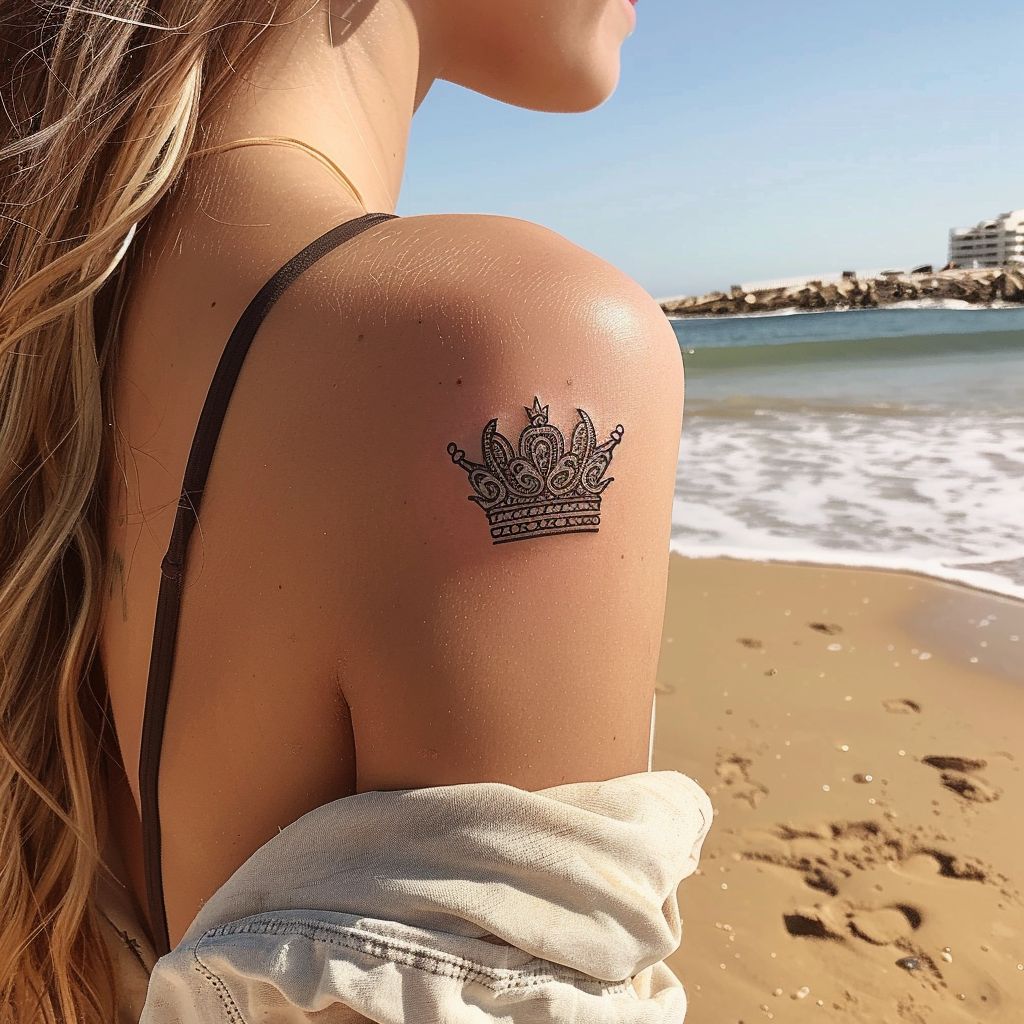
The classic royal crown is the open-topped, five-point shape with jewel settings, a base band and often small crosses or an orb on top.
It is the most literal version of the symbol: authority, rank and the responsibility that comes with both. In my experience it is the one people choose when they have stepped into a role — a promotion, a business, a family they now lead.
On the back it sits best centred between the shoulder blades, where the flat plane lets the artist keep the band perfectly level. A crown that tilts on a curved surface is the single most common complaint I hear about this design.
Detail is the trade-off here. Jewel settings, filigree and shading need physical space, so anything under about three inches wide tends to blur into a dark blob within a decade.
2. King and Queen Crowns
King and queen crowns are usually inked as a pair, one on each partner. The king crown is drawn squarer with a heavier frame, the queen crown more curved and open.
The meaning is straightforward — commitment, and the idea that you are each other’s highest authority. Some people also use it individually to mark being at the top of something they worked for.
I will be honest about the risk: matching couple tattoos are the ones most often brought in for cover-ups. If you want the symbolism without the exposure, a solo crown with a meaningful date or initial is easier to live with.
If you like the royal theme but want it in a single design rather than a pair, our guide to king tattoo meaning and design covers the standalone options.
3. Crown with a Cross
Adding a cross — either topping the crown or set inside the band — moves the meaning from personal power to a higher authority.
For most people who choose it, the message is that they are not the one in charge. It is a faith tattoo that happens to use a crown as its frame, rather than a crown tattoo with a decorative cross.
It works well small, which is why the nape and upper spine are popular. The cross gives the design a clear vertical axis that follows the spine naturally.
One practical note: a cross set inside the band reads more clearly at small sizes than one balanced on top, which tends to lose its shape as the ink spreads.
4. Crown and Skull
A crown resting on a skull is the memento mori version of this tattoo — a reminder that power, status and the body itself all run out.
It is also one of the most technically demanding designs on this list. The skull needs real depth in the eye sockets and cheekbones, and the crown needs enough contrast to sit on top of it rather than sink in.
When I tested placement options with artists, most recommended the shoulder blade or mid-back for this one, purely because it needs width to hold the detail.
Budget more time than you think. Four to seven hours is normal for a well-shaded crown and skull, and many artists split it across two sittings.
If the skull half is what appeals most, there are more direction ideas in our collection of skull tattoo ideas.
5. Crown with Jewels
A heavily jewelled crown pushes the design toward wealth, achievement and things earned rather than inherited.
Gems are pure contrast work. A ruby, an emerald and a sapphire only read as different stones if the artist varies the shading pattern and leaves clean, unshaded highlights.
This is one of the few crown designs where colour genuinely earns its place. In black and grey the stones have to be distinguished by facet shape alone, which takes a more skilled hand.
Coloured stones also fade at different rates — reds and yellows generally soften faster than blues and greens — so ask your artist how the specific inks they use have aged on past clients.
6. Crown and Lion
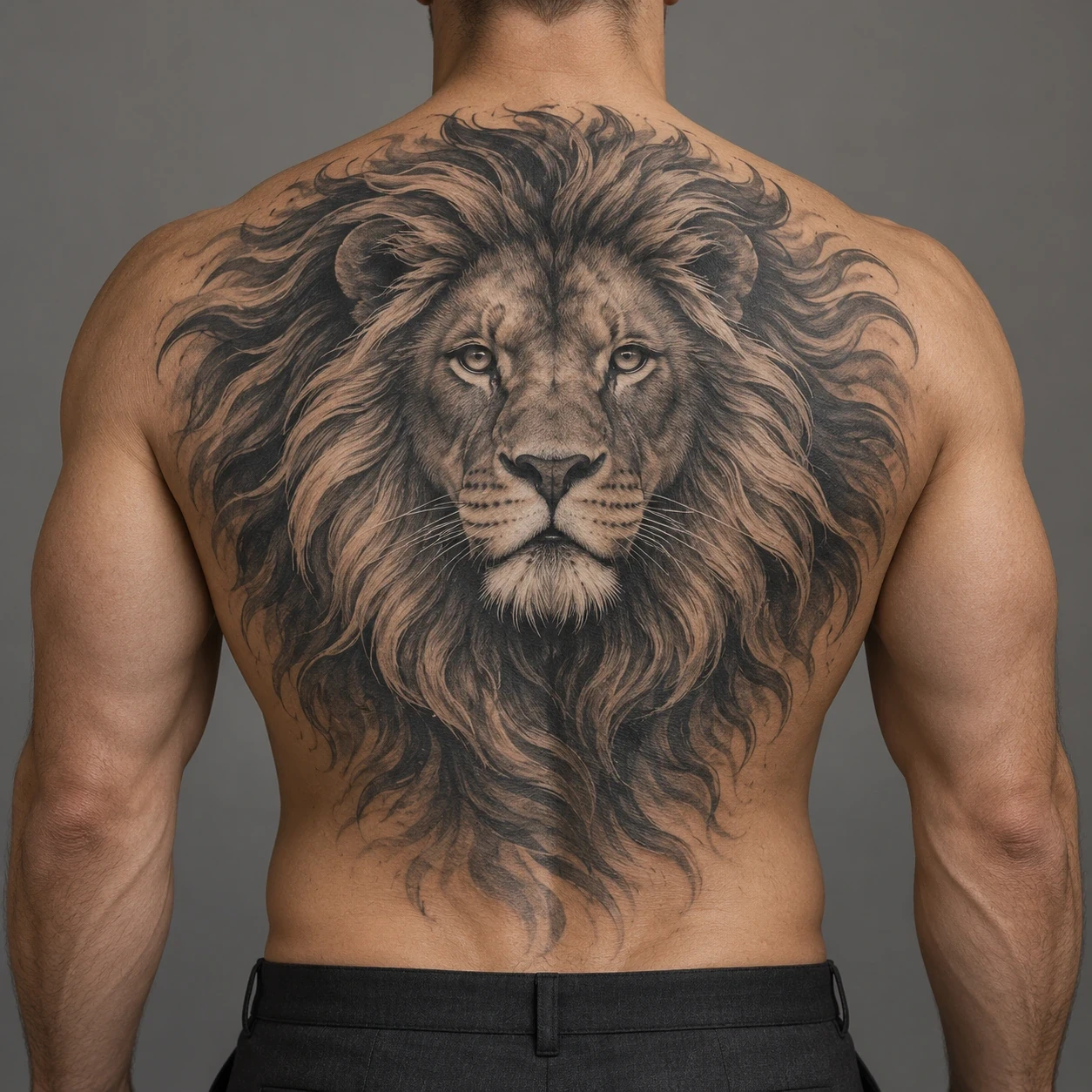
The crowned lion is the biggest commitment on this list and the one that most often becomes a full upper back piece.
Meaning-wise it stacks two symbols that already agree with each other: the lion brings courage and protection, the crown brings authority. Together they read as leadership rather than dominance.
Realistic lion portraits need serious space. Anything under about eight inches tall and the mane detail starts competing with the crown for attention, and both lose.
Every artist I have asked recommends booking this one as multiple sessions from the start rather than trying to push through a single ten-hour day. Skin gets irritated, and the last two hours are where mistakes happen.
Geometric and linework versions are a lighter option — see our geometric lion tattoo ideas for that approach.
7. Crown with Flowers
A floral crown swaps the metal points for blossoms, or weaves flowers through a traditional frame.
It softens the symbol considerably. Instead of authority over others, it usually reads as growth, self-worth or a tribute — birth flowers for children and parents are a common reason people choose it.
The spine is the most flattering placement I have seen for this design, because a vine or stem can follow the vertebrae and give the piece a natural spine of its own.
Fine floral linework does soften over time, more so than bold traditional work. That is not a flaw, but plan the spacing with it in mind so petals do not merge into each other.
8. Crown of Thorns
The crown of thorns is the heaviest symbol in this article and the one I would think longest about.
It refers directly to the crucifixion and carries sacrifice, endurance and suffering rather than status. Some people also choose it to mark a period of their life they survived rather than enjoyed.
Visually it is the opposite of the jewelled crown — no gems, no shine, just interlocking thorns and negative space. It sits well at the nape, where the circular shape frames the top of the spine.
Be sure of what you are saying with it. This is not a design people read as neutral, and it will invite questions for the rest of your life.
Variations and Related Symbols
If none of the eight above fits, these variations cover most of what is left.
Imperial and Traditional Crowns
The imperial crown is closed and domed rather than open-topped, usually with arches meeting at an orb. It reads as older and more formal than the standard royal crown.
The traditional or old school crown strips the design back to bold outlines and flat colour. In my experience it is the version that ages best over twenty or thirty years, because heavy lines survive ink spread that fine detail does not.
Crown and Anchor
Crown and anchor is a long-standing pairing in nautical flash, historically tied to naval service and, later, to stability and a safe return.
It suits the shoulder blade well, where the anchor shank can run vertically and the crown caps it. Our guide to what an anchor tattoo symbolizes goes deeper on that half of the design.
Placement Variations Across the Back
- Nape: small, private, easy to cover with hair — the least painful of the back options for most people.
- Between the shoulder blades: flat, symmetrical, the best surface for a level crown band.
- Single shoulder blade: good for asymmetrical or paired designs, and a common first back tattoo.
- Spine: striking for vertical designs, but bony and usually the sharpest pain on the back.
- Lower back: more space than people expect, and easy to keep covered at work.
For a broader look at how back placements read at different scales, our guides to symbolic back tattoos and spine tattoo ideas are worth a look before you book.
Practical Tips Before and After You Get It
Bring reference images of crowns you like and crowns you do not. Telling an artist what to avoid narrows a design faster than another folder of favourites.
Ask to see healed photos, not fresh ones. Fresh work always looks sharp; healed work at two or three years tells you whether the artist’s linework holds up.
Eat properly beforehand and plan for the back being awkward to sleep on for the first week. A mid-back piece means face-down or side sleeping until the peeling stage passes.
For healing, follow the aftercare your artist gives you rather than anything you read online, including this article. General guidance from sources like the Mayo Clinic’s overview of tattoo and piercing risks is useful context, but it is not a substitute for professional advice.
If you see spreading redness, swelling that worsens after day three, pus, or a fever, contact a doctor rather than waiting it out. Allergic reactions to specific pigments — red is the one most often reported — can also appear weeks or months later and need a medical opinion, not a home remedy.
And never let anyone tattoo or attempt to remove a tattoo outside a licensed studio. Back pieces are large, and an infection across that surface area is not a small problem.
Common Mistakes and What to Do If You Are Still Unsure
The mistake I see most often is going too small for the level of detail. A jewelled crown at two inches wide is a solid shape by year ten.
The second is ignoring the curve of the back. A design drawn flat on paper can sit crooked once it wraps a shoulder, so always check the stencil in a mirror while standing naturally, not while hunched over.
The third is rushing the symbol. A crown is permanent shorthand for something specific — if you cannot say in one sentence what yours means, wait.
Still weighing it up? It helps to look at how a crown competes or cooperates with other back designs. Our galleries of back tattoo designs for men and full back tattoo ideas for women show what scale actually looks like on a body.
And if the thorn version is what pulled you in, the symbolism overlaps with our piece on rose with thorns tattoo meaning.
Frequently Asked Questions
What does a crown tattoo on the back symbolize?
Most commonly it symbolizes self-control, personal authority and having come through something difficult. It can also mean royalty, faith, partnership or achievement depending on what the crown is paired with. A crown alone tends to read as sovereignty over yourself, while a crown resting on a skull, lion or cross shifts the meaning toward mortality, courage or devotion. There is no single fixed meaning, which is part of why it stays popular.
Is a crown tattoo on the back a masculine or feminine design?
It works for anyone, and the design choices matter far more than the placement. Squarer frames, heavy linework and lion or skull pairings tend to read as more masculine, while curved frames, florals and fine linework read as softer. In practice I see roughly as many men as women choosing crowns, just in different styles. Pick the version that matches what you want it to say, not what the symbol is assumed to mean.
How much does a back crown tattoo hurt?
The fleshy areas between and around the shoulder blades are among the more tolerable spots on the body for most people. The spine, the shoulder blade bone itself and the lower ribs are noticeably sharper because the needle is working close to bone. Longer sessions also get harder as the area becomes irritated, which is why large pieces are usually split. Everyone’s tolerance differs, so treat any pain chart as a rough guide only.
How long does a crown tattoo on the back take?
A small, simple crown at the nape can be done in about an hour. A detailed classic royal crown between the shoulder blades usually runs two to four hours, and a crowned lion covering the upper back can take six to twelve hours across multiple sittings. These are the ranges artists have quoted me, and your own quote will depend on size, shading and the artist’s speed. Always ask for an estimate at the consultation rather than on the day.
Can a crown tattoo on the back be covered up or changed later?
Crowns cover up reasonably well because the shape is wide, mostly open at the top and easy to absorb into a larger design. Adding a lion, florals or a mandala around an existing crown is a common fix. Heavily blacked-in or very dark crowns are harder and may need laser lightening first, which a qualified practitioner should assess in person. Never attempt removal at home — DIY removal methods can cause scarring and infection.
Quick Summary
- Core meaning: a crown tattoo on the back usually stands for self-control and personal authority, not literal royalty.
- Pairings change everything: a skull adds mortality, a lion adds courage, a cross adds faith, thorns add sacrifice.
- Best placement for a level design: centred between the shoulder blades, where the surface is flattest.
- Size honestly: jewelled and filigree crowns need at least three inches of width to stay readable long term.
- Style for longevity: bold traditional linework ages better over decades than fine detail.
- Time and sessions: one to four hours for most crowns, six to twelve split across sittings for a crowned lion.
- Aftercare: follow your artist’s instructions, and see a doctor for worsening redness, pus or fever.
- Think before thorns: the crown of thorns is a specific religious statement that people will read literally.