A koi fish tattoo drawing lives or dies on two things: the direction the fish is swimming, and whether the water around it was drawn as part of the design rather than added later. Everything else — colour, scale detail, size — is negotiable.
I have watched a lot of people bring a koi reference to a consultation, and the ones who walk out happy are almost always the ones who arrived with a shape in mind rather than a finished picture.
This guide covers what koi actually symbolise, how the drawings differ by style, which placements suit which layouts, and the mistakes that turn a beautiful sketch into a muddy tattoo. If you want to see how these translate into finished pieces, the gallery of koi fish tattoo designs is a useful companion to this page.
Every image below is a drawing rather than a healed tattoo, which is deliberate — this is the stage where you can still change things.
Which Koi Fish Tattoo Drawing Style Is Right for You?
There is no single correct koi style, but the four below cover the overwhelming majority of what artists are asked for.
| Style | Best Placement | Typical Sitting Time | Ages Well? |
|---|---|---|---|
| Traditional Japanese (irezumi) | Full sleeve, back, thigh | Multiple sessions over months | Excellent — built for it |
| Black and grey realism | Forearm, calf, upper back | One to three sessions | Good with strong contrast |
| Fine line / single needle | Inner forearm, ribs, ankle | Usually one session | Softens fastest; expect touch-ups |
| Watercolour | Shoulder, thigh, upper arm | One to two sessions | Better with a black anchor line |
If you are drawn to the last row, it is worth reading about watercolour tattoo approaches before committing, because the technique has real trade-offs.
What Koi Fish Tattoos Actually Mean
The koi is a domesticated colour variety of the common carp, bred in Japan for ornamental ponds — Wikipedia’s entry on koi covers the fish itself in more detail than most tattoo articles bother with.
The symbolism that gets tattooed comes from a Chinese legend, retold widely in Japan, in which a carp that swims up a waterfall at the Dragon Gate is transformed into a dragon.
That story is why koi are so consistently read as perseverance, endurance, and reward earned rather than given.
It is also why direction matters in the drawing. A koi swimming upstream, against the current, is the version tied to struggle still in progress; a koi swimming downstream is usually read as a goal already reached.
Neither direction is wrong, and no artist I have worked with treats one as bad luck. But if the piece is meant to mark something specific, decide which reading you want before the stencil is cut.
Colour carries meaning too in some tellings — red for love or strength, black for overcoming hardship, gold for prosperity. These readings vary by source and region, so treat them as a starting point rather than a fixed code.
If you want the broader tradition the koi sits inside, Japanese irezumi is the umbrella term worth knowing.
Koi Fish Tattoo Drawing Ideas by Style and Placement
The drawings below are grouped by the decision they help you make, not by how they look.
Single Koi, Vertical Layout
This is the default, and there is a reason for it: a single fish drawn on a vertical axis fits the forearm, the calf, and the outer thigh without redrawing.
In my experience it is also the easiest layout to size up later. If you add a sleeve around it in three years, a vertical koi becomes the centre panel instead of an obstacle.
Keep the head at the top and the tail sweeping across the body of the limb. A koi drawn perfectly straight looks stiff, and stiffness is the most common flaw in amateur references.
Ask for the tail to break the outline of the water rather than sit inside it — that single change adds depth for free.
Two Koi and Circular Compositions
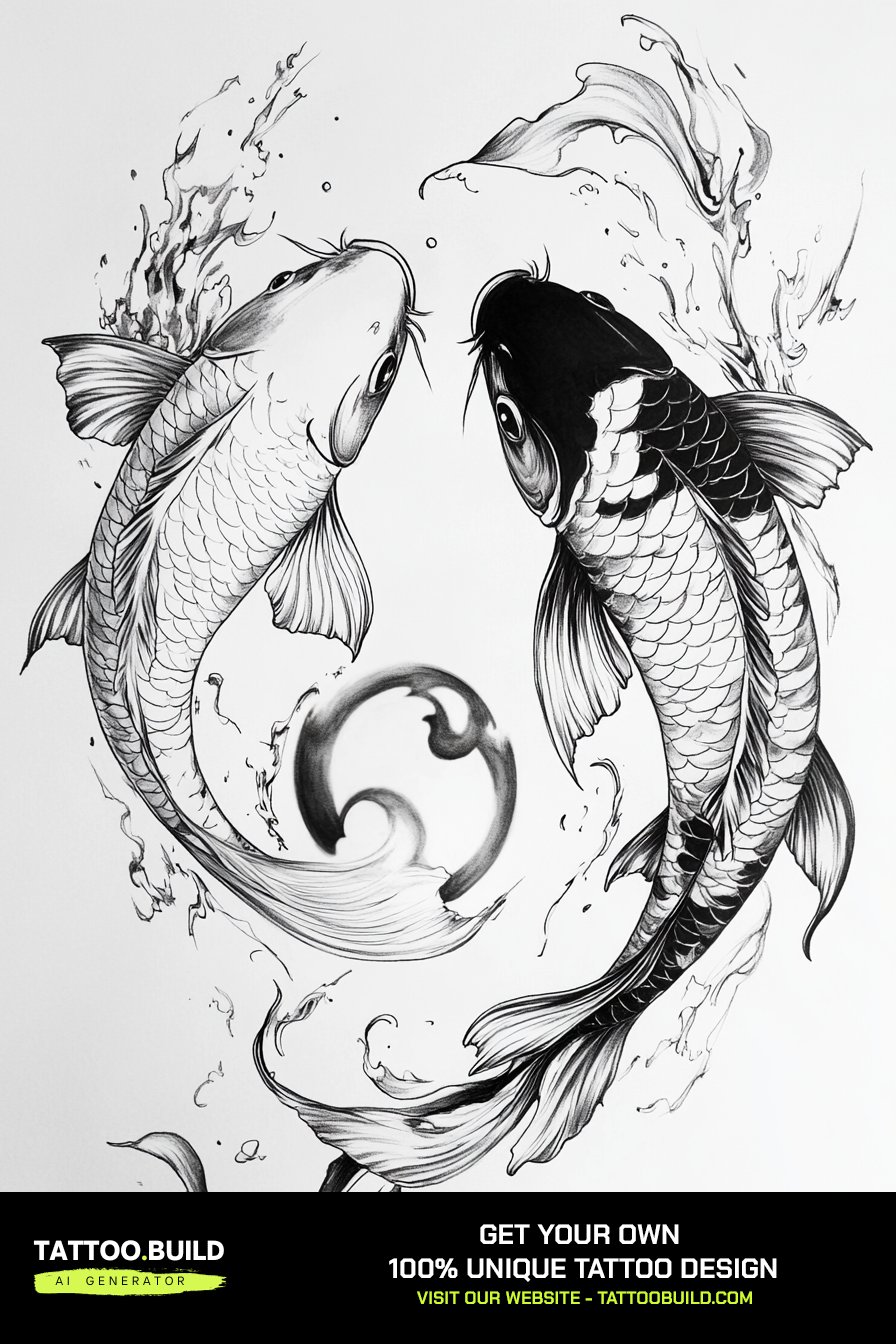
Two fish chasing each other in a circle is the second most requested koi layout, and it suits round placements — the shoulder cap, the shoulder blade, the centre of the back.
The design borrows the yin and yang silhouette, which is where a lot of people get the meaning slightly wrong: the pairing usually reads as balance or partnership, not as good versus evil.
Drawn well, the two bodies interlock so that each tail nearly touches the opposite head. Drawn badly, they read as two separate fish that happen to be near each other.
When I have seen this done at small sizes it tends to close up as it heals, because the negative space between the bodies is thin. Sixteen centimetres across is a sensible floor.
Koi With Lotus, Cherry Blossom, and Peony
Flowers do two jobs in a koi drawing: they fill background space and they tell the eye where the composition ends.
Lotus is the most common pairing and the most forgiving, because the flat petal shapes contrast with the busy scale texture. If you like that direction, lotus flower tattoo designs shows how the flower behaves on its own.
Cherry blossom scatters better than it clusters — small petals drifting across the background read as movement, while a solid clump of blossom competes with the fish.
Peony is the heaviest of the three and needs a large canvas. On a forearm it usually swallows the koi.
Waves, Water, and Background
This is the section most people skip, and it is the one that decides whether the tattoo looks finished.
Traditional Japanese water is drawn as finger waves — repeating curved lines with foam caps — and it is designed to flow around a limb, which is why it survives on sleeves so well.
Realistic water uses splash, droplets, and reflected highlight instead. It looks stunning fresh and it is the first element to go soft after a decade, because it relies on fine grey values.
Whichever you choose, the water should be drawn at the same time as the fish, not added afterwards. Every artist I have asked says the same thing about retrofitted backgrounds: they always look retrofitted.
Half Sleeve and Full Sleeve Layouts
A koi sleeve is a wrap, not a picture. The drawing has to resolve from the front, the side, and the back of the arm.
The usual solution is one large fish running diagonally from the shoulder to the inner elbow, with water carrying the composition around the limb.
If you are planning this, look at how other half sleeve tattoo drawings handle the wrap before you commit to a reference — the geometry matters more than the subject.
Budget realistically as well. A koi sleeve is many sessions of work, and what a sleeve tattoo actually costs is worth reading before you book, because the number surprises people.
Back Pieces and Large-Scale Koi
The back is where koi drawings get to be what they were originally designed to be: large, detailed, and unhurried.
At this scale the fish can be drawn with individually rendered scales, layered fin membrane, and a full wave background, none of which survives shrinking to forearm size.
A back piece is also a commitment measured in sittings rather than hours. Plan for a long project and an artist whose healed work you have actually seen.
For layout inspiration at this scale, full back tattoo ideas show how a single subject can carry an entire back without filler.
Koi-to-Dragon Transformation Designs
This is the legend drawn literally: a fish part-way through becoming a dragon, with the head already scaled and horned while the body is still carp.
It is genuinely difficult to draw. The transition has to be gradual enough to read as one creature, and most references you find online resolve it too abruptly.
I would only take this design to an artist who already has Japanese work in their healed portfolio, not just their flash.
If the dragon end of the spectrum appeals more than the fish, dragon tattoo ideas covers that subject on its own terms.
Minimal and Fine Line Koi
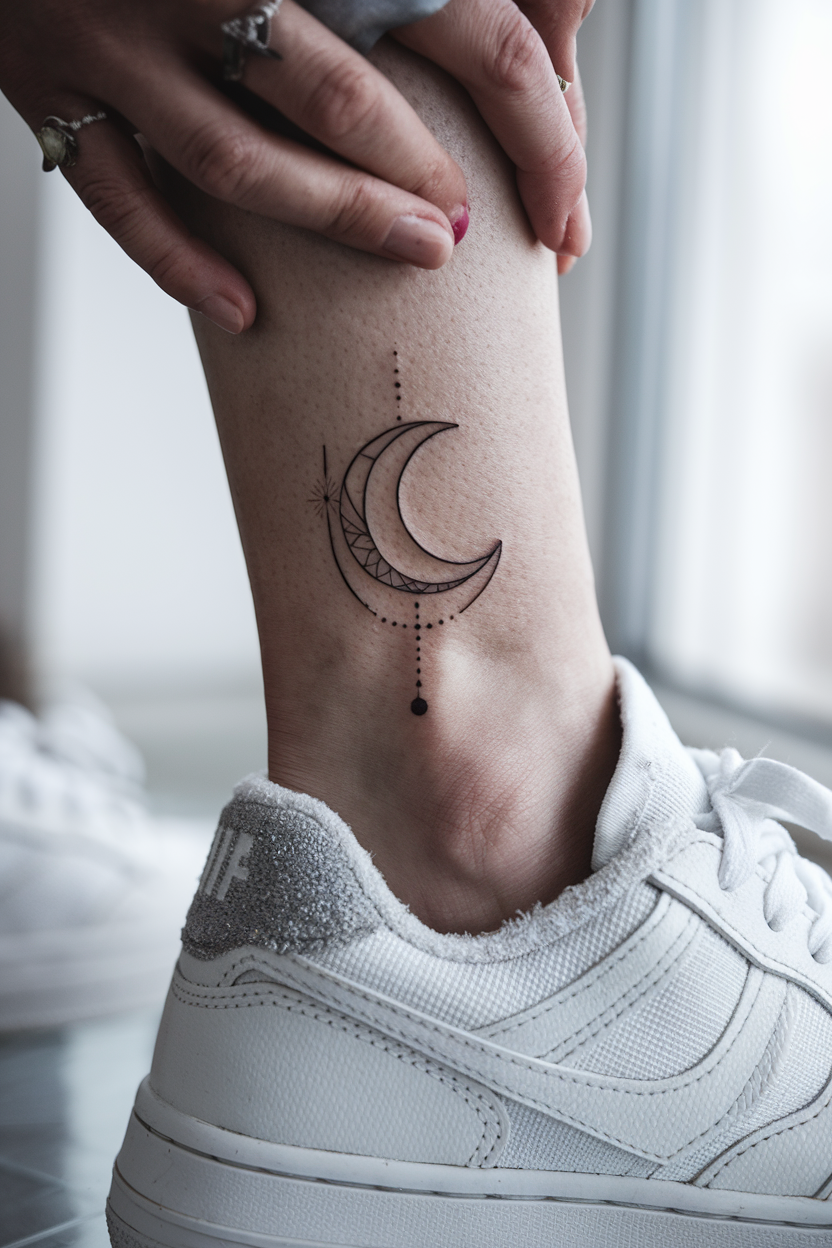
A koi reduced to a contour line and a handful of scale marks is a legitimate design, not a compromise.
It suits the inner forearm, the ankle, and the ribs, and it usually takes a single sitting.
Be honest with yourself about maintenance, though. Fine line work softens faster than bold work, especially on hands, feet, and anywhere that gets daily sun.
Where I have seen these age best is on the inner arm, which spends most of its life shaded.
Variations Worth Considering
If the standard koi layouts do not quite fit, these are the directions people most often end up taking instead.
Blackwork and Negative Space Koi
Solid black water with the fish left as bare skin is high contrast and holds up unusually well over time.
It is also a lot of black ink in one sitting, which means longer healing and more aftercare discipline.
Koi With Japanese Lettering
Adding a kanji or a short phrase alongside the fish is common, and it goes wrong more often than any other addition.
Have the characters checked by someone who reads the language — not by a translation app, and not by the artist unless they read it too. Japanese word tattoo ideas is worth a look before you decide.
Other Fish Subjects
Koi are not the only fish with a settled symbolic reading, and sometimes another subject fits the story better.
If you like the aquatic direction but not the carp specifically, the meaning behind flying fish tattoos is a reasonable place to start comparing.
Preparing for the Session and Caring for the Result
Bring three or four reference drawings rather than one, and be explicit about which element you care about in each — the pose in one, the water in another.
Ask to see the stencil on your skin before the needle starts, and stand up. A design that looks balanced while you are lying flat can sit crooked when you are upright.
For healing, follow the written instructions your artist gives you, because they know their inks and their technique. Broadly, that means keeping the area clean, moisturised, and out of direct sun, and not soaking it in a bath, pool, or hot tub until it has fully closed.
If you develop spreading redness, swelling that worsens after the first few days, pus, or a fever, contact a doctor rather than waiting it out. Allergic reactions to pigment — red ink is the usual culprit — can also appear weeks later and need medical assessment, not home remedies.
This article is general information rather than medical advice. The US FDA fact sheet on tattoos and permanent makeup is a sensible primary source on tattoo risks and pigment safety.
And to state the obvious: do not attempt to tattoo or remove a tattoo yourself. Both are done safely by trained professionals with sterile equipment, and neither is a home project.
Common Mistakes — and What to Do If You Are Still Not Sure
The most frequent mistake is choosing a drawing that is too detailed for the space it is going into. Detail that cannot be read from arm’s length is detail that will blur.
The second is treating the water as optional, which leaves the fish floating on skin with nothing to explain the pose.
The third is copying another person’s tattoo exactly. Most reputable artists will decline, and the good ones will offer you something better anyway.
If you are still undecided, it usually helps to narrow the placement first and the subject second. Browsing sleeve tattoo ideas by placement rather than by motif tends to clarify things quickly.
And if none of the koi layouts here feel right, that is useful information too — a design you are talking yourself into is a design worth postponing.
Frequently Asked Questions
Should my koi be swimming up or down?
Upstream is traditionally read as a struggle still underway, and downstream as a goal already achieved. Neither is considered unlucky, and artists do not treat one as a mistake. Choose based on which reading fits what the tattoo is marking. If the piece is purely decorative, pick whichever pose flows better with the limb.
How big does a koi fish tattoo need to be?
It depends entirely on how much detail the drawing carries. A minimal line-work koi works at eight or ten centimetres, while a design with individually rendered scales and a wave background usually needs a forearm, calf, or larger. As a rule, if you cannot make out the fin structure from arm’s length, the drawing is too detailed for that size. Your artist will tell you honestly if a reference will not shrink.
Does koi colour change the meaning?
In some tellings it does — red is associated with love or strength, black with overcoming hardship, and gold with prosperity. These readings vary between sources and regions rather than following one fixed code, so treat them as a starting point for a conversation with your artist. Plenty of people choose colour purely for how it sits against their skin tone. Both are valid reasons.
How long does a koi tattoo take to heal?
The surface usually closes within a couple of weeks, while the deeper skin settles over a month or two, and larger or heavily shaded pieces sit at the longer end. Follow the specific aftercare your artist gives you rather than generic advice from the internet. Keep it clean, out of the sun, and out of pools and baths until it has closed. If anything looks infected, see a doctor rather than waiting.
Can I add water or flowers to an existing koi tattoo later?
Often yes, but it rarely looks as cohesive as a design drawn that way from the start. An artist can build a background around an existing fish, though they are working around choices someone else already made. If you think you might expand the piece, say so at the first consultation so the original is drawn with room to grow. That one sentence saves a lot of compromise later.
Quick Summary
- Decide the swimming direction first — upstream for a struggle in progress, downstream for one already won.
- Have the water drawn as part of the design, never added afterwards.
- Match the level of detail to the placement; detail you cannot read at arm’s length will blur.
- Single vertical koi is the most adaptable layout and the easiest to expand later.
- Two-fish circular compositions need roughly sixteen centimetres or more to stay open as they heal.
- Bold outlines and strong contrast age better than fine line and soft grey.
- Have any Japanese lettering verified by someone who reads the language.
- Follow your artist’s written aftercare, and see a doctor for spreading redness, pus, or fever.