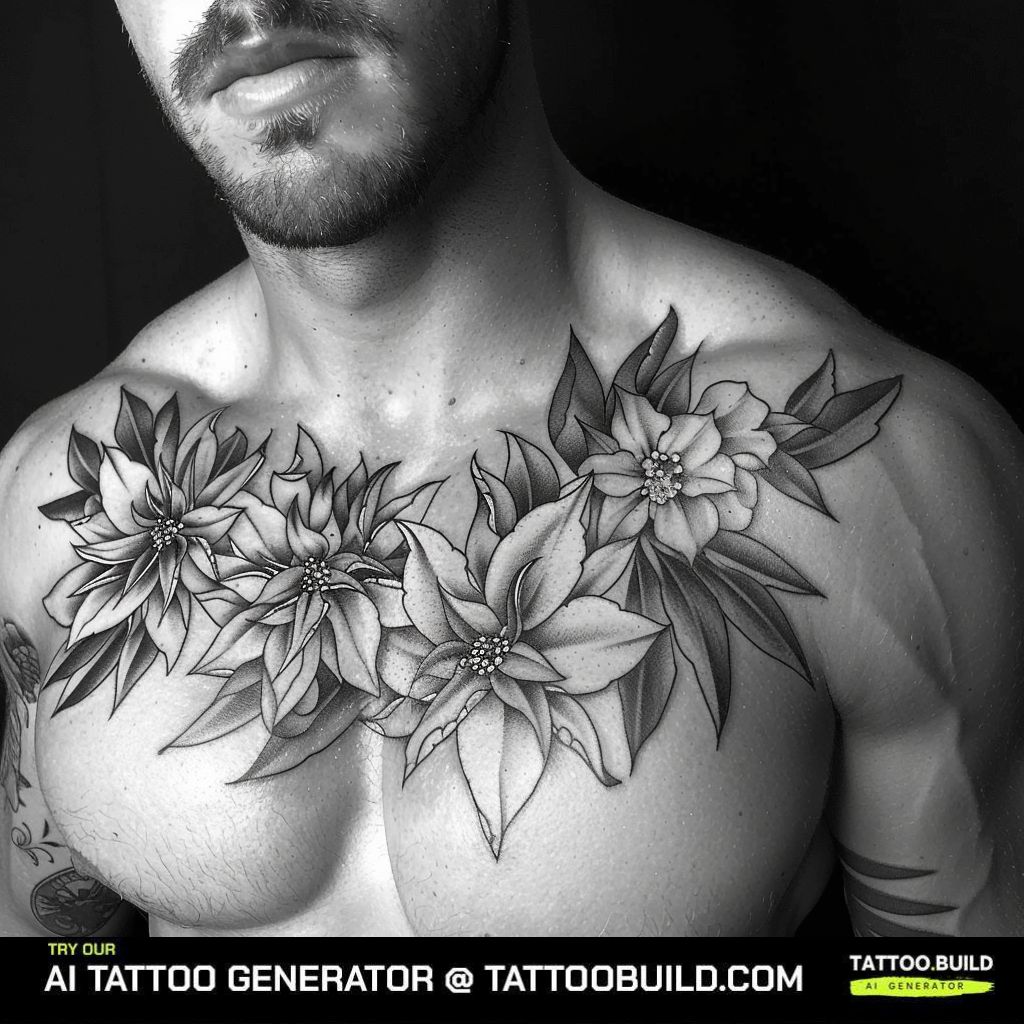
I have watched the lotus go from a quiet studio request to one of the three flowers I see on almost every flash sheet. The reason it keeps working is that it carries real meaning and it is one of the few floral shapes that survives being tattooed very small.
The symbolism is not marketing. In Buddhist and Hindu iconography the lotus roots in silt and opens clean above the water, which is why it reads as rebirth, clarity and coming through something difficult.
What most guides skip is the practical half. A lotus can be three lines on a wrist or a fully packed mandala across a back, and those two tattoos have almost nothing in common in terms of cost, session length or how they age.
Below are twenty designs I keep coming back to, grouped by style, with an honest note on what each one asks of you. If you are still deciding on a general direction, the spiritual tattoo ideas roundup is a useful companion read.
Which Lotus Tattoo Style Is Right for You?
This is the comparison I sketch out for people who arrive knowing they want a lotus and nothing else. Sizes are the smallest I would personally commit to for that style.
| Style | Smallest size I’d do | Typical sitting | How it ages | Best for |
|---|---|---|---|---|
| Fine line | 2 in / 5 cm | 1–2 hours | Softens; may need a touch-up in 5–10 years | Wrist, ankle, sternum |
| Geometric mandala | 4 in / 10 cm | 3–6 hours | Very well if dotwork is spaced properly | Forearm, thigh, back |
| Watercolor | 3 in / 8 cm | 2–4 hours | Fades fastest of the group; outline helps a lot | Shoulder blade, upper arm |
| Blackout / blackwork | 3 in / 8 cm | 2–5 hours | Excellent, but hard to cover or remove later | Upper arm, calf |
| Minimalist line | 1 in / 2.5 cm | 30–60 minutes | Good; thick-enough lines matter more than size | Finger, behind ear, wrist |
| Realistic / droplets | 4 in / 10 cm | 3–5 hours | Good in black and grey; needs the size | Forearm, shoulder, thigh |
What the Lotus Actually Means (and What It Doesn’t)
The core idea is consistent across the traditions that use the flower: it grows out of mud and opens unstained. That is the whole metaphor, and it is why the lotus is so often chosen after recovery, loss, or a hard chapter someone came out the other side of.
In Buddhist art the flower functions as a seat and a symbol of awakening rather than a decoration, which is worth knowing before you commit — you are wearing a religious symbol, not only a plant. The Metropolitan Museum’s overview of Buddhist art and iconography is a good non-commercial starting point.
Colour carries its own layer. White is usually read as purity, pink as the highest or most sacred form, red as compassion and the heart, blue as wisdom and restraint over the senses. These readings come from Buddhist iconographic tradition, not from a modern colour chart, and they vary by region.
Botanically the sacred lotus is Nelumbo nucifera, and it genuinely does hold its bloom above the water on a stalk rather than floating flat like a water lily — a distinction covered well in Britannica’s entry on the genus. Artists who get this right draw a stem; artists who don’t draw a water lily and call it a lotus.
What it does not mean: there is no single fixed number of petals you are obliged to use, and no rule that a closed bud is unlucky. Anyone telling you otherwise is inventing tradition.
Eight Lotus Flower Tattoo Designs Worth Copying
Each of these is a distinct build, not a variation of the same drawing. I have noted the placement each one is actually suited to rather than the one that photographs best.
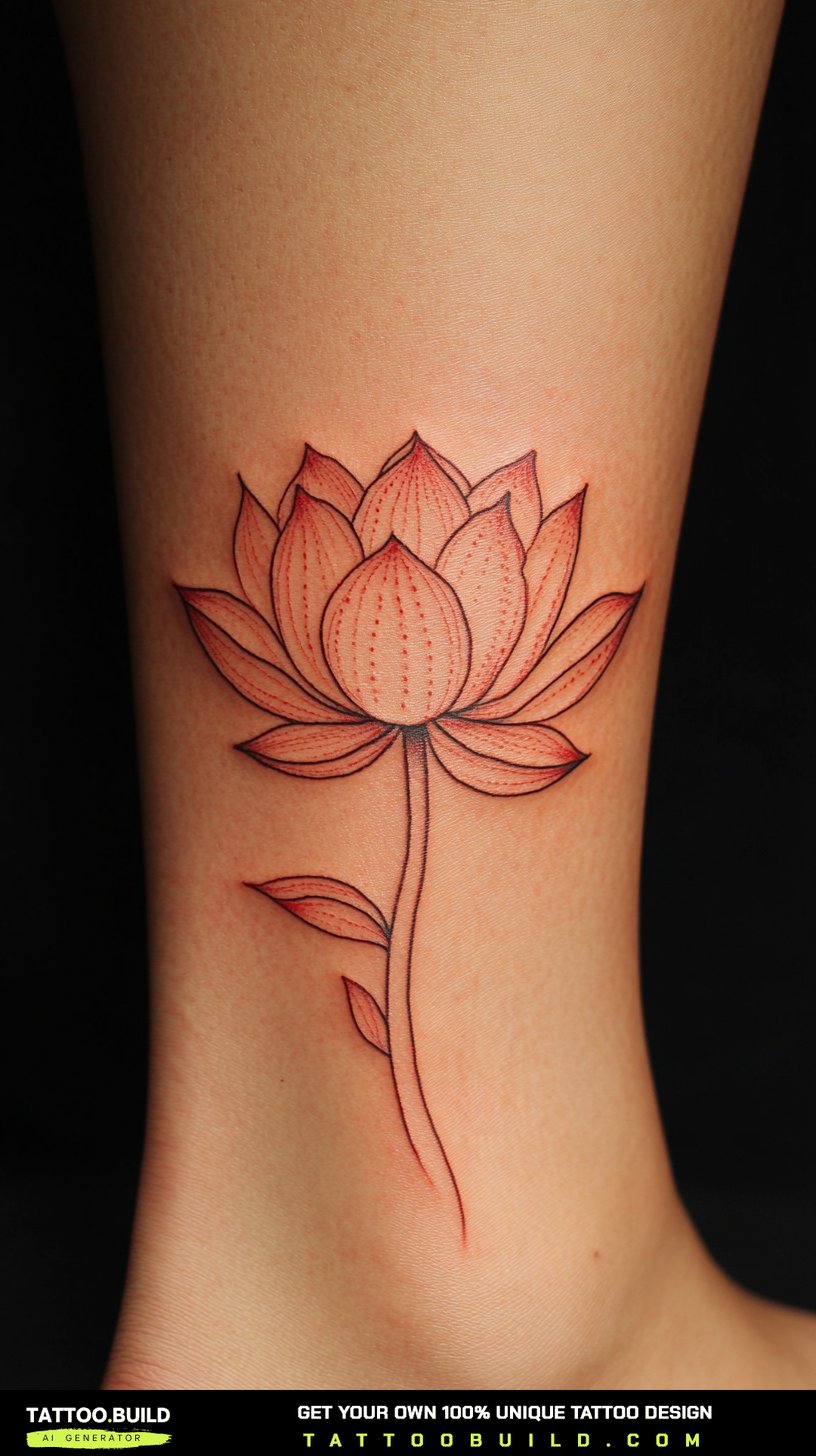
1. A single delicate lotus in fine-line style
This is the most requested lotus I see, and the one people most often get wrong by going too small. Fine line means a consistent thin needle grouping, usually a single needle or a tight three, with no shading to hide behind.
Because there is no fill, every millimetre of spacing between petals is visible. In my experience anything under about two inches starts to blur those gaps within a few years as the ink settles and spreads slightly under the skin.
It suits the wrist, the collarbone, the sternum and behind the ear. If that is your direction, the broader fine-line tattoo ideas guide covers what to ask an artist about line weight before you book.
Ask to see healed photos, not fresh ones. Fine line looks flawless the day it is done; the honest test is a photo at the twelve-month mark.
2. A fully bloomed lotus with water droplets
Droplets are a shading exercise, not a linework one. The convincing ones are built from a soft grey base with a hard white or bare-skin highlight, and no outline at all around the drop.
Every artist I have asked about this design says the same thing: give it room. Below about four inches the highlights merge with the shading and the droplets read as smudges.
It works best on the forearm, outer shoulder or thigh, where the skin is flat enough to keep the reflections consistent. Curved surfaces distort the highlight placement.
This is a black-and-grey design at heart. Adding colour underneath tends to fight the realism rather than support it.
3. A geometric lotus with mandala patterns
The lotus sits at the centre and the mandala radiates out from it in repeated rings of triangles, dots and arcs. Structurally this is the most demanding design on the list.
Symmetry is the whole game. When I have seen these go wrong it is almost never the lotus itself — it is a mandala ring that drifts a degree or two off centre and makes the entire piece look tilted on the limb.
Good artists stencil these in sections and check alignment against the body’s own centre line while you are standing, not lying down. If yours does not do that, be cautious.
Plan for four inches minimum and a three to six hour sitting. The lotus mandala tattoo ideas collection shows the range, and dotwork tattoos explains why dot spacing matters more than dot count.
4. A lotus floating on calm water with ripples
The ripples are what make this design specific. Remove them and you are left with a generic flower; keep them and the piece tells the mud-to-bloom story in one image.
The trick is restraint on the waterline. Two or three concentric arcs read as water; six read as a target.
A faint partial reflection below the surface adds depth cheaply, in ink terms, and it is the detail I would push for if the budget allows only one extra element.
Ribcage and outer thigh both suit it, because the horizontal waterline has room to sit level across a flat plane.
5. A lotus combined with a crescent moon
This pairing has become extremely common, which is not a reason to avoid it — but it is a reason to make yours structurally specific rather than generic.
The version that works has the crescent framing the bloom, arcing behind or beneath it, so the two shapes share a single silhouette instead of sitting side by side as two separate stickers.
Inner forearm is the placement I would choose, because both elements stay on one visual plane and the design does not wrap out of view.
If the moon is the part you care about most, moon phase tattoo ideas covers the ways to build it as the anchor element rather than an accent.
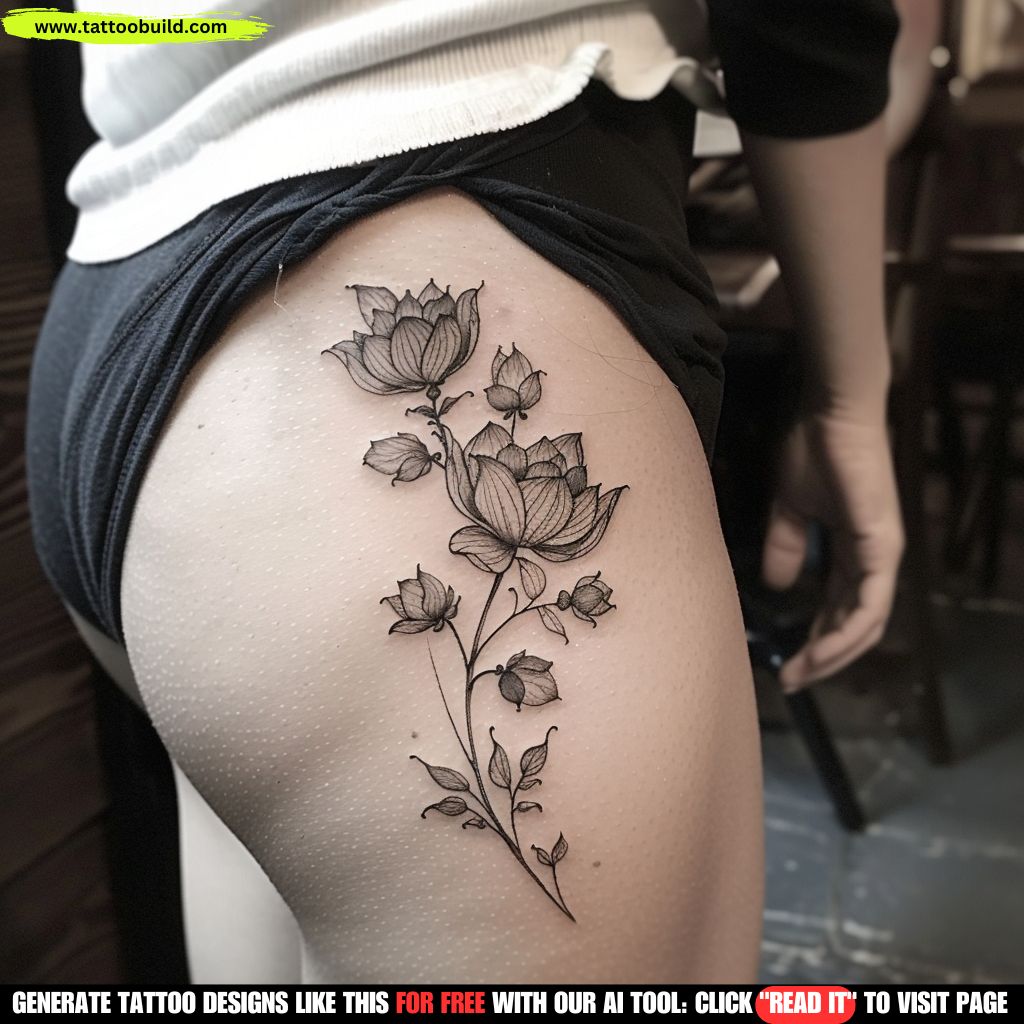
6. A lotus blooming from a thin, elegant stem
The stem is doing more work here than the flower. It turns a small, roughly circular bloom into a design that follows the length of a limb.
This is my usual recommendation for people who want something meaningful on the forearm or spine but do not want a large piece. A two-inch bloom on a six-inch stem occupies the limb properly while keeping the actual detail small.
Keep the stem line slightly thicker than the petal lines. When I have seen these age poorly it is because the stem was drawn at the same hairline weight and softened into near-invisibility.
Ribcage, spine, outer forearm and the back of the upper arm all take it well.
7. A watercolor lotus in blended pinks and purples
Watercolour is the highest-reward and highest-risk style on this list. Fresh, nothing else looks like it.
The single decision that determines how it ages is whether there is a structural outline underneath the wash. Purely outline-free watercolour spreads and dulls faster than any other approach I have watched over time.
A light black or dark-toned line skeleton, with the colour washed over and past it, gives you the painterly effect and something that still reads as a lotus a decade later.
Expect to plan for touch-ups sooner than with black and grey. watercolor tattoos goes deeper on pigment choices and placement, and shoulder blade or upper arm — areas with less sun exposure — will hold the colour longest.
8. A minimalist lotus of simple curved lines
Six or seven curves, sometimes fewer. This is a subtraction exercise and it is genuinely harder to design than it looks.
The failure mode is adding one curve too many, at which point it stops reading as deliberately minimal and starts reading as an unfinished sketch.
Ask for slightly thicker lines than feel right on the stencil. Very small tattoos with hairline weight are the ones I most often see back for touch-ups.
Finger, behind the ear, inner wrist and the back of the arm all work. minimalist tattoo ideas and tiny wrist tattoo ideas between them cover the placement trade-offs in more detail.
Bolder Variations Worth Considering
These two sit outside the delicate-floral lane most lotus tattoos occupy. Both are excellent choices — with caveats that deserve stating plainly.
Blackout lotus
Solid black fill with the petal separations left as negative space, so the untouched skin becomes the linework. It is the most graphically striking version of the flower.
Saturation is everything. Packing large areas of black evenly is a specific skill, and patchy fill is far more visible than patchy shading — ask specifically to see healed blackwork, not fresh.
Be clear-eyed about permanence: a large solid black area is difficult to cover with another tattoo and slow and expensive to lighten with laser. Choose this when you are certain, not as an experiment.
Upper arm and calf carry it best. blackwork tattoo ideas shows the range of what heavy black can do beyond floral work.
Lotus hand tattoo
The hand is the most visible placement on this list and the one that fades fastest, because of constant washing, sun exposure and friction.
Every artist I have asked treats hands as a touch-up-expected placement rather than a one-and-done. Some studios will not tattoo hands at all for exactly that reason, and some decline first tattoos there on principle.
If you go ahead, favour slightly bolder lines than you would elsewhere and keep detail away from the sides of the fingers, where ink drops out most reliably.
Think honestly about work and travel before booking. Visible hand tattoos still carry real professional consequences in some fields and some countries.
Aftercare and Practical Tips for a Lotus Tattoo
Follow the aftercare your artist gives you over anything you read online, including this. They know the ink, the depth they worked at, and your skin.
The general shape of it is consistent, though: keep the area clean with unscented soap, moisturise thinly rather than heavily, and keep it out of the sun while it heals. The American Academy of Dermatology’s guidance on caring for tattooed skin is a reliable, non-commercial reference.
Sunscreen once healed is the single highest-value habit for a lotus tattoo, and it matters most for watercolour and fine-line work, where there is no dense black to hide fading.
Spreading, increasing redness after the first few days, heat, pus, or a fever are not normal healing. Those are signs to contact your artist and, if they persist or worsen, see a doctor — this article is not medical advice, and an infection or an ink allergy needs a professional, not a forum thread.
Still Not Sure? Common Lotus Tattoo Mistakes
Going too small for the style. A mandala lotus at two inches is not a small mandala lotus — it is a grey blob in five years.
Booking a fine-line artist for a blackwork piece, or the reverse. These are different technical skills, and portfolios tell you which one someone actually has.
Choosing colour symbolism from a random chart without checking the tradition it came from. If the meaning is the point, spend an evening reading before you spend three hours in a chair.
Copying another person’s tattoo exactly. Most artists will decline, and the ones who agree are usually not the ones you want. Bring three references and ask for something built for your body instead.
Not thinking about how the piece will extend later. If a sleeve is even a possibility, say so at the consultation — it changes placement. Browsing spiritual tattoo ideas and lotus mandala tattoo ideas first will tell you whether a lotus is your whole plan or the start of one.
Frequently Asked Questions
What does a lotus flower tattoo symbolise?
The lotus is most commonly read as rebirth, resilience and spiritual clarity, because the plant roots in mud and opens clean above the water. In Buddhist and Hindu iconography it also represents awakening and purity of mind. Many people choose it to mark coming through a difficult period rather than for the flower itself. The meaning is genuinely traditional, not a modern invention, though the exact emphasis varies by region and school.
How much does a lotus tattoo cost?
It depends far more on style and size than on the lotus itself. A small minimalist line lotus is usually a shop-minimum piece taking under an hour, while a geometric mandala lotus can run three to six hours of an artist’s hourly rate. Watercolour and realistic droplet work sit in between and often need a touch-up session budgeted in. Ask for a quote at consultation rather than over message, since placement changes the estimate.
Where is the best placement for a lotus tattoo?
For fine-line and minimalist versions, the inner wrist, sternum, behind the ear and the ankle all work well. Mandala and realistic versions need a flatter, larger plane such as the forearm, outer thigh, shoulder or back. Single-stem designs are the most flexible, since the stem lets a small bloom follow the length of a limb. Hands and fingers look striking but fade fastest and usually need touch-ups.
Do lotus tattoos age well?
Black-and-grey and blackwork lotus tattoos generally age very well because the shapes are bold and the contrast holds. Fine-line work softens over time and often benefits from a touch-up somewhere in the five to ten year range. Watercolour without a structural outline underneath is the least predictable of the group. Sun exposure is the biggest variable in all cases, so daily sunscreen once healed matters more than the style you pick.
Is it disrespectful to get a lotus tattoo if I’m not Buddhist or Hindu?
Opinions differ, and it is worth hearing that honestly rather than getting a simple yes or no. The lotus is a widely shared botanical and artistic symbol across many cultures, and most practitioners I have spoken to do not treat the flower alone as restricted. Where more care is warranted is combining it with specific religious figures, deities or sacred text, and with placement — feet and the lower body are considered inappropriate for sacred imagery in several traditions. If it matters to you, ask someone from that tradition rather than a tattoo forum.
Quick Summary
- The lotus symbolises rebirth and resilience because it roots in mud and blooms clean — that meaning is traditional, not marketing.
- Style, not the flower, drives cost and sitting length: minimalist line under an hour, geometric mandala three to six hours.
- Fine line needs at least two inches to keep petal gaps readable as it settles.
- Realistic droplets are shading, not linework, and need roughly four inches of room to work.
- Watercolour ages far better with a light structural outline underneath the wash.
- Blackout lotus work looks superb and holds its contrast, but is hard to cover or remove later.
- Hand placements are the most visible and the fastest to fade — expect touch-ups.
- Daily sunscreen once healed is the highest-value habit for keeping any lotus tattoo sharp.