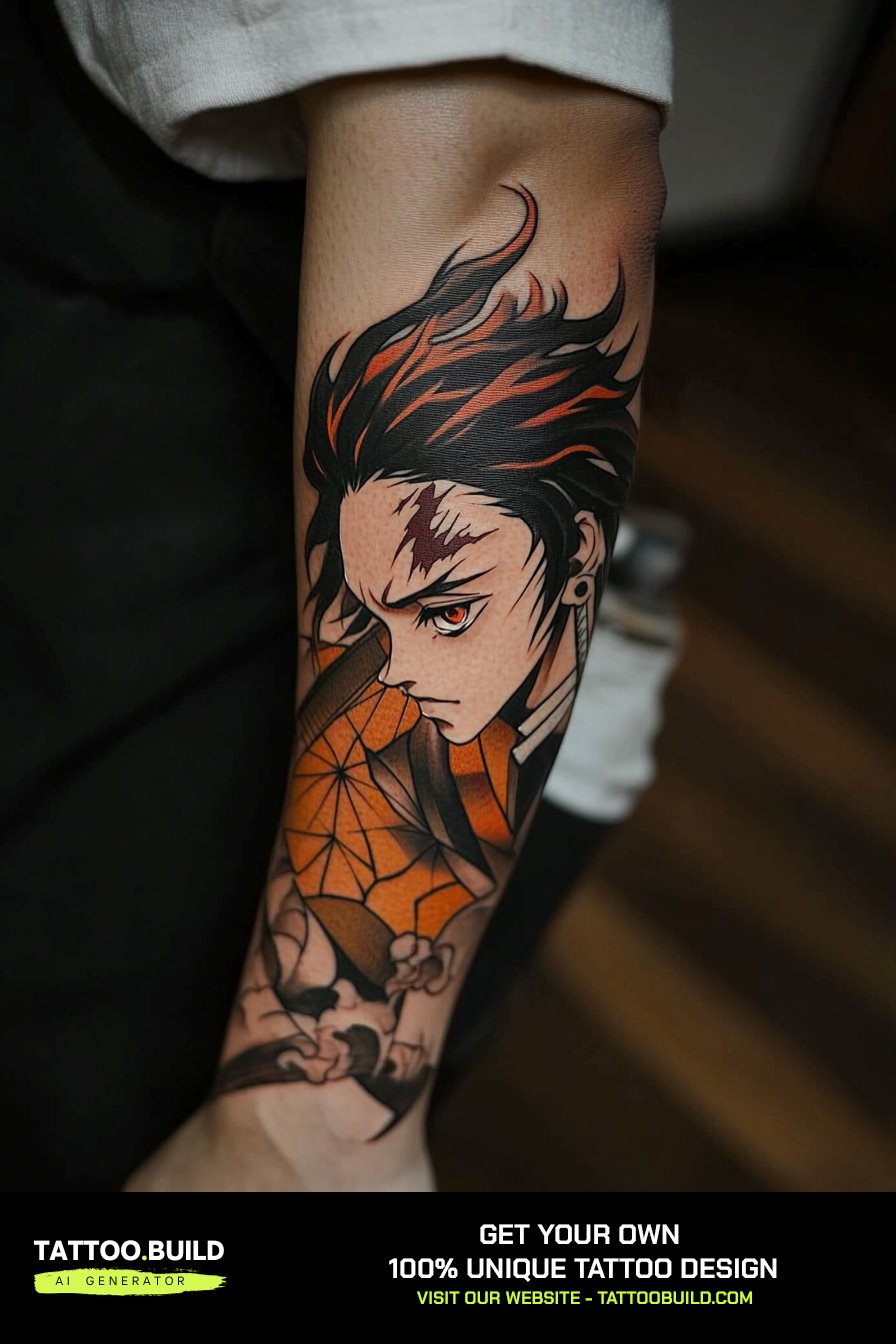
I have watched Demon Slayer go from a niche request to something an artist gets asked for most weeks, and the difference between the ones that land and the ones that do not usually comes down to restraint. A Demon Slayer tattoo works best when you commit to one character or one motif and let the artist build the whole composition around it, rather than trying to squeeze the entire cast onto a single forearm.
Kimetsu no Yaiba gives tattooers an unusual amount to work with: a colour palette built on teal, ember orange and deep indigo, patterns that already behave like traditional Japanese textile design, and a story about grief and persistence that people genuinely want on their skin for reasons beyond fandom.
If you are still deciding whether an anime piece is the right direction at all, it is worth browsing broader anime tattoo ideas first — the same composition rules apply across every series, and seeing them side by side makes the choice easier.
Below I have broken down the designs by character, by breathing style, and by the smaller symbols that tend to age better than a full portrait. There are real trade-offs in each direction, and I have tried to be honest about them.
Which Demon Slayer Tattoo Style Is Right for You?
Every approach below can carry the same character. What changes is how it reads from three feet away, how much it costs, and how it looks in ten years.
| Style | Best For | Typical Size | Honest Trade-off |
|---|---|---|---|
| Anime-accurate colour | Character portraits, breathing-style effects | Outer forearm to half sleeve | The brightest teals and oranges are the first pigments to soften; expect a touch-up in five to ten years |
| Japanese traditional (irezumi) | Full sleeves, back pieces, water and flame motifs | Sleeve or larger | Reads as a Japanese tattoo first and a Demon Slayer tattoo second — some fans find that too subtle |
| Black and grey realism | Single portraits, Muzan, Rengoku | Palm-sized to forearm panel | Loses the colour cues that make characters instantly recognisable |
| Fine line / minimal | Hanafuda earrings, katana, crest symbols | Two to four inches | Thin lines spread over time, especially on hands, ribs and feet |
| Neo-traditional | Nezuko, Shinobu, anything with a decorative border | Forearm panel or thigh | Bold outlines change the character’s face shape — it will not look exactly like the screencap |
Why Demon Slayer Designs Translate So Well to Skin
Most anime does not tattoo well. The line weight is too even, the faces are too smooth, and the colour is flat — put it on an arm and it turns into a sticker.
Demon Slayer is an exception, and the reason is that Ufotable built the show on motifs that Japanese tattooing has been using for centuries. Water breathing is drawn as ukiyo-e wave crests. Flame breathing is drawn the way traditional artists render fire.
That overlap is the single biggest reason these pieces succeed — an artist who already tattoos Japanese work has the vocabulary for the effects, and can build background around them instead of leaving dead space.
The patterns help too. Tanjiro’s black-and-green check, Zenitsu’s triangle scale pattern and Nezuko’s hemp-leaf asanoha print are all real textile designs, which means they fill negative space cleanly and still look intentional to someone who has never watched the show.
There is a practical upside as well. If you eventually want to expand a single character into a sleeve, the wave, flame and cloud filler is already part of the visual language, so the addition will not look bolted on. That is the sort of thing worth checking against wider Japanese tattoo designs before you commit to placement.
Demon Slayer Tattoo Ideas by Character
These are the requests I see most often, roughly in order of popularity, with what each one actually demands from the artist.
Tanjiro Kamado
Tanjiro is the default choice and the hardest to make interesting, because everyone brings in the same three reference images.
The pieces that stand out usually crop tight — just the head and the raised sword, with the hanafuda earrings catching the light — rather than trying to include his full body and haori.
His forehead scar and the black-green checked pattern are the two elements that make him readable at a glance. If your artist has to shrink the design, those are the last things to sacrifice.
In my experience a Tanjiro portrait needs at least five inches of height to hold facial detail. Below that, the eyes flatten out within a couple of years and he starts to look like a generic anime figure.
Nezuko Kamado
Nezuko is the most requested character among the people I have talked to, and she is more forgiving than Tanjiro because her design carries so much colour.
The bamboo muzzle, the pink-tipped hair and the asanoha kimono give an artist three separate colour anchors, so even a small piece stays recognisable.
Blood Demon Art versions — pink flame wrapping the figure — are where she really works. The flame gives the composition a shape instead of leaving a floating portrait.
One honest warning: pink is among the least stable tattoo pigments over long exposure to sun. If you want her on a forearm, plan on sunscreen becoming a habit.
Zenitsu Agatsuma
Zenitsu is the best value in the entire cast for a tattoo, because Thunder Breathing gives you a design even without a face.
Yellow-to-orange gradient hair, the triangle-scale haori and a single fork of lightning will read as Zenitsu to anyone who knows the show.
The sleeping-Zenitsu pose — head down, blade drawn, lightning arcing outward — is a stronger composition than his awake expression, and it is a lot easier to tattoo well.
Yellow is the trickiest colour in tattooing. On darker skin tones it can disappear almost entirely, so ask your artist for a healed photo on skin similar to yours before you book.
Inosuke Hashibira
The boar mask is the design. Inosuke without it is just a young man with long hair, and the recognition collapses.
That mask happens to be excellent tattoo material — it has hard edges, a clear silhouette and enough texture to hold shading, which is exactly what a small piece needs.
A mask-only tattoo, no figure at all, is my usual recommendation for people who want Inosuke on a calf or upper arm. It sits comfortably alongside traditional Japanese mask work.
If you do want the full figure, twin blades crossed behind him give the composition a frame and stop it from drifting into an empty area of skin.
Giyu Tomioka
Giyu is the connoisseur pick. He is quieter than the others, and the half-and-half haori — solid maroon on one side, geometric print on the other — is a gift for a tattooer.
Pair him with Water Breathing wave forms and you effectively have a small Japanese-traditional panel that happens to contain a character.
Every artist I have asked who tattoos a lot of Japanese work says Giyu is the easiest Demon Slayer request to say yes to, because the surrounding water does the heavy lifting.
That also means he scales up well. A Giyu forearm piece can grow into a sleeve later without redesigning anything.
Shinobu Kocho
Shinobu brings butterflies, and butterflies are already one of the most tattooed motifs there is — which cuts both ways.
On the plus side, any artist can handle the wing structure, and the purple-to-teal gradient on her haori is genuinely beautiful on skin.
On the minus side, a small Shinobu piece can read as a generic butterfly tattoo to anyone outside the fandom. Keep her hairpin and the gradient haori in frame if that matters to you.
If the insect side appeals more than the character, it is worth comparing against standalone butterfly tattoo ideas before you settle.
Kyojuro Rengoku
Rengoku is the emotional one. Most people asking for him are not asking for a character — they are asking for the line about setting your heart ablaze.
Flame Breathing renders as traditional Japanese fire almost exactly, so a Rengoku piece can be as large and as loud as you want without looking cluttered.
His yellow-and-red hair needs a confident colour packer. Done badly it turns muddy orange within a year; done well it is the most striking piece in this entire list.
I have seen more Rengoku memorial tattoos than any other Demon Slayer design, usually with a date or a short line of text worked into the flame.
Muzan and the Upper Moons
Villain tattoos are a smaller slice of requests but often the most striking, because the designs are less constrained.
Muzan’s red eyes with the kanji numerals, Akaza’s blue combat markings and Douma’s rainbow irises all give an artist something unusual to work with.
The Upper Moon eye kanji on its own — just the numeral in a red iris — is one of the few Demon Slayer designs that works genuinely small, down to about two inches.
If you like the direction but not the specific characters, broader demon tattoo ideas cover the same territory without tying you to one series.
Breathing Styles as Tattoo Motifs
If you want the show without a face on your arm, this is the section that matters. Breathing styles are pure pattern, and pattern is what tattooing does best.
Water Breathing
The most tattooable of the lot. Water Breathing is drawn as stacked, curling wave crests that are almost identical to the ones in classic Japanese woodblock prints.
It works at any size, on any placement, and in black and grey or full colour. A wave wrap around a forearm with a small katana silhouette is about as safe a Demon Slayer tattoo as exists.
Because it is abstract, it also ages better than anything with a face. There is no fine detail to blur.
Flame Breathing
Flame Breathing is the loudest option and the one that most needs a skilled colour packer.
Traditional Japanese fire uses layered orange, red and black with hard-edged tongues, and the anime version follows it closely enough that reference from either source works.
My honest advice: if a shop’s portfolio has no healed colour work in it, do not get Flame Breathing there. It is the least forgiving thing on this page.
Thunder Breathing
Lightning is graphic, high-contrast and reads instantly from across a room, which makes it excellent for smaller placements.
The trick is asymmetry. A single main fork with two or three secondary branches looks like lightning; an even, symmetrical bolt looks like a logo.
Solid black lightning with a thin yellow highlight ages far better than a fully yellow bolt, and I would push most people toward that version.
Sun Breathing and the Hinokami Kagura
Sun Breathing is the origin of every other style in the series, and visually it is the most ambitious: a full solar disc with radiating flame.
It is also the most flexible, because a sun motif stands on its own even to someone who has never watched an episode of the show.
Circular designs sit well on shoulders, upper backs and the outer thigh, where the skin is relatively flat. On a forearm the circle distorts.
For layout ideas beyond the anime version, it is worth looking at general sun tattoo designs — the geometry problems are identical.
Symbols, Patterns and Smaller Designs
Not everyone wants a panel. These are the pieces that fit on a wrist, an ankle or behind an ear, and several of them are the ones I would actually recommend first.
Hanafuda Earrings
The single best small Demon Slayer tattoo. Two rectangular cards with a red sun disc and radiating lines — simple, symmetrical, and unmistakable to anyone who knows the series.
They work as a matched pair on either side of the neck or behind the ears, or as a single card on the inner wrist.
Keep the linework medium weight rather than hairline. The red disc is small, and a too-thin border around it will close up as the tattoo settles.
Wisteria Flowers
Wisteria repels demons in the story, which makes it the closest thing the series has to a protective symbol — and protective symbols are what people tattoo for real reasons.
Hanging purple clusters follow the line of a spine, a collarbone or the back of an arm beautifully, and they are soft enough to pair with almost anything else.
This is the design I would suggest to someone who loves the show but does not want it to be obvious. Most people just see flowers.
Haori Patterns and Textiles
Tanjiro’s black-and-green check, Nezuko’s asanoha hemp leaf, Zenitsu’s triangle scales and Giyu’s split geometric print are all usable as standalone designs.
A pattern band around a bicep or ankle is subtle, easy to tattoo well, and holds its shape indefinitely because there is no fine detail to lose.
These are also the cheapest entry point. A simple band is usually a short sitting rather than a multi-hour session.
The Demon Slayer Mark and Corps Crest
The flame-shaped marks that appear on characters at their limit are among the more personal choices, usually placed where the character wears them.
The Corps uniform crest — the kanji for destroy across the back — is the boldest option here and needs real scale to look deliberate.
If you are considering Japanese characters, please have the kanji checked by someone who reads Japanese before it goes on. It is the single most common regret in this whole category, and Japanese word tattoo ideas is a better starting point than a screenshot.
Placement and Sizing: What Actually Fits Where
Placement decides more about how a Demon Slayer tattoo turns out than the artwork does. Here is the short version of what I have seen work.
Outer forearm is the default for a reason — flat, visible, and roughly seven inches of usable height, which is enough for a single character with a bit of background.
Upper arm and shoulder suit circular designs like the Hinokami Kagura and anything with a flame halo. Calves take vertical figures well and hold colour better than most people expect.
Ribs, sternum and inner bicep hurt considerably more and are usually a poor choice for a first piece with this much detail. Hands, fingers and feet will need touching up on a repeating basis; that is not pessimism, it is just how those areas behave.
Variations Worth Considering Before You Book
If none of the above is quite right, these are the directions people most often end up taking instead.
Blackwork and Silhouette Versions
Solid black silhouettes of the characters mid-swing, with the breathing effect in negative space, cost less, heal faster and are essentially permanent in appearance.
The trade-off is real: you lose every colour cue, so the design leans entirely on pose and silhouette.
Manga Panel Tattoos
A screentone-heavy manga panel, complete with speech bubble, is an increasingly common alternative to a clean anime portrait.
These need an artist comfortable with dot and line texture. Ask specifically for healed examples of screentone work — it is a distinct skill.
Japanese Traditional Fusion
Rather than tattooing the character, you tattoo the world: waves, flame, wisteria, a nichirin blade, a demon mask, all in classic irezumi construction.
This is the version most likely to still look good in twenty years, and the version most likely to disappoint a fan who wanted the actual character. Both things are true.
Watercolour and Splash Styles
Blood Demon Art in particular suits a loose watercolour treatment, with pigment bleeding outward from the figure.
Be aware that unlined watercolour work generally softens faster than lined work. If you like the look, watercolour tattoo ideas is worth reading first so you know what you are signing up for.
Aftercare and Keeping the Colour
A colour-heavy anime piece is more demanding to heal than a small black tattoo, and the first three weeks decide how it looks for the next decade.
Follow the specific aftercare your artist gives you rather than anything you read online, including this page — they know their inks, their needles and their local climate. In general that means keeping the tattoo clean, lightly moisturised and out of soaking water while it heals.
Sun is the main long-term enemy of a Demon Slayer tattoo. Once healed, high-SPF sunscreen on exposed placements does more to preserve the teals, pinks and yellows than any product sold specifically for tattoos.
If you see spreading redness, swelling that worsens after the first few days, heat, pus, or you develop a fever, contact a doctor rather than your artist. Tattoo infections and pigment allergies are medical issues, not aesthetic ones, and both are treatable when caught early. The American Academy of Dermatology publishes plain-language guidance on what normal healing looks like and when to seek help, and the US FDA covers ink safety and reaction risks. Nothing on this page is medical advice.
One last practical note: never attempt to tattoo or remove anything yourself. Removal in particular is a laser procedure that belongs with a licensed practitioner, and DIY attempts scar.
Common Mistakes — and What to Do Instead
Bringing a phone screenshot as the only reference. Anime frames are low resolution and flat; give your artist a few images and let them redraw it for skin.
Going too small. Almost every disappointing anime portrait I have seen was simply under-sized for the amount of detail packed into it.
Choosing an artist by price rather than portfolio. Ask for healed colour photos, not fresh ones — fresh work always looks good.
Trying to include three or four characters at once. Pick one, build the composition properly, and add the others later as separate panels if you still want them.
Still weighing it up? Comparing across series helps more than staring at the same designs. One Piece tattoo ideas and samurai tattoo ideas cover similar territory, and cherry blossom tattoos pair naturally with anything in this article if you want softer filler around a character.
Frequently Asked Questions
How much does a Demon Slayer tattoo cost?
It depends almost entirely on size, colour and your artist’s hourly rate, and rates vary widely by city, so any figure I gave you would be misleading. As a rough shape: a small hanafuda earring or pattern band is usually a single short sitting, a coloured forearm character is commonly several hours, and a sleeve is a multi-session project booked over months. Ask for a quote in hours rather than a flat price, since that is how most artists actually think about it. Colour packing takes longer than line and grey, so expect a colour piece to run above a black and grey version of the same design.
Which Demon Slayer character makes the best tattoo?
Nezuko and Tanjiro are the most requested, but if you want the piece to look good longest, Giyu Tomioka or a pure Water Breathing design are the smarter picks because they sit naturally inside Japanese traditional tattooing. Zenitsu gives you the most recognition for the least detail, thanks to the lightning. For a small tattoo, the hanafuda earrings beat every character portrait. The best choice is genuinely the one that means something to you — recognisability is a secondary concern.
Will a colour Demon Slayer tattoo fade?
Every tattoo changes over time, and bright colours change fastest. In most cases the teals, pinks and yellows that make these designs pop will soften noticeably over five to ten years, faster on sun-exposed placements like forearms. Sunscreen is the single most effective thing you can do about it. A touch-up session down the line is normal and expected rather than a sign anything went wrong.
Is it disrespectful to get an anime tattoo in a Japanese style?
Opinions differ, and it is worth hearing more than one. Japanese traditional tattooing carries real cultural history, and some practitioners feel strongly about how its motifs are used; others tattoo anime-influenced Japanese work happily and see it as part of a living tradition. The most practical step is to talk it through with an artist who specialises in the style — they will tell you where they personally draw the line, and that conversation is more useful than a rule.
Can I get a Demon Slayer tattoo over an existing tattoo?
Sometimes, but it depends on how dark and how large the existing piece is, and it needs an artist who does cover-ups specifically. Colour anime work is a difficult cover-up because it relies on bright pigment, and bright pigment does not sit over dark ink. In many cases a few sessions of laser lightening first will give a much better result than trying to cover directly. Bring the existing tattoo to a consultation and let the artist tell you honestly whether it can work.
Quick Summary
- Pick one character or one motif and build the whole composition around it rather than combining several.
- Water Breathing, wisteria and haori patterns age better than any portrait because they have no fine facial detail to lose.
- Nezuko and Tanjiro are the most requested; Giyu and Zenitsu are often the better tattoos.
- Hanafuda earrings are the strongest small design in the series, at around two to three inches.
- Outer forearm, upper arm and calf are the most forgiving placements; hands, fingers and feet will need repeat touch-ups.
- Colour work needs an artist with healed colour photos in their portfolio — ask to see them, not fresh work.
- Sunscreen after healing does more for long-term colour than any tattoo-specific product.
- Treat spreading redness, worsening swelling, pus or fever as a medical issue and see a doctor, not your artist.
More Demon Slayer Tattoo Inspiration
A final set of references to bring to your consultation. Save the ones that share a composition, not just a character — that is the information your artist actually needs.