Looking for demon tattoo ideas that hold up past the first Instagram scroll? The demons that age best are the ones built on silhouette and contrast, not on tiny detail that blurs into a grey smudge within a decade.
I have been collecting and photographing this motif for years, and the pattern is consistent. The pieces people still love at year eight are bold, simple in shape, and placed somewhere the skin does not stretch much.
Demons carry more range than almost any other dark motif. They can read as menacing, mournful, protective, or genuinely funny, depending entirely on the eyes and the linework. If you want the softer end of that range, the angel and devil tattoo pairing is a good place to start.
Below are eight directions worth considering, with real placement notes, honest ageing advice, and the trade-offs nobody mentions until you are already in the chair.
Which Demon Tattoo Style Is Right for You?
Style matters more than subject here. The same horned face looks completely different in heavy blackwork than it does in fine line, and the two age on entirely different timelines.
| Style | Best For | Sensible Size & Placement | How It Ages |
|---|---|---|---|
| Heavy blackwork | Menacing silhouettes, oni masks, bound demons | 6 inches and up — outer arm, back, thigh | Excellent. Solid black holds its edge longest of anything |
| Black & grey realism | Reaper portraits, fragmented faces, demon busts | 7 inches and up — forearm, chest, calf | Good if contrast is strong; soft mid-greys fade first |
| Neo-traditional | Female demons, demon and crow pairings | 5–8 inches — upper arm, thigh, shoulder | Very good. Bold outlines contain the colour as it softens |
| Fine line / single needle | Small ankle demons, subtle horned motifs | 2–4 inches — ankle, inner arm, ribs | Weakest of the four. Expect softening and possible touch-ups |
| Cute / cartoon | Playful devils, heart-tailed imps | 2–5 inches — forearm, ankle, behind the ear | Good, provided the outline is bold rather than hairline |
What a Demon Tattoo Actually Says
There is no single meaning, and anyone who tells you otherwise is selling something. Meaning here comes from culture, context, and what you tell people when they ask.
In a lot of Western work, the demon stands in for an internal struggle rather than an external evil. Addiction, grief, anger, a period someone survived — the demon is the thing that was faced, not worshipped.
Japanese-influenced designs work differently. The hannya mask represents a woman transformed by jealousy and sorrow, and reads as tragic as much as frightening. Oni figures were often protective, warding off worse things.
The practical upshot is that you should decide your own one-sentence explanation before you book. You will repeat it more times than you expect, and it shapes which version of the design you actually want.
Every artist I have asked about this says the same thing: clients who can explain their demon in a sentence end up with better tattoos, because the brief is tighter. If you want the aesthetic without the mythology, gothic tattoo drawings cover similar ground with less to explain.
Eight Demon Tattoo Ideas Worth Considering
These are grouped by concept rather than by style, so each one can be executed in whichever column of the table above suits you.
1. Demon in Bondage
A demon wrapped in chains is the most literal version of the inner-conflict idea, and it is popular for a reason — the imagery explains itself.
What makes it work technically is that chains give the artist a built-in structure to wrap around the body. On a shoulder or a calf, the links follow the muscle instead of sitting flat on it, which is why these pieces look alive when you move.
I would push for larger here. Chain detail at three inches turns into a grey rope within a few years, and the whole point is lost. Six inches and up, on the outer arm, back, or thigh, is where this design breathes.
Ask your artist to keep the demon’s face slightly obscured. The restrained-but-still-dangerous read is much stronger than a fully visible snarl, and it dates less quickly.
2. Grim Reaper Demon
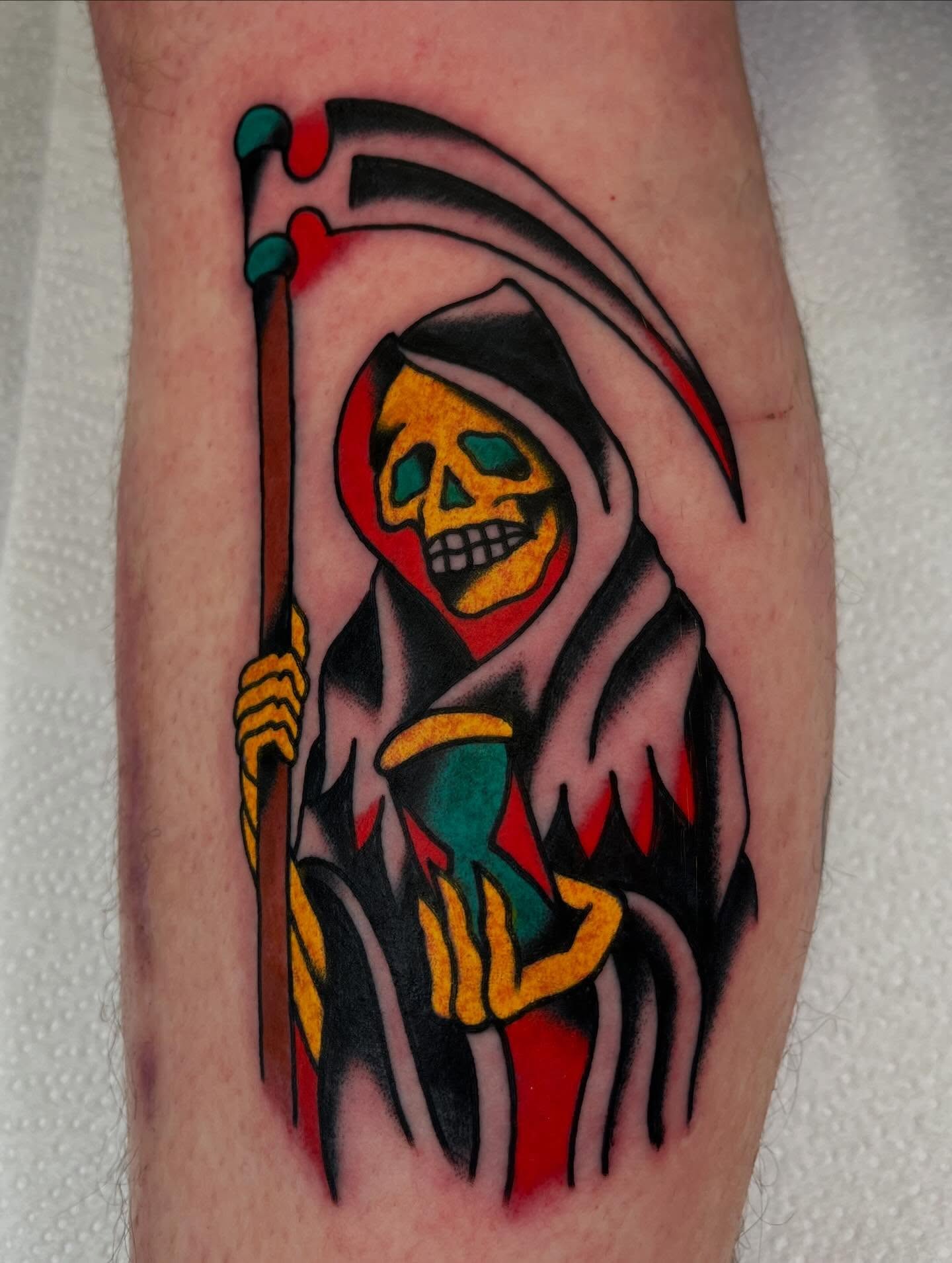
The reaper is not strictly a demon in most traditions, but it has been absorbed into the same visual family, and the crossover pieces are some of the strongest in this whole category.
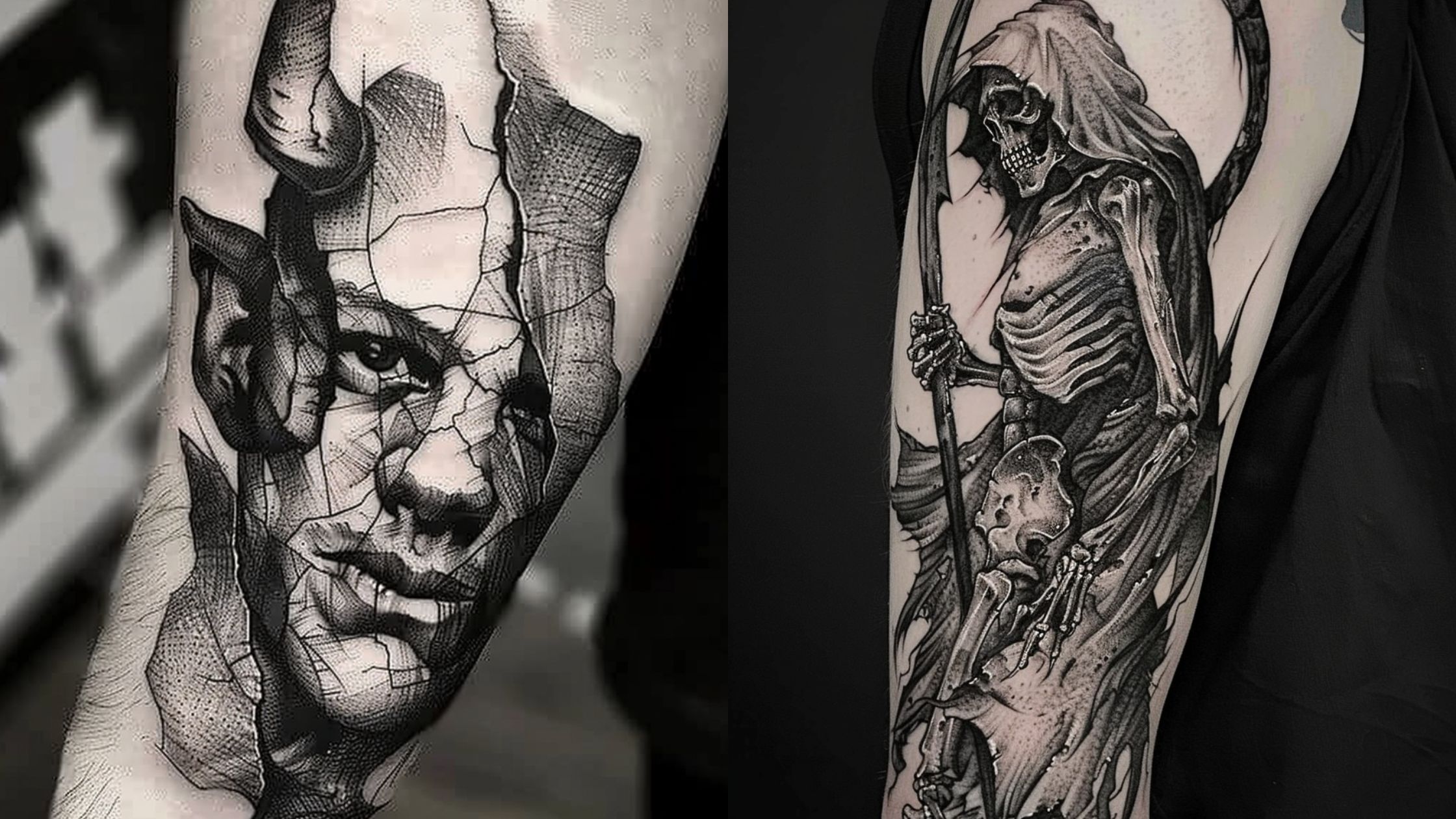
The hood is the reason. It creates a huge area of solid black or deep shading that anchors the design, and it hides the boundary where the tattoo meets bare skin. That soft edge is what makes a piece look like it belongs on the body rather than stuck to it.
Forearms and calves suit it well because the vertical shape of a cloaked figure matches the shape of the limb. Chest and back pieces work too, but you are then committing to a much longer session.
If this direction appeals to you, the wider grim reaper tattoo ideas collection has more compositions than I can fit here.
3. Demon Ankle Tattoo
Small demons on the ankle are the most requested version I see from people getting their first dark piece, and they are the easiest to get wrong.
The ankle is a difficult location: thin skin, bone directly underneath, and constant friction from socks and shoes. It is one of the more uncomfortable spots on the body, and healing is slower because the area moves every time you walk.
Design-wise, strip it back further than feels natural. Horns, a tail, an outline — that is enough. Anything with internal shading at this scale will close up over time as the ink spreads slightly under the skin.
Plan for a touch-up at the twelve-month mark and budget for it. On feet and ankles that is normal maintenance, not a failure by the artist. There are more small options in the ankle tattoo ideas roundup.
4. Demon Head Tattoo
Just the head — no body, no scene. This is the most versatile demon tattoo idea on the list because it scales from a two-inch filler piece to a full back panel without changing the concept.
Horns are doing the heavy lifting. They give the design a distinctive outer silhouette, which is what lets people recognise it from across a room. Wide curved horns read better than tall narrow ones at small sizes.
When I have looked at these healed after several years, the ones that held up best had a strong shadow under the brow and genuinely dark blacks in the mouth. Mid-grey faces went flat much faster.
Contrast is the single biggest predictor of how a demon head will look in a decade. If your reference has ten shades of grey and no true black, ask the artist to push it darker.
5. Fragmented Demon Face
A face breaking apart into shards, cracks, or geometric fragments. It is a newer look and it photographs extremely well, which is partly why it has spread so fast.
The concept usually reads as a mask slipping, or a persona coming apart. That is a genuinely different idea from most demon work, which tends to be about a fixed identity rather than a changing one.
Technically this is demanding. The fragments only work if the negative space between them is planned in advance — scattered gaps look like patchy healing rather than intentional design. Ask to see healed photos of this specific style from your artist, not fresh ones.
Size matters more than usual. Under six inches, the fragments merge and you lose the effect entirely. Forearm, outer arm, and thigh are the practical minimums.
6. Cute Demon Tattoo
Flipping the motif entirely: big eyes, small horns, a heart-tipped tail. These are some of my favourite pieces in the category because they are doing something with the symbolism rather than just repeating it.
The joke lands because the viewer expects menace and gets mischief instead. That contrast is the whole design, so lean into it — a half-cute demon reads as indecisive.
Bold outlines are non-negotiable here. Cartoon styling depends on clean shape recognition, and hairline outlines at three inches will soften until the character loses its face.
Colour is worth considering for this one specifically. Reds and pinks fade faster than black, but on a small playful piece the fade is far less damaging than it would be on a realistic portrait.
7. Beautiful Female Demon
Succubus and she-devil portraits sit at the intersection of dark and decorative, and they are among the most requested designs I hear artists mention.
The eyes decide everything. A demon portrait with well-executed eyes is striking; one with slightly-off eyes is unsettling in the wrong way and impossible to fix later without a cover-up.
This is the design where artist selection matters most. Ask specifically for healed portrait work in their portfolio — not designs, not fresh photos. Portraiture is a distinct skill from linework and not every good tattooer has it.
Roses, snakes, and smoke are the common supporting elements. They give the composition somewhere to fade out at the edges. If you like this direction generally, dark feminine tattoos explores the softer end of the same aesthetic.
8. Demon and Crow
Pairing a demon with a crow or raven stacks two dark symbols in one piece, and the black plumage gives the artist a natural excuse for large areas of saturated ink.
Wings are the practical advantage. Outstretched, they fill a shoulder blade or upper back beautifully; folded, they compress into a much smaller vertical shape for a forearm.
The risk is visual clutter. Two detailed subjects competing in the same composition can end up as a dark blob at a distance. Ask your artist to make one subject dominant and let the other support it.
Crows carry their own long symbolic history, covered in more depth in the crow tattoo ideas guide, and the two meanings do not always sit comfortably together — worth thinking about before you commit.
Variations Worth Considering
If none of the eight above is quite right, these adjacent directions come up constantly in consultations.
Oni and Hannya Masks
Japanese demon masks bring a formal design language with centuries of refinement behind it. The shapes are already optimised for readability, which is a real advantage.
Do the reading first, though. These carry specific cultural meaning, and getting one because it looks cool without knowing what it represents is a conversation you will have to have repeatedly.
Angel Versus Demon
The split composition — half angel, half demon — is a well-worn idea, which is exactly why it works. Everyone understands it instantly.
Execution separates the good ones from the generic. Look for designs where the two halves share a single silhouette rather than sitting side by side as separate figures.
Demon-Adjacent Anime Work
Anime-influenced demon designs have driven a lot of new interest in this category, particularly among younger clients. Bold outlines and flat colour make them technically well suited to tattooing.
If that is your entry point, Demon Slayer tattoo ideas covers that lane specifically, including the placement questions that come with character work.
Pure Blackwork Abstraction
Some of the strongest dark pieces I have seen barely depict a demon at all — just horns, shadow, and negative space suggesting a shape.
These age exceptionally well and are far less likely to feel dated, since there is no specific rendering style to fall out of fashion. Blackwork tattoo ideas show the range of what is possible.
Getting a Demon Tattoo That Ages Well
Dark, heavily saturated work asks more of your skin than a small line drawing does, and the healing is correspondingly less forgiving.
Follow your artist’s aftercare instructions rather than anything you read online, including this page — they know what ink and technique they used on you. In general, expect to keep the area clean, moisturised with a thin layer of whatever they recommend, and out of direct sun while it heals.
Solid black areas often peel more dramatically than lighter work, and can look patchy for a week or two before settling. That is usually normal. What is not normal is spreading redness, heat, swelling that increases after day three, pus, or a fever — those warrant a doctor, not a wait-and-see. The Mayo Clinic’s overview of tattoo risks is a reasonable plain-English reference, and the FDA’s tattoo and permanent makeup fact sheet covers ink safety and reactions. Neither this article nor any article is medical advice.
Long term, sunscreen on the healed tattoo does more for it than any aftercare product. UV exposure is the main thing that turns a crisp black demon into a soft blue-grey one. Never attempt DIY tattooing or at-home removal — both carry real infection and scarring risk, and removal in particular needs a licensed professional.
Still Not Sure? Common Demon Tattoo Mistakes
Almost every regret I have heard about in this category traces back to one of four things.
- Going too small for the design. A fragmented face or a chained demon at three inches will not survive a decade. Match the size to the detail level, not to your nerves.
- Copying a reference exactly. Bring three or four references and let the artist build something for your body. Direct copies also raise real questions about another artist’s work.
- Choosing the artist by price. Portrait and realism work in particular varies enormously in quality, and a cheap demon portrait is the most expensive tattoo you will ever get once you factor in the cover-up.
- Ignoring placement stretch. Inner bicep, stomach, and inner thigh all change shape more than the outer arm or calf. Detailed work distorts there over time.
- Not thinking about visibility. Demon imagery draws comment in a way a flower does not. Hands, neck, and face come with genuine social consequences in some workplaces — worth being honest with yourself about.
If you are still weighing options, browsing adjacent categories usually clarifies things faster than staring at more demons. The skull tattoo ideas collection covers similar territory with a different tone.
Frequently Asked Questions
What does a demon tattoo actually mean?
There is no fixed meaning, and it changes considerably between cultures. In most Western tattooing, a demon represents an internal struggle that the wearer has faced — grief, addiction, anger, a difficult period — rather than an endorsement of anything evil. Japanese oni and hannya designs carry their own distinct meanings, often protective or tragic rather than menacing. The most useful approach is to decide what yours means to you before you book, because you will be asked.
How much does a demon tattoo cost?
Pricing varies too much by region, artist reputation, and size to give a reliable number, so treat any figure you see online with caution. What I can say is that most artists charge either an hourly rate or a flat piece price, and detailed black and grey realism takes considerably longer than bold blackwork of the same size. Ask for a quote at consultation and ask what it includes — some artists build one free touch-up into the price and some do not.
Do demon tattoos hurt more than other designs?
The subject matter has nothing to do with pain, but the style does. Heavy blackwork requires many passes over the same skin to build up saturation, so it generally feels more intense than a line drawing of the same size. Placement matters far more than either: ribs, ankles, feet, inner arm, and anywhere directly over bone are consistently reported as the harder spots. If you are worried, start somewhere fleshy like the outer arm or thigh.
Will a small demon tattoo stay sharp?
Small pieces with fine internal detail generally soften over time, as ink spreads slightly within the skin over years. That is normal ageing rather than poor work. To keep a small demon readable, strip the design down to its silhouette — horns, outline, minimal shading — and accept that a touch-up every few years may be part of owning it. High-friction spots like ankles and hands soften faster than protected areas.
Can a demon tattoo be covered up later?
Dark, heavily saturated designs are among the harder tattoos to cover, because a cover-up has to be darker still or use a design that absorbs the existing black. That usually means going larger and accepting a limited palette. Laser fading sessions before a cover-up widen the options considerably, but that takes months and should only ever be done by a licensed practitioner. It is a real argument for getting the first one right.
Quick Summary
- Silhouette and contrast decide how a demon tattoo ages — not how much detail it contains.
- Heavy blackwork holds up best over decades; fine line work on the ankle holds up least.
- Match size to detail level: fragmented faces and chained demons need six inches or more.
- Demon heads are the most versatile idea here, scaling from filler piece to full back panel.
- Cute and cartoon demons work because of the contrast — commit fully or skip the concept.
- For female demon portraits, choose the artist on healed portrait work specifically.
- Decide your one-sentence explanation before booking; it tightens the brief and you will use it often.
- Follow your artist’s aftercare, use sunscreen once healed, and see a doctor for any sign of infection.