I have been collecting and redrawing gothic tattoo designs for years, and the thing I keep coming back to is this: a gothic tattoo drawing succeeds or fails on mood and contrast long before anyone notices the subject matter.
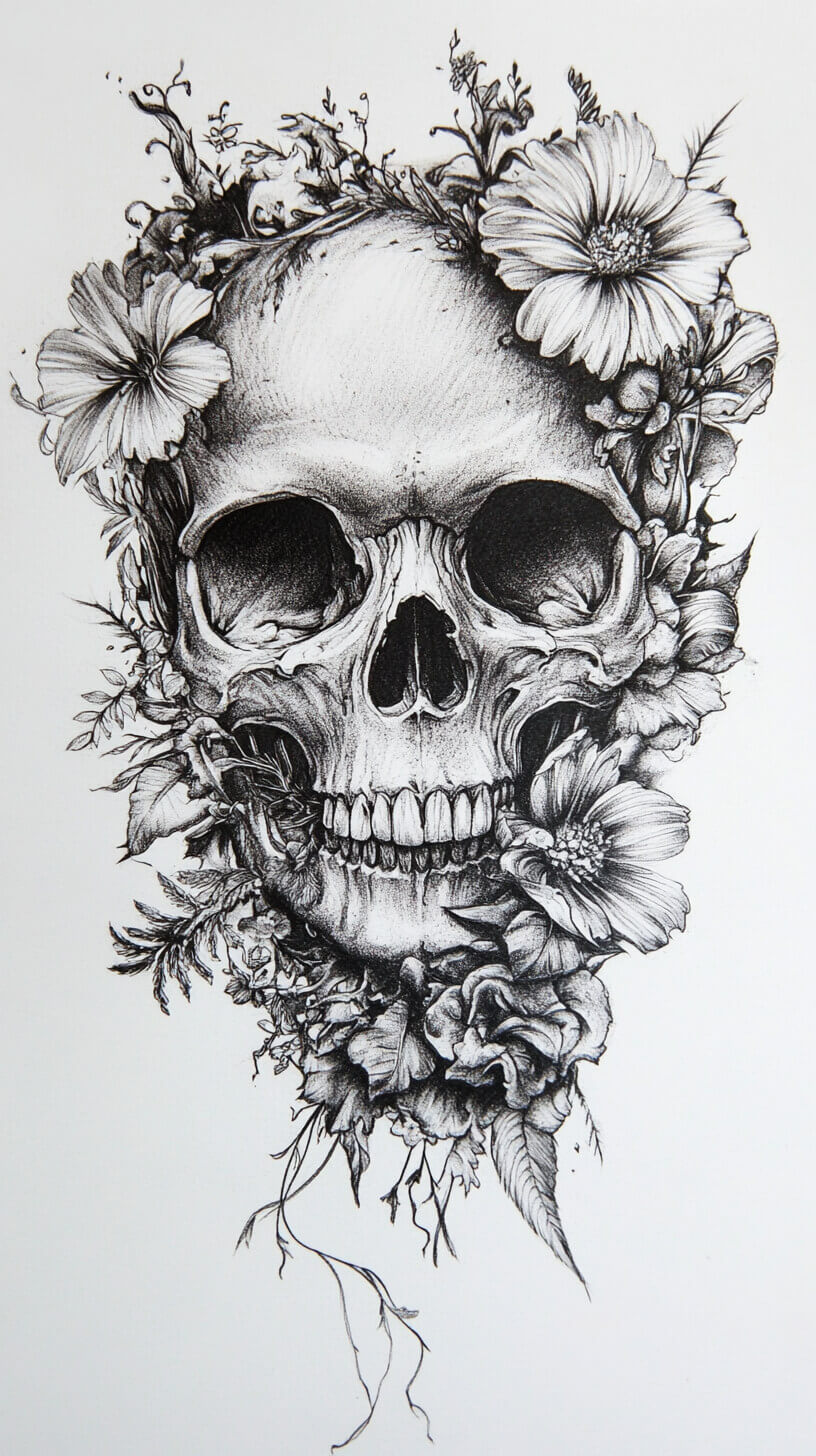
A skull drawn badly is just a skull. A skull drawn with the right weight of black, the right ornament and the right amount of empty skin around it becomes something you keep looking at.
Gothic work borrows from medieval cathedrals, Victorian mourning jewellery, and the literary gothic of Poe and Shelley. That heritage is what separates it from generic dark art, and it is why I usually point people toward dark feminine tattoo ideas when they want the atmosphere without a horror motif.
Below are the motifs, sub-styles, sizing decisions and mistakes I see most often, plus a large gallery of reference drawings you can take to an artist.
Which Gothic Style Is Right for You?
Most people arrive with a subject in mind and no idea which drawing style suits it. This table is the short version of the conversation I have with almost everyone.
| Gothic Style | Best For | Typical Size | How It Ages |
|---|---|---|---|
| Heavy blackwork | Bold silhouettes, cover-ups, high contrast | Medium to large | Excellent, if the fill is packed solid |
| Black and grey realism | Portraits, skulls, statuary | Large | Good with strong contrast, softens over time |
| Ornamental / filigree | Chest, sternum, spine, symmetrical layouts | Medium to large | Good if lines are not packed too tightly |
| Fine line gothic | Small, delicate motifs and first tattoos | Small to medium | Needs the most care; can soften noticeably |
| Neo-traditional gothic | Ravens, roses, daggers, storytelling pieces | Medium | Very good, bold outlines hold shape |
| Etching / engraving style | Woodcut and old-manuscript looks | Medium | Good, though fine hatching can blur |
If you are torn, my usual advice is to pick the style that ages best for your placement and let the motif follow. A design you still like in fifteen years beats a design that photographs well in week one.
What Actually Makes a Drawing Look Gothic
Gothic is not simply dark. Plenty of black and grey tattoos have no gothic quality at all, and a few brightly lit designs absolutely do.
The first ingredient is architecture. Pointed arches, tracery, rose windows and stonework give gothic drawings their structure, and even a small piece borrows that geometry.
The second is ornament. Filigree, scrollwork, chain and jewellery detail frame the subject the way a reliquary frames a relic.
The third is symbolism, usually about mortality. Skulls, hourglasses, wilting flowers and guttering candles all come from the memento mori and vanitas traditions, and they carry meaning that a plain silhouette does not.
The fourth is restraint with light. Gothic drawings tend to keep large areas very dark and reserve the brightest values for one or two focal points, which is why contrast is the single most useful thing to get right.
Gothic Tattoo Drawing Ideas by Motif
These are the motifs I see requested most often, with notes on what each one actually needs from the drawing.
Skulls and Memento Mori
The skull is the foundational gothic motif and also the easiest to do badly. Anatomy is unforgiving, and a slightly wrong eye socket reads as wrong even to people who cannot say why.
What lifts a gothic skull above a generic one is context: a crown, a veil, an hourglass, a spray of thorns, a cracked stone base. The skull becomes the centre of a scene rather than a sticker.
In my experience, skulls are also the most forgiving motif for size. They read clearly at three inches on a forearm and still hold up as a full back panel, which is rare.
If you want a wider range of reference before you commit, our collection of skull tattoo designs covers variations from realism through to heavy blackwork.
Cathedral Architecture and Ornamental Filigree
This is where gothic tattooing is most distinct from every other dark style, and it is my favourite category to draw.
Rose windows, ribbed vaults, spires and stone tracery all translate into tattoo line work almost directly, because they were designed as line and shadow in the first place.
Ornamental filigree works differently. It is not a subject, it is connective tissue, and it is what turns three separate motifs into one composition across a chest or a sternum.
The practical warning is spacing. Filigree drawn too tightly will close up as it heals, so ask your artist to open the gaps by roughly a third compared with what looks right on paper.
Ravens, Bats and Moths
Gothic creature work is built around silhouette. If the shape does not read from across a room, no amount of feather detail will save it.
Ravens suit the forearm and calf because the body and tail follow the limb naturally. Bats are symmetrical, which makes them ideal for sternum, spine and upper back placements.
The death’s-head moth has become one of the most requested gothic motifs of the last decade, and for good reason: it is symmetrical, symbolic and scales from two inches to a full chest piece. We have a whole gallery of moth tattoo drawings if that is the direction you are leaning.
Every artist I have asked about wings says the same thing — resist the urge to draw every scale or feather. Group them into shapes and let the eye fill in the rest.
Black Roses, Thorns and Dark Florals
Dark florals are how most people ease into gothic work without committing to a skull.
A black rose is not just a rose shaded darker. The petals need harder edges, the stem needs visible thorns, and the whole thing benefits from a slightly wilting posture rather than a fresh bloom.
Thorns matter more than people expect. They are what stops the design reading as a generic floral tattoo, and they give the artist somewhere to put sharp contrast. If you want to see the range, our guide to black rose tattoos is a good starting point.
Dark florals are also the most flexible filler in gothic sleeve work, because they bend around limbs and cover awkward gaps between larger motifs.
Crosses, Reliquaries and Sacred Iconography
Gothic tattooing is heavily indebted to church imagery, and ornate crosses remain one of the most common requests.
The gothic version is rarely a plain cross. It is layered with filigree, set into a stone frame, wrapped in chain or hung as a pendant with a gemstone at the centre.
Reliquaries and rosaries work especially well on sternum and collarbone placements because the chain follows the body’s own lines.
If the religious element is the point rather than the ornament, our page of cross tattoo drawings covers simpler and more traditional treatments.
Gothic Portraits, Vampires and Mourning Figures
This is the hardest category to get right and the one I most often talk people out of rushing.
A gothic portrait lives on soft grey transitions rather than hard outlines, which means the artist needs genuine black and grey realism experience, not just an interest in the aesthetic.
Veils, high collars, lace and hair give the drawing its period feel. Without at least one of those elements, a portrait usually stops reading as gothic and becomes a plain black and grey face.
When I have seen these go wrong, it is almost always because the piece was drawn too small. Give a portrait real estate — upper arm, thigh or back — and it will hold together far longer.
Daggers, Serpents and Occult Line Work
Daggers and serpents are the workhorses of gothic composition. They are directional, they are readable at any size, and they link larger motifs together.
A dagger through a rose or a snake coiled around a skull are old combinations, but they persist because the shapes genuinely complement each other.
Occult symbols deserve a note of caution. Sigils and alchemical marks carry specific meanings to specific communities, and I would strongly suggest researching a symbol properly before wearing it permanently.
If the look is what appeals rather than the meaning, ask your artist to design an original ornamental mark instead. You get the aesthetic with none of the ambiguity.
Moons, Candles and Gothic Still Life
Not every gothic tattoo needs a skull, and still life compositions are the most underrated way into the style.
A crescent moon, a guttering candle, a stack of old books, a hand mirror, a moth resting on a stone ledge — grouped together, these carry the same vanitas symbolism with a much softer tone.
These pieces are also usually cheaper, because they can be built at a modest size without losing meaning.
Still life is where I send people who love the gothic mood but do not want a tattoo that startles strangers.
Style Variations Worth Considering
The same motif can be drawn six different ways, and the choice changes how the tattoo looks in ten years far more than the subject does.
Fine Line Gothic
Delicate, elegant and increasingly popular, fine line gothic strips the style back to its outlines.
It is a genuine option, but it needs realistic expectations. Fine lines soften as skin ages, and they demand the most careful placement and aftercare. Our overview of fine line tattoo ideas explains the trade-offs in more detail.
Heavy Blackwork
At the other extreme, blackwork gothic uses large solid areas of black and lets negative space do the drawing.
It ages better than almost anything else, provided the fill is packed properly in the first place. If that appeals, our gallery of blackwork tattoo ideas shows how far the approach can be pushed.
The catch is that blackwork is difficult to cover or lighten later, so treat it as a firm commitment.
Etching and Engraving Style
This style mimics old woodcuts and copperplate engravings using dense parallel hatching instead of smooth shading.
It suits gothic subject matter beautifully because the reference material genuinely comes from the same era.
Ask to see healed examples specifically — hatching that is spaced too tightly can merge into flat grey within a couple of years.
Practical Tips Before You Commit
Decide the placement before you finalise the drawing. A design drawn flat on paper almost never sits correctly on a curved forearm without adjustment.
Judge an artist by healed photographs rather than fresh ones. Fresh gothic work always looks crisp; the healed gallery tells you whether the detail spacing was right.
Build large pieces in planned stages. Ornamental chest and back work is far easier when the whole layout is drawn first and tattooed across sessions, rather than added to piece by piece.
Plan for the sitting itself. Solid black fill is repetitive and tiring, so if you are choosing between placements it is worth reading up on the most painful tattoo spots before you book a long session on the ribs or sternum.
Common Mistakes and Still Not Sure?
The most common mistake by a wide margin is too much detail in too little space. Gothic drawings are dense by nature, and that density has to be edited down before it goes on skin.
The second is combining too many motifs. A skull, a raven, a rose, a dagger and a cathedral in one forearm piece will read as noise. Pick one hero and let the rest support it.
The third is skipping aftercare on heavy black fill. Solid black areas are effectively a large wound and they need consistent care while they heal.
Follow whatever instructions your artist gives you first, and use our tattoo aftercare guide as a general reference rather than a substitute. If you develop spreading redness, heat, swelling that worsens after a few days, pus or a fever, stop researching online and see a doctor — those can be signs of infection, and a tattoo artist is not a medical professional.
Reputable general guidance on tattoo risks and safe practice is available from the US Food and Drug Administration and the American Academy of Dermatology, and both are worth reading before a first large piece.
Frequently Asked Questions
Do gothic tattoo drawings have to be black and grey?
No, though the overwhelming majority are. Black and grey suits the subject matter and holds its contrast for decades, which is why most gothic specialists work that way. I have seen beautiful gothic pieces with a single muted accent colour, usually a deep oxblood red or a cold blue, and they can look striking. If you want colour, ask your artist to keep the palette narrow rather than full spectrum, or the piece stops reading as gothic.
How much does a gothic tattoo usually cost?
Cost depends far more on hours than on style, so there is no fixed gothic price. Most shops in North America and the UK charge either an hourly rate or a session day rate, and detailed ornamental or realism work simply takes longer than a simple silhouette. A palm-sized single motif is often one sitting; a full ornamental chest panel can run several. Ask for a quote based on the finished drawing rather than a rough idea, because the drawing is what determines the time.
Are gothic tattoos more painful than other styles?
The style itself does not change the pain, but the technique can. Large areas of solid black fill mean the needle passes over the same skin repeatedly, and most people find that more tiring than outlining. Placement matters more than anything else, and ribs, sternum, spine and inner arm are consistently reported as the harder spots. If pain is a real concern, start with a forearm or outer thigh piece.
Can I bring my own gothic drawing to a tattoo artist?
Yes, and good artists welcome reference. What they usually will not do is copy another tattooer’s finished tattoo, both out of professional courtesy and because a design drawn for someone else’s body rarely fits yours. Bring your drawing as a starting point and expect the artist to redraw it for your placement, your proportions and the way ink behaves in skin. In my experience that redraw is where most of the quality comes from.
What is the difference between gothic and dark art tattoos?
The two overlap heavily and plenty of artists use the words interchangeably. Gothic usually implies a specific visual heritage: medieval architecture, memento mori symbolism, Victorian mourning imagery, and the literary gothic of Poe and Shelley. Dark art is a broader umbrella that also takes in surrealism, horror and occult imagery with no historical anchor. If you want the architectural, ornamental feel, ask specifically for gothic rather than dark.
Quick Summary
- Gothic tattoo drawings are defined by mood and ornament, not just by dark subject matter.
- Pick your sub-style first: blackwork, black and grey realism, ornamental, fine line, neo-traditional or etching.
- Skulls, ravens, cathedral architecture, black roses, crosses and moths are the reliable core motifs.
- Contrast and negative space matter more than density of detail — crowded drawings blur as they heal.
- Match the drawing to the placement before it is finalised; the body’s curves change the composition.
- Choose an artist by their healed gothic work, not by their freshest studio photos.
- Expect ornamental and realism pieces to need multiple sessions and a planned layout.
- Follow your artist’s aftercare instructions and see a doctor for anything that looks infected.