The first rooster I ever tattooed was for a man who had spent twenty years getting up at four in the morning. He did not want a cute farmyard bird. He wanted the thing that had been shouting at him through the dark for two decades. A rooster tattoo almost always means courage, vigilance and the willingness to announce yourself before anyone else is awake — and that is a heavier idea than the barnyard reputation suggests.
It is one of the few animal designs where the symbolism is genuinely consistent across cultures. Chinese, Celtic, Portuguese, French and American traditional sources all land in roughly the same territory: pride, protection, the sun, and the start of something.
I have watched this design get chosen by people marking sobriety, by people born in a Rooster year, by chefs, farmers, and by more than one person who simply liked that the bird refuses to be ignored. If you are weighing it against other winged options, our guide to bird tattoos and their meanings sets the rooster next to its relatives.
Below is everything I would tell you across a consultation: what the bird actually signifies, which styles hold up, where it sits well on the body, and the mistakes I see most often.
Which Rooster Tattoo Style Is Right for You?
Style decides how the rooster ages far more than size does. Here is how the four most common approaches compare in practice.
| Style | Best For | Typical Size | How It Ages | Sittings |
|---|---|---|---|---|
| American traditional | Anyone who wants it readable from across a room | 4–7 inches | Best of the four — heavy outlines hold shape for decades | One, usually 2–4 hours |
| Neo-traditional | Detailed plumage without losing structure | 6–10 inches | Very good, provided the artist keeps the outline weight up | One to two |
| Black and grey realism | Feather texture, portrait-level detail | 7–12 inches | Softens over time; mid-tones need the most care | Two or more |
| Fine-line | Subtle, small, easy to cover | 2–4 inches | The most fragile — thin lines spread, small gaps close up | One, often under 2 hours |
If you are torn, I would say this: pick traditional or neo-traditional unless you have a specific reason not to. The rooster is a shape-driven subject, and those two styles protect the shape.
Why the Rooster Carries So Much Symbolic Weight
Before clocks, the rooster was the clock. That single fact explains most of what the tattoo has come to mean.
A bird that reliably announces the end of night gets attached to every idea humans have about darkness ending — dawn, safety, resurrection, the turning of a bad season. That association shows up independently in European folk practice, in Chinese tradition, and in early Christian imagery.
The second layer is behavioural. Roosters guard. They put themselves between a threat and the flock, and they do it loudly, which is why vigilance and protection attach to the bird as naturally as sunrise does.
The third layer is less comfortable but it is part of the history: cockfighting. The fighting-cock image is where a lot of the bird’s swagger in Western tattooing comes from, and it is why the design reads as defiant rather than pastoral.
Put those three together and you get a symbol that means I get up, I watch, and I do not back down. That is a lot of meaning for one bird to carry, and it is the reason the design has stayed popular for over a century.
What a Rooster Tattoo Symbolizes
These are the meanings clients actually bring into the shop, roughly in order of how often I hear them.
Courage and Confidence
This is the most common reading by a wide margin. The rooster is a small animal that behaves like a large one, and people who have had to be braver than they felt tend to recognise that immediately.
In my experience the posture does most of the work here. A rooster drawn mid-crow with its chest forward and hackles raised reads as confident; the same bird drawn side-on and calm reads as decorative.
If confidence is your reason, tell your artist that directly. It changes the pose, the angle of the head, and whether the spurs are visible — small choices that decide whether the finished piece looks proud or merely pretty. Ask for the crow, not the portrait.
The Chinese Zodiac and the Year of the Rooster
The Rooster is the tenth sign of the Chinese zodiac, and recent Rooster years include 1969, 1981, 1993, 2005 and 2017.
Traditionally the sign is associated with honesty, punctuality, hard work and a certain bluntness. You can read a general overview of the twelve-sign cycle at Britannica’s entry on the Chinese zodiac if you want the background before committing.
Clients who come in for a zodiac rooster usually want the symbolism legible — a Chinese character, a peony, or a specific colour scheme. I would only add the character if a fluent reader has checked it first. I have covered up more than one well-intentioned mistranslation.
Dawn, Renewal, and New Beginnings
The crowing rooster is one of the cleanest visual shorthands for starting over, which is why it turns up so often on sobriety pieces, recovery pieces and tattoos marking the end of a long illness.
Every artist I have asked about this says the same thing: clients rarely explain the reason, but the pose request gives it away. They want the beak open.
Sunrise elements — rays, a horizon line, a rising sun behind the bird — push the meaning further toward renewal without needing any text. If you like that direction, our sun tattoo designs gallery has motifs that pair well.
Protection and Vigilance
Weathervane roosters were not decorative accidents. The bird sat on barns and church spires across Europe as a guardian figure, watching in every direction.
That is the reading I would point you toward if you want something protective rather than triumphant. It calls for a still, alert bird — head up, eye sharp — rather than a mid-fight pose.
Placement reinforces this meaning more than any detail in the drawing does. Over the heart, on the upper back, or on the outside of the forearm all read as a guardian position.
Celtic and Solar Symbolism
In Celtic folklore the rooster is a threshold animal, linked to the boundary between the living world and the otherworld, and credited with driving off spirits at first light.
Solar symbolism runs through the same territory. Because the bird announces the sun, it inherits the sun’s associations: vitality, clarity, the burning-off of what happened in the dark.
Knotwork frames this well, and black and grey suits it better than colour. If you want to see how that interlace reads on skin before deciding, blackwork tattoo designs is a useful reference.
Fertility, Harvest, and Rural Roots
There is an older, quieter meaning that gets overlooked: abundance. A healthy rooster meant a healthy flock, and a healthy flock meant the household ate.
I tattoo this version most often for people with genuine farm backgrounds, and it tends to come with specific requests — a particular breed, a particular colouring, sometimes a bird they actually kept.
Wheat, corn, barn wood and fence line all support this reading. It is the warmest version of the design and the one that ages best in full colour, because the palette is already earthy.
Fighting Spirit and Resilience
The gamecock is a real strand of tattoo history, particularly in American traditional and in Southeast Asian and Latin American traditions where the imagery carries its own local weight.
It is worth being honest about this one. Cockfighting is illegal in many countries, and some viewers will read a gamecock image through that lens regardless of what you intended.
If resilience is what you are after and you would rather avoid the association, a standing rooster with raised hackles gets you most of the attitude without the arena. I usually steer first-timers toward that version.
Popular Rooster Tattoo Designs and Placements
Meaning settles the what. This section is the how.
Traditional and Neo-Traditional Roosters
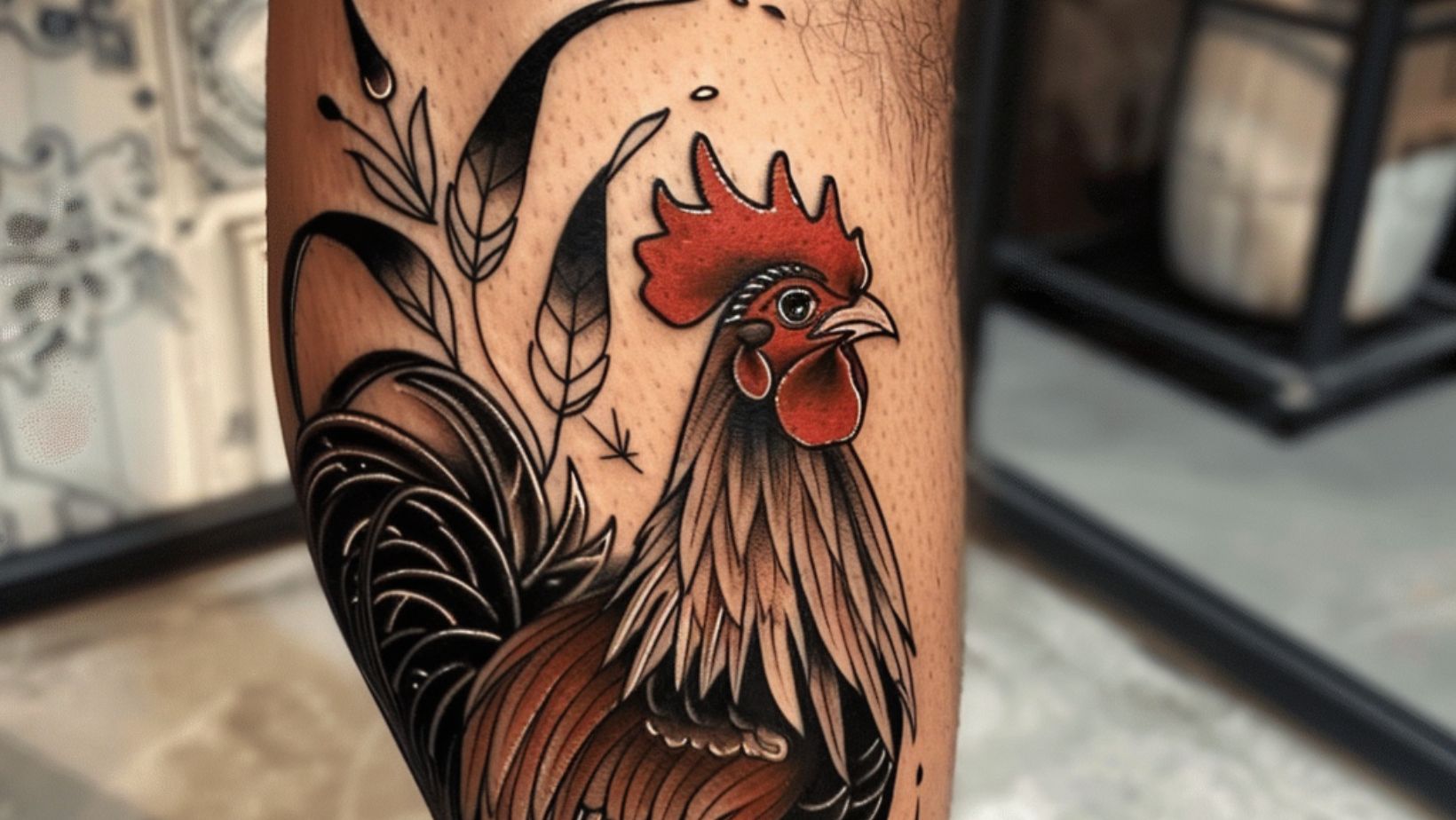
American traditional is the default for a reason: bold outline, limited palette, and a silhouette that survives blowout, sun and thirty years of skin.
Neo-traditional keeps that structure but opens up the colour range and adds depth to the feathers — the sweet spot for most people who want detail without committing to realism.
Both suit the outer arm, the calf and the chest. If you like the heavier historical look, American traditional animal work shows how that outline weight behaves on a large subject.
Realism and Color Showpieces
Realistic roosters are genuinely impressive and genuinely demanding. Feathers are a texture problem, and texture is where inexperienced artists come unstuck.
Colour realism is the most rewarding version of this bird, because plumage gives you reds, greens, coppers and iridescent blacks in one subject.
Budget for two sittings minimum at a decent size, and ask to see healed photographs — not fresh ones — before you book.
Fine-Line and Minimal Roosters
Fine-line roosters are elegant and they are the ones I get asked to touch up most often.
Thin lines spread slightly as they settle, and a small rooster has closely spaced detail in the tail and comb that can close into a solid mass over the years.
If you want small, go simpler rather than finer: fewer lines, slightly heavier, more space between them. Space is what keeps a small tattoo legible.
Combining the Rooster With Other Symbols
The rooster pairs cleanly with a rising sun, wheat, roses, a horseshoe, a clock face, or a banner with a date or name.
Avoid crowding it. The bird’s silhouette is its strength, and a busy background is the fastest way to lose that.
For larger builds, a rooster works well as the focal point of a half sleeve with simpler filler around it — our forearm tattoo ideas page shows how that composition tends to be laid out.
Placement, Sizing and Aftercare Tips
Give the tail feathers somewhere to go. A rooster is a vertical subject with a sweeping tail, which is why the outer forearm, calf, thigh and outer upper arm all work better than a flat square of space.
Under about three inches, cut detail deliberately. I would rather remove the individual feather barbs and keep the comb, wattle and tail shape than shrink everything equally and lose all of it.
On healing, follow the aftercare your artist gives you — they know their inks and their technique. The general dermatological guidance from the American Academy of Dermatology is a sensible cross-check: keep it clean, keep it moisturised, keep it out of the sun, and do not pick.
If the area becomes increasingly painful after the first few days, spreads redness outward, swells, weeps, or you develop a fever, see a doctor rather than asking the internet. Infection and allergic reaction both happen, both are treatable early, and neither is something an article can diagnose. The FDA’s consumer guidance on tattoo safety covers ink reactions in more detail. Never attempt to remove or rework a tattoo yourself.
Still Not Sure? Common Mistakes to Avoid
Going too small for the amount of detail requested. This is the single most common regret I see with this design, and it is entirely avoidable at the sketch stage.
Choosing an artist by style rather than by subject. Plenty of excellent artists have never drawn a bird. Ask specifically for healed feather work in their portfolio.
Adding text or characters without verification. If a symbol is going on your skin permanently, have a fluent reader confirm it first.
Ignoring how the bird will sit when your arm is down. Roosters drawn on a flat sketchpad sometimes end up facing the floor. Ask for a stencil placement photo before the needle starts.
Still weighing options? Different bird tattoo meanings is worth a read, and if you want something in the same defiant register, phoenix tattoo designs and swallow tattoo meanings cover the two closest alternatives.
Frequently Asked Questions
What does a rooster tattoo symbolize?
A rooster tattoo most often symbolises courage, confidence, vigilance and new beginnings. The connection to dawn gives it a strong association with renewal and starting over, which is why it appears frequently on recovery and milestone pieces. In Chinese tradition it also carries honesty, punctuality and hard work through the zodiac sign. In Celtic and European folklore it functions as a protective, threshold-guarding figure. Most people choose it for some combination of bravery and fresh starts.
Is a rooster tattoo considered good luck?
In several traditions, yes. Chinese symbolism treats the rooster as an auspicious animal, and European folk practice used rooster imagery on weathervanes and buildings as a protective charm. Portuguese culture has its own well-known good-luck rooster, the Galo de Barcelos. Whether that translates into luck for you is personal rather than universal. What it does reliably communicate is alertness and protection.
Where is the best place for a rooster tattoo?
The outer forearm, calf, thigh and outer upper arm suit it best, because all four give the tail feathers vertical room. The chest works well for the protective reading, sitting over the heart. Avoid very small, high-friction spots like fingers and the side of the hand, where fine detail fades fastest. If you need it coverable for work, the upper arm and thigh are the easiest. Ask your artist to place the stencil and then check it in a mirror with your arm relaxed.
Do rooster tattoos suit both men and women?
Yes, and I have tattooed roughly as many on women as on men. The design reads differently depending on treatment rather than on who is wearing it: bold traditional work leans defiant, while neo-traditional and fine-line versions lean decorative and elegant. Colour choice shifts it further. There is no gendered version of this symbol in any of the traditions it comes from. Choose the style that matches the tone you want.
How much does a rooster tattoo cost?
It depends on size, style, your artist’s rate and your region, so any single figure would be misleading. As a rough guide, a small fine-line rooster is usually a shop-minimum or single short-session job, while a colour realism piece across the forearm or calf runs into multiple sessions and costs accordingly. Hourly rates vary enormously between cities and between artists. The most reliable answer is to send reference images to two or three artists and ask for a quote. Our guide to tattoo design costs explains what drives the numbers.
Quick Summary
- Core meaning: courage, vigilance, pride and new beginnings — consistent across Chinese, Celtic, European and American sources.
- Dawn symbolism makes it a natural choice for recovery, sobriety and fresh-start tattoos.
- Zodiac link: the Rooster is the tenth Chinese zodiac sign, tied to honesty and hard work.
- Best styles: American traditional and neo-traditional age the best; fine-line is the most fragile.
- Best placements: outer forearm, calf, thigh, outer upper arm and chest — anywhere the tail has vertical room.
- Size honestly: under three inches, cut detail rather than shrinking everything.
- Vet the artist on healed feather work specifically, not just on overall style.
- Healing: follow your artist’s aftercare, and see a doctor for spreading redness, swelling, worsening pain or fever.