I have been writing about American traditional flash for years, and the bear is the one animal design people ask me to explain more than any other. A traditional bear tattoo almost always reads as strength, protection and the willingness to stand your ground — but the exact meaning shifts depending on whether the bear is roaring, walking or sleeping.
That last detail is the part most guides skip, and it is the part that changes what your tattoo says about you.
In this guide I will walk through what the motif actually means, how the pose and the props around it change that meaning, where the design sits best on the body, and what to expect from the healing. If you like this style generally, it is worth browsing American traditional animal tattoos to see how the bear compares with the eagle, panther and wolf.
Everything below comes from looking at hundreds of these pieces and from questions I have put to working artists over the years. I will flag where opinions differ rather than pretend there is one right answer.
Which Bear Tattoo Style Is Right for You?
Traditional is only one of four styles people consider when they want a bear. Here is how I would compare them on the things that actually matter.
| Style | Look | How It Ages | Best For |
|---|---|---|---|
| American Traditional | Heavy black outlines, flat colour, limited palette | Usually the most forgiving over decades | Anyone who wants the design readable from across a room |
| Neo-Traditional | Traditional bones with richer colour and more depth | Holds well, though fine detail softens sooner | People who want a more illustrative, ornamental bear |
| Black and Grey | No colour, built from smooth shading | Depends heavily on shading density | Realistic or memorial pieces |
| Geometric | Bear shape built from angles and line work | Thin lines can blur; needs solid linework | A modern, graphic take on the same symbolism |
If you are leaning toward the last row, remember that a graphic bear still carries the same symbolism — it just states it in a more modern visual language.
Why the Bear Became a Traditional Tattoo Staple
American traditional tattooing was built around a small vocabulary of images that had to read clearly on skin from a distance and stay readable for fifty years.
The bear fits that brief better than almost any animal. A bear silhouette is instantly recognisable at small scale, and its bulk gives an artist plenty of solid black to work with.
There is a practical reason too. Traditional flash was designed to be tattooed quickly and cheaply, and a bear head packs a lot of visual weight into a design that can be finished in a single sitting.
The symbolism helped. Sailors, soldiers and dock workers were the early customer base, and a bear said something plain about the person wearing it without needing a caption.
Bears also carry real cultural weight across a lot of traditions — from Indigenous North American clan associations to Nordic berserker legend. Traditional tattooing absorbed those associations without belonging to any of them, which is part of why the motif still travels so well.
What a Traditional Bear Tattoo Means
Below are the meanings I actually hear from people wearing these pieces, roughly in order of how often they come up.
Strength and Standing Your Ground
This is the default reading, and it is the one most artists will assume if you do not say otherwise.
A bear does not chase and it does not flee — it holds its position. That is the specific flavour of strength the tattoo carries: defensive rather than aggressive.
In my experience people who choose this meaning usually pick a standing or walking bear rather than a roaring head, because a full body reads as composure and a roaring head reads as confrontation.
If your priority is quiet resilience rather than intimidation, tell your artist that before they sketch. It changes the pose, the eye line and how much red goes into the mouth. If strength is the core idea, you may also want to look at other tattoos that mean strength and courage.
Protection and the Guardian Role
The second most common meaning is protection — of a family, a child, or the wearer themselves.
Artists usually signal this with a bear that faces outward from the body, positioned as though it is watching the approach rather than the wearer.
Every artist I have asked about this uses roughly the same trick: the bear goes on the outer arm, outer thigh or the chest, facing away from the centre line.
It is a subtle thing, but people notice it without knowing why. A protective bear looks like it is on duty.
Motherhood, Fatherhood and Family
Bear-and-cub designs are one of the few traditional motifs that genuinely work as a family piece.
The “mama bear” and “papa bear” framing is modern, but the underlying idea — a parent who will absolutely fight for their kids — is old and it suits the style.
The practical note here: cubs need space. A bear with two cubs at forearm scale usually turns into a dark blob within ten years because the small shapes sit too close together.
If you want cubs in the design, budget for a bigger placement rather than squeezing them in. Related ideas sit in the family tattoo ideas collection.
Hibernation, Rebirth and Coming Through Something
This one is less common but it is my favourite, because it is the meaning people choose after a hard few years.
Bears withdraw, go quiet, and come back. That cycle maps neatly onto recovery, grief and long illness.
Designs that lean into this often add a pine, a cave mouth or a crescent moon behind the bear rather than changing the bear itself.
If the tattoo is marking a loss rather than a recovery, the memorial tattoo ideas guide is a better starting point for the surrounding elements.
Heritage, Land and Ancestry
For some people the bear is about a place — a region, a mountain range, a family that has always lived somewhere cold.
These pieces usually pick a specific bear rather than a generic one. A grizzly, a black bear and a polar bear have different silhouettes, and a good artist will draw the difference.
One honest caution: if you are drawn to a bear because of an Indigenous clan or crest design, that imagery belongs to specific nations and specific families. Admiring it is fine; wearing a direct copy of a crest you have no connection to is not.
A generic traditional bear carries the same strength symbolism without borrowing anyone’s inherited design.
The Bear as a Rival — Hunter and Trapper Flash
Older flash sheets sometimes show the bear against a hunter, a trap or a knife.
That version is not about admiring the animal. It is about the contest — testing yourself against something bigger than you.
I see this most on people with an outdoors background, and it usually gets paired with a rifle, an axe or a compass rather than florals.
It is the least common reading now, but it is the most historically traditional one.
Best Placements for a Traditional Bear Tattoo
Placement affects a bear design more than it affects most motifs, because the bear’s bulk needs a surface that will not distort it.
Upper Arm
The upper arm is the classic home for traditional flash and the placement I would recommend to most people getting their first bear.
The outer bicep is a broad, gently curved surface that shows a bear head or a seated bear without wrapping awkwardly.
It also ages well. There is less sun exposure than the forearm and less stretch than the stomach or inner arm.
Expect a single-session piece for a bear head at this size, in most cases somewhere in the two to four hour range depending on colour packing.
Chest
A chest bear is a statement piece, and it suits the roaring or forward-facing poses best.
The advantage is symmetry — you can centre a bear head on the sternum or run a bear across one pectoral to mirror an existing piece.
The trade-off is comfort. The sternum and the area near the collarbone are among the more painful spots most people report, and a chest bear is rarely a one-sitting job.
If this is your first tattoo, I would not start here. Browse chest piece tattoo ideas first to see the scale you would be committing to.
Back
The back is the only placement where a full scene really works — bear, trees, mountains and sky in one composition.
It is also the placement people most often abandon halfway through, because a full back piece is a multi-session commitment measured in months, not hours.
If you want the scale but not the schedule, a single shoulder blade holds a large standing bear comfortably on its own.
Thigh
The thigh is underrated for traditional work and it is what I suggest when someone wants a large bear but wants to keep it coverable.
There is a lot of flat surface, the pain is manageable for most people, and the outer thigh in particular holds bold colour well.
The one caution is stretch. Significant weight change affects the thigh more than the arm, so heavy fine detail is a slightly riskier bet here.
Forearm
The forearm is the most visible option and the one people choose when the tattoo is meant to be seen daily, including by themselves.
A bear head fits well; a full standing bear usually needs to be simplified or turned vertically to sit right.
Sun exposure is the real issue here. The forearm gets more UV than almost anywhere else, and UV is the main driver of fading in coloured work.
Sunscreen on a healed forearm tattoo is not fussiness, it is the single cheapest thing you can do to keep the colour. There are more layout options in the forearm tattoo ideas guide.
Variations and Alternatives Worth Considering
If the straight traditional bear is not quite it, these are the directions people usually move in.
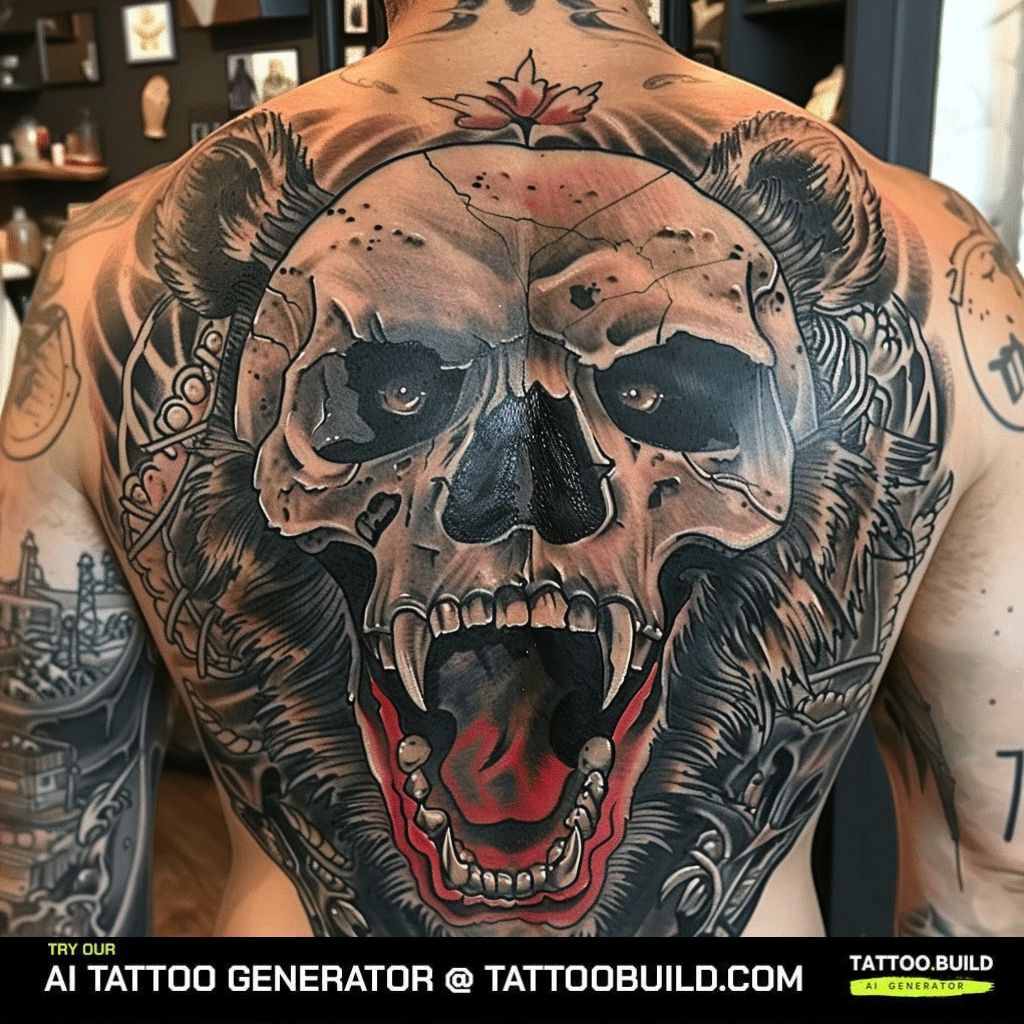
Bear Skull
Swapping the living bear for a skull shifts the meaning from strength toward mortality, endurance and what remains after.
It also solves a design problem: a skull has clearer, harder shapes than fur, which makes it easier to keep readable at small sizes.
Bear with Roses or a Dagger
Adding a rose softens the piece and pulls it toward love, loss or a named person. Adding a dagger sharpens it toward conflict and sacrifice.
These are the two most traditional add-ons, and both fill negative space in a way that helps the composition rather than crowding it.
Neo-Traditional and Ornamental Bears
Neo-traditional keeps the bold outline but opens up the palette and adds depth, jewellery, florals or geometric halos.
It photographs beautifully. It also usually costs more and takes longer, because the shading is doing more work.
A Different Animal Entirely
If what you actually want is loyalty and instinct rather than defensive strength, the wolf may fit better — there are options in the wolf tattoo ideas collection.
And if the pull is toward Norse or Nordic symbolism specifically, the bear often sits alongside runes and knotwork in Viking tattoo ideas.
Getting a Traditional Bear Tattoo That Ages Well
The single biggest factor is the artist. Look for a portfolio with healed traditional work in it, not just fresh photos — healed pictures are where line quality actually shows.
Ask for the stencil to be sized on your body before the needle starts. Bears look different on a curved arm than they do flat on paper, and it is much cheaper to resize a stencil than to fix a design later.
For healing, follow the aftercare your artist gives you rather than anything you read online, including here — they know their ink, their technique and your skin. Broadly it means keeping the area clean, not soaking it, and not picking at it while it settles.
If you get spreading redness, swelling that gets worse rather than better after the first few days, pus or a fever, that is a doctor visit, not a forum question. The American Academy of Dermatology has a plain-English rundown of tattoo skin reactions and what to do about them, and Mayo Clinic covers the broader risks and precautions around tattoos. Nothing in this article is medical advice.
Common Mistakes — and What to Do If You Are Still Not Sure
The mistake I see most often is going too small. A bear needs mass, and a two-inch bear with cubs and pine trees will not survive a decade.
The second is over-specifying. People arrive with a reference photo of a real grizzly and ask for it in traditional style, which fights the whole point of the style — traditional simplifies deliberately.
The third is copying another person’s tattoo outright. Bring three or four references and let the artist build something that fits your body.
If you are still weighing it up, it helps to look sideways at related motifs first: geometric bear designs or bear skull symbolism. Sitting with it for a month costs nothing.
Frequently Asked Questions
What does a traditional bear tattoo mean?
A traditional bear tattoo most commonly means strength, protection and standing your ground rather than backing down. Depending on the design it can also point toward family, heritage or coming through a difficult period, since bears hibernate and return. The pose matters: a roaring bear head reads as confrontation, while a standing or walking bear reads as composure. Tell your artist which of these you want before they sketch, because it changes the whole drawing.
Where does a traditional bear tattoo look best?
The outer upper arm is the most reliable placement and the one I would recommend for a first bear, because it is broad, gently curved and ages well. The thigh is the best option if you want size but need it coverable, and the chest suits symmetrical, forward-facing poses. The back is the only placement where a full bear-and-landscape scene really works. The forearm is the most visible but takes the most sun, which fades colour fastest.
How long does a traditional bear tattoo take?
A bear head on the upper arm is usually a single session, often somewhere in the two to four hour range depending on how much solid colour is packed in. A larger thigh or chest piece commonly runs across two or more sittings. A full back scene is a project measured in months rather than hours. Your artist will give you a realistic estimate once they have sized the design on your body.
Is a traditional bear tattoo suitable for women?
Yes, and the mama bear reading in particular makes it a popular choice. There is nothing gendered about the motif itself; what varies is scale and the elements around it, with florals, moons and pine commonly softening the composition. I see traditional bears on thighs, shoulder blades and upper arms across the board. Pick the version that matches the meaning you want rather than the one you think you are supposed to have.
Does a traditional bear tattoo hurt more than other styles?
The style itself is not unusually painful, but the heavy colour packing traditional work uses means more passes over the same skin, which many people find more tiring than a light line drawing. Placement matters far more than style: the sternum, ribs and inner arm are generally reported as tougher than the outer bicep or outer thigh. Pain tolerance genuinely varies from person to person, so treat any pain chart as a rough guide. If you are worried, book a shorter first session and see how you handle it.
Quick Summary
- A traditional bear tattoo primarily means strength, protection and holding your ground.
- The pose changes the meaning: roaring reads as confrontation, standing reads as composure, sleeping reads as renewal.
- Bear-and-cub designs work as family pieces but need a larger placement so the small shapes do not merge.
- The outer upper arm is the most forgiving placement; the back is the only one that supports a full scene.
- Heavy black outlines and flat colour are what make this style age better than fine-detail alternatives.
- Avoid going too small, avoid copying a photorealistic reference, and bring several references rather than one.
- Follow your artist’s aftercare, and see a doctor for worsening redness, swelling, pus or fever.
- If the bear is not quite right, look at bear skulls, geometric bears or wolves before committing.