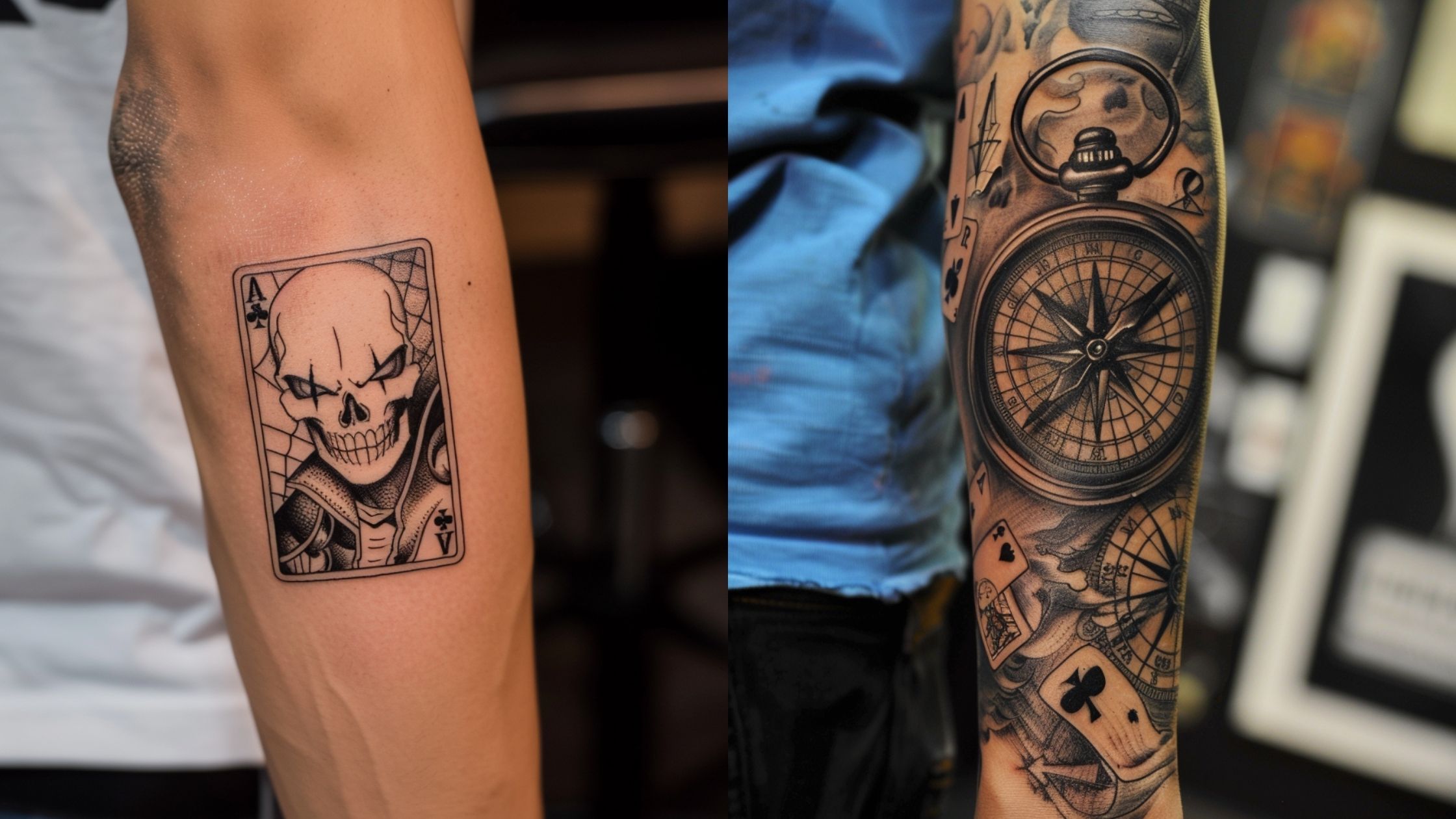
I have watched the ace go from a biker-shop staple to one of the most requested small tattoos on the board, and the reason is simple. The ace is the only card in the deck that means something before you even explain it — highest value, best hand, luck that landed your way.
That built-in meaning is why it survives at almost any size. A one-inch spade on a wrist reads instantly. A full card sleeve down an arm still reads instantly.
Over the years I have sat with artists who will happily tattoo an ace of spades on their lunch break and grumble for an hour about how badly most people plan the rest of the design. The card is easy. What you put around it is where these go right or wrong.
Below are the suits, the pairings that actually work, the placements that hold up, and the mistakes I keep seeing. If you like this card-table territory, my poker tattoo ideas guide covers the wider deck.
Which Ace Suit Is Right for You?
Before you look at designs, pick a suit. It narrows everything else — size, placement, colour, even the artist you should book.
| Suit | Usual Meaning | Best Size & Placement | Ages Well? |
|---|---|---|---|
| Ace of Spades | Luck, fate, mortality, “the death card” in some traditions | 2–4 in, forearm, hand, calf | Excellent — mostly solid black |
| Ace of Hearts | Love, loyalty, devotion to a person or memory | 1.5–3 in, inner arm, ribs, wrist | Good, if the red is kept bold |
| Ace of Diamonds | Wealth, ambition, value, the risk of chasing it | 2–3 in, forearm, shoulder | Good — sharp corners need clean edges |
| Ace of Clubs | Growth, work, earning your outcome rather than drawing it | 2–3 in, forearm, upper arm | Excellent — thick, forgiving shape |
| Full Ace Sleeve | A whole narrative — risk, chance, consequence | Half or full sleeve, 3–6+ sessions | Depends entirely on the artist |
The ages-well column matters more than most people expect. Solid, chunky shapes stay legible for decades; fine interior linework rarely does.
What the Ace Actually Symbolizes
The ace outranks everything in most card games, which is where the whole symbolic load starts. It is the card that wins.
From that, three meanings branch off. Luck — you were dealt the best one. Power — you hold the strongest position at the table. Individuality — there is only one of each ace in the deck.
The ace of spades carries the heaviest baggage. It has been read as a fate or death card in various folk traditions, and that darker reading is a large part of why it pairs so naturally with skulls and snakes.
Every artist I have asked says the same thing: the suit you pick tells them more about the tattoo than the reference photo does. Someone choosing clubs usually wants a work-ethic piece. Someone choosing spades usually wants something with edge.
None of this is fixed. If you want an ace of hearts to mean stubbornness rather than love, it means stubbornness. Symbolism in tattooing is a starting point, not a rulebook.
Ace Tattoo Ideas by Suit
Ace of Spades Tattoos
This is the one people ask for by name, and by a wide margin. The spade is a broad, solid shape with a natural stem, so it fills space without needing much detail.
When I have watched artists tattoo these, the good ones spend most of their time on the outline rather than the fill. A spade with a wobbly edge looks wrong from across a room even if the black inside is flawless.
Two directions work well here. Keep it flat and graphic — solid black, crisp edges, nothing inside. Or open the interior up and put something in it: a skull, smoke, a small scene.
At two to four inches on a forearm, a spade will still look sharp in fifteen years. Below an inch, drop the card frame and tattoo the suit symbol alone.
Ace of Hearts Tattoos
The ace of hearts is the one suit where red ink genuinely earns its place, because the colour is the meaning.
It is also the suit that is most often paired with something personal — a date, initials, a name in the card’s white space. That is fine, but ask your artist how small the text can go before it blurs.
Fair warning on red: red pigments are the ones most commonly linked with allergic reactions and itchy raised patches, which Mayo Clinic flags specifically. If you have reacted to a tattoo before, tell your artist first.
Black and grey ace of hearts work beautifully too, and they sidestep the pigment question entirely.
Ace of Diamonds Tattoos
Diamonds read as money, value and ambition — and, depending on how you frame it, the cost of chasing them.
The shape is the sharpest of the four, which cuts both ways. Clean corners look excellent fresh, but soft corners are the first thing to blur as ink settles over years.
If you want a diamond, ask specifically for a bold, confident outline rather than a fine one. This is the suit where line weight does the most work.
Geometric treatments suit it — faceted shading, mirrored halves, or the diamond built out of straight-line hatching rather than solid fill.
Ace of Clubs Tattoos
Clubs are the least requested ace and, to my eye, the most underrated one.
The three-lobed shape is thick and forgiving. It holds shading well, it does not blur at the edges, and it looks deliberate at small sizes where a diamond can look like a smudge.
Symbolically, clubs lean toward growth and earned progress — the club as a stylised clover or trefoil rather than a weapon. If your tattoo is about work rather than luck, this is your suit.
Popular Ace Tattoo Pairings That Actually Work
An ace alone is a strong graphic. An ace with the wrong companion is a cluttered graphic. These are the combinations I have seen hold up.
Ace and Skull
The most common pairing by a distance, and the one most likely to go wrong through overcrowding.
The trick is contrast. Let the skull carry the realism and shading, and keep the card flat and graphic behind it — or the reverse. When both compete for detail, neither wins.
If the skull is doing the heavy lifting, you will want an artist who is confident with bone structure specifically. My skull tattoo drawings collection is a useful reference to bring to a consultation.
Ace and Snake
Snakes solve the ace’s biggest design problem: a playing card is a flat rectangle, and arms are not flat.
A snake coiled through or around the card gives the piece a path to follow, so it wraps the limb instead of sitting on it like a sticker.
This pairing needs more space than people expect — realistically four inches or more before the scales stop reading as texture noise.
Ace and Wings
Wings widen the design horizontally, which makes this the natural choice for chest pieces, upper backs and shoulder caps.
The meaning usually lands on freedom, luck in flight, or a memorial. It is a common memorial format, and it carries that weight well.
Feather detail is fine linework, and fine linework softens faster than solid work. Ask for slightly heavier feather separation than the reference shows — it will look better in ten years. My wing tattoo ideas guide goes deeper on wing construction.
Ace and Compass
Luck plus direction — a request I hear most often from people marking a move, a career change or a long stretch of travel.
It works because the two shapes are visually different: the card is rectangular and solid, the compass rose is radial and open. They do not fight each other.
If you like this territory, the snake and compass tattoo uses the same logic with a different partner.
Ace with Roses and Florals
The most reliable way to soften an ace without weakening it.
Roses do two useful jobs: they fill the awkward negative space around a rectangular card, and they give the artist a place to put colour or shading that the card itself cannot hold.
This is also the pairing that scales up best into a larger piece — the florals can keep growing outward long after the card is finished.
Ace and Light Bulb
A newer pairing, and one I have seen more of in the last couple of years.
The reading is straightforward: the idea that paid off, the bet on yourself that worked. It suits people who want the luck symbolism without the gambling association.
Keep the bulb simple. Filament detail is very fine linework and it is usually the first part of the tattoo to fade.
Where Ace Tattoos Sit Best
Placement decides size, and size decides how much detail is realistic. Work in that order, not the reverse.
Forearm and Inner Arm
The default, and for good reason. A forearm gives you a flat-ish canvas roughly three to four inches wide with easy visibility and moderate pain.
Single cards, fanned decks and card-and-skull pieces all fit here without compromise. The inner arm is softer to sit through than the outer.
Full and Half Sleeves
An ace sleeve is a different commitment entirely — typically several sessions spread over months, with a budget to match.
The single biggest predictor of a good ace sleeve is whether the background ties the cards together. Smoke, drapery, shading, a table surface — something has to connect the elements or it reads as stickers on an arm.
If you are weighing this up, my sleeve tattoo ideas guide covers how to plan the flow before the first session.
Upper Arm and Shoulder
The shoulder cap curves in every direction, which suits radial designs — wings, compass roses, fanned cards.
It is also easy to cover for work, and it stays out of daily sun exposure, which is quietly one of the best things you can do for a tattoo’s lifespan.
Hands, Fingers and Small Placements
Small suit symbols on fingers look great in the studio and fade faster than anywhere else on the body. Hands take constant friction and washing.
If you want one, go in expecting a touch-up within a year or two, and choose the chunkiest version of the shape you can. The realities are covered further in my hand tattoo guide.
Style Variations Worth Considering
Same subject, very different results depending on how it is rendered.
American Traditional
Bold black outline, limited colour palette, no fine detail. It is the style aces were built for and the one that ages best of all.
Blackwork and Solid Black
Heavy black fill with negative space doing the drawing. Aces suit this naturally because the suits are already solid shapes — see blackwork tattoo designs for the wider approach.
Fine Line and Micro-Realism
Delicate and current, but the least durable. Expect softening within five to ten years, faster on hands, feet and anywhere sun-exposed.
Neo-Traditional and Illustrative
Thicker outlines than fine line, richer shading than traditional, room for ornamental framing around the card. A good middle ground if you want detail that will actually last.
Aftercare and Practical Advice
Ace tattoos are usually high-contrast black work, and high-contrast black work is unforgiving about healing. Patchy black shows up far more obviously than patchy colour.
Mayo Clinic’s guidance is the sensible baseline: wash the area twice a day with soap and water, apply a mild moisturiser, keep it out of direct sunlight, and stay out of pools and open water while it heals — roughly two weeks for the surface. Their full tattoo safety and aftercare page is worth reading before your appointment, not after.
Sunscreen once healed is the single highest-return habit for keeping black work sharp. UV exposure is what turns crisp black into soft grey.
On safety: the FDA notes that unsterile equipment can transmit serious infections, that contaminated inks have caused problems even in clean studios, and that no colour additives are approved for injection into skin. Their tattoo fact sheet is short and worth your time. Use a licensed studio, watch them open fresh needles, and if something looks off after healing — spreading redness, heat, pus, fever — see a doctor rather than waiting it out. This article is design guidance, not medical advice.
Common Mistakes and How to Avoid Them
The mistake I see most: going too small for the amount of detail requested. A full card with corner pips, interior artwork and a border needs at least three inches to survive the decade.
Second: picking the suit for looks and then being asked what it means for the next twenty years. Decide early, even if the answer is “I just like spades.”
Third: copying a reference exactly. Bring three or four images showing the parts you like and let the artist build something that fits your arm. Browsing playing card tattoo drawings and general tattoo drawings is a better way to build a brief than locking onto one photo.
Fourth, and most expensive: booking on price. An ace is simple enough that a weak artist can look competent in a photo taken the same day — and obviously weak two years later. Ask to see healed work, not fresh work.
Frequently Asked Questions
What does an ace tattoo actually mean?
At its simplest, an ace tattoo means luck — the ace is the highest card in most games, so it stands for coming out on top. Beyond that, meaning shifts by suit: spades lean toward fate and mortality, hearts toward love, diamonds toward wealth, clubs toward earned progress. Plenty of people get one purely because the shape looks good, and that is a completely legitimate reason. If the meaning matters to you, decide what yours is before you sit down, because your artist will ask.
Is the ace of spades a bad luck or death tattoo?
It depends who you ask, which is exactly why it works as a tattoo. In some card traditions the ace of spades is read as a death or fate card, and it picked up that association again through military folklore. In gambling culture it is simply the strongest card in the deck. In my experience most people wearing one mean “I accept whatever comes,” not “I am cursed.”
How much does an ace tattoo cost?
A small single-suit ace usually lands in the shop-minimum range, which is commonly around $80–$150 in North America depending on the studio. A detailed ace-and-skull piece on a forearm typically runs a few hours of shop time. Full sleeves are a different category altogether — I have broken down that math separately in my sleeve tattoo cost guide. Always confirm the price before the needle starts, not after.
Do ace tattoos work in small sizes?
Yes, better than most designs. The suit symbols are simple, high-contrast shapes, so they stay readable at an inch or two where a portrait would turn to mush. What does not shrink well is the card frame with tiny corner pips and fine interior detail. If you want something small, ask for the suit symbol alone rather than a miniature full card.
How long does an ace tattoo take to heal?
The surface usually looks settled in about two weeks, though Mayo Clinic notes the deeper layers keep repairing for longer than the skin suggests. Keep it clean, moisturised and out of direct sun and pool water during that window. If you see spreading redness, heat, pus or a fever, that is not normal healing — contact your artist and see a doctor. Nothing in this article is medical advice.
Quick Summary
- Pick your suit first — spades for fate and edge, hearts for love, diamonds for ambition, clubs for earned progress.
- Solid, chunky shapes age best. Spades and clubs are the most durable of the four.
- Go two to four inches on a forearm for a full card; below an inch, use the suit symbol alone.
- Pair with contrast, not competition — if the skull is detailed, keep the card flat.
- Snakes and florals solve the flat-card-on-a-round-arm problem better than anything else.
- Sleeves need a connecting background or the cards read as unrelated stickers.
- Wash twice daily, moisturise, avoid sun and water for about two weeks, then use sunscreen for life.
- Judge an artist by healed photos of their black work, never by fresh ones.