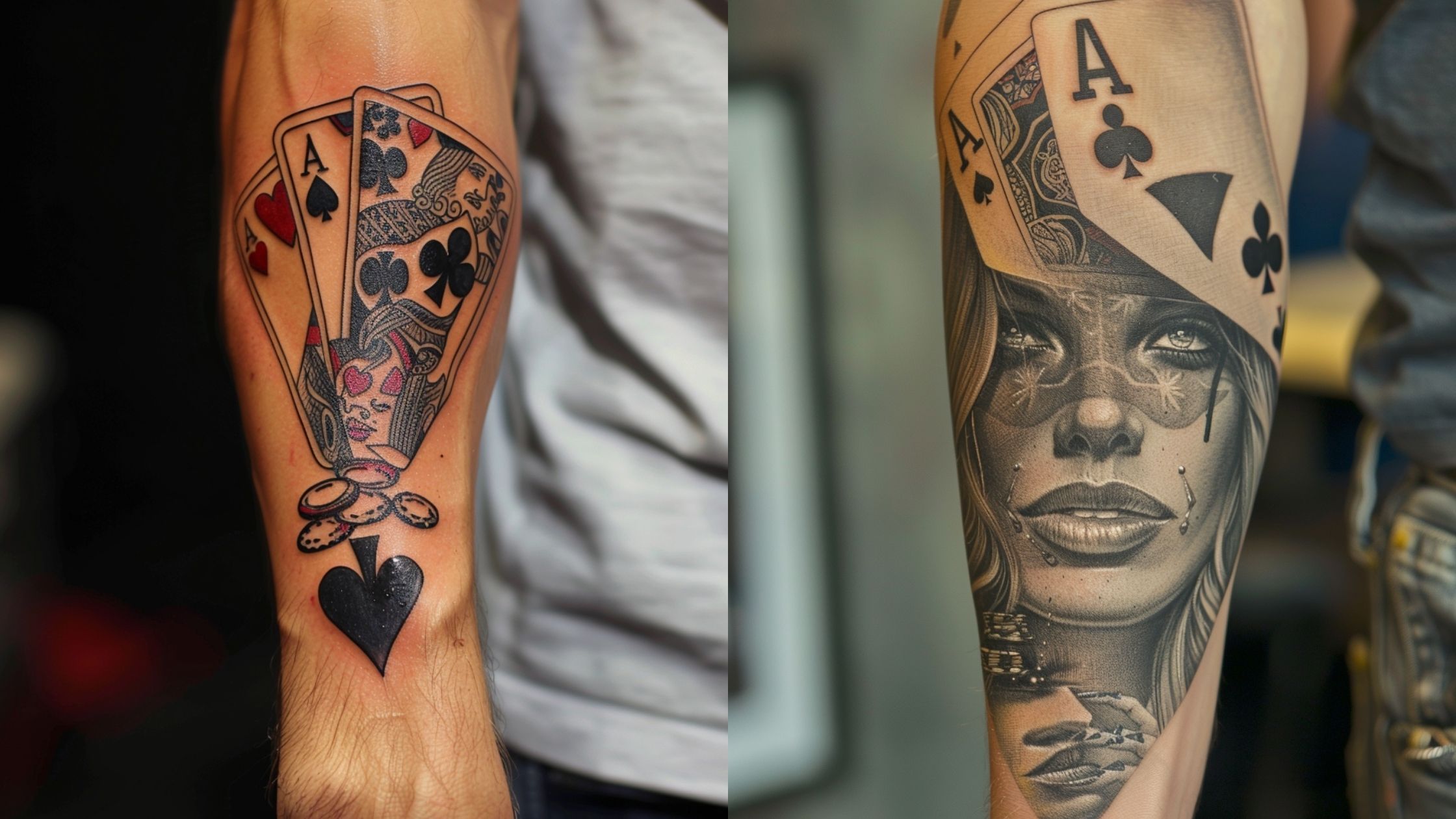
I have been sketching and researching card-themed tattoos for years, and poker imagery keeps coming back around. A poker tattoo is rarely about gambling — it is almost always about how someone handles risk, reads people, and keeps their nerve when the odds turn.
The first poker piece I ever watched go on was a royal flush down a client’s inner forearm. He was not a card player. He had just come out the other side of a rough two years and wanted a reminder that a bad hand is not the end of the game.
That is the thing about this subject. The symbols are instantly readable — aces, chips, suits, a joker’s grin — but the meaning underneath is personal and usually a lot more serious than the imagery suggests.
Below are the ten poker designs I see requested most often, what each one actually communicates, and the practical stuff nobody tells you until you are already in the chair. If you want a broader look at the base imagery first, my guide to playing cards tattoo drawings covers the linework fundamentals.
Which Poker Tattoo Style Is Right for You?
Every poker design I have seen falls into one of a few visual approaches. The style you pick affects how long it stays readable far more than the subject does.
| Style | Best For | Typical Size | How It Ages |
|---|---|---|---|
| American traditional | Bold aces, dice, single cards | 3–6 inches | Excellent — heavy outlines hold for decades |
| Black and grey realism | Skulls, hands holding cards, portraits | 5–10 inches | Good with strong contrast; soft greys fade first |
| Fine line | Small suit symbols, minimal chips | 1–3 inches | Weakest — expect a touch-up within a few years |
| Neo-traditional | Jokers, snakes and cards, framed scenes | 5–12 inches | Very good — strong shapes plus colour depth |
| Blackwork | Solid suits, geometric card fans | Any | Excellent, though solid black needs a skilled hand |
If you are drawn to the graphic end of that table, be aware that solid black is deceptively hard to lay in evenly — it is worth paying for a specialist.
What Poker Tattoos Actually Mean
Poker sits at an unusual intersection: it rewards discipline and pattern recognition, but it still hands out cards at random. That tension is exactly why the imagery works as a tattoo.
In my experience the most common motivation has nothing to do with casinos. People choose these designs after a divorce, a diagnosis, a business that failed, or a stretch where they had to make a decision with incomplete information.
The card you show the world and the card you hold are different cards — that is the idea most poker tattoos are quietly built on. It is why aces, jokers and face-down cards appear so often.
There is also a straightforward tribute layer. I have inked poker hands that matched a grandfather’s favourite game, a friend’s date of death spelled out in card values, and one piece that recreated a specific hand from a home game that no longer exists.
None of this requires you to explain it to anyone. Card imagery reads as decorative to strangers and as specific to you, which is usually the point.
10 Poker Tattoo Ideas Worth Considering
These are the designs I get asked about most, roughly in order of frequency. Each one carries a slightly different message.
1. The Royal Flush
Ten through ace in a single suit — the unbeatable hand. It is the most requested poker tattoo and, honestly, the one most at risk of looking generic.
The version that works is the one that treats the five cards as a composition rather than a row. Fanned at a slight angle, with one card lifted or curled, gives the artist somewhere to put shadow and stops the piece reading as clipart.
Placement matters more here than with almost any other design. Five overlapping cards need length, which is why the inner forearm, the outer calf and the ribs are the three spots I recommend most. A royal flush squeezed onto a shoulder cap tends to lose the individual card faces within a few years.
Ask for the suit that means something to you rather than defaulting to spades. Hearts and diamonds open up red ink and change the whole feel of the piece.
Expect a session of roughly three to five hours for a detailed forearm version in black and grey, longer if you want colour on the face cards.
2. Poker Chips
Chips are the quiet option. They carry the poker association without the theatre of a full hand, and they scale down better than almost any other card imagery.
A stack of three or four chips at an angle gives you depth from the edge striping alone, which means the design still reads at two inches across. That is rare in this subject.
I have seen people use chip denominations as a date, a number of years sober, or a jersey number. It is one of the easiest poker motifs to load with private meaning.
The weak point is colour. Casino chips are defined by their colour banding, so a black and grey chip stack needs deliberate value separation or the layers blur together. If you want chips small, commit to colour.
3. The Card Deck
A full or spilling deck is the most flexible poker composition, because the cards themselves become texture. It fills space the way florals do in other styles.
Spilling decks work particularly well as sleeve filler. Cards scattering out of a box give an artist a repeatable shape to flow around an existing piece without competing with it.
The mistake I see is uniform cards. Every card facing the same way at the same scale flattens the whole thing. Ask for varied rotation and at least two cards partially cropped by the edge of the design.
If you are building a larger arm piece around this, the composition principles in my tattoo sleeve filler ideas guide apply almost directly.
4. The Poker Face
Portrait-style poker tattoos — a figure holding cards, face half in shadow — are the most technically demanding option on this list and the most rewarding when done well.
The whole design rests on the expression. A poker face is not a blank face; it is a face actively withholding something, and that difference is subtle enough that plenty of artists miss it.
Before booking, I would ask to see healed photographs of the artist’s portrait work specifically, not fresh ones. Soft grey shading in a face is where poorly planned work falls apart at the two-year mark.
Give this design room. Realistic faces need scale — the thigh, the upper arm or the chest, rarely anything smaller than a palm.
Sessions run long. A detailed black and grey poker face on the upper arm is usually multiple sittings, and rushing it is the one thing guaranteed to compromise the result.
5. The Joker
The joker is the wildcard, which makes it the most symbolically loaded card in the deck. It belongs to no suit and it can become anything.
People pick it for two very different reasons. Some mean chaos and unpredictability; others mean adaptability — the ability to be whatever the situation requires.
Worth flagging: a lot of joker requests are really Batman-villain requests wearing a card-deck disguise. There is nothing wrong with that, but the two look completely different on skin, and it is worth being honest with your artist about which one you actually want.
Neo-traditional suits this subject better than realism. Exaggerated features, strong colour and a heavy outline give the joker the theatrical quality the card is supposed to have. If you like the unsettling end of that spectrum, the symbolism in my guide to the crying clown tattoo meaning overlaps heavily.
6. Flaming Cards
Burning cards are about the moment the hand goes wrong — or about going all in and not looking back, depending on who you ask.
Technically, flames are one of the friendlier elements in tattooing. They have no fixed shape, so a good artist can use them to fill awkward gaps and wrap the design around the natural curve of a limb.
The risk is fussiness. Flames rendered with too many thin wisps turn into a grey smudge as the tattoo settles. Ask for fewer, larger flame shapes with real negative space between them.
This design pairs well with existing work because the fire can literally reach toward whatever is next to it, which makes it a strong choice for anyone building a piece outward over time.
7. Snake and Cards
A snake coiled through a hand of cards is one of the strongest compositions in this whole category, and it is badly underused.
The snake solves the layout problem. Cards are rigid rectangles; a snake is a continuous curve. Running one through the other gives you flow and rigidity in the same design.
Symbolically it reads as hidden danger or temptation — the thing at the table you did not account for. Combined with cards it becomes a fairly direct statement about trusting the wrong person.
This design wraps limbs better than anything else here, which makes it a natural fit for a forearm or a full sleeve. The broader symbolism is covered in my snake tattoo meaning guide if you want the background before committing.
8. Skull and Cards
The skull-and-cards pairing is old, and it is old because it works. It is essentially a modern memento mori: play the hand, the house always wins eventually.
Almost every variation I see puts the cards either in the skull’s teeth or fanned behind it. The teeth version is more aggressive; the fanned version reads calmer and gives you more room for card detail.
Skulls are unforgiving. The eye sockets, the cheekbone and the jaw all rely on precise value transitions, and a skull with muddy shading looks wrong even to people who cannot say why.
Pick an artist whose portfolio is full of skulls, not one who is willing to try one. The skull tattoo ideas collection is a reasonable place to calibrate what good execution looks like.
9. Money and Cards
Cash and cards is the most literal design on this list, and the one I would think hardest about.
Done well it is about ambition, risk tolerance and betting on yourself. Done badly it just looks like a wallet.
The fix is usually to make the money secondary. Bills folded under a hand, or a single note curling behind the cards, keeps the composition about the game rather than the payout.
It is also worth being realistic about how this reads in a workplace. Card imagery is broadly neutral; stacks of cash are not, and this is one of the few designs where placement should probably account for that. Forearms are the usual compromise — my forearm tattoo ideas guide covers what actually stays coverable.
10. Hourglass and Cards
The hourglass turns a poker tattoo into something closer to a philosophy piece. Cards falling through an hourglass says the game is timed and the clock is not negotiable.
This is my favourite variation to design, because the hourglass gives the composition a frame. Cards scattered inside the glass, or spilling from the lower bulb, solve the layout problem before you start.
It also sits beautifully vertically, which suits the outer forearm, the spine and the calf — placements where a horizontal card fan would never work.
If the timepiece element is what draws you, the variations in my hourglass tattoo ideas guide are worth comparing before you settle on a layout.
Smaller Variations and Alternatives
Not everyone wants a full hand of cards. These smaller options carry the same idea at a fraction of the commitment.
Single suit symbols
One spade, heart, club or diamond — often on a finger, behind the ear or on the inner wrist. It is the most discreet entry point into this subject.
Solid black holds up best at this scale. Fine outlined suits smaller than about half an inch tend to soften into a blob over time.
The ace alone
A single ace of spades carries most of the poker association on its own and needs a fraction of the space a full hand does.
It also has a long military history as a symbol, which is worth knowing before you wear one — the association is not universally read as a card game.
Dice instead of cards
If your interest is chance rather than skill, dice communicate that more honestly than poker cards do. Poker is a skill game with a luck component; dice are pure variance.
A specific hand
Two cards representing initials or a date — an ace and a king for someone born on the first and thirteenth, for example. It is the most personal option and the least likely to date.
Hands holding cards
Cropping to just the hands removes the portrait difficulty of a poker face while keeping the tension. Hands are still hard to draw well, but they are far more forgiving than a face.
Two hands folding, or one sliding a card face-down across a table, tells a whole story in a design that fits comfortably on a forearm.
Placement, Cost and Aftercare
Poker designs tend to be linear, which pushes them toward long, straight placements: the inner and outer forearm, the outer calf, the ribs and the spine. Fanned cards fight round surfaces like the shoulder cap and the outer thigh.
On cost, the honest answer is that it depends entirely on your artist’s hourly rate and your city. A small chip or single suit is usually a shop-minimum piece; a detailed royal flush or a poker-face portrait runs into multiple hours. My breakdown of how much a small tattoo costs gives a sense of the lower end.
For healing, follow the specific instructions your artist gives you over anything you read online, including this. Studios differ on wrap type and washing schedules, and yours knows what they put in your skin.
The general pattern is that the surface usually closes over in about two to three weeks, while the deeper layers keep settling for a few months. Colour and fine detail can look slightly hazy during that window and then sharpen up — that is normal, and it is why touch-up appointments are typically booked well after healing rather than during it.
Keep it out of direct sun and off tanning beds, and use sunscreen on it once it is fully healed. The American Academy of Dermatology has straightforward guidance on caring for tattooed skin.
If you see spreading redness, swelling that worsens after the first few days, pus, a fever, or a rash around the ink, stop guessing and see a doctor. Infections and allergic reactions to pigment both happen, and the US FDA maintains a plain-language fact sheet on the risks. Nothing in this article is medical advice.
One more thing I will say plainly: do not attempt tattooing or tattoo removal yourself. Both require sterile equipment and training, and home removal in particular causes scarring that is far harder to fix than the tattoo was.
Still Not Sure? Common Mistakes to Avoid
Almost every poker tattoo I have seen someone regret failed for one of these reasons rather than because of the subject itself.
Going too small for the detail level. Five cards with visible faces need real estate. If you only have space for two inches, pick chips, a single ace or a suit symbol instead of shrinking a royal flush.
Copying a reference image exactly. Bring three or four references showing the elements you like, then let your artist build something that fits your body. A design lifted wholesale from someone else’s arm rarely sits right on yours.
Ignoring how the design flows with the limb. Cards are rectangles, and rectangles fight curves. Ask to see the stencil on your skin and move it around before anyone starts.
Choosing an artist by price rather than portfolio. This is the expensive mistake. If you are considering a heavily shaded piece, look through blackwork tattoo designs and my skull tattoo drawings collection to calibrate what competent execution actually looks like before you book anything.
Frequently Asked Questions
What does a poker tattoo mean?
Most poker tattoos are about how someone handles risk and uncertainty rather than about gambling itself. A royal flush usually signals confidence or a comeback, a joker signals adaptability or unpredictability, and skulls paired with cards read as a reminder that the game ends for everyone. That said, the meaning is set by the wearer — in my experience the private reason is almost always more specific than the symbol suggests. There is no fixed dictionary here.
Do poker tattoos suggest a gambling problem?
Generally no, and most people I have tattooed with card imagery do not play seriously at all. The symbols have moved a long way past their origin and now function more like imagery about decision-making and nerve. If you are worried about how it reads, keeping the design focused on cards rather than chips and cash usually shifts the interpretation. Placement you can cover also removes the question entirely.
Which poker design ages the best?
Bold, simple designs with heavy outlines — single aces, solid suit symbols, traditional-style cards — hold up the longest. Fine line work and soft grey shading are the first things to soften, particularly on hands, fingers and feet where skin turns over faster. A royal flush ages well if it is large enough that the card faces are not competing for space. Ask your artist to show you healed photographs, not fresh ones.
How much does a poker tattoo cost?
It varies too much by city and artist for a single number to be useful. A small chip or suit symbol is usually a shop-minimum piece, while a detailed royal flush or a poker-face portrait is priced by the hour across several hours or multiple sessions. Reputable studios will quote you before you commit, and a quote that seems unusually low is worth questioning. Budget for a touch-up too.
Where is the best place for a poker tattoo?
The inner and outer forearm are the most popular for good reason: they are flat enough for card shapes, easy to see, and straightforward to cover when needed. The outer calf, the ribs and the spine also suit long vertical compositions like an hourglass full of cards. I would avoid round, high-movement areas for anything with five distinct card faces. Hands and fingers look great but fade fastest.
Quick Summary
- Poker tattoos are usually about risk, nerve and decision-making — not gambling.
- The royal flush is the most requested design and needs a long, flat placement to work.
- Chips and single suit symbols scale down best if you want something small.
- Snakes and hourglasses solve the layout problem that rigid card rectangles create.
- Poker-face portraits are the hardest option — check healed portfolio work before booking.
- Bold outlines and strong value contrast age far better than fine line and soft grey.
- Follow your artist’s aftercare instructions, and see a doctor for spreading redness, pus or fever.
- Never attempt DIY tattooing or home removal — both cause damage that is hard to reverse.