Running tattoo ideas can mark a race, a familiar route or the everyday habit of getting out the door. The best starting point is the part of running you want to remember: movement, a place, a distance or the people who shared it. A running tattoo does not need a marathon time to have a personal reason behind it.
These 24 distinct design concepts range from a small shoe or race distance to trails, track layouts and practical running objects. Compare the outer shape first, then decide which details matter enough to keep. There is a separate hero image, for 25 images in total.
All images are AI-generated concepts, not real or healed client tattoos and not ready-to-use stencils. Have an artist create an original drawing, check the anatomy or object structure, and confirm every letter and number before tattooing.
Start with the part of running that matters to you
A runner silhouette puts movement first. A route outline can refer to a place. A race distance records a milestone, while a shoe, flask or headlamp can represent the daily routine behind it. These are possible personal readings rather than fixed meanings attached to every runner's tattoo.
Choose one main idea before adding a date, quote, mountain, medal and finish time to the same drawing. A clear focal point gives your artist something to build around. If you want the design to sit on the lower leg, compare the shapes in our calf tattoo ideas; the placement principles can be useful regardless of gender.
Check distances and race details before adding them
The World Athletics marathon page gives the distance as 42.195 km, and its half-marathon page gives 21.0975 km. The familiar 26.2 and 13.1 mile inscriptions are rounded labels. Decide whether you want a familiar label, the exact kilometre distance or your own event result.
Use your actual result record for a finish time, bib number or date. Check whether a time is your personal chip time or another published result, and agree on the exact punctuation. For a route, supply your own verified map or activity file. The route illustration below is deliberately generic and does not represent a real event.
1. Runner in stride
A side-profile runner makes the action the main subject. Bent arms and a long stride create a shape that reads before you notice the clothing details.
Ask the artist to trace all four limbs and check the pose against a running photograph. The silhouette should stay understandable without extra speed lines.
2. Single running shoe
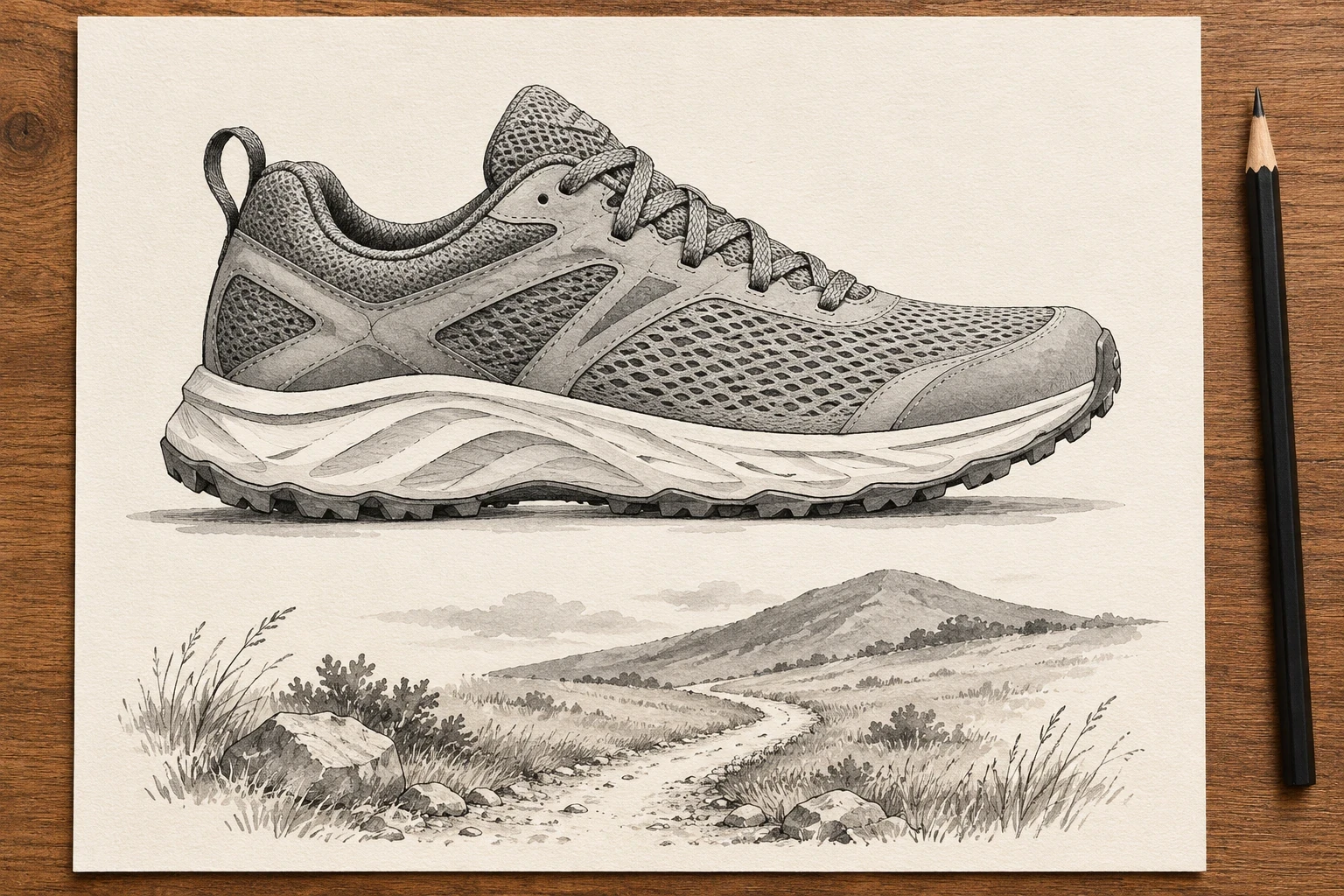
A shoe can stand for ordinary training days as easily as a particular race. The low horizontal shape offers room for laces, mesh and a defined sole.
Bring a photograph if a specific pair matters. Ask for an original unbranded interpretation or discuss which real details you want preserved rather than relying on the generated tread.
3. Winged running shoe
The wing gives a familiar object an imaginative extension. Feather layers rise above the heel, turning the shoe into a taller emblem.
Keep the shoe and wing clearly connected. Decide whether the feathers or footwear should carry the detail so that neither disappears in equally dark shading.
4. Oval running track
Nested oval lines create a spare graphic reference to track running. There is no athlete, date or result to make the piece depend on one particular race.
Check that every lane is continuous in the artist’s drawing. Treat this as an emblem rather than a scale plan of a certified track.
5. Checkered finish ribbon
A ribbon gives the finish-line idea a contained shape. Its loose ends add movement without needing a full crowd or race scene.
Keep the checkered rows organized where the ribbon curves. Ask whether fewer, larger squares would make the pattern clearer at your intended size.
6. Finisher medal
A hanging medal puts a milestone into the form of a small object. The ribbon adds height while the round medallion gives the composition a focal point.
Use a photograph if you want your actual medal. This concept is generic; do not assume its ribbon, center motif or proportions match a real event award.
7. Stopwatch
A simple stopwatch can refer to training, pacing or the act of showing up for a session. The circular face keeps the idea compact.
If the hands should record a specific moment, tell the artist exactly what you intend. Otherwise keep the dial decorative and avoid inventing a result from the generated hand positions.
8. 26.2 marathon inscription
A distance label lets the number carry the story. The clean underline makes a simple base without adding a second symbol.
This is the familiar rounded mile label. If you prefer an exact kilometre inscription or want units included, supply the full text and check the decimal point in the stencil.
9. 13.1 half-marathon inscription
Black numerals, a fine underline and a leafy wreath give this milestone a contained treatment. The leaves provide an outer frame around the distance.
Agree on the units and precision before drawing. Check that the decimal is intentional and that the 3 and 1 remain distinct at actual size.
10. 5K milestone
A short label inside an circular border creates a small emblem. It can refer to a first event, a favorite distance or another personal connection.
Keep the circle separate from the characters. Choose the meaning from your own experience rather than treating one distance as a prerequisite for a running tattoo.
11. 10K with a leafy accent
The distance stays the main subject while a small sprig provides a softer lower edge. The contrast gives plain lettering a little more shape.
Ask the artist to balance the weight of the characters and leaves. Make the K clearly readable, especially if the sprig approaches the baseline.
12. Mountain trail panel
A winding trail leads into two peaks inside a narrow frame. The panel gives the landscape a clear boundary and a vertical direction.
If this refers to a real trail, provide a photograph or map. Decide which features should be recognizable and which can become a general landscape.
13. Forest path
Dark tree groups frame a pale route through the center. The open path makes the destination feel less important than moving through the scene.
Keep a visible gap through the trees. Ask the artist to simplify branches before reducing the path to a thin sliver of unmarked space.
14. Road at sunrise
Converging road edges point toward a rising sun. A small warm accent can make the horizon the focal point without coloring every surface.
Decide how much perspective you want to keep. Avoid crowding a quote or result into the narrow horizon just because it looks empty in the concept.
15. Personal route line
An irregular line can give a route its own recognizable outline. Separate start and end markers help explain how the drawing is meant to be followed.
This illustration is not a real course. Supply your own verified route, then ask the artist which turns can be simplified while keeping the part that matters to you.
16. Race bib
A blank bib offers a rectangular object that can later hold a verified personal detail. The folds and corner attachments provide the visual structure here.
Use your actual bib if the number or event matters. Keep any added text separate in the brief and confirm permission before reproducing an event logo.
17. Shoelace heart
A single lace forms a heart with two loose ends. It can express a personal affection for running without adding a full shoe or athlete.
Follow the lace through the crossing in the artist’s drawing. Keep both aglets identifiable so that the shape still reads as a lace rather than a generic ribbon.
18. Running shoe sole prints
Two staggered sole prints create a direction of travel. The tread gives the concept texture while keeping the outline close to a familiar object.
Bring your own sole reference if you want a particular pair. Ask the artist to keep the heel and forefoot groups clear before adding tiny tread blocks.
19. Relay baton
A diagonal baton makes teamwork the possible personal reference. The simple cylinder and short motion strokes give the idea a compact composition.
Keep the cylindrical perspective coherent. A small handoff scene would introduce more anatomy; this object-only version leaves the shared story to your explanation.
20. Soft running flask
A small flask can refer to long outings and the equipment that goes with them. Curved sides distinguish it from a rigid everyday bottle.
Choose the features that make your own flask recognizable, such as the nozzle or cap. Simplify labels rather than asking the artist to reproduce unreadable packaging.
21. Trail headlamp
A lamp and looped strap give night running a practical visual reference. The central lens supplies a small circular focal point.
Check how the strap joins the lamp in the drawing. Keep the casing and lens more prominent than minor buttons if you want a smaller piece.
22. Compass with a winding trail
A compass rose above a broken route line combines direction and movement. The open spacing keeps it from becoming a dense navigation chart.
Decide whether the compass is symbolic or needs exact directional information. This concept omits letters and does not claim to map an actual route.
23. RUN lettering
Slanted capitals and short lines give a single word a sense of motion. The lettering makes the subject explicit without a portrait or piece of equipment.
Check the R, U and N separately in the stencil. Keep motion marks outside the letters so they cannot be mistaken for extra strokes.
24. Running shoe with wildflowers
Flowers rising from the shoe opening combine equipment with a softer organic shape. It offers a different emphasis from race results or performance symbols.
Tell the artist if a particular flower has a personal reference. Keep the stems connected to the opening and preserve enough of the shoe structure for both subjects to read.
Match the design's shape to the placement
| Design family | Shape to compare | What to check in the stencil |
|---|---|---|
| Shoe, distance or RUN lettering | A compact horizontal arrangement | Letters and small gaps remain distinct at actual size |
| Runner, mountain trail or forest path | A taller silhouette or panel | The important shape is visible from the main viewing angle |
| Track, heart or medal | A rounded or contained emblem | Curves remain intentional when placed on the body |
| Route or shoelace | A loose continuous line | Turns and crossings can be followed without confusion |
These are comparisons, not fixed size prescriptions. Ask the artist to show the stencil on your actual placement, with the limb relaxed. A design that looks compact on a screen may need more room for tread, lettering or a runner's limbs. Avoid choosing a size solely to fit a saved image.
If you prefer fewer marks, our minimalist tattoo ideas offer useful comparisons for open spacing. For an outdoor direction, browse our mountain tattoo ideas. Use the references to explain a preference, then let the artist draw a coherent piece.
Give your artist a clear brief
- Name the reference. Explain whether the tattoo marks a specific race, route, training partner or everyday habit.
- Separate essentials from decoration. A particular distance may be essential while a border or motion line is optional.
- Supply accurate details. Bring the result, map or object photograph rather than expecting an AI-generated concept to preserve it.
- Check the structure. Trace a runner's arms and legs, a shoe's sole, or every turn of a route in the artist's drawing.
- Read the final stencil. Confirm numbers, units, dates, word breaks and orientation one last time at actual size.
Ask to see healed examples of similar linework or lettering from the artist's portfolio. Generated images show visual ideas; they cannot demonstrate how an artist's tattoo work heals. If you are considering initials for a running partner, our initials tattoo ideas explore ways to make the letters the main subject.
Plan the appointment around your running routine
Tell your artist about clothing, shoes, straps or equipment that will touch the chosen area. Ask for written aftercare instructions and discuss how your running schedule should fit around them. Do not use this design gallery as a return-to-exercise timetable. Ask a clinician about a skin reaction, healing concern or medical question.
Frequently asked questions
What is a subtle tattoo for a runner?
A small shoe, a simple distance inscription or a short route line can keep the idea understated. Choose the detail that makes it personal, then ask the artist what size keeps that detail clear.
Do I need to have run a marathon to get a running tattoo?
No. A daily route, first 5K, relay, trail outing or long-term routine can be the reference. Choose a design that reflects your own relationship to running rather than borrowing someone else's achievement.
Should a marathon tattoo say 26.2 or 42.195?
That depends on the units and level of precision you want. The first is a familiar rounded mile label; the second is the exact kilometre distance given by World Athletics. Add a unit if you want the inscription to be explicit, and check all the characters in the stencil.
Can I tattoo my race route?
You can use a route as a starting point for an artist's drawing. Supply a verified reference and decide which bends matter most before simplifying it. If you include a route that begins at home, consider how much location detail you want to make visible.
Can these designs work for a running partner?
Yes. Two people might share a route, track shape or object while choosing their own placement and line treatment. Matching tattoos do not have to contain identical dates, results or distances.
Race-distance sources checked November 6, 2026. Personal interpretations and composition advice are editorial suggestions.