Female tribal tattoos are one of the few styles that look as good in thirty years as they do on the drive home from the studio. That is the whole appeal, and it is also the thing most people miss when they browse designs.
I have been collecting and photographing tribal work for this site for years, and the pieces that still look sharp are almost never the most intricate ones.
They are the ones with confident black, generous spacing, and a shape that follows the body underneath it. Everything else is decoration.
This guide covers where the style actually comes from, which variations suit which placements, what to ask an artist before you book, and how to approach cultural motifs respectfully. If you want a broader starting point first, our general tribal tattoo ideas guide is a good companion piece.
Which Tribal Style Is Right for You?
The word “tribal” covers several unrelated design traditions plus a modern Western style that borrows from all of them. Knowing which one you are looking at changes the conversation with your artist completely.
| Style | Visual signature | Best placements | Cultural sensitivity | Typical session |
|---|---|---|---|---|
| Polynesian (general) | Dense black fields, repeating small motifs, strong negative space | Shoulder, upper arm, thigh, calf | High — motifs carry specific meanings | 4–8 hours per panel |
| Maori-inspired (kirituhi) | Curved spirals, chisel-like lines, flowing bands | Upper arm, shoulder, back | Very high — true ta moko is not for outsiders | 5–10 hours |
| Neo-tribal / modern blackwork | Abstract curves, sharp points, no ancestral content | Anywhere — spine, ribs, forearm, hip | Low — invented style | 2–5 hours |
| Aztec / Mesoamerican | Stepped fret borders, blocky glyph forms | Forearm, calf, back panel | Moderate to high | 4–7 hours |
| Fine-line tribal | Thin tapering strokes, lots of skin left open | Spine, ankle, inner arm, neck | Low | 1–3 hours |
If you are drawn to the bottom two rows, you have a lot of freedom. If you are drawn to the top two, the rest of this guide matters more.
Why Tribal Tattoos Age Better Than Almost Anything Else
Tattoo ink does not stay where the artist puts it. Over years it spreads slightly through the dermis, which is why thin lines thicken and tight details close up.
Tribal design was built around that reality long before anyone measured it. Bold lines, wide gaps, solid fills — all of it tolerates a little spread without losing the shape.
In my experience the difference shows up around year eight. A heavily detailed micro-realism piece from the same era often needs a rework by then; a well-spaced tribal piece usually just needs a black touch-up.
The single best predictor of how a tribal tattoo will age is the width of the gaps, not the quality of the linework. Every artist I have asked about this says the same thing, usually before I finish the question.
That is also why artists push back when you ask them to shrink a design. The pattern does not scale down cleanly; it has to be redrawn simpler.
Female Tribal Tattoo Designs Worth Considering
1. Shoulder Cap and Upper Arm
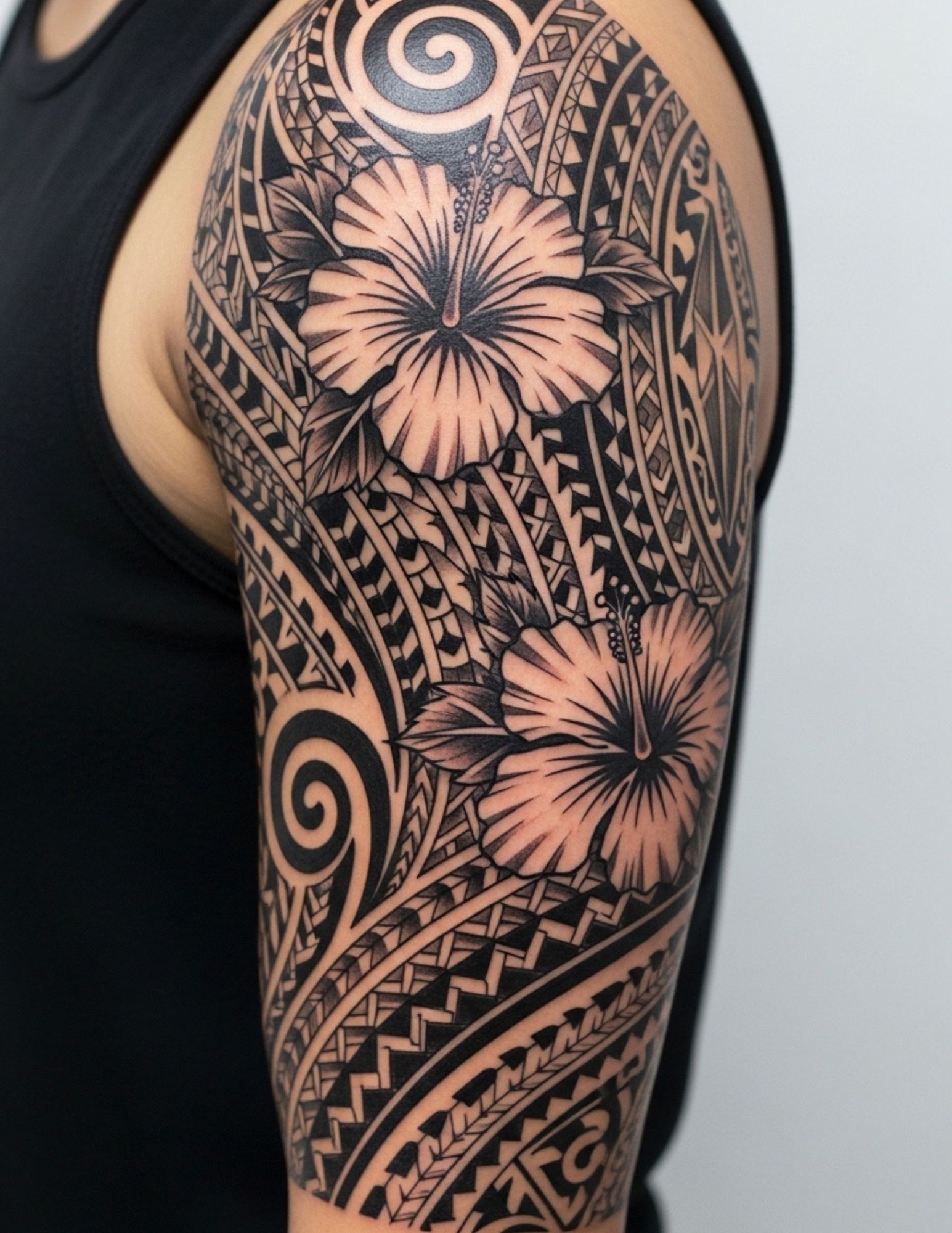
The shoulder is the most forgiving placement in the style. It is curved, it is rarely stretched by weight change, and it takes a large design without needing to wrap awkwardly.
A shoulder cap that ends cleanly at the deltoid also lets you extend later into a half sleeve without redrawing what you already have.
When I have watched artists stencil these, they almost always place the design standing, then check it with the arm raised and lowered. A stencil that looks balanced with your arm down can pull badly out of shape when you reach up.
Expect four to eight hours for a full cap in dense black, usually split across two sittings. Solid black over a wide area is more tiring than it sounds.
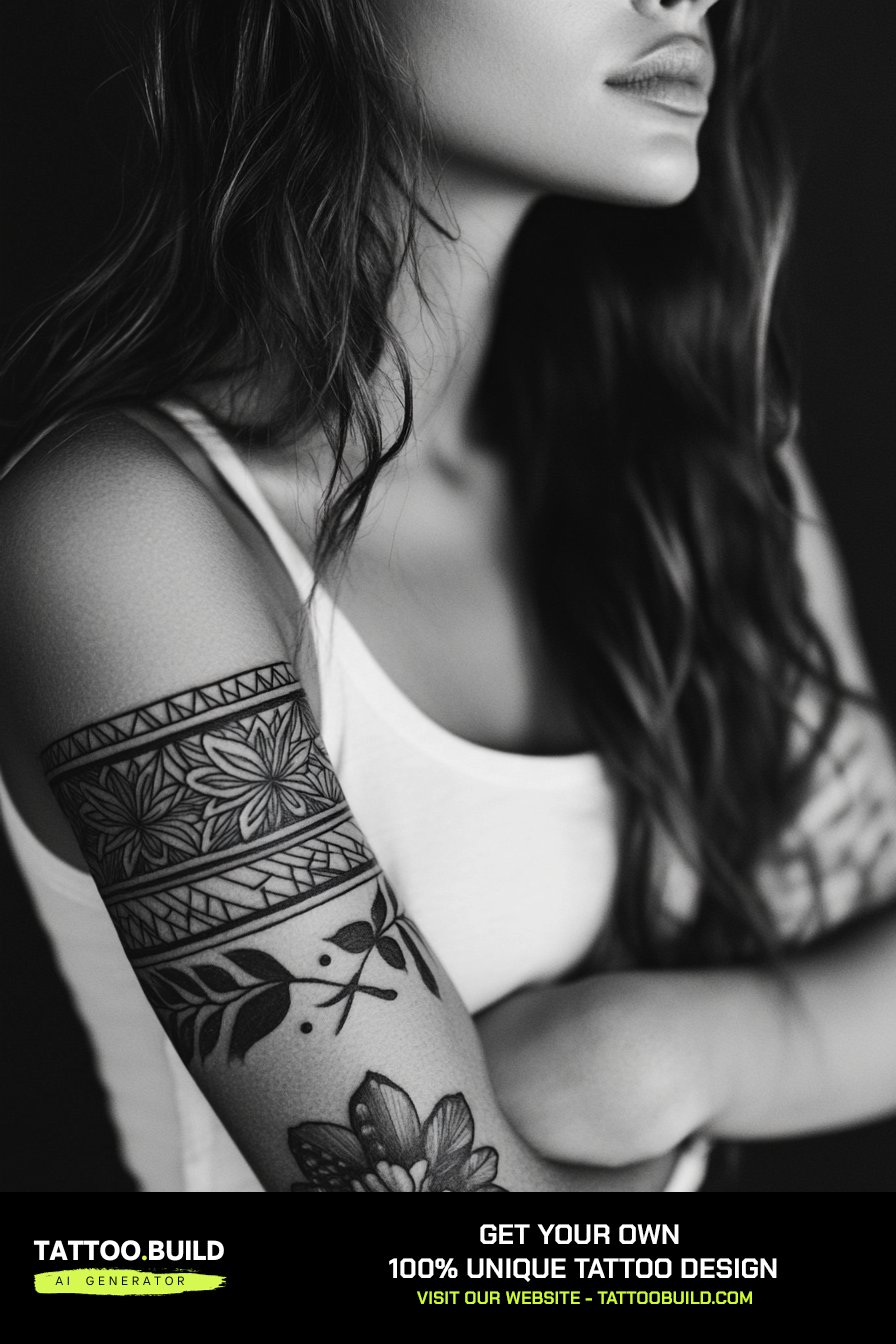
2. Forearm Bands and Panels
Forearm tribal is having a genuine moment, particularly the narrower panels that run from elbow to wrist rather than wrapping fully.
The advantage is visibility: you see it every day, which sounds obvious but changes how attached you get to a piece.
The complication is the wrap. A band that closes on the inner forearm sits on thinner, more sensitive skin, and the join is where most amateur work goes wrong.
If you want a full closed band, ask to see healed photos of the artist’s joins specifically. Our roundup of forearm tattoos for women has more placement ideas if you are still deciding.
3. Spine and Back Pieces
Symmetrical tribal on the spine is one of the strongest looks in the style, because the body gives you a perfect centre line for free.
It is also unforgiving. Any asymmetry reads immediately, and the stencil has to be applied with you standing straight rather than lying on the table.
Fine-line versions have become popular for people who want the shape without the commitment of a full black back piece. They fade faster, but they are far easier to extend or cover later.
For non-tribal alternatives in the same placement, feminine spine tattoo designs covers softer options.
4. Thigh and Hip Designs
The thigh is the largest flat canvas most people have, and it is usually covered, which makes it the default choice for anyone with a workplace dress code.
Sweeping symmetrical blackwork suits it particularly well because there is room for the pattern to breathe.
One honest caveat: thighs and hips change shape with weight more than arms do. Artists tend to build in slightly wider spacing here for that reason.
If you want something in this placement that is not tribal, classy feminine thigh tattoos is a useful comparison.
5. Small and Fine-Line Tribal
Not every tribal piece needs to be a panel. Compact motifs — a sun, a crescent, a single spearhead row — work well as first tattoos.
The rule I keep coming back to: a small tribal tattoo should be a simplified pattern, never a shrunken one.
When you shrink a complex design, the gaps close and it turns into a dark smudge within a few years. When you simplify it, it stays readable indefinitely.
Ankles, inner arms and the back of the neck all suit this scale. Hands and fingers technically work but blur fastest of anywhere on the body.
6. Hybrid Tribal — Floral, Feather and Geometric
Blending tribal linework with florals or geometry is where a lot of the most interesting current work sits.
It also sidesteps the cultural question entirely, because a floral hybrid is clearly a contemporary design rather than a borrowed one.
Dotwork shading inside bold outlines is the most common modern addition. Traditional tribal never used it, which is worth knowing if authenticity matters to you.
For pure pattern work in the same visual family, geometric tattoo designs overlaps heavily with neo-tribal.
7. Full and Half Sleeves
A tribal sleeve is planned as one continuous design, not as separate tattoos that meet in the middle. That distinction drives everything else.
It means the first session commits you to the whole layout, and it means switching artists partway through is genuinely difficult.
Budget realistically: most full tribal sleeves run six to ten sessions spread over several months, with healing time between each.
Sleeve tattoos for women covers non-tribal options in the same footprint if you are weighing them up.
8. Ribs, Calves and the Painful Placements
Ribs, sternum, ankles and the inner arm are the placements people underestimate. Bone close to the surface means more sensation, and tribal work involves long stretches of solid packing.
Packing black is repetitive and slow, which is a different kind of hard than a short detailed piece.
If you are new to tattooing, I would not start with a rib panel. Do a forearm band first and find out how your body handles two hours before you sign up for six.
Variations and Alternatives to Classic Tribal
If the traditional look is not quite right, several adjacent styles get you most of the way there.
Neo-Tribal Blackwork
Abstract curves and points with no ancestral content. All the visual weight, none of the cultural weight.
Aztec and Mesoamerican Patterns
Stepped fret borders and blocky glyph forms from a completely different tradition. Visually bolder and more angular than Pacific work. See Aztec tattoos for females for examples.
Blackwork Without Tribal Motifs
Pure solid-black shapes, ornamental patterns and negative-space designs. Ages just as well, with no motif borrowing at all.
Black and Grey Illustrative
If you like the monochrome palette but not the geometry, black and grey tattoo ideas for women offers a softer route with shading instead of flat fill.
Kirituhi Rather Than Ta Moko
Kirituhi is the term for Maori-style design created for people outside Maori whakapapa. It is the respectful path if the Maori aesthetic is what draws you — our Maori tattoo guide explains the distinction in more depth.
Practical Advice Before and After You Book
Ask to see healed photographs, not fresh ones. Fresh tribal always looks perfect; healed work at two years tells you whether the artist spaced it properly.
Bring reference images but stay open on the specifics. Tribal designs need to be drawn to your body, and an artist who copies a photo exactly is usually the wrong artist.
On aftercare, follow whatever protocol your artist gives you rather than advice from the internet — large areas of packed black weep more and can look alarming on day two when nothing is wrong. If you develop spreading redness, heat, swelling that worsens after day three, pus, or a fever, contact a doctor rather than waiting it out; those are signs of infection, not normal healing. The American Academy of Dermatology publishes general tattoo skin-care guidance worth reading beforehand.
Expect a touch-up. Solid black almost always heals with a few light patches, and most reputable studios include one touch-up session in the price. Ask about that policy before you book, not after.
Common Mistakes and How to Avoid Them
The most frequent one is choosing a design from a photo without knowing what the motifs mean. Some Pacific patterns encode family lineage, status or specific life events, and wearing them without that context lands badly with people who recognise them.
The second is going too small too soon. I have seen more regret from shrinking a pattern than from any other single decision in this style.
The third is skipping the placement conversation. A design that looks balanced on paper can distort completely once it is on a curved limb.
The fourth is treating “tribal” as one thing. It is at least four unrelated traditions plus a modern invention, and mixing them arbitrarily produces work that reads as generic. The Metropolitan Museum of Art has a good overview of tattooing’s history across cultures if you want the background.
Still weighing options? Compare against general tribal tattoo ideas before committing to a full panel.
Frequently Asked Questions
Are female tribal tattoos culturally appropriative?
It depends entirely on which motifs you use. Neo-tribal and abstract blackwork are modern inventions with no ancestral content, so they raise no issue at all. Specific Polynesian, Maori or Samoan motifs often encode family lineage and personal history, and wearing those without connection to the culture is widely considered disrespectful. The usual middle ground is kirituhi — designs made in the visual style for people outside the culture, without the genealogical content.
How much do tribal tattoos hurt compared to other styles?
Generally more than a comparable line-only piece, because packing solid black means going over the same skin repeatedly. Placement matters more than style, though: ribs, sternum, ankles and inner arms are noticeably tougher than outer arm, shoulder or thigh. Most people describe a forearm band as very manageable and a rib panel as genuinely hard. If it is your first tattoo, starting somewhere fleshy is sensible.
Do tribal tattoos fade faster than colour work?
No — solid black is typically the most durable ink there is, and it usually outlasts colour by a wide margin. What tribal work does is spread rather than fade, so lines thicken slightly and tight gaps can close over the years. Good spacing at the design stage is what prevents that from becoming a problem. Sun protection makes a real difference too.
Can a tribal tattoo be covered up or removed later?
Cover-ups are difficult because solid black leaves very little to work with; usually the only realistic options are a larger blackwork piece or laser lightening first. Laser removal does work on black ink, often better than on colour, but it takes multiple sessions over many months and results vary by skin tone and ink depth. Never attempt any DIY removal method — consult a licensed practitioner or dermatologist. Plan a tribal piece as permanent.
What should I budget for a tribal tattoo?
Pricing varies enormously by region and artist, so ask for a quote rather than trusting a number online. As a rough shape, a small fine-line motif is typically a single short session, a forearm band a half day, and a full sleeve six to ten sessions across several months. Studios that specialise in Pacific-style work often quote by the panel rather than the hour. Always confirm whether a touch-up is included.
Quick Summary
- Tribal ages better than almost any other style because bold lines and wide gaps tolerate ink spread.
- “Tribal” covers several unrelated traditions plus a modern Western style — know which one you want.
- Shoulder, upper arm and thigh are the most forgiving placements; ribs and hands are the hardest.
- Small tribal should be a simplified pattern, never a shrunken complex one.
- Use kirituhi or neo-tribal if you love the look but have no cultural connection to the motifs.
- Ask every artist for healed photos, especially of band joins and solid black areas.
- Budget for a touch-up; packed black almost always heals with light patches.
- Treat it as permanent — cover-ups over solid black are genuinely limited.