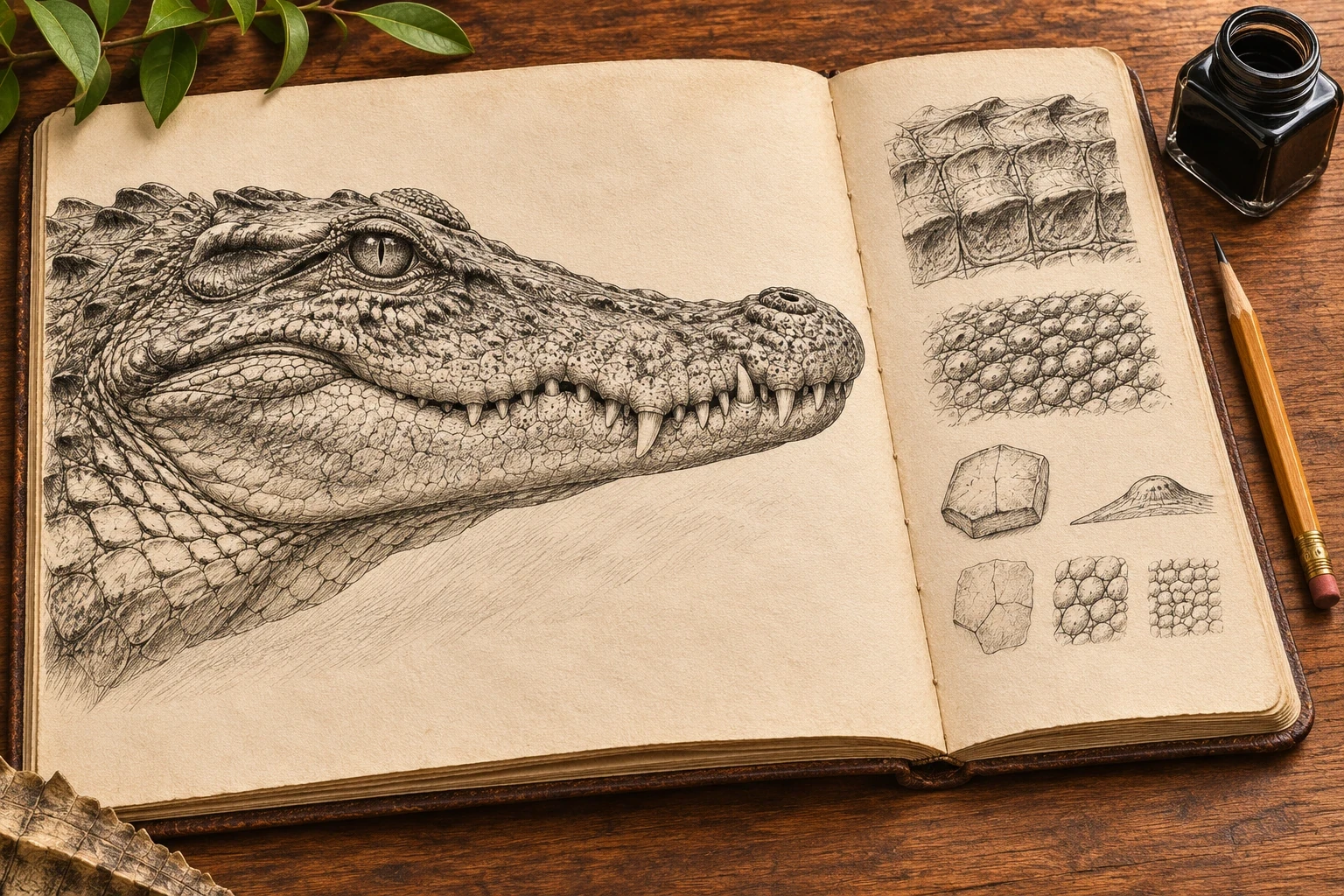
A crocodile tattoo can read as one low, quiet shape or as a wide-open jaw that takes up the whole frame. The two choices make very different stencils. Before picking a style, decide what you want people to notice first: the long snout, the armored back, or the tail cutting through water.
Image disclosure: All 20 designs and the separate hero are AI-generated concepts. They are drawing references, not photographs of real or healed tattoos.
What makes a crocodile recognizable?
The National Park Service’s American crocodile profile describes a tapering snout, four short legs and a long muscular tail. It also compares the snout with the broader American alligator’s. If a particular species matters to you, bring a reference photo as well as the drawing. The animal in the illustration may be stylized.
For a compact piece, start with a head. A full crocodile makes sense when you have room to show the turn of the tail. Browse these snake tattoo ideas if you want to compare how a long reptile silhouette can follow a limb.
1. A simple crocodile outline
A low muzzle and a tail that lifts at the end do most of the work. Start by taking away all the interior marks. If the animal still reads, add only the one or two details you miss.
2. Open jaws in woodcut
A strongly defined mouth can carry the whole piece. Leave a clear light gap inside the jaws, then place the deepest hatch marks behind the eye rather than covering the whole head evenly.
3. Overhead crocodile with a curved tail
This view gives the tail equal weight with the head. Tilt the curve to follow a forearm or calf and make sure the legs don't read as part of the tail.
4. Crocodile curled into a circle
A curved body can fit where a straight profile is too long. Keep a clear gap between the head and the tip of the tail so the silhouette doesn't turn into a ring.
5. Crocodile cut out of a river band
The pale animal takes shape between dark bands of water. Decide how much of the bar should extend beyond the tail before you set the width of the whole tattoo.
6. Eyes above a waterline
A ridge, an eye and a few ripples can suggest the whole animal. It's a useful direction if you want something horizontal without an obvious full reptile profile.
7. Open-mouth study viewed head-on
A frontal composition puts the opening of the mouth at the center. Give the artist room to separate the jaw edges from the teeth and see how the two sides balance on the stencil.
8. Green crocodile with sun rays
Use the rays as a frame for the head and make the eye a small point of contrast. If you prefer less color, keep the warm eye and draw the rest with black ink alone.
9. Crocodile among reeds
Two long reeds can point the eye toward the muzzle. Keep them thinner than the main outline so the animal stays easy to pick out.
10. Long crocodile with a trail of dots
The open space beyond the tail matters as much as the dots. Use it to lead toward a nearby tattoo or leave it open so the animal can stand alone.
11. Engraved crocodile skull
The long upper jaw is the detail to prioritize. If the piece has to be small, ask for fewer teeth and a simpler hinge before you shrink all the lines together.
12. A head made from angular planes
Instead of drawing every scale, use a few planes to show where the head changes direction. Ask the artist to keep the openings between those planes wide enough to read at stencil size.
13. Crocodile under a moon and mangrove roots
Leave a lighter opening around the animal so it doesn't disappear into the roots. A tall shape gives the branches and the water room to frame the crocodile without crowding it.
14. Crocodile resting on a sandbank
A horizontal silhouette and a short water line tell the story with very little detail. Leave the far bank out if the stencil feels too busy.
15. Three-quarter crocodile head
This angle combines the long muzzle with the texture of the brow. Ask for a clear muzzle outline and concentrate the smaller scale marks where they support the turn of the head.
16. Crocodile with a green wash
A loose wash can suggest the light and movement of water. Decide whether the pigment should follow the body or drift outside the outline, and ask to see healed work with a similar palette.
17. A curled crocodile with a flower
A small flower shifts the tone of a coiled reptile. Place it where it doesn't interrupt the muzzle so you keep both the softness of the flower and the outline of the animal.
18. Tail disappearing into a ripple
This design lets the water line imply the missing body. Keep a distinct bend or broken ripple at the point where you want the tail to look submerged.
19. Crocodile under a mangrove sprig
The leafy arc balances the low profile of the animal. Try one stem first and move the branch away from the ridge of the back if the two outlines run together.
20. Crocodile inside a shield
A firm outer edge makes the piece read like a badge. Keep the whole tail inside the border or deliberately open the border where it exits; an accidental tangent makes the two edges hard to read.
Fit the snout and tail to the placement
- Long and narrow: Try the outline or the crocodile in motion. Run the tail along the limb rather than curling it into the space left over.
- Short and wide: Go with the head, waterline or sandbank. Decide which part of the silhouette needs the most room.
- Around a curve: Check the stencil straight on and from the side. Set the jaw or eye where you can see it without turning your arm.
What to ask your tattoo artist
Point to the detail you want to keep if the drawing needs to be simplified. For an open-jaw portrait, that could be the mouth shape. For a full animal, it might be the first bend in the tail. Ask to see the stencil at actual size and bring references for both the animal and the linework. These blackwork tattoo designs offer examples of how different amounts of solid ink change a silhouette.
Crocodile tattoo FAQs
Can a crocodile tattoo be small?
Yes. A spare outline, a short side profile or a few waterline marks are easier to simplify than a full head with rows of teeth and scales. Check the shape at the intended size before choosing the details.
What can a crocodile tattoo mean?
It might remind you of a place, stand for patience, or simply be an animal shape you like. There’s no single meaning you have to attach to it.
How do I make it look more like a crocodile than an alligator?
Start with a photo of the species you want. If it’s an American crocodile, a tapering muzzle is a useful cue. Ask your artist to preserve the muzzle shape before spending time on the small scales.