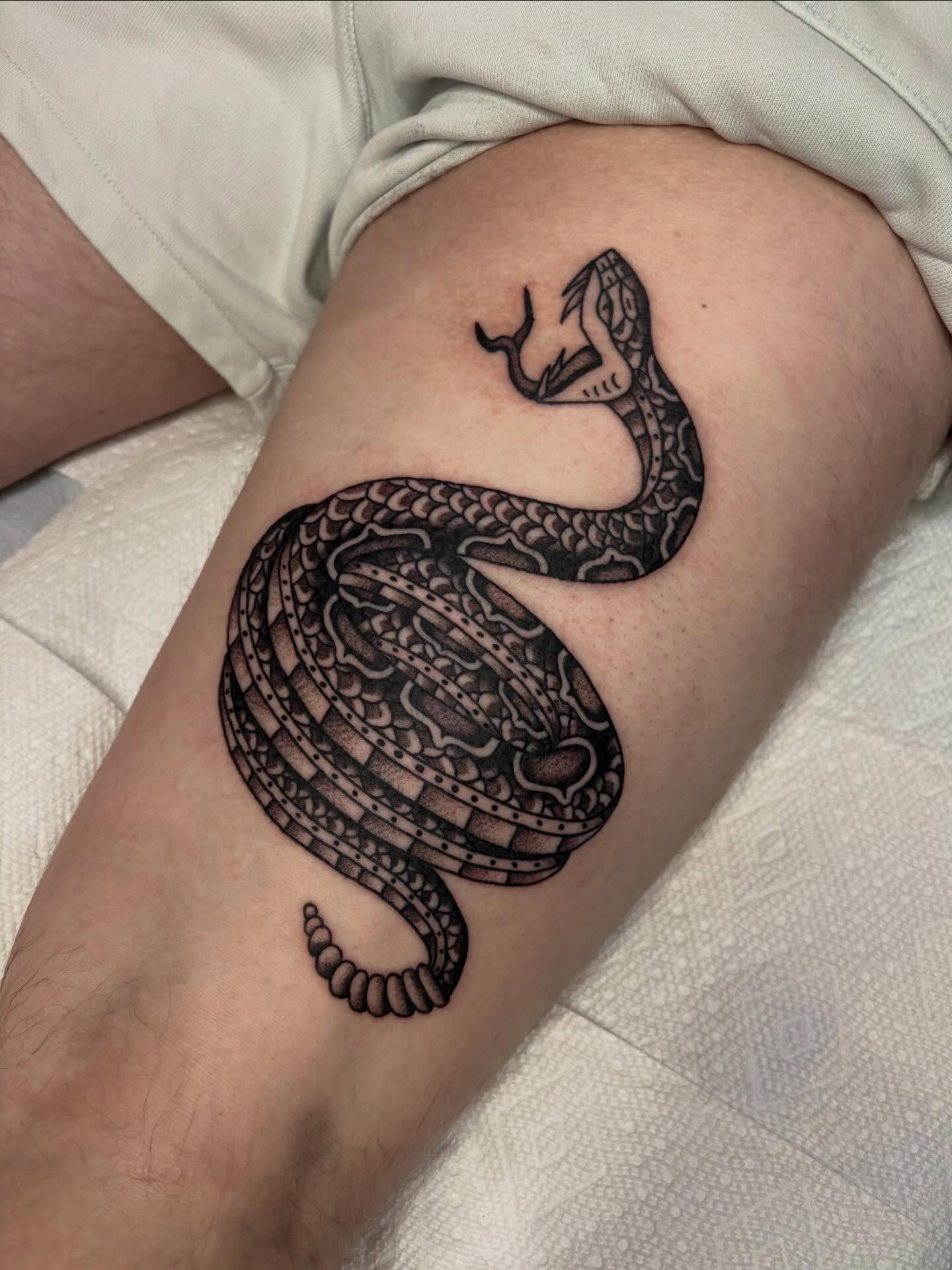
The first time I saw a finished ornamental piece up close — a sternum mandala still shiny under its second-skin dressing — I assumed the client was wearing jewelry. Ornamental tattooing does not depict anything; it decorates, and at its best it reads as metalwork applied directly to skin.
This style borrows from filigree, lacework, architectural carving and Persian and Islamic geometric design rather than from traditional tattoo imagery. There is no subject to recognise, only pattern, symmetry and the quality of the line.
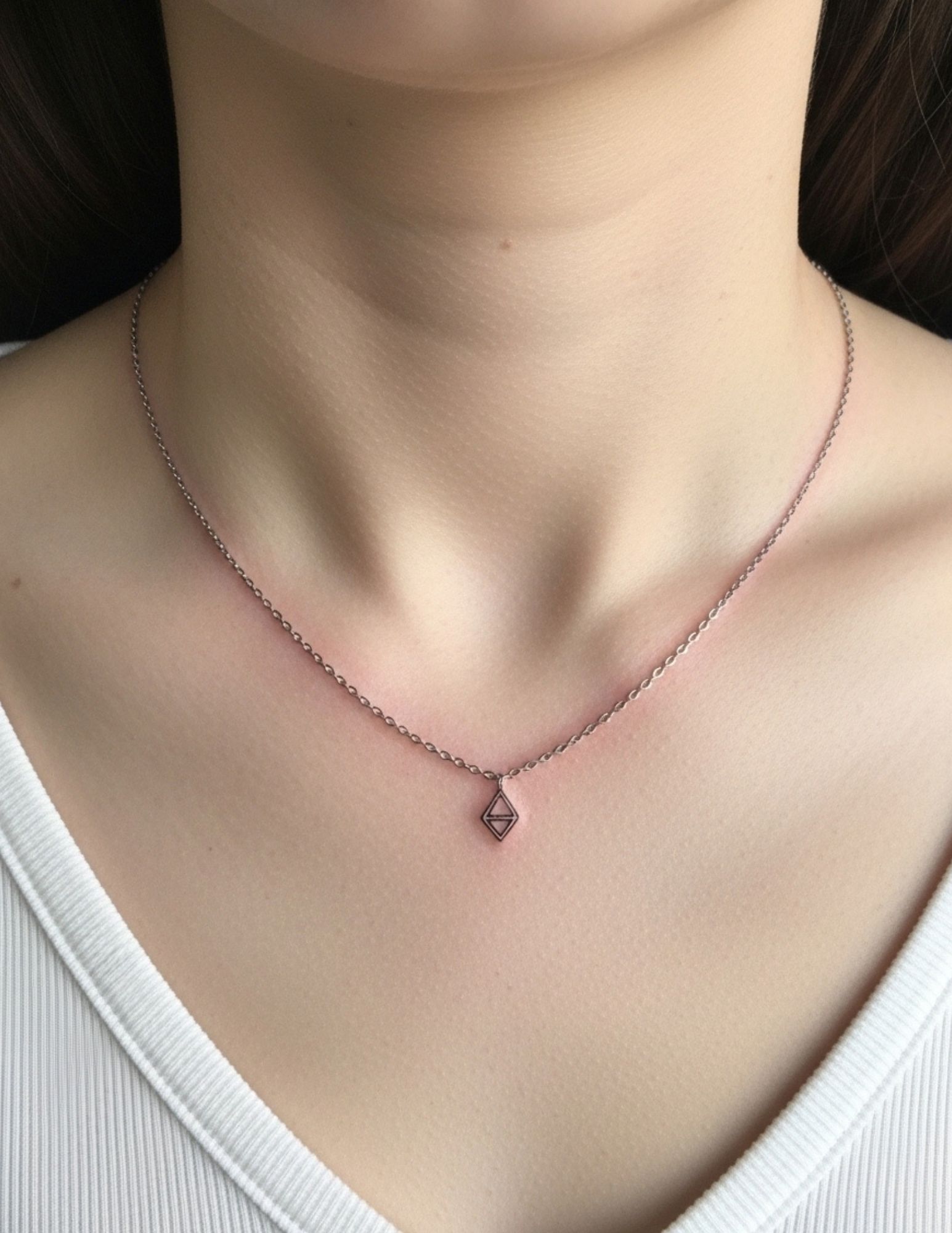
I have spent a lot of time looking at this work in portfolios and in person, and the pattern I keep noticing is that ornamental tattoos live or die on placement. A design that follows the body reads as jewelry; the same design dropped onto a flat panel of skin reads as a sticker. If you like this idea but want something more literally jewelry-shaped, our guide to jewelry tattoo ideas covers chains, pendants and bracelets specifically.
Below are 20 ornamental tattoo ideas organised by placement, with an honest note on what each one costs you in sitting time, pain and long-term upkeep.
Which Ornamental Approach Is Right for You?
Ornamental is not one look. These are the four approaches I see most often, and what each one actually asks of you.
| Approach | What it looks like | Best placements | Ages best when |
|---|---|---|---|
| Filigree | Curling metalwork scrolls, jewel-like drops, asymmetrical flow | Collarbone, hip, ankle, wrist | Lines are kept slightly thicker than the artist’s minimum |
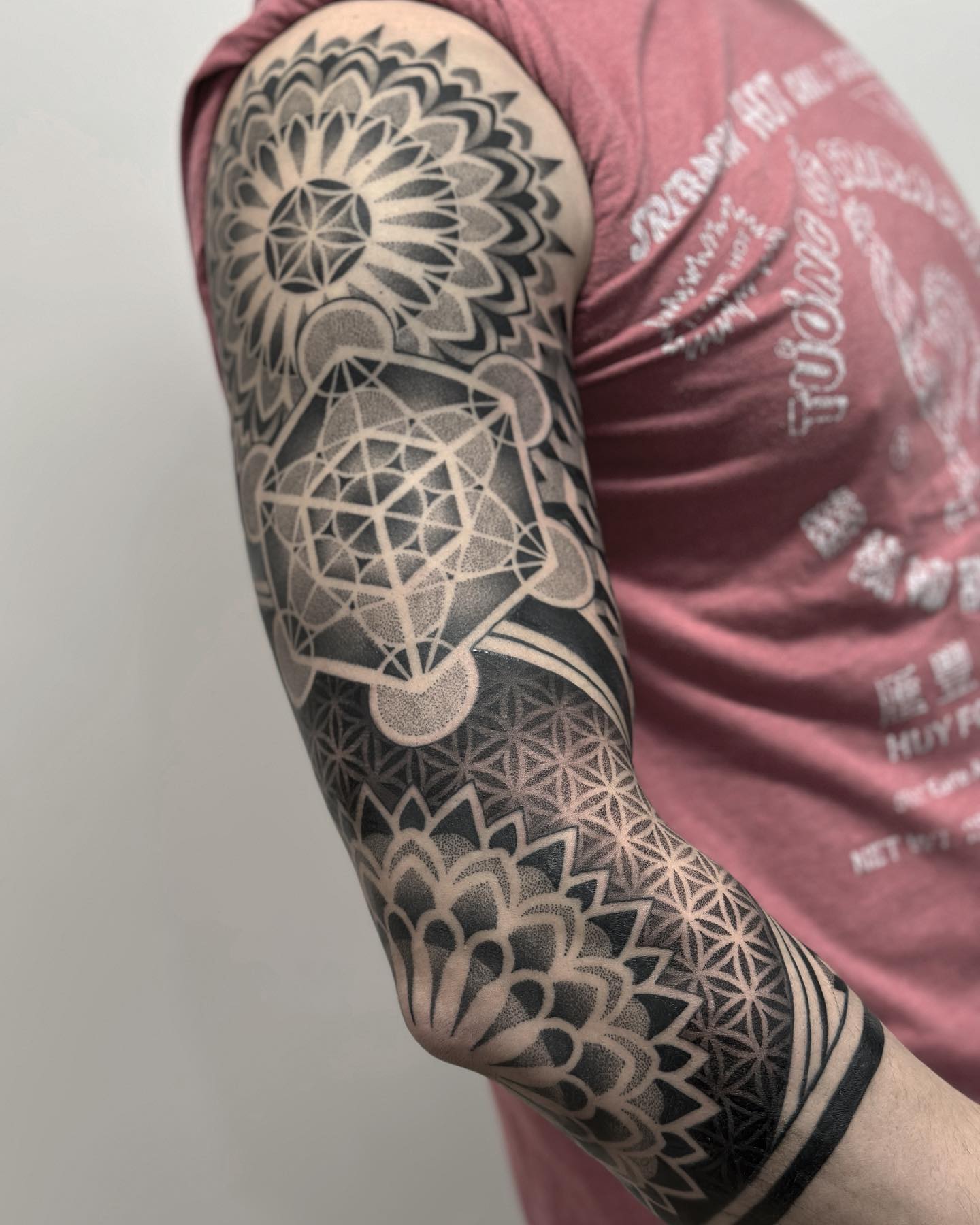
| Mandala / geometric | Radial symmetry, compass-built repetition, dotwork shading | Sternum, shoulder cap, full back | The centre point sits on a genuine body midline |
| Lace and pattern | Dense repeating texture reading as fabric | Hand, thigh, ribcage | Negative space is deliberately oversized |
| Ornamental armour | Heavy engraved plates and borders, high black content | Chest, upper back, outer arm | Built in sessions with full healing between them |
If you are torn, my honest advice is to pick the approach that suits your placement rather than picking the placement to suit a design you saved.
What Defines Ornamental Tattooing
Ornamental tattooing is defined by reference rather than subject. The visual sources are filigree metalwork, mandala geometry, architectural carving, lace, and the geometric traditions documented in collections like the Met’s essay on geometric patterns in Islamic art.
The technical markers are consistent: fine linework, deliberate symmetry, repeating elements, and dotwork or stipple shading instead of solid grey wash.
The impression you are after is something made rather than drawn — a piece that looks engraved, cast or woven rather than sketched.
That is also why the style is unusually demanding on the artist. There is no subject for the eye to forgive; a wobble in a repeating border is visible from across a room, and a mandala that is a few degrees off-centre never stops looking off-centre.
Closely related, and often overlapping, is the softer scrollwork look covered in our guide to filigree tattoos. Most artists treat filigree as a subset of ornamental rather than a separate discipline.
20 Ornamental Tattoo Ideas
1. Sternum Ornamental Mandala
The sternum is the placement that made ornamental tattooing mainstream, and the reason is structural: the body already gives you a centre line, so a radial design has something honest to be symmetrical about.
A typical sternum piece runs from the collarbone notch down to the base of the ribs, built as a central mandala with filigree drops trailing below it.
In my experience this is a three to five hour sitting for a medium-sized design, and almost nobody describes it as comfortable — the sternum is thin skin directly over bone.
It also heals well, because the area sees little friction and almost no sun. If you are weighing this placement generally, our sternum tattoo ideas guide covers non-ornamental options too.
If you want one ornamental piece that reads unmistakably as this style, the sternum is the safest bet.
2. Collarbone Filigree
Fine filigree following the clavicle from the shoulder toward the centre of the chest, tracing a line the body already has.
The effect is a permanent delicate necklace, and it is one of the few ornamental placements that reads clearly from across a room without being large.
When I have asked artists about this one, the recurring note is that the collarbone rewards restraint: two or three scroll elements with generous spacing hold up far better than a dense band.
Pain is moderate to sharp directly over the bone and mild in the soft tissue either side. Most collarbone filigree pieces are a single session of two to three hours.
3. Ornamental Sleeve Border
A repeating ornamental band circling the wrist, bicep or forearm, used either as a standalone piece or as the finished edge of a larger composition.
Borders are the most underrated entry point into this style. They are small, relatively quick, and they teach you how your skin holds fine repeating line before you commit to a back piece.
The technical challenge is the join: the pattern has to meet itself on the inner arm without an obvious seam, which is harder than it sounds on a limb that is not a perfect cylinder.
Ask to see a healed photo of the join specifically, not just a fresh one.
4. Back of Hand Ornamental
Filigree and geometric elements covering the back of the hand, often reading as a decorative half-glove or a fixed piece of body jewelry.
This is the placement I would think hardest about. Hands are the least forgiving skin on the body for fine line: the skin is thin, it regenerates quickly, and it takes constant sun and washing.
Every artist I have asked about hand work says the same thing — expect to touch it up, and expect some spreading in the finest lines within a few years.
Many studios also have a first-tattoo policy against hands, and some decline them entirely. That is not gatekeeping for its own sake; it is a reflection of how often these need rework.
5. Spine Ornamental Column
An architectural column of ornament running from the base of the neck down the vertebrae, with repeating elements stepping down the spine.
Visually this is the most powerful placement in the style. The vertical run mirrors a carved pilaster, and the body’s own symmetry does half the compositional work.
It is also a long sitting and a genuinely sharp one over the vertebrae themselves. Most people I have spoken to split a full spine piece across two or three sessions rather than pushing through in one.
Placement precision matters more here than anywhere else — a spine piece that drifts off the midline is very hard to correct later. For thinner, more delicate versions, see our fine line spine tattoo guide.
6. Ornamental Shoulder Cap
A composition radiating from the point of the shoulder and spilling a short distance down the upper arm, like a worn epaulette.
The shoulder cap suits ornamental work because the rounded surface lets a radial design wrap without distorting — the pattern follows the deltoid instead of fighting it.
This is one of the better first large ornamental pieces, because it can stand alone now and still function as the anchor of a full sleeve later.
Pain is generally reported as moderate on the outer deltoid, sharper as the design moves toward the collarbone or armpit.
7. Hip and Waist Adornment
Ornament following the crest of the hip bone and curving toward the waist, reading as a permanent hip chain.
The hip gives you a strong natural line to trace, which is exactly what this style needs, and it is one of the more private placements — visible in swimwear, covered by most clothing.
Something worth knowing before you book: the hip and waist are areas where skin can change noticeably with weight fluctuation or pregnancy, and dense fine-line pattern shows that stretch more obviously than a loose illustrative design would.
That is not a reason to avoid it. It is a reason to have the conversation with your artist about line weight and spacing first.
8. Full Back Ornamental Panel
A large central mandala with ornamental work radiating out toward the shoulders, spine and lower back.
This is the maximum version of the style and it produces the most extraordinary results I have seen in ornamental work. It is also a multi-session commitment measured in months, not weeks.
A realistic full back runs across several sittings with full healing between them, and the price reflects hours rather than a flat quote.
The practical advice I would give: agree the complete layout before the first needle, even if you are building it in stages. Back pieces assembled from unrelated sessions rarely resolve into one design.
9. Ear and Temple Ornamental
Fine filigree wrapping the outer ear and stepping onto the temple, creating the impression of elaborate permanent earrings.
This is small, intimate work and it is more visible day to day than most people expect — hair moves.
Honestly, the head and ear are specialist territory. The skin over cartilage behaves differently from skin over muscle, and the healing window tends to be shorter and fussier.
If you want this, look specifically for an artist with healed ear work in their portfolio rather than assuming a strong ornamental artist can transfer the skill.
10. Forearm Ornamental Panel
A rectangular panel of ornament running wrist to elbow, treating the forearm as a framed decorative surface.
The forearm is the most practical ornamental placement: easy for the artist to reach, relatively comfortable, straightforward to heal, and visible whenever you want it to be.
It is also the placement where I would push hardest for a proper border. A panel with a defined edge looks intentional; the same pattern fading out at the edges looks unfinished.
Expect the inner forearm to be noticeably more tender than the outer.
11. Chest Armour Ornamental
Ornament arranged as a breastplate — engraved plates, borders and rivets suggested in line and dotwork across the upper chest.
This one only works at scale. A small version reads as a random pattern; the armour illusion depends on the design covering enough of the chest to imply a shape.
Because the black content is higher than in filigree work, it also holds up better over decades than the very finest ornamental linework does.
Plan for several sessions and for the chest to be one of the more demanding areas to sit through, particularly near the sternum and collarbones.
12. Ankle Ornamental Cuff
A band of repeating ornament circling the ankle, more elaborate than a plain band and clearly reading as decorative metalwork.
Ankles are a lovely showcase for this style and a genuinely awkward area to heal. Socks, shoes and swelling all work against you for the first fortnight.
When I have seen these heal badly, it has almost always been friction from footwear rather than anything the artist did.
Book it when you can wear open shoes for two weeks, and expect the bone at the front of the ankle to be sharp going in.
13. Ribcage Ornamental Panel
Ornament following the curve of the ribs down the side of the torso, private and only visible when the side is bare.
The rib curve gives a designer something genuinely useful: a set of natural guide lines that make repeating pattern look deliberate.
It is also, by near-universal agreement, one of the least comfortable places to be tattooed. Thin skin, bone underneath, and your own breathing moving the surface.
Ribs are worth breaking into shorter sessions. Pushing through a long sitting here tends to produce a rougher heal, not a braver story.
14. Geometric Ornamental Mix
Sacred-geometry structure — compass-drawn mandala forms — with the internal sections filled with ornamental filigree.
This hybrid gets you the mathematical precision of geometry and the decorative richness of ornament in one design, and it is probably the most common request in the style right now.
The risk is density. When every geometric cell is filled, the piece turns into a grey mass at conversational distance and the detail is wasted.
A good artist will leave whole sections empty on purpose. For more on the underlying forms, see our mandala tattoo ideas.
15. Crown or Tiara on the Wrist
A crown or diadem rendered in fine ornamental line at wrist scale, sitting where a watch or bracelet would.
It reads two ways at once — as a jewelry reference and as a statement about self-sovereignty — which is part of why it stays popular.
Wrists take constant movement and the inner wrist in particular is sensitive, so keep the design simple enough that a little line softening will not ruin it.
At this scale, fewer and slightly heavier lines will still look like a crown in ten years; a hairline-thin one may not.
16. Finger Ornamental
Small ornamental motifs across several fingers, worn as a coordinated set that mimics a handful of rings.
Fingers are the shortest-lived tattoos on the body. The skin is thin, it sheds constantly, and the sides of the fingers in particular tend to drop ink.
I would only recommend this to someone who accepts up front that touch-ups are part of the deal, not a failure.
Keep each motif simple and open. Detailed micro-ornament on a finger blurs into a smudge faster than anything else in this style. Our finger tattoo ideas guide goes deeper on what survives there.
17. Mandorla or Vesica Piscis
The almond-shaped mandorla — the overlap of two circles — filled with fine ornamental detail.
The form carries real history: it appears in Christian iconography as a frame for sacred figures and in sacred geometry as the vesica piscis.
As a tattoo it is useful because the outline is simple and instantly legible, which gives the ornamental fill something to sit inside.
It scales well from a few centimetres on the forearm up to a full sternum piece without redesigning the concept.
18. Ornamental Frame for a Portrait
A decorative cartouche or frame built around a central image — a portrait, an animal, a flower — presenting it like an engraved medallion.
This is the most useful idea on the list for people who do not want a purely abstract tattoo. The ornament does the styling; the subject carries the meaning.
It also solves a real problem: a lone portrait or single object often floats on the skin with no relationship to the body. A frame anchors it.
If you are adding a frame to an existing tattoo, bring the original artist’s work to the consultation — matching line weight across two hands is the hard part.
19. Geometric Grid with Ornamental Nodes
A repeating grid or lattice where the intersections carry small ornamental flourishes.
The effect changes with distance, which is what I like about it: architectural and structural from across a room, decorative and intricate up close.
Grids are unforgiving. Any drift in spacing is immediately readable because the eye has a repeating reference, so this is one to book with someone whose healed geometric work you have actually seen.
It also suits larger flat-ish areas — outer thigh, upper back, outer forearm — better than heavily curved ones.
20. Full Hand Ornamental
Ornament covering the back of the hand, the fingers and the wrist as a single continuous composition, like a lace glove in permanent ink.
This is the most dramatic placement in the style and the one with the highest maintenance cost. You are combining the two areas that hold fine line worst — hands and fingers — into one piece.
It is also highly visible in professional settings, which is worth thinking about honestly rather than optimistically.
If you want the look with less consequence, a bordered wrist cuff plus a single back-of-hand element gets you most of the visual effect with a fraction of the commitment.
Ornamental Variations Worth Considering
Once you have settled on placement, these are the variations that most change how the finished piece looks.
Gold and Yellow Ink Accents
Some artists offer warm yellow or gold-toned accents inside otherwise black ornamental work, and it is the most convincing way to push the jewelry illusion.
The trade-off is real: yellow and gold pigments generally have less staying power than black and tend to fade sooner, especially with sun exposure. Treat gold accents as something you will refresh.
Blackwork-Weight Ornament
Heavier solid black shapes with ornamental detail cut into the negative space, rather than fine line on bare skin.
This ages better than any other version of the style, because solid black holds its edge far longer than a hairline. Our blackwork tattoo designs guide covers the approach in more depth.
Dotwork Shading Instead of Whip Shading
Stippled dotwork gives ornamental pieces their characteristic engraved, etched quality and avoids the softness of a grey wash.
It takes considerably longer to execute, so expect the quote to reflect hours rather than square inches.
Ornamental Combined With Florals
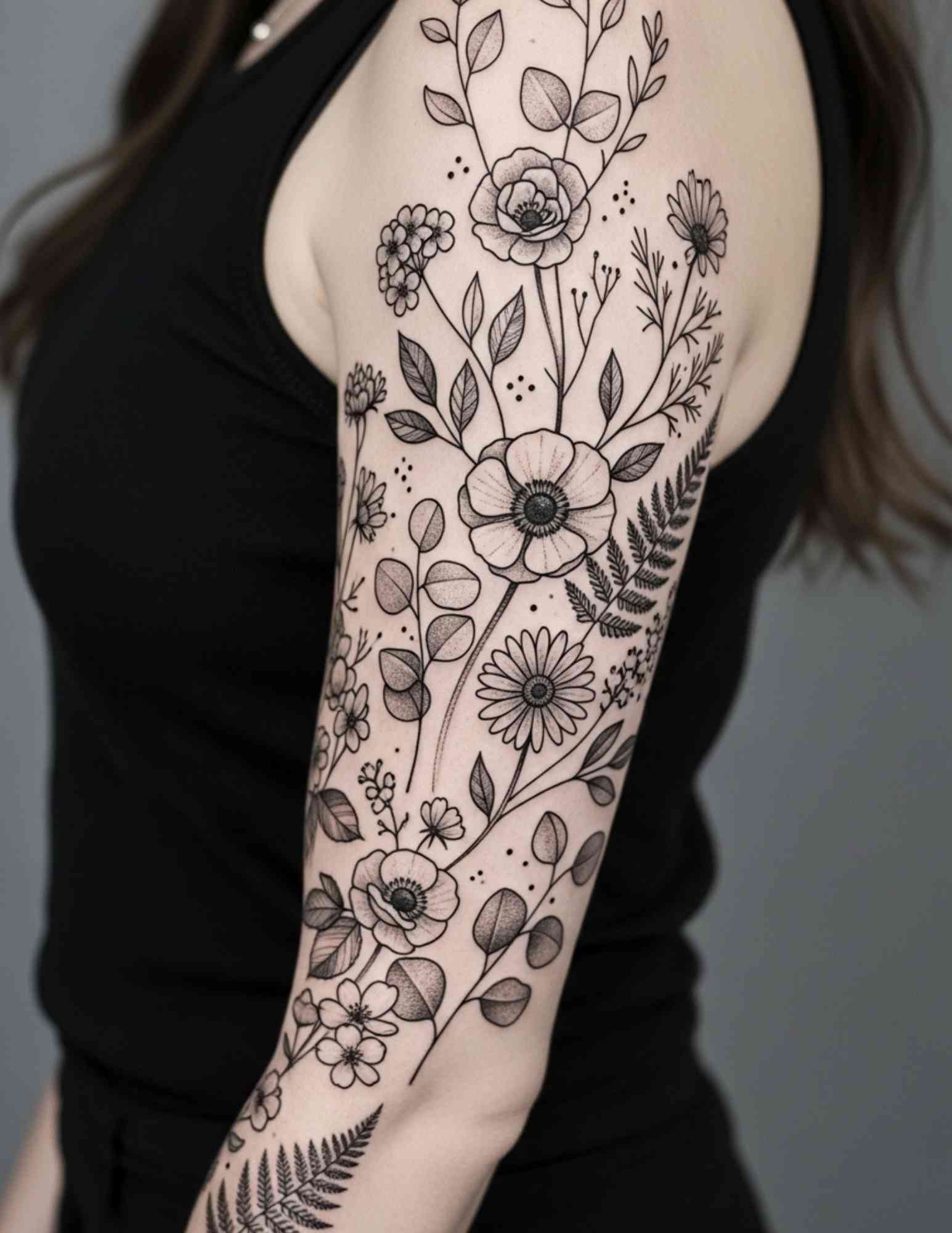
Scrollwork wrapped around a botanical centre is a comfortable middle ground for people who find pure pattern too abstract.
The usual mistake is giving both elements equal weight. Decide which one leads, and let the other support it.
Ornamental as a Gap-Filler
Ornament is excellent connective tissue in a sleeve, bridging unrelated tattoos into something that reads as one composition.
It is one of the few styles that can do this without competing with the pieces it is joining.
Keeping Fine Ornamental Linework Sharp
Fine line ornamental work is the style most affected by aftercare, because there is no thickness of ink to hide a bad heal.
Follow whatever aftercare your artist gives you — they know how they packed the ink — and keep the area clean, moisturised and unpicked through the peeling stage. Our tattoo aftercare guide covers the basics if you want a refresher between consultation and appointment.
Sun is the long game. Ultraviolet exposure breaks pigment down, and a design built from thin lines has less pigment to lose, so daily sunscreen on an exposed ornamental piece does more for its lifespan than anything else you can do after it heals.
Plan for touch-ups rather than hoping to avoid them. Many artists include one free touch-up within the first few months, and on hands, fingers and feet a second visit is common rather than exceptional.
If something looks wrong while healing — spreading redness, heat, swelling that increases after the first few days, discharge, or a rash in the tattooed area — contact your artist and see a doctor. The American Academy of Dermatology’s guidance on caring for tattooed skin and on tattoo skin reactions is a sensible starting point, but this article is not medical advice and no online guide replaces someone looking at your skin.
Common Ornamental Mistakes — and Still Not Sure?
The mistake I see most often is going too fine. A line drawn at the absolute minimum the machine can produce looks spectacular on day one and noticeably softer after a few years, and that softening is not a flaw in the work.
The second is ignoring the body’s own lines. Ornamental design borrowed straight from a flat reference image rarely survives contact with a shoulder or a ribcage without adjustment.
The third is over-filling. Negative space is a design element in this style, not wasted room, and a piece with nothing left empty stops reading as ornament and starts reading as a shadow.
The fourth is booking on price. This style depends almost entirely on line consistency, which is exactly the skill that separates artists, so look for healed photos rather than fresh ones in a portfolio.
Still weighing it up? If the geometry is what draws you, our geometric tattoo designs guide is a better starting point, and if you are mainly deciding where it should go, the tattoo pain chart is worth reading before you book.
Frequently Asked Questions
Do ornamental tattoos age well?
It depends almost entirely on line weight. Ornamental work built with moderately weighted lines and generous negative space generally holds up well for decades, while designs drawn at the very finest line the artist can produce tend to soften and spread over the years. Placement matters too — hands, fingers and feet age fastest. Ask your artist to show you healed photographs of their work from several years ago rather than fresh ones.
How much does an ornamental tattoo cost?
Ornamental work is usually quoted by the hour rather than by size, because the detail level drives the time far more than the footprint does. A small collarbone or wrist piece is often a single short session, while a sternum or full back panel runs across multiple sittings. Dotwork shading in particular adds hours. Ask for an estimate in session time at consultation, and treat any flat quote for a large piece with some caution.
Are ornamental tattoos more painful than other styles?
The style itself is not especially painful, but the placements it favours often are. Sternum, ribs, spine and ankle all put the needle close to bone with little tissue in between, and those are exactly the spots where ornamental designs look best. Fine line work also involves a lot of passes over the same area. Splitting long sessions is a reasonable request, not a weakness.
Can ornamental tattoos be covered up or removed later?
Cover-ups are harder than with illustrative styles, because ornamental work is often spread over a wide area in consistent line rather than concentrated in one solid mass. That said, fine line generally responds reasonably well to laser removal, and a skilled artist can sometimes absorb an older ornamental piece into a heavier blackwork design. Consult a qualified professional about your specific tattoo. Never attempt removal at home with creams or abrasion — it risks scarring and infection.
What should I look for in an ornamental tattoo artist?
Look for healed photographs, consistent line weight across a whole piece, and clean joins where repeating patterns meet. Check whether they design to the body — their portfolio should show pieces that follow a shoulder or ribcage rather than sitting flat on it. Specialists in this style are worth travelling for, because the margin for error is smaller than in most other tattoo styles. A good consultation will also include an honest conversation about touch-ups.
Quick Summary
- Ornamental tattooing decorates rather than depicts, borrowing from filigree, lace, architecture and geometric pattern traditions.
- Placement is the whole game — sternum, spine and shoulder cap work because the body supplies the symmetry.
- Filigree, mandala geometry, lace pattern and ornamental armour are the four main approaches, each with different upkeep.
- Hands, fingers, feet and ears hold fine line worst; plan for touch-ups there rather than hoping to avoid them.
- Slightly heavier lines and deliberate negative space age far better than the finest possible linework.
- Dotwork shading gives the engraved look but adds significant session time, so expect hourly pricing.
- Gold and yellow accents create the strongest jewelry illusion but fade sooner than black and need refreshing.
- Daily sunscreen after healing does more for the lifespan of a fine ornamental piece than anything else.