I have lost count of how many times I have watched someone lean in toward a photo, squint, and then say “wait, that’s a tattoo?” A jewelry tattoo works when the drawing obeys gravity and the body underneath it, not when the linework is simply pretty.
That is the whole trick, and it is also why so many attempts miss. A necklace inked as a flat oval across the chest looks like a sticker. The same necklace, drawn so the chain sags in the hollow of the throat and thins where it curves away, reads as metal.
I have sat with artists who specialise in this and the conversation is always about physics before it is about style — where does the weight fall, where does the light hit, where does the piece disappear behind the body. Fine line work makes it possible, but the drawing decides whether it is convincing.
Below are 21 ideas grouped by the kind of jewelry they imitate, plus the practical side nobody mentions until you are already in the chair. If you are drawn to the wrist specifically, the women’s bracelet tattoo ideas guide covers that placement in more depth.
Which Jewelry Tattoo Style Is Right for You?
The four approaches below all produce jewelry tattoos, but they age very differently and they suit different placements. In my experience this table settles the question faster than scrolling another hundred photos.
| Style | Looks Most Like | Best Placements | How It Ages | Touch-Up Outlook |
|---|---|---|---|---|
| Fine line | Delicate chains, thin bands, anklets | Wrist, ankle, upper arm, collarbone | Softens and can blur if lines are pushed too thin | Most likely of the four to need one |
| Ornamental blackwork | Chokers, collars, filigree, henna-inspired pieces | Sternum, back of neck, upper arm, spine | Holds shape well because of solid black anchors | Usually the most durable |
| Micro-realism | Gemstones, pearls, medallions, brooches | Sternum, forearm, shoulder blade | Fine highlights are the first detail to fade | Plan for highlight refreshes |
| Dotwork / stippling | Beaded strands, textured metal, soft shadow | Back, ribs, upper arm | Dots can merge over time if packed tightly | Moderate, depends on dot spacing |
What Actually Makes a Jewelry Tattoo Look Like Jewelry
Ask any artist who does this well and they will talk about four things before they talk about the design itself.
The first is line weight variation. A real chain is thicker where it faces you and thinner where it turns away, so a chain drawn at one uniform width instantly reads as a drawing of a chain rather than a chain.
The second is the break. Jewelry does not continue around the far side of your arm in your field of vision — it disappears. Every convincing band tattoo I have seen fades, thins, or stops where the limb curves away.
The third is the highlight. One small, hard-edged bright spot does more work than an hour of soft shading, because that is how light behaves on polished metal and cut stone.
The fourth is drape. A necklace sits in the notch of the throat. A body chain hangs off the shoulder and swings inward. Drawing either one as a flat arc is the single most common way these pieces fail.
21 Jewelry Tattoo Ideas for Women
These are grouped by the piece they imitate. Numbers run straight through so you can note the ones you want to show your artist.
1–3. Bracelets, Bangles and Wrist Chains
The wrist is where most people start, and it is also the least forgiving placement on this list. Skin here is thin, it creases constantly, and fine lines get worked hard by daily movement.
1. Fine line bracelet. A single hair-thin chain wrapping once, breaking cleanly at the underside of the wrist rather than circling all the way round.
2. Stacked bangles. Three or four thin bands with deliberately uneven gaps between them. Even spacing is what makes stacked bands look like a barcode instead of jewelry.
3. Slave bracelet. The connected piece — a band at the wrist with fine chains running to a ring on the middle finger. It is the most ornate wrist option and needs a clean hand to execute.
Every artist I have asked recommends keeping wrist linework slightly thicker than looks right on paper, because it will thin as it settles. If you want more wrist-specific direction, the female wrist tattoo ideas roundup is worth a look.
4–5. Rings and Knuckle Jewelry
Finger tattoos are the shortest-lived work on the body, and anyone who tells you otherwise has not seen one at the three-year mark.
4. Ring tattoo. A simple band at the base of the finger, sometimes with a tiny stone shape on top. Popular as a wedding alternative — the wedding ring tattoo ideas guide goes deeper on that use case.
5. Knuckle rings. Thin bands across two or three fingers at the middle knuckle, reading as a stacked set.
When I tested how these hold up by asking artists what they see coming back, the answer was consistent: the sides of fingers and anything crossing a knuckle fade fastest, because that skin regenerates quickly and gets scrubbed constantly. Expect to budget for refreshes rather than hoping you will be the exception. Classy women’s finger tattoos covers placements that survive better.
6–8. Necklaces, Chokers and Pearls
This is the group where drape matters most, and where the difference between a good and a great artist is most visible.
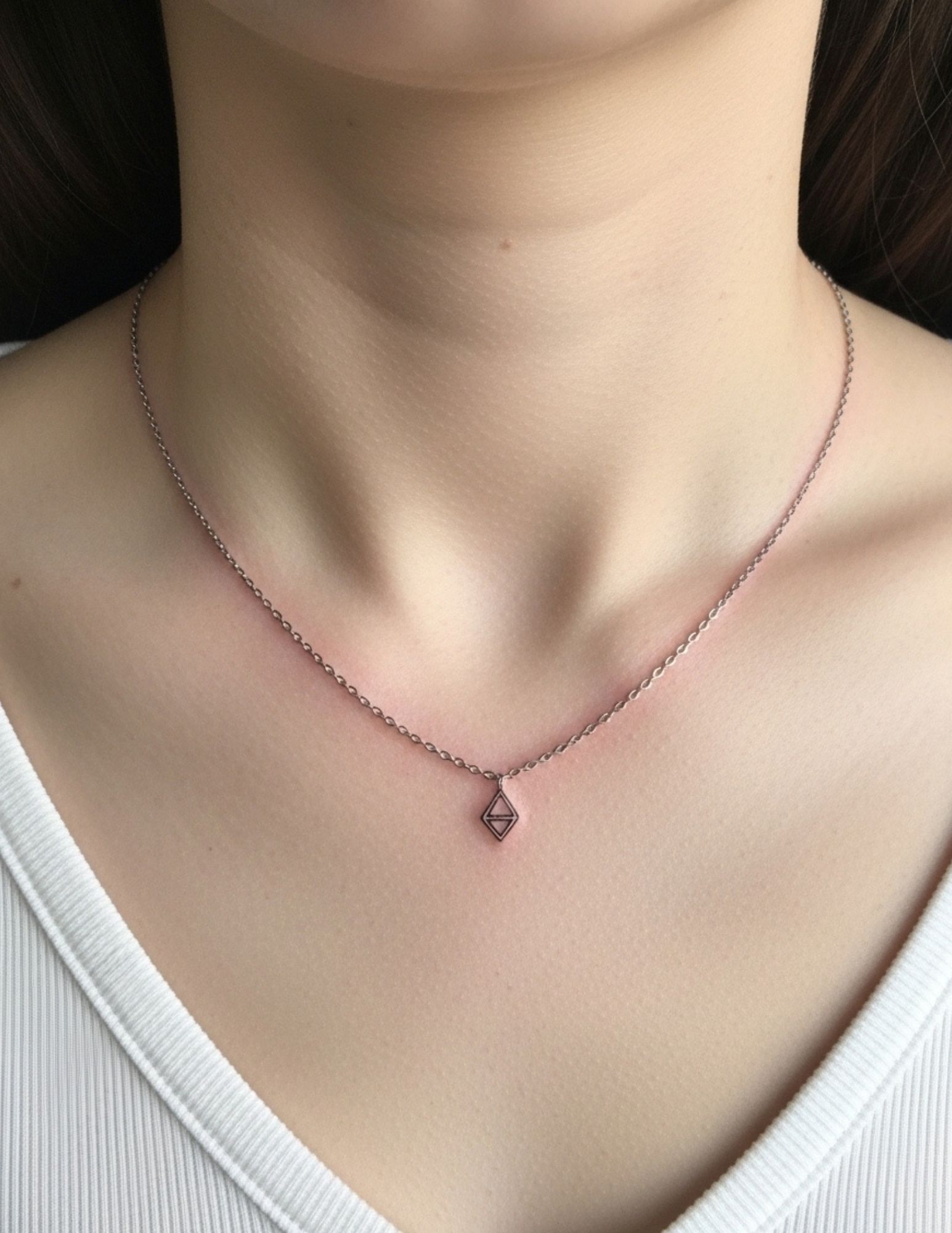
6. Diamond necklace. A fine chain with a pendant stone that sits exactly where a real one would — usually a little lower than people expect.
7. Choker tattoo. A close band at the base of the neck, often ornamental rather than literal. This is the piece most likely to be judged in professional settings, so think about placement before style.
8. Pearl necklace. A strand of rounded stones, each with one bright highlight and a soft reflected glow underneath. Done well it is startling; done flat it looks like a row of circles.
A neck piece is a real commitment in terms of visibility. Neck tattoos for women is a useful reality check before you book.
9–11. Armlets, Anklets and Leg Chains
Bands that circle a limb are the most forgiving jewelry tattoos to place, because the body does half the design work for you.
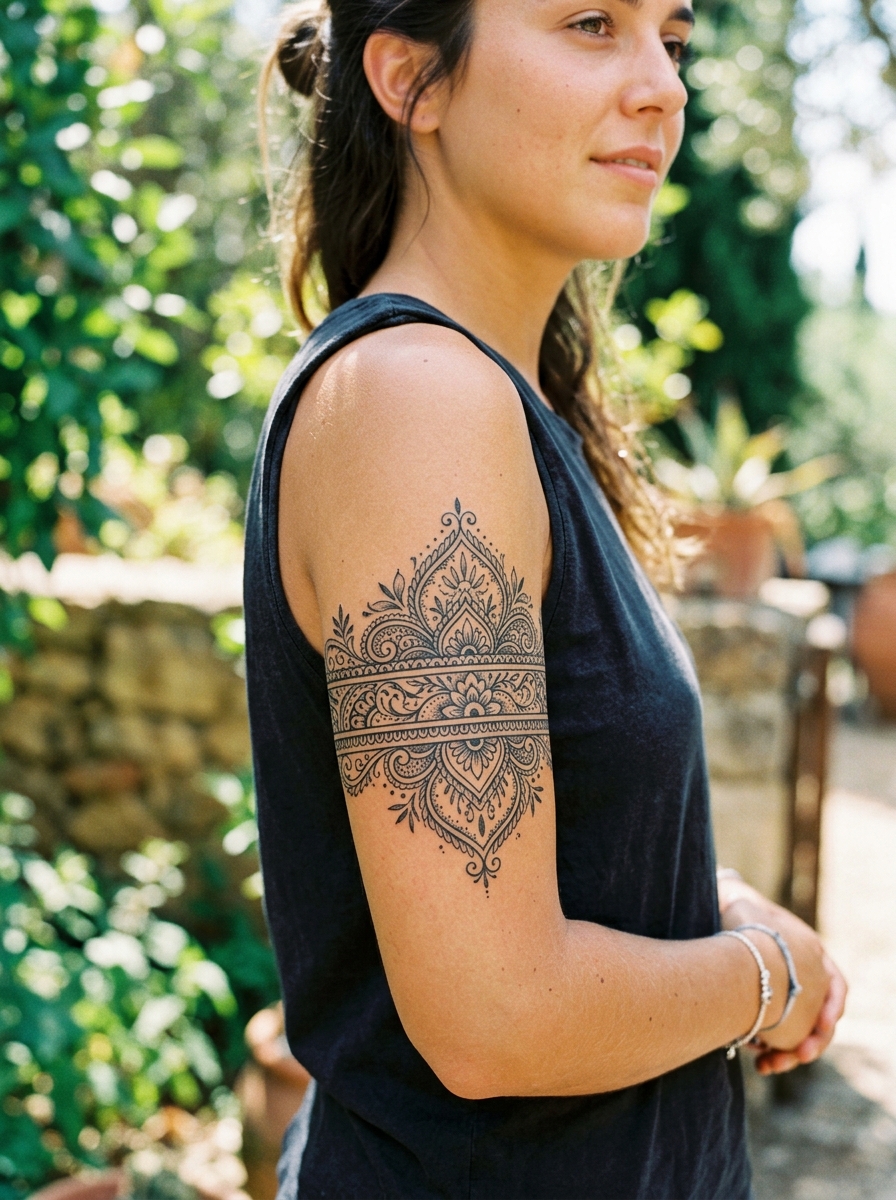
9. Armlet band. A band around the upper arm, ideally at the widest point so the line does not visually pinch inward.
10. Anklet. A fine chain with a small charm. In my experience anklets age better than wrist bracelets simply because ankles crease less.
11. Chain around the waist. A waist chain following the natural curve above the hip, usually visible only when you choose to show it.
For ankle placement specifically, ankle bracelet tattoo ideas covers how these sit against different shoe lines.
12–13. Body Chains and Draped Pieces
Draped work is the most ambitious category here and the one that most rewards a specialist.
12. Body chain. Chains crossing the chest and shoulders the way a harness-style piece would, hanging rather than lying flat.
13. Geometric gem setting. Angular claw settings holding a stone, usually on the sternum or below the collarbone.
The reason these succeed or fail is hang. A chain crossing the shoulder should droop between contact points, and the amount of droop should change as the chain moves across the body. When I have seen this done properly, the artist sketched it directly on the skin while the client stood, sat, and raised an arm, because a drape drawn on a lying-down body looks wrong the moment you stand up.
14–16. Gems, Pendants and Medallions
If you want one statement piece rather than a set, this is the group to look at.
14. Gem or jewel. A single faceted stone rendered with hard-edged facets. Soft blending kills it — cut stone has sharp transitions.
15. Medallion pendant. A round engraved disc hanging from a fine chain, often with a sun, moon, or ornamental motif.
16. Vintage brooch. Scrollwork with a centre stone, usually placed on the shoulder or upper chest where a real brooch would pin.
Detail density is the thing to negotiate here. Every artist I have asked says the same: a brooch designed at three inches that gets tattooed at one and a half will turn into a grey smudge within a few years, because fine detail closes up as ink spreads under the skin. Size up, or simplify.
17–18. Ornamental Collars and Filigree
Ornamental work borrows from mandala and henna traditions rather than imitating a specific piece of jewelry, and it is the most durable style on this list.
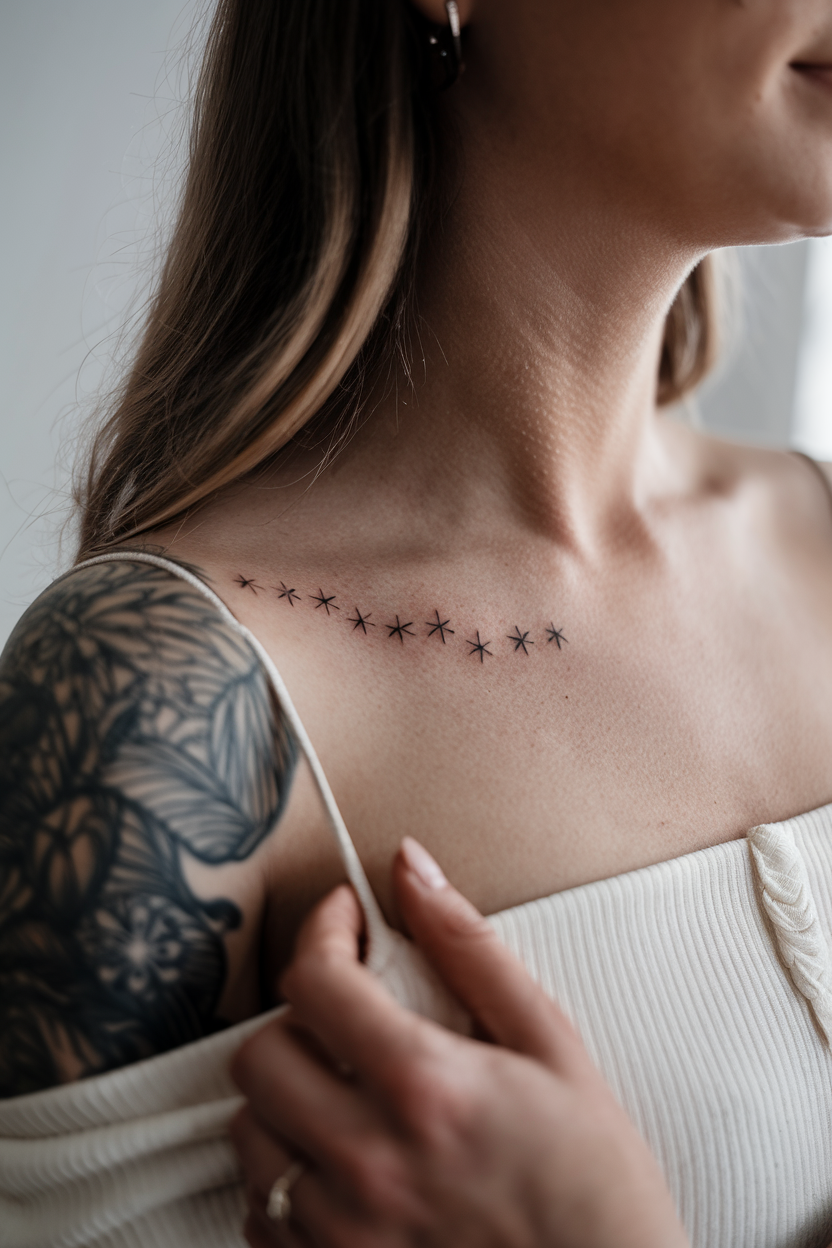
17. Ornamental collar necklace. A symmetrical pattern spanning both collarbones, mirrored on the centre line.
18. Flower crown headband. A band of small blooms and leaves running across the hairline or around the upper arm.
Because these designs use solid blacks and repeating shapes rather than a single delicate outline, they hold their structure far longer than fine line work. If a piece blurs slightly, the pattern still reads. The ornamental tattoo ideas guide covers the tradition these draw from.
19–21. Ear Cuffs, Crowns and Chandelier Earrings
The smallest and most conversation-starting group — and the one with the most placement constraints.
19. Ear cuff tattoo. A fine ornamental line following the outer cartilage ridge. The ridge itself gives the design its shape, which is why these look convincing at tiny sizes.
20. Chandelier earring tattoo. A drop design hanging from the lobe down toward the jaw, sometimes continuing onto the neck.
21. Tiara or crown hairline piece. A small crown at the hairline or behind the ear. Minimal crown tattoo covers standalone crown designs in more depth.
One honest caveat: ear skin is thin, close to cartilage, and known for holding ink unpredictably. Several artists have told me they quote ear work with a touch-up already assumed. Ask before you book rather than after.
Variations Worth Considering Before You Commit
If the classic black fine line version is not quite what you picture, these are the directions people usually explore next.
White and Skin-Tone Ink
White ink jewelry tattoos look ethereal in fresh photos and very often disappear, yellow, or turn patchy within a couple of years. Most artists I have spoken to will do them but will tell you plainly not to expect permanence.
Warm-Toned Shading for a Gold Look
Rather than trying to tattoo gold, some artists use warm brown and ochre shading with a sharp highlight to suggest it. It is a suggestion rather than a replica, and it usually ages better than attempting a metallic colour outright.
Dotwork Instead of Solid Line
Building a chain from stippled dots gives a softer, more textile feel. Worth asking about if you want something less crisp than fine line but more delicate than blackwork.
Test It First
Draw the piece on with a skin-safe marker, or get a jagua or henna version, and live with it for a week. Ideas that look perfect in a photo often sit wrong on your own proportions. This is the cheapest mistake-prevention available.
Aftercare and Keeping Fine Jewelry Work Sharp
Fine line work is more vulnerable during healing than bold traditional work, because there is less ink in the skin to begin with and less margin for loss.
Follow whatever aftercare instructions your artist gives you — they know their ink and their technique. The general principles are well summarised by the American Academy of Dermatology in its guide to caring for tattooed skin: keep it clean, keep it moisturised without smothering it, and keep it out of the sun.
Sun is the long game. Daily sunscreen on exposed pieces — wrists, ankles, hands, collarbone — is the single biggest thing in your control for keeping a delicate design readable a decade out.
Watch for reactions rather than assuming everything unusual is normal healing. Spreading redness, heat, pus, a fever, or a raised itchy patch that appears weeks or months later are all reasons to contact a doctor rather than wait it out. The AAD has a plain-language rundown of unexpected skin reactions to tattoos, and the FDA publishes consumer guidance on tattoos covering ink safety and what to report. This article is not medical advice — an infected or reacting tattoo is a question for a clinician, and a healing-quality question is one for the artist who did the work.
Common Mistakes and What to Ask Instead
The mistakes I see repeated are rarely about taste. They are about brief-setting.
Bringing a reference photo of the jewelry instead of a tattoo of the jewelry. A photograph contains reflections and colour information that will not translate. Ask your artist to show you healed examples of similar work, not fresh ones.
Going too small. A delicate design at a size that flatters it today may be unreadable in five years, because ink spreads slightly as it settles and fine gaps close up first.
Choosing an artist by portfolio breadth rather than by specialism. Fine line and ornamental work are genuinely different skill sets, and the best blackwork artist in your city may not be the right choice for a hair-thin chain.
Ignoring visibility. Hands, fingers, and the neck are the placements people most often revisit. If you are unsure, the dainty tattoos for women collection offers lower-stakes starting points, and classy women’s tattoo designs covers restrained designs that work in most settings.
Frequently Asked Questions
Do jewelry tattoos really look like real jewelry in person?
The good ones genuinely do, at conversational distance. What sells the illusion is line weight that changes as the piece curves, a hard-edged highlight where light would catch metal, and a clean break where the jewelry would disappear around the body. Up close you can usually tell, because real metal reflects its surroundings and ink cannot. In my experience the pieces that fool people are the ones where the artist spent as long on the drape as on the detail.
How long does a fine line jewelry tattoo last before it needs a touch-up?
It depends far more on placement than on the design. Wrists, fingers, and hands take the most daily wear and are the most likely to need attention; upper arms, ribs, and the back tend to hold longer. Sun exposure is the biggest variable you control. Ask your artist for their honest expectation for the specific placement you want, and ask whether a touch-up is included.
Does a jewelry tattoo hurt more than a regular tattoo?
Not because of the style, but often because of where these pieces go. Collarbone, sternum, ribs, fingers, ears, and the top of the foot are all thin-skinned or close to bone, and most people find them sharper than fleshier areas. The upside is that jewelry tattoos are usually small and quick. Sessions for a single band or ring are often over in well under an hour.
Can I get a jewelry tattoo instead of actually wearing jewelry for allergies?
Some people do choose this route when metal sensitivities rule out real pieces, and a tattoo avoids the nickel and metal contact entirely. It is not automatically risk-free, though — tattoo inks themselves can cause reactions in some people, including delayed ones. If you have a history of skin allergies, raise it with both your artist and a dermatologist before booking rather than after.
What style holds up best over the long term?
Ornamental blackwork, in most cases. Solid black shapes and repeating patterns keep their structure even as edges soften, so the design still reads clearly after years. Fine line work is the most beautiful when fresh and the most demanding to maintain. Micro-realism sits in between, with the fine highlights usually fading before anything else.
Quick Summary
- A jewelry tattoo convinces through physics — weight, drape, break, and highlight — not through detail alone.
- Line weight should change as the piece curves, and the design should stop where real jewelry would disappear from view.
- Ornamental blackwork is the most durable style; fine line is the most delicate and the most likely to need touch-ups.
- Fingers, hands, and wrists fade fastest; upper arms, ribs, and the back hold detail longest.
- Size up rather than down — fine gaps close as ink settles, and an under-sized detailed piece will blur.
- Choose an artist by specialism, and ask to see healed work rather than fresh photos.
- Sunscreen on exposed placements is the highest-value habit for keeping delicate work readable.
- Test the placement with marker, henna, or jagua for a week before committing.