My wife and I both wear ring tattoos, and after eleven years of marriage I still get asked the same question at parties: a wedding ring tattoo is not a shortcut to a cheaper ring — it is a completely different commitment, one that fades, blurs and has to be re-touched.
I did not understand that when I booked mine. I walked in expecting a permanent band and walked out with a design that needed its first touch-up fourteen months later.
That is not a warning against getting one. It is the honest starting point that most articles skip, and it changes which design you should pick.
Below are the styles I have watched hold up, the ones I have watched fade, and how to choose between them. If you want a broader look at finger placement first, our guide to finger tattoo ideas covers the healing quirks in more depth.
Which Wedding Ring Tattoo Style Is Right for You?
Every artist I have asked agrees on one thing: the thicker and simpler the linework, the longer a finger tattoo survives. Here is how the main styles compare.
| Style | How Well It Holds | Typical Session | Best For |
|---|---|---|---|
| Solid band | Strongest — thick ink hides fading | 20–40 minutes | Anyone who wants a true ring replacement |
| Initials or names | Moderate — letters can close up | 30–45 minutes | Couples who want something readable |
| Wedding date / numerals | Moderate — keep digits generously spaced | 30–45 minutes | Marking one exact day |
| Fine line / minimalist | Weakest on fingers — expect touch-ups | 15–30 minutes | Subtle looks, people fine with upkeep |
| Geometric / mandala band | Good if lines stay bold | 45–90 minutes | Decorative, ornate ring designs |
| Floral / botanical | Varies — simplified shapes last longer | 45–75 minutes | Softer, less traditional bands |
If you are torn between two rows of that table, pick the bolder one. I have never met anyone who regretted going slightly thicker on a finger.
Why Ring Finger Tattoos Behave Differently
Fingers are the hardest place on the body to hold a tattoo, and it has nothing to do with the artist’s skill.
The skin there is thin, it sits over constantly moving joints, and you wash your hands more than any other part of you. All three work against fresh ink at the same time.
In my experience the sides of the finger and the area closest to the knuckle blur first. The flat top of the finger, between the knuckle and the base, is the most reliable real estate you have.
Palms and the inside crease of the finger are the worst offenders. I have seen inner-finger lettering go from crisp to unreadable in under two years.
None of that makes the tattoo a bad idea. It just means you should plan for touch-ups the way you would plan for resizing a metal ring — as maintenance, not failure.
Wedding Ring Tattoo Ideas Worth Considering
These are the design families I see most often in shops, ordered roughly from most to least common.
1. Initials and Names
The most requested version, and the one most likely to look dated if you rush the font choice.
A single initial in a clean serif holds better than a full first name in thin cursive, simply because there is less detail to close up.
When I tested this on my own hand, the block-letter initial my artist used still reads clearly today, while the delicate flourish on my wife’s needed re-lining. If you want to explore lettering further, our name tattoo ideas guide covers font weight in detail.
Ask your artist to print the design at actual size before you commit — letters that look elegant on a tablet often shrink to a smudge on a finger.
2. Wedding Dates and Roman Numerals
A date is the most literal way to mark the day, and numerals suit the narrow shape of a finger better than most imagery.
Roman numerals in particular work well because they are made of straight strokes, which survive fading far better than curves.
The trap is spacing. Every artist I have asked says the same thing: leave more gap between characters than looks right on paper, because ink spreads outward over the years. Our roman numeral tattoo guide shows how different date formats sit on the skin.
Digits stacked too tightly turn into a solid grey bar after a few years, and there is no easy fix once that happens.
3. Matching Symbols
Symbols are the safest option for couples who want something shared but not identical.
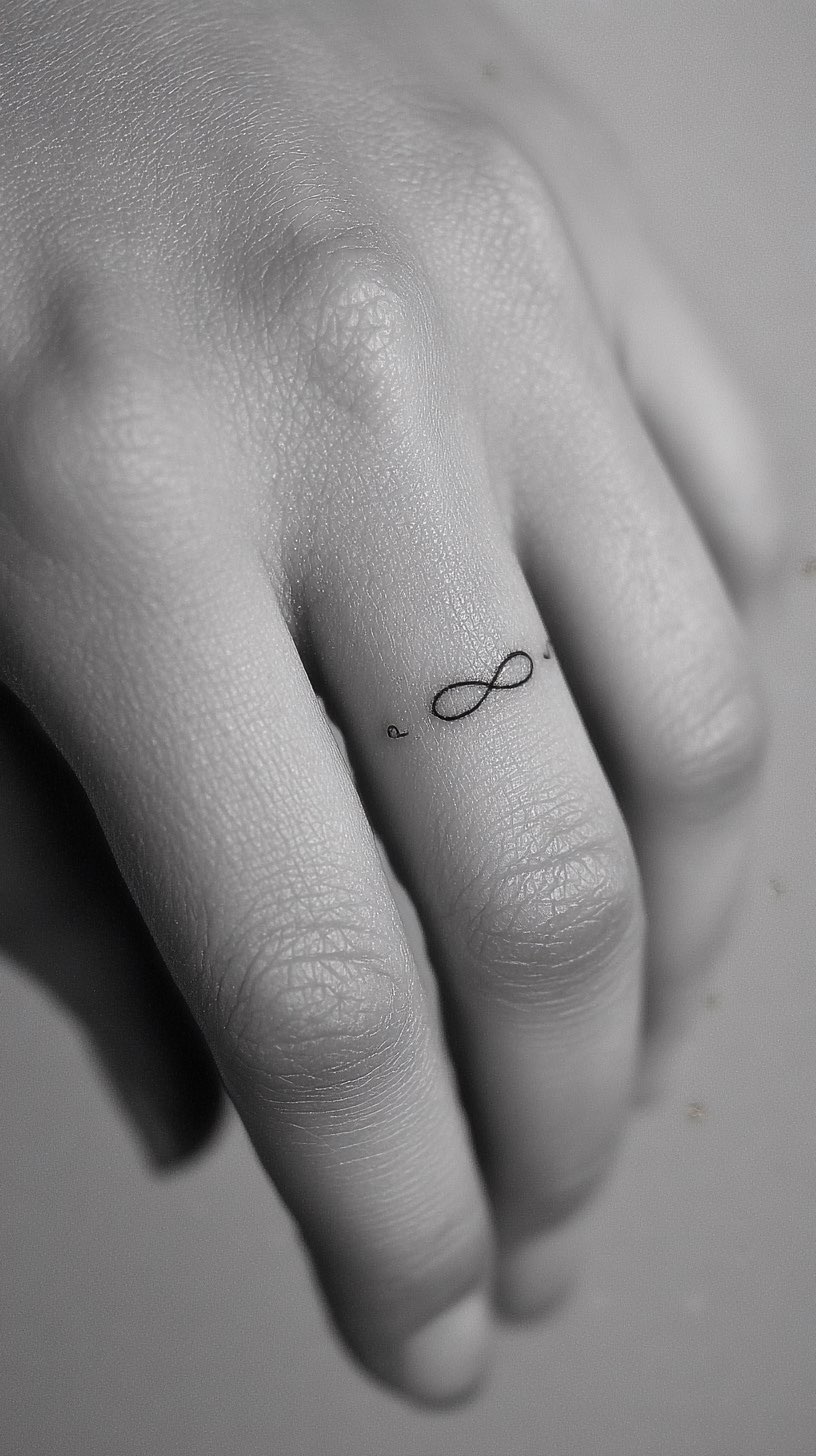
A small heart, an infinity loop, a single star — each one reads instantly and needs very little detail to work.
I have seen couples split a symbol across two hands so it only completes when they hold hands, which is a lovely idea and photographs beautifully. There are more of these in our matching tattoos for couples collection.
Keep symbols above 8mm. Below that, the internal negative space tends to fill in and the shape loses its outline.
4. Solid and Textured Bands
If you want the closest thing to an actual ring, this is it.
A solid black band is the single most durable finger tattoo I have seen. There is no fine detail to lose, so fading reads as softening rather than damage.
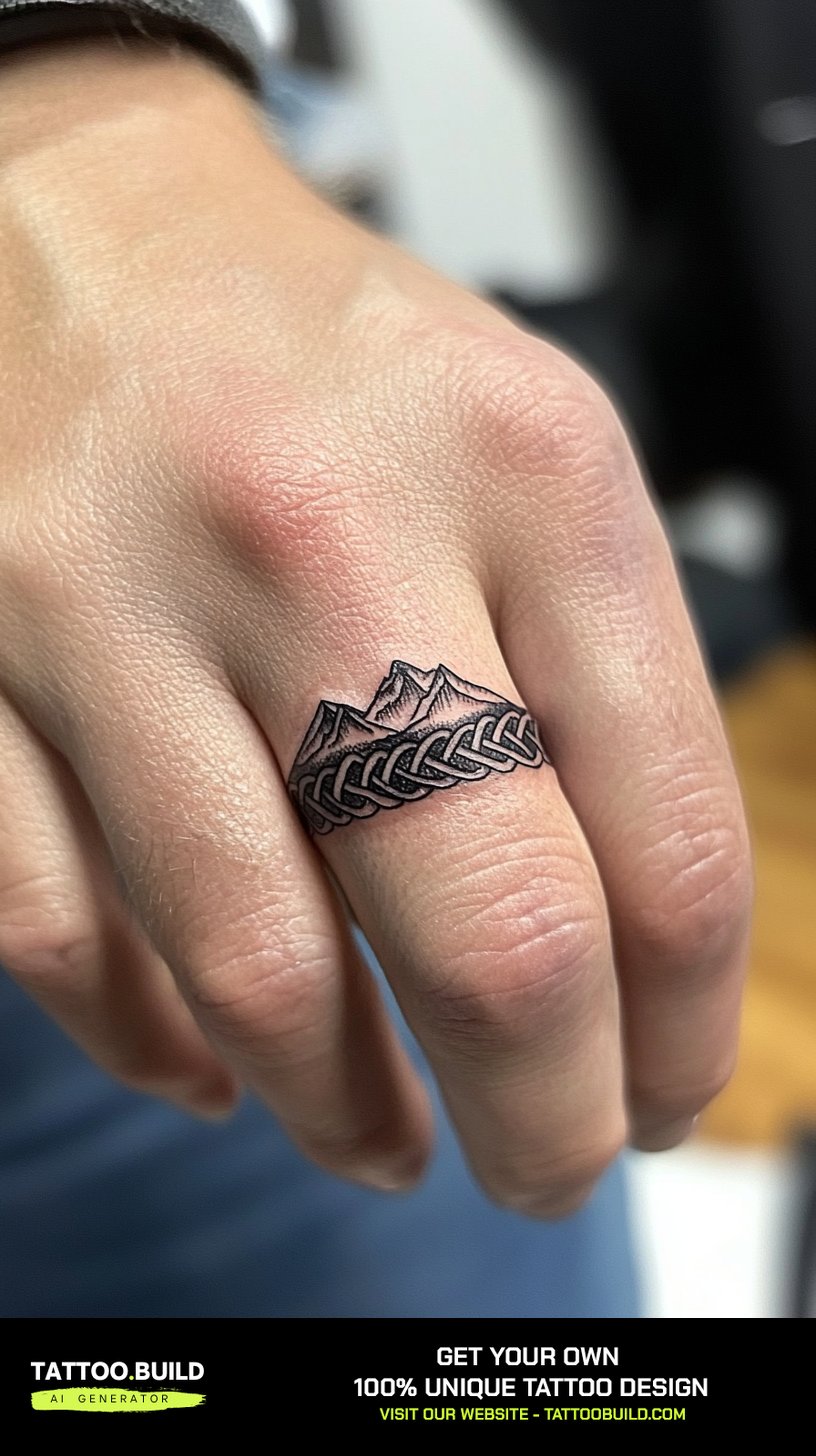
Textured variations — braided rope, a chain link, a hammered-metal effect — add character without adding fragility, as long as the artist keeps the pattern chunky.
The one honest downside: a solid band is the hardest wedding ring tattoo to cover or remove later, because there is so much saturated ink in a small area.
5. Words, Quotes and Handwriting
One word beats a sentence every single time on a finger.
“Always”, “Mine”, “Home” — short words fit the length of the finger naturally and stay legible at a readable size.
Tracing a partner’s actual handwriting is the version I find most moving, and it is genuinely one of a kind. Ask them to write the word ten times and let the artist pick the cleanest sample.
Be realistic about scripts with hairline strokes. They photograph beautifully on day one and need attention sooner than most people expect — our fine line tattoo guide explains why.
6. Faith and Meaningful Symbols
For many couples the ring itself carries religious meaning, and the tattoo follows.
A small cross on the side of the finger is the most common request I see, usually paired between partners rather than matched exactly.
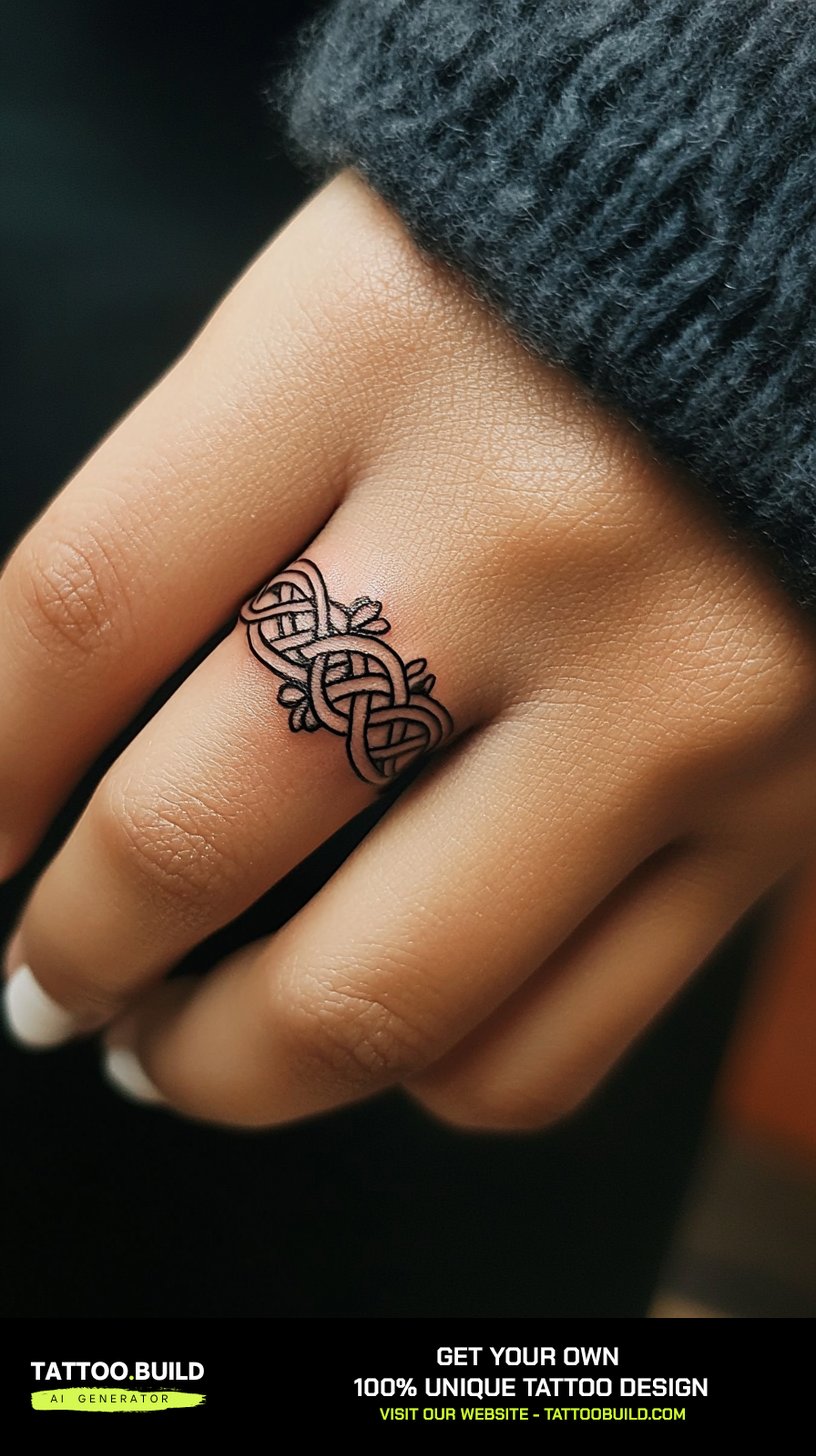
Celtic and knotwork designs suit a band shape unusually well because the pattern is already circular by nature — see our Celtic knot tattoo ideas for how those loops are built.
If the design carries cultural or religious weight that is not yours, talk to your artist about it honestly. Most will tell you plainly whether a motif is appropriate to borrow.
7. Floral and Botanical Bands
A vine wrapping the finger is the softest alternative to a hard-edged band.
Simplified flowers work; hyper-detailed botanical illustration usually does not, because the petal detail sits too close together.
A single small bloom at the base of the finger with a plain band behind it is the compromise I recommend most often. You get the softness without betting everything on fine detail.
Birth flowers are a popular way to make this personal — each partner wears the other’s.
8. Geometric and Mandala Bands
The most decorative option, and surprisingly practical if the linework stays bold.
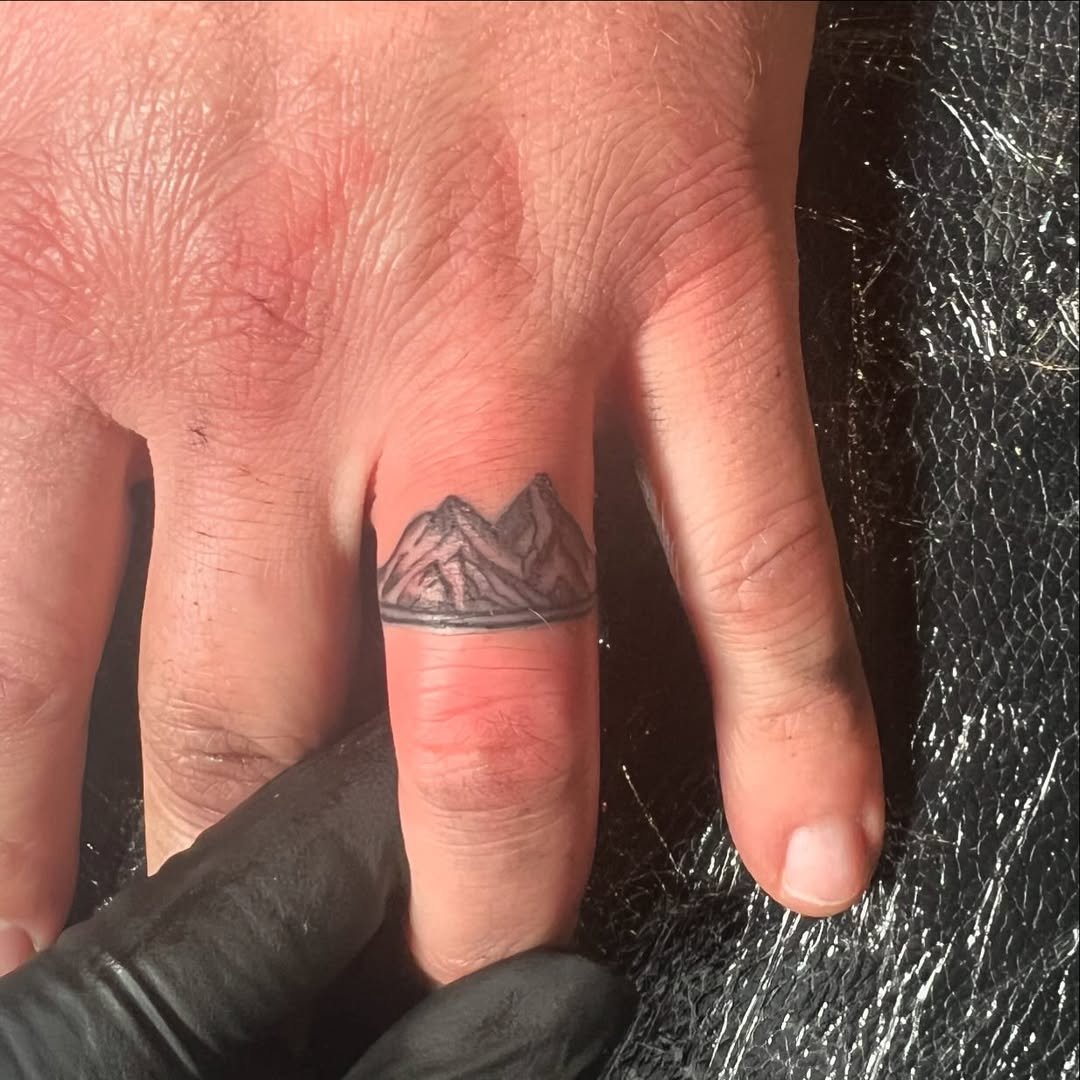
Repeating geometry — chevrons, triangles, a row of dots — wraps a cylinder naturally, so the design looks intentional from every angle.
Mandala-style bands sit somewhere between jewellery and tattoo, and they are the ones strangers comment on most. Our mandala tattoo ideas page has fuller versions of these patterns.
Dotwork shading is the risk here. Individual dots on a finger tend to merge over time, so ask for slightly larger, more separated points than you would on an arm.
Alternatives and Variations Worth Knowing
Not every couple wants ink on the ring finger itself, and there are good reasons to look sideways.
Minimalist and Micro Rings
A single thin line, a few dots, or a 5mm mark on the side of the finger.
These are the quietest option and the easiest to hide at work. They are also the ones that need touching up soonest — our minimalist tattoo ideas guide covers the trade-off honestly.
Moving Off the Finger Entirely
A ring motif on the wrist, inner arm or over the heart keeps the symbolism and skips the fading problem completely.
I have also seen couples tattoo the ring inside the upper arm where a sleeve hides it, which works well for jobs with visible-tattoo policies.
Placement on the outer forearm or bicep holds detail far better than any finger will, so if your dream design is intricate, this is the honest recommendation.
Ink Alongside a Real Ring
Plenty of people wear both — the tattoo for daily life, the metal ring for occasions.
This is genuinely practical if you work with your hands, since a metal band can be a snag hazard in trades, climbing and medical work.
Aftercare and Practical Advice
Finger tattoos ask more of you in the first two weeks than almost any other placement, mostly because you cannot stop using your hands.
Follow whatever aftercare routine your artist gives you — they know their ink and their machine. General guidance from the American Academy of Dermatology covers washing, moisturising and sun protection well.
Handwashing is the part people underestimate. Every wash pulls moisture out of healing skin, so a thin layer of the ointment your artist recommends after each one makes a real difference.
Keep the fresh tattoo out of dishwater, gym chalk, gardening soil and swimming pools until it has fully closed over, usually two to three weeks.
Book the touch-up conversation early. Many artists include one free touch-up within a set window — ask before you book, not after. And if you notice spreading redness, swelling, heat, pus or a fever, that is a job for a doctor rather than a tattoo forum; the Mayo Clinic outlines the warning signs of infection and allergic reaction.
Nothing here is medical advice — if something about your healing worries you, see a professional.
Common Mistakes and Still Not Sure?
The mistakes I see repeated are almost always design decisions, not aftercare ones.
- Going too small. A design that looks delicate at 5mm often has no room to age.
- Choosing a script with hairline strokes for a finger, where those strokes are the first thing to go.
- Booking a couple’s appointment as a surprise — both people should see the stencil placed.
- Assuming a tattoo removes the cost problem. Touch-ups over a decade add up.
- Getting inked on a hand you are about to sunburn on honeymoon. UV fades fresh ink fast.
- Skipping the patch conversation if you have sensitive skin or a history of reactions to pigments.
If you are still undecided, browse adjacent styles before you book — cross tattoo designs and couple tattoo ideas both cover ground that overlaps with ring tattoos.
And there is no rule that says the decision has to happen before the wedding. Some of the best ring tattoos I have seen were done on a first or fifth anniversary, once the couple knew exactly what they wanted.
Frequently Asked Questions
How long does a wedding ring tattoo actually last?
The ink is permanent, but the appearance is not stable the way an arm tattoo is. In my experience a bold solid band still looks sharp after five to seven years, while fine line work often needs its first touch-up somewhere between one and two years. Fingers move, stretch and get washed constantly, which is what drives the fading. Treat touch-ups as normal maintenance rather than a sign something went wrong.
Does a ring finger tattoo hurt more than other placements?
Most people find it sharper than a forearm, largely because the skin is thin and sits close to bone. The good news is that it is over quickly — a simple band is usually done in half an hour. Pain varies enormously between individuals, so treat anyone’s rating as a rough guide only. If you are anxious, tell your artist; they can pace the session.
Can a wedding ring tattoo be removed if things change?
It can be lightened or removed with laser treatment, but fingers are a difficult area and results vary. Solid black bands take the most sessions because there is so much saturated ink in a small space. A cover-up is sometimes easier than removal, depending on what is already there. Speak to a qualified laser practitioner rather than relying on at-home products, which can damage skin.
Should we both get the same design?
There is no right answer, and I have seen both work. Identical designs read clearly as a pair, while complementary ones — the same style in different weights, or two halves of one symbol — let each person keep their own aesthetic. What matters more is that you both actually like the design rather than one person going along with it. Sit with the stencil on before the needle starts.
What if my job does not allow visible tattoos?
A ring tattoo is one of the hardest to hide, since gloves and jewellery only cover so much. Some people place the design on the inside of the finger, though that is also where fading is worst. The more reliable workaround is moving the ring motif to a covered spot such as the inner arm or over the heart. Check your workplace policy before booking, not after.
Quick Summary
- Bolder lasts longer. On fingers, line weight matters more than design cleverness.
- Solid bands are the most durable option; fine line work is the least.
- Space out letters and numerals more than looks right — ink spreads over the years.
- Keep symbols above roughly 8mm so the negative space survives.
- The flat top of the finger holds ink best; inner-finger and palm-side placements fade fastest.
- Budget for touch-ups the way you would budget for resizing a metal ring.
- If your dream design is intricate, put the ring motif somewhere other than the finger.
- Any sign of infection or allergic reaction is a doctor’s job, not a forum’s.
Whatever you choose, take the extra week to sit with the design. The ring is a symbol either way — there is no prize for deciding fast.