A wedding ring tattoo is a band of ink where a metal ring would sit — and it behaves nothing like the rest of the tattoos on your body. Fingers are the single worst place on the human body to hold ink, which is exactly why the design you choose matters more here than anywhere else.
I have been photographing and writing about finger work for years, and the pattern is remarkably consistent: the couples who love their ring tattoos five years later are almost never the ones who picked the most detailed design.
They are the ones who picked something simple enough to survive. If you are still weighing placement in general, our wider guide to finger tattoo ideas is worth a look before you commit to the ring finger specifically.
Below are the styles that actually hold up, the ones that rarely do, and an honest account of what the healing and touch-up cycle looks like.
Which Wedding Ring Tattoo Style Is Right for You?
This is the comparison I end up sketching for people on a napkin, so here it is properly. Touch-up figures are the ranges artists typically quote — your own skin, job and sun exposure move them.
| Style | Best for | How well it ages | Typical touch-up cycle |
|---|---|---|---|
| Solid black band | Anyone who wants a ring that reads as a ring from across a room | Best of any option; edges soften but the shape survives | Every 3–5 years, sometimes longer |
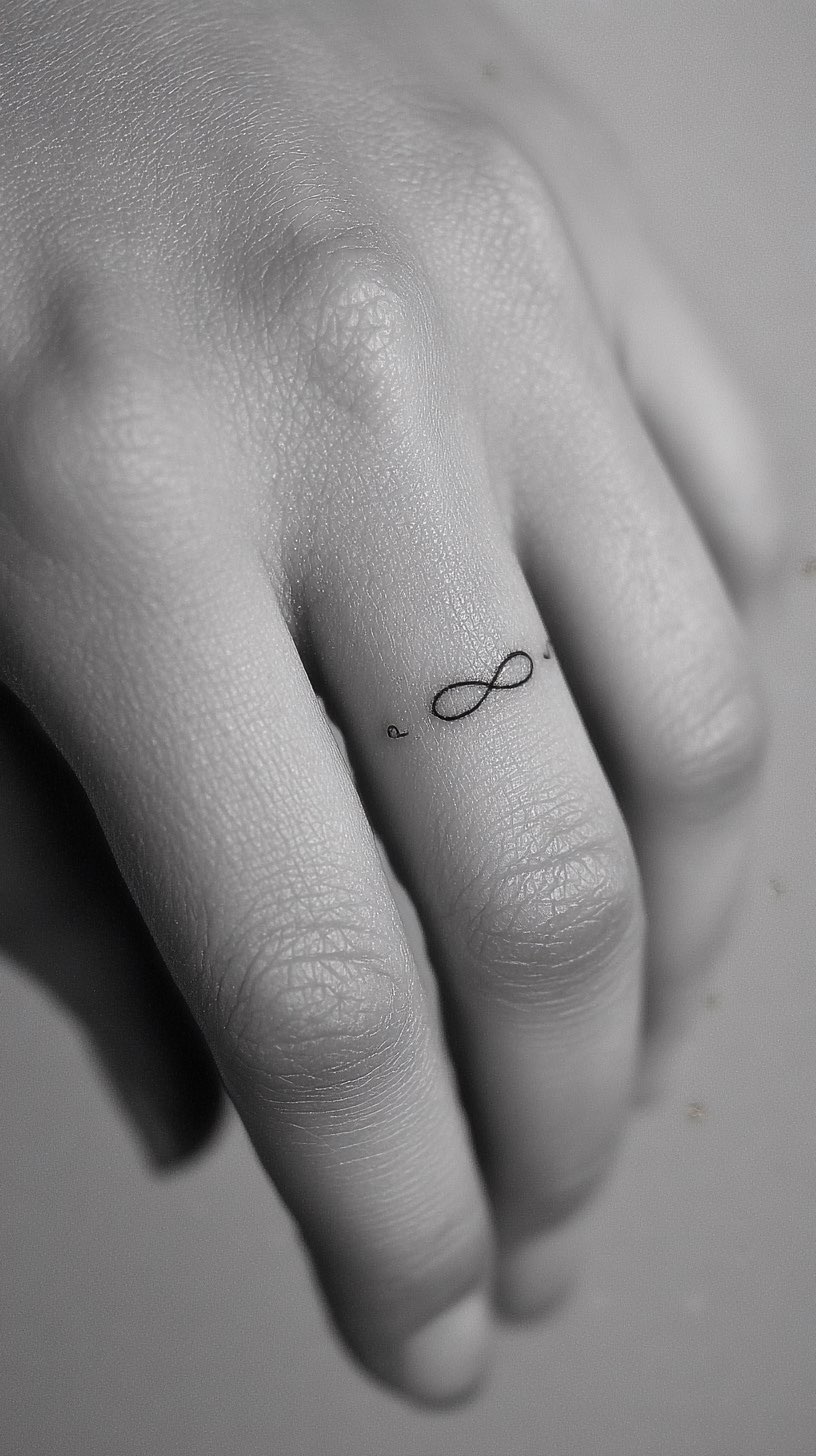
| Thin single line | Understated hands, office jobs, first tattoos | Good, though a hairline can break up in patches | Every 2–4 years |
| Fine-line botanical | Couples who want something decorative, not graphic | Fair; small gaps between leaves tend to close up | Every 1–3 years |
| Script, names or dates | People who want words rather than a symbol | Hardest to keep legible at finger scale | Every 1–2 years |
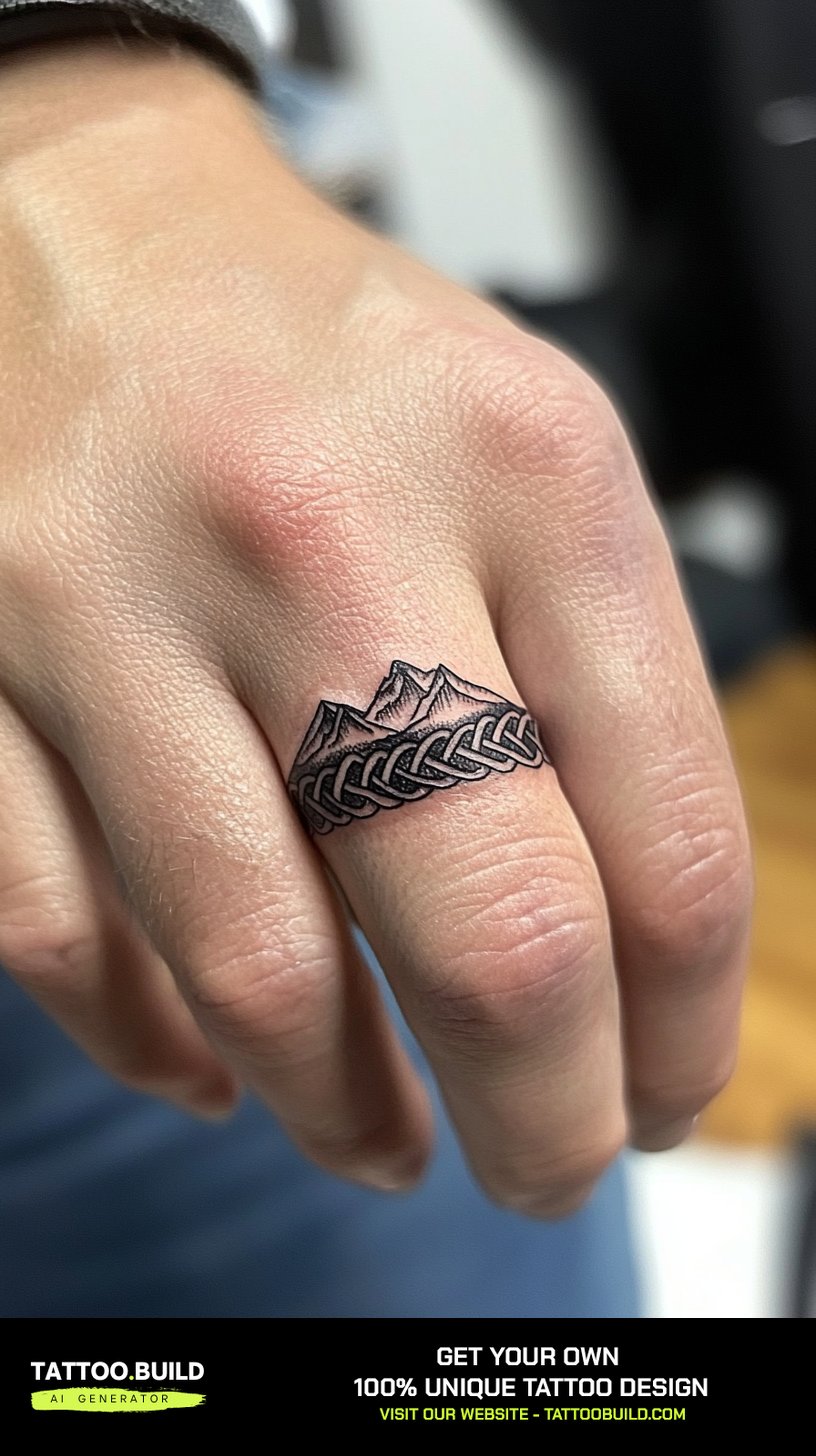
| Knotwork or patterned band | Wider fingers and bolder hands | Good if the artist leaves generous gaps | Every 2–4 years |
| Traditional metal ring | Anyone who wants the option to take it off | Indefinitely, but it can be lost or caught | None |
Why Finger Tattoos Fade Faster Than Everything Else
The skin on your fingers turns over faster than skin almost anywhere else on the body, and it is thin over the sides where a band has to wrap.
Add hand washing, gym bars, steering wheels, dishwater and sunlight, and you have a surface that is constantly abrading the layer your ink sits in.
In practice this means two things. The first is that fading is normal rather than a sign your artist did something wrong.
The second is that the sides and underside of the finger almost always lose ink before the top does. Every artist I have asked about this says the same thing: expect the underside to go patchy first, and plan the design so that patchiness does not ruin it.
Pain is a smaller issue than most people fear. Fingers rank high on the sensitivity scale — our tattoo pain chart puts them near the top — but a simple band is usually done in under fifteen minutes, so the whole thing is over quickly.
Wedding Ring Tattoo Ideas by Style
These are grouped by how the design is built rather than by theme, because the construction is what decides how it looks in year five.
1. The Solid Black Band
This is the design I recommend most often, and it is not close. A band of solid black, two to five millimetres wide, wrapped all the way around the finger.
It ages better than any other wedding ring tattoo because there is no internal detail to lose. When the edges soften, it still reads as a band.
It is also the easiest to repair. A touch-up on a solid band is a five-minute pass, whereas repairing script means re-drawing it.
The variations worth knowing: a single wide band, two thin bands stacked with a gap between them, or a band that stops short on the palm side so it never crosses the crease.
2. Fine-Line Vines and Botanical Bands
A vine, a laurel, or a run of tiny leaves that circles the finger instead of sitting flat on top of it.
These are the most photogenic wedding ring tattoos by a distance, and they are also the ones I see needing the earliest touch-up.
The reason is spacing. If the leaves sit close together, healed ink spreads slightly and the gaps fill in until the whole thing reads as a smudged band. A good fine-line tattoo artist will deliberately leave more air in the design than looks right on paper.
Ask to see healed photographs of the artist’s finger work specifically — not fresh ones. Fresh finger tattoos all look immaculate.
3. Script, Initials and Dates
Words are the most personal option and the most fragile. A name, an initial, a wedding date, or a short phrase running along the top of the finger.
Anything smaller than about four millimetres tall on a finger is living on borrowed time. Letters blur into each other as the ink settles, and the gap inside an ‘e’ or an ‘a’ is usually the first thing to close.
If you want a date, Roman numerals hold up noticeably better than digits because the strokes are straight and separated — there are good examples in our Roman numeral tattoo guide.
A single initial is the safest version of this idea. One letter, generously sized, on the top of the finger where wear is slowest.
4. Symbols Instead of Bands
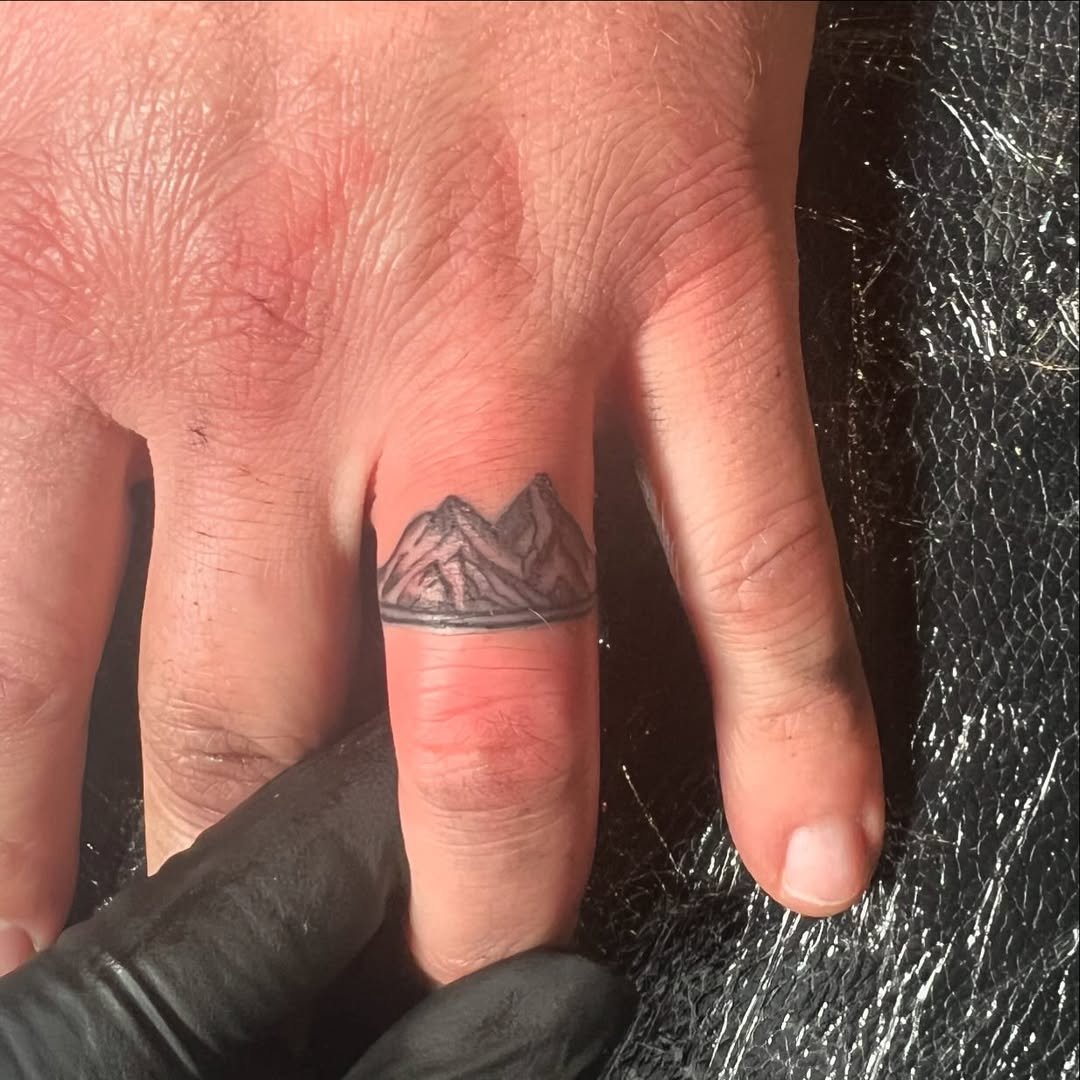
Not everyone wants something that circles the finger. A small motif sitting where a stone would be is a genuinely different look.
Sun and moon, a four-point sparkle, a tiny star, a heart, a dot — these work because they carry meaning without needing detail.
They also solve the wrap problem entirely. Nothing crosses the underside of the finger, so nothing goes patchy in the place that patches first. If this is your instinct, our minimalist tattoo ideas collection has more in the same register.
The couples’ version of this that I like best is complementary rather than identical: one partner takes the sun, the other the moon, and the pair only completes when the hands are together.
5. Celtic and Knotwork Bands
A woven or braided band, usually a few millimetres wider than a minimalist ring, with a repeating pattern running around the finger.
These carry real cultural weight — the endless-loop knot has been read as a symbol of continuity for a very long time, and our guide to Celtic knot tattoos covers the specific motifs.
Practically, they need width. A knot squeezed into a two-millimetre band will blur into a grey stripe within a couple of years.
Give a knotwork ring at least six or seven millimetres of height and insist on wide negative space between the strands.
6. Geometric and Negative-Space Bands
A bold band with a shape cut out of it — a diamond, a triangle, a gap in the middle — so the skin itself becomes part of the design.
This is a smart compromise. You get the durability of solid black plus a detail that means something, and the cut-out is large enough that it does not close up.
Dots and dashes work on the same principle. A hairline with two dots either side reads as deliberate rather than as a stray line.
7. Ink Worn With Metal
Nobody says you have to choose. Plenty of people I have spoken to wear a tattooed band under a metal ring and only show the ink when the ring comes off.
It is a practical answer for anyone who wants a visible ring at a wedding or at work but hates wearing one at the gym.
It also hedges the permanence question honestly — the ink is the private version, the metal is the public one.
Alternatives If a Finger Tattoo Is Not Right for You
Fingers are not the only way to mark this, and a few of these hold ink far better.
The Inner Finger
The palm-facing side of the finger is more private and, contrary to expectation, wears at roughly the same rate as the top.
It is a good option if your workplace is conservative about visible ink.
The Ring Finger Base or Knuckle Side
Just below where a ring sits, on the web of the hand, the skin is slightly thicker and holds a small design better.
Wrist, Inner Arm or Over the Heart
If the design you love is genuinely detailed, put it somewhere that can hold detail. A small piece on the inner wrist will still be sharp in a decade, which is rarely true of the same design on a finger — delicate hand and finger work looks its best when the detail is scaled to the skin it sits on.
A Silicone Band as a Trial Run
Wearing a plain silicone ring for a few months tells you a surprising amount about whether you want something on that finger permanently.
How to Get a Wedding Ring Tattoo That Lasts
Choose the artist on their healed finger work, not their portfolio in general. Finger tattooing is a specific skill and plenty of excellent artists avoid it.
Expect to pay a shop minimum rather than a per-hour rate for something this small — our breakdown of what a small tattoo costs covers the usual ranges. Many artists include the first touch-up free, so ask before you book.
For healing, follow whatever your artist tells you first; their instructions beat anything on the internet. The general principles — keep it clean, keep it moisturised, keep it out of the sun — are set out well by the American Academy of Dermatology.
The finger-specific parts matter more than usual: no soaking in water, no gym gloves or rings over it while it heals, and expect to wash your hands constantly, which is exactly what fresh ink does not want.
Do not judge the result until it has fully settled — usually a few weeks, sometimes longer. Fresh finger tattoos look bolder than they will end up, and some ink loss during healing is expected rather than a mistake.
On safety: tattoos carry real, if uncommon, risks including infection and allergic reaction, and the US Food and Drug Administration and Mayo Clinic both cover these clearly. If a healing tattoo becomes hot, swollen, increasingly painful or starts weeping after the first couple of days, that is a doctor’s question, not a forum question. Never attempt to tattoo or remove one yourself.
Common Mistakes — and What to Do If You Are Still Not Sure
The most common one is scale. People bring in a design drawn for a forearm and ask for it shrunk onto a finger.
The second is getting it done immediately before the wedding. A healing tattoo is red, shiny and often peeling for a week or two, so give it a month of margin.
The third is matching too literally. Identical rings are lovely, but complementary designs tend to suit two different hands better than one design forced onto both.
If you are not settled on the idea, look sideways rather than harder. Our matching tattoo ideas for couples collection covers designs that work on more forgiving placements, and if the appeal is really about carrying a person’s name, name tattoo ideas is a better starting point than a band.
And there is no rush. A ring tattoo will still be available on your fifth anniversary, when you will know a lot more about how you both feel about permanent ink.
Frequently Asked Questions
Do wedding ring tattoos hurt more than other tattoos?
Fingers are among the more sensitive spots on the body, mostly because the skin is thin and sits close to bone and nerve endings. That said, the pain is brief. A simple band is often finished in ten to fifteen minutes, which is far less time under the needle than most tattoos. Most people I have spoken to describe it as sharp but very manageable.
How often will I need a touch-up?
It depends entirely on the design and on what your hands do all day. Solid bands often go three to five years before they need attention, while fine-line script can need work within a year or two. Manual work, frequent hand washing and sun exposure all shorten the interval. Ask your artist for their honest estimate for your specific design and build the cost into your decision.
What happens to a wedding ring tattoo if the marriage ends?
This is worth thinking about honestly rather than dismissing. A simple band is comparatively easy to cover or rework into a different design, which is one more argument for keeping it simple. Laser removal on fingers is possible but generally takes multiple sessions and should only ever be done by a qualified practitioner. Names and dates are the hardest to move on from.
Can I get a wedding ring tattoo over an existing scar or callus?
Sometimes, but it needs an in-person assessment. Scar tissue takes ink unpredictably and can hold it patchily or not at all, and heavy calluses shed too fast to keep a clean line. A good artist will tell you honestly if a spot will not hold and suggest shifting the design a few millimetres. Do not push an artist who says no to this.
Is white ink a good option for a subtle wedding ring tattoo?
White ink is popular in photographs and disappointing in real life more often than not. It tends to fade to a faint yellowish or barely visible mark, and on fingers, where wear is highest, that happens quickly. If you want something subtle, a very thin black line usually holds up far better than white. Some artists decline white finger work altogether for this reason.
Quick Summary
- Fingers hold ink worse than anywhere else on the body — assume fading, and design around it.
- A solid black band is the most durable wedding ring tattoo and the easiest to repair.
- Fine-line botanicals photograph beautifully but usually need a touch-up within one to three years.
- Script, names and dates are the hardest to keep legible; a single generously sized initial is the safer version.
- Symbols placed on top of the finger avoid the underside, which is where patchiness always starts first.
- Knotwork bands need real width and generous negative space or they blur into a grey stripe.
- Book at least a month before the wedding, and pick your artist on healed finger photographs.
- Ink and metal are not mutually exclusive — plenty of people wear both.