If you have been searching for Yukuza tattoo ideas, you are really looking at irezumi — the full-coverage Japanese tattoo tradition that the yakuza adopted, not one they invented.
Quick note on spelling before we go further: the crime syndicates are spelled yakuza, and the tattoo style is irezumi. "Yukuza" is how most people type it, so I have kept the word here, but knowing the correct terms will save you a lot of confusion when you start talking to artists.
I have spent years looking at Japanese work, sitting for it, and asking artists what separates a piece that still reads beautifully after fifteen years from one that turns into a grey smudge. The answer is almost never the subject. It is the planning.
Below you will find design ideas broken down by placement and motif, an honest look at what committing to this style actually costs in time and money, and the questions I wish someone had asked me before my first Japanese piece. Start with these Japanese tattoo designs if you want the wider style context first.
Which Yukuza Tattoo Placement Is Right for You?
Before choosing a dragon or a tiger, choose the canvas. In my experience this decision drives everything else — the budget, the number of sessions, how much of the design anyone will ever actually see.
| Placement | Typical sessions | Pain level | Easy to cover? | Best for |
|---|---|---|---|---|
| Full sleeve | 8–15 | Moderate, spikes at elbow and inner bicep | Long sleeves only | First large commitment |
| Full leg | 10–20 | Moderate, worst on shin and inner thigh | Yes, most of the year | Big composition, low visibility |
| Back piece | 12–25 | Manageable centre, sharp over spine and ribs | Almost always | The traditional centrepiece |
| Chest panels | 6–12 | High over sternum and collarbone | Yes | Building toward a body suit |
| Single motif (dragon or tiger) | 1–4 | Depends entirely on location | Usually | Testing the style before committing |
Session counts here are the ranges artists have quoted me and friends over the years, not a guarantee. A slow, detail-heavy artist may take twice as long as a fast one, and both can be excellent.
Why Irezumi Carries So Much Weight
Japanese tattooing predates the yakuza by centuries. The full-body style most people picture grew out of Edo-period woodblock art and the folk heroes of Suikoden, and it was worn by firefighters, labourers and gamblers long before it became shorthand for organised crime.
The association hardened in the twentieth century. If you want the sober historical background rather than film mythology, Britannica’s overview of the yakuza is a reasonable starting point.
That history has real consequences today. Many onsen, public pools and gyms in Japan still refuse entry to visibly tattooed guests, and the rule is applied to tourists as often as to locals.
I mention this not to talk anyone out of the style but because it is the single thing people most often fail to think through. A leg piece you can hide under trousers sits very differently in daily life than hands or a throat.
There is also the question of respect. Wearing irezumi as an outsider is not inherently disrespectful — Japanese artists have exported and taught this style deliberately for decades — but copying gang-specific imagery or claiming an affiliation you do not have is a different matter entirely.
Yukuza Tattoo Ideas by Placement and Motif
What follows is organised the way an artist would actually plan the work: canvas first, then subject, then background. Every image here comes from a real piece, so treat them as a starting conversation with your artist rather than something to copy line for line.
1. Full Leg Yukuza Tattoo Designs
Leg work is where I usually send people who want the scale of traditional irezumi without putting it on display. A full leg runs hip to ankle and gives an artist enough room for a main subject, a secondary subject and a proper background.
The classic compositions are a dragon spiralling the calf with cloud work behind it, koi swimming upstream through water bars, or a phoenix rising from flame across the thigh.
The shin is the part nobody warns you about. There is very little between skin and bone there, and every person I have asked rates it as the sharpest stretch of a leg piece. The good news is that it is a small percentage of the total surface.
Budget more sessions than you think. Legs are large, and the wrapping seams — where the design meets itself around the back of the calf — take real planning to avoid an obvious join.
2. Full Sleeve Yukuza Arm Designs
The Japanese sleeve is the most common entry point into this style, and for good reason: it is large enough to be a serious piece of art but small enough to finish inside a year of regular sittings.
Traditional layouts stop at a defined point rather than fading out. A nagasode runs to the wrist, a shichibu stops mid-forearm, and a gobu ends above the elbow — the cut points chosen so the tattoo disappears under a shirt sleeve.
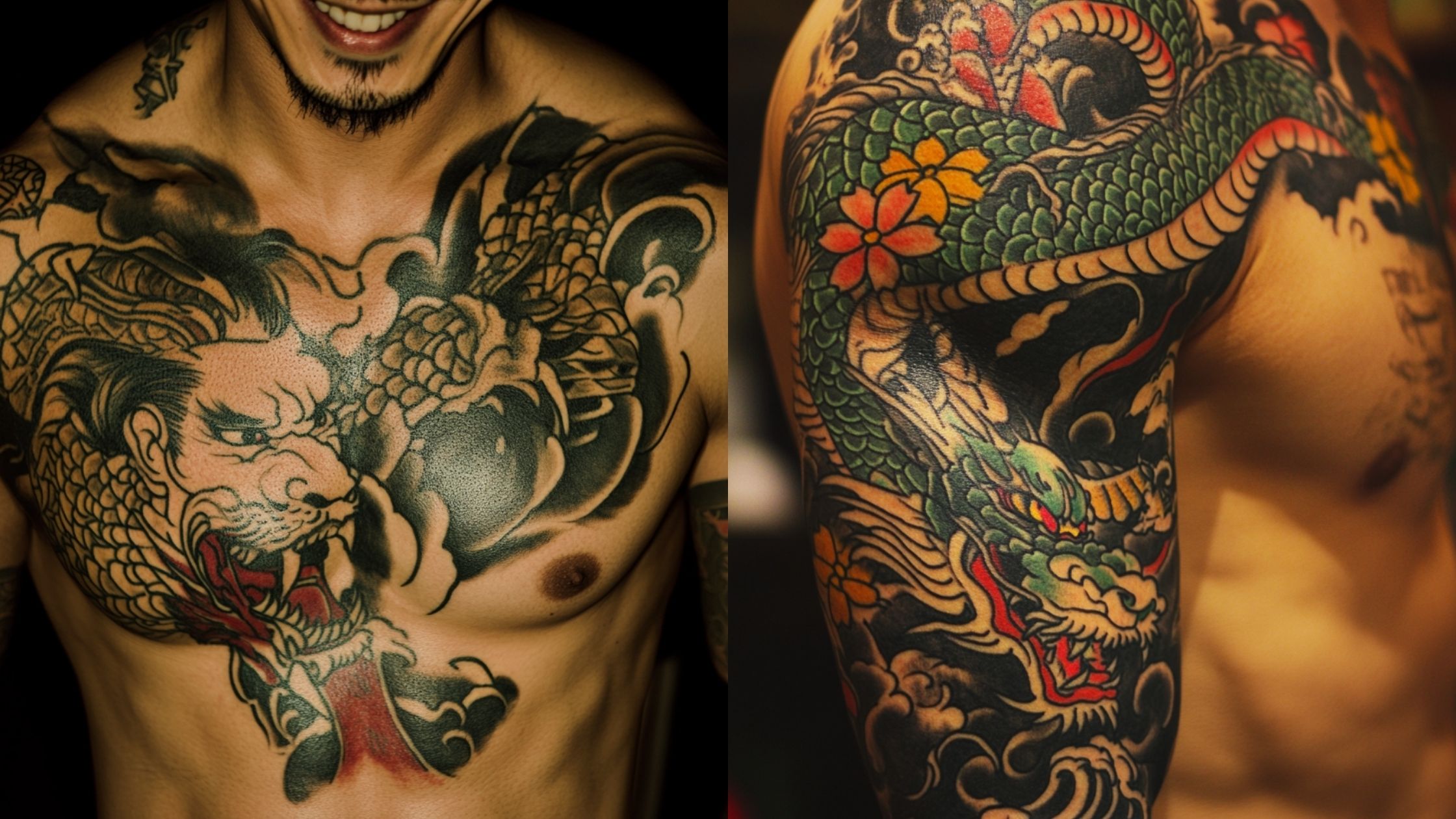
When I tested different subjects against arm anatomy, the ones that worked best were the ones that follow the limb: a dragon coiling with the bicep, a snake tracing the forearm, a tiger prowling downward along the outer arm. If snake tattoo meaning interests you, the same principle applies.
Colour or black and grey is a real decision here. Forearms take sun and friction, and black and grey generally holds its definition longer with less touch-up work.
3. Dragon Yukuza Tattoo Designs
The dragon — ryu — is the most requested motif in the style and the easiest to get wrong. Japanese dragons are drawn with three claws, long whiskers and a serpentine body without wings, which is what separates them from Chinese and European dragons.
Symbolically they are protective and benevolent rather than destructive, associated with water, wisdom and generosity. That is a meaningfully different story from the Western dragon most people carry in their head.
Every artist I have asked says the same thing about dragon placement: give it a run. A dragon compressed into a small square loses the sinuous line that makes it work. It wants a sleeve, a leg or a back.
If you want a softer or more decorative interpretation, these dragon tattoo ideas for women show how the same creature reads in a different register.
4. Tiger Yukuza Tattoo Designs
The tiger — tora — is the dragon’s traditional counterpart. Dragon governs the sky and water, tiger governs the earth and wind, and pairing them on opposite limbs or opposite sides of a back piece is one of the oldest compositions in Japanese tattooing.
Tigers are drawn stylised, not realistic: exaggerated stripes, an oversized head, a body caught mid-prowl. This is deliberate, because the design has to read from across a room and not just at arm’s length.
Bamboo is the traditional filler for a tiger, the way clouds go with a dragon and water goes with koi. Mixing those pairings is not forbidden, but it does signal to anyone who knows the style that the piece was assembled rather than designed.
A tiger head alone is a genuinely good compromise if you want the motif but not the commitment of a full limb.
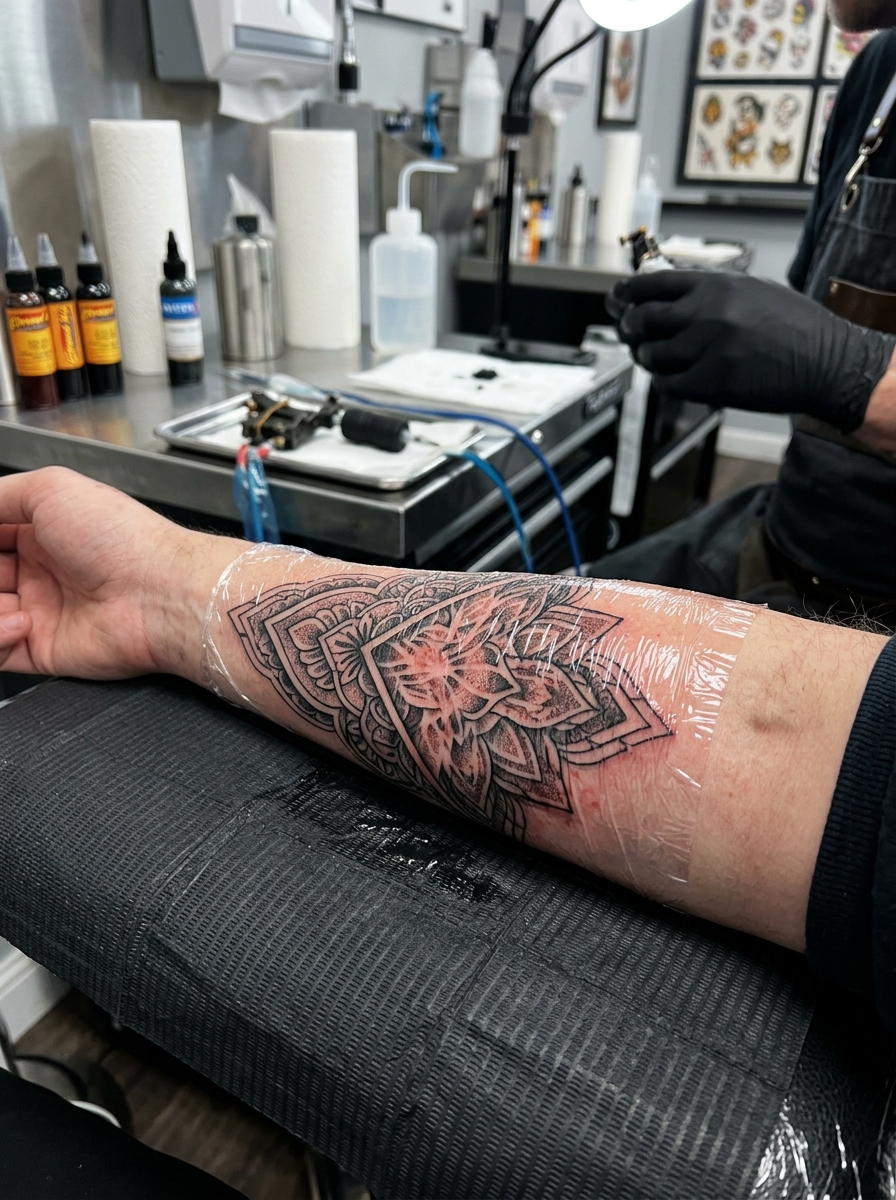
5. Stencils and Linework: Seeing the Plan First
These are stencil and linework stages rather than finished tattoos, and I have included them because they are the most useful thing on this page.
The stencil is where composition problems are cheap to fix. Once the outline is in your skin, changing the direction a dragon faces is a cover-up job, not an edit.
When I sat for my first Japanese piece, my artist spent longer on stencil placement than on the first hour of lining. Sit down, stand up, look in the mirror from three angles, walk around. If something feels off at stencil stage, say so.
Note in these images how the outlines curve with the body rather than sitting flat on it. That is the difference between a Japanese tattoo and a Japanese drawing stuck onto a person. If linework itself appeals to you, blackwork tattoo designs explore that approach further.
6. Chest and Torso Panels
Chest panels are the building blocks of a full body suit. The traditional layout leaves an open strip down the centre of the chest and stomach — the munewari — so the tattoo appears to part when a kimono is worn open.
People new to the style sometimes read that gap as unfinished. It is not. It is one of the defining features of a traditional suit.
Pain is worth being straight about here. The sternum, collarbone and floating ribs are consistently the hardest areas I have sat through and the ones friends most often break sessions over. Plan shorter sittings and eat beforehand.
Masks are common in this zone — the hannya mask, a jealous female spirit from Noh theatre, is the one you will see most. Paired with peonies it makes a composition that balances menace against beauty.
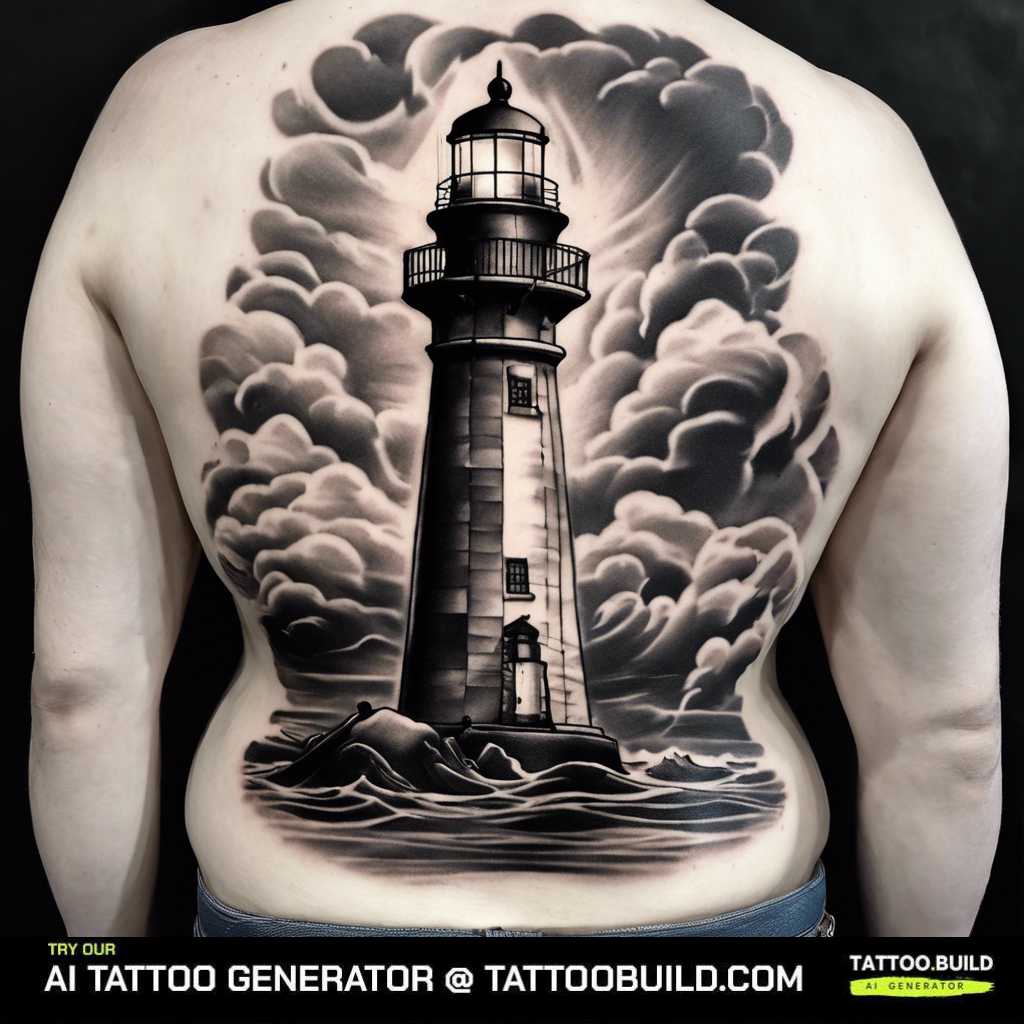
7. Back Pieces and Modern Hybrids
The back is the traditional centrepiece of a full suit and the most rewarding canvas in the style, because it is the only place where a single unbroken composition is possible.
It is also the longest project on this page. A back piece is measured in years for most people, not months, and the pace is usually set by budget rather than healing.
The last images in this group show where the style is going: anime-influenced character work and photorealistic shading sitting on a traditional irezumi framework. Purists dislike it. I think a hybrid done well by an artist who understands both traditions can be excellent — the failures happen when someone understands neither.
If you are weighing this against other large-scale approaches, every tattoo style explained lays out how the major styles differ in practice.
8. More Yukuza Tattoo Design Ideas
A final gallery for browsing. Look past the subject in each one and watch the background — the wind bars, cloud forms and water that fill the space between the main figures.
Background is what separates traditional Japanese work from a collection of Japanese-looking tattoos on the same arm. It is also, in my experience, the thing clients try hardest to cut from the budget and regret most.
Alternatives If a Full Yukuza Piece Is Too Much
Not everyone wants a body suit, and the style is flexible enough to scale down if you plan for it from the start.
Single Botanical Motifs
Peonies, chrysanthemums and cherry blossoms carry their own meanings and work beautifully as standalone pieces. These cherry blossom tattoo meanings and chrysanthemum tattoo ideas cover what each flower signifies.
Neo-Japanese and Black-and-Grey
Neo-Japanese keeps the motifs and composition rules but loosens the colour palette and line weight. It reads modern while still respecting the underlying grammar of the style.
Background-Only Filler
Some artists will tattoo wind bars, water or cloud tattoo ideas as a connective layer to unify tattoos you already have. It is an underused option and often cheaper than a new subject.
Kanji and Lettering
If you want the cultural reference without the coverage, well-chosen lettering is an option — but have it verified by a native reader first. These Japanese word tattoo ideas explain why that check matters.
Practical Advice Before You Book
Choose the artist before you choose the design. A specialist in Japanese work will improve your idea; a generalist will execute it exactly as you drew it, flaws included. Look through healed photos, not fresh ones — fresh tattoos all look good.
Ask about the full plan up front. A good Japanese artist will want to design the whole limb even if you can only afford a third of it this year, because the sections have to work together.
Aftercare is straightforward but not optional. Keep the area clean, follow the specific instructions your artist gives you, and avoid sun and soaking while it heals; American Academy of Dermatology guidance on caring for tattooed skin is a solid general reference.
If you develop spreading redness, increasing pain after the first few days, fever or discharge, see a doctor rather than posting a photo online. Allergic reactions to certain pigments are also possible — FDA consumer information on tattoo inks covers what is known and not known about ink safety. Nothing on this page is medical advice.
Common Mistakes — and What to Do If You Are Still Not Sure
Starting too small is the most frequent one. A small dragon on the forearm that you later want to grow into a sleeve almost always has to be redesigned around, because it was never placed with a sleeve in mind.
Sourcing a design from a single reference image is the second. Bring five or six images that show the feeling you want and let the artist compose, rather than asking for a copy of someone else’s tattoo.
Skipping the background to save money is the third. In my experience it is the change people most often pay to fix later, at greater cost than doing it in the first place.
Still weighing it up? Look at samurai tattoo ideas if warrior imagery appeals to you more than creatures, and give yourself a few months. A style built for lifetime commitment can survive a season of thinking about it.
Frequently Asked Questions
Is it disrespectful to get a Yukuza style tattoo if I am not Japanese?
Opinions differ, and it is fair to say there is no single answer. Most Japanese tattoo artists have taught and exported irezumi deliberately for decades, and wearing the style with genuine interest in its history is generally seen as appreciation rather than appropriation. Where people object is when someone copies imagery specific to an actual criminal organisation or implies an affiliation they do not have. If you are unsure about a particular motif, ask an artist who works in the tradition.
How much does a full Japanese sleeve cost?
It varies enormously by country, artist reputation and how fast they work, so any single number would be misleading. The useful way to ask is by session: get your artist’s hourly or day rate and their estimate of how many sittings the design needs, then multiply. Expect a serious sleeve to be a four-figure commitment in most Western markets. Paying more for a specialist is usually cheaper than paying twice.
Will I be banned from onsen and gyms in Japan with this tattoo?
Possibly, and it is worth planning around. Many hot springs, public pools, beaches and gyms in Japan still refuse entry to visibly tattooed guests, and the rule is often applied regardless of nationality. Some venues now allow cover patches or have private baths available, and attitudes are slowly loosening in tourist areas. Check individual venue policies before you travel rather than assuming.
How long does a full back piece take to finish?
For most people it is measured in years rather than months. The limiting factor is rarely healing time, which typically runs two to three weeks between sittings for the surface and longer underneath; it is usually budget and scheduling. Artists commonly book large projects as a standing monthly or six-weekly appointment. Going slowly is normal and does not harm the result.
Can a Yukuza style tattoo be removed or covered later?
Covering large Japanese work is difficult because so much of it is already dense black, and removal is a long, expensive series of laser sessions handled by a qualified practitioner — never something to attempt at home. Results depend on ink colours, depth and your skin, and complete removal is not guaranteed. This is precisely why the planning stage matters so much. Talk to a dermatologist or a licensed removal clinic for an honest assessment of your specific tattoo.
Quick Summary
- The style you are looking for is irezumi, traditional Japanese tattooing; the yakuza adopted it rather than created it.
- Choose the canvas before the subject — sleeve, leg, back, chest or a single motif — because it sets the budget and timeline.
- Dragons want a long run of skin; tigers pair with bamboo; koi pair with water; clouds pair with dragons.
- Background work is not filler. It is what makes the piece read as one design instead of several tattoos.
- Expect a sleeve in the range of eight to fifteen sessions and a back piece in years, not months.
- Visible Japanese tattoos can still restrict entry to onsen, pools and gyms in Japan — check venue policies before travelling.
- Pick an artist who specialises in Japanese work and judge them on healed photos, not fresh ones.
- Follow your artist’s aftercare instructions, and see a doctor for any sign of infection or allergic reaction.