I have been writing about devotional tattoos for years, and no subject comes back to my inbox as often as this one. A Shiva tattoo is not decoration — it is a statement about destruction, renewal and the calm that sits underneath both.
The first Shiva piece I watched being tattooed took just over nine hours across two sittings, and the artist spent the first forty minutes redrawing the eyes alone. That is the part most people underestimate.
Shiva is depicted in dozens of forms, and each one changes what the tattoo says about you. If you are still deciding between the meditative and the fearsome side of the deity, my guide to Mahadev tattoo ideas covers that split in more detail.
Below are the design directions I keep recommending, what each one actually means, and the practical notes — size, placement, healing — that decide whether the piece still looks good in five years.
Which Shiva Tattoo Style Is Right for You?
Every version of Shiva carries a different emotional register. This is the shorthand I use when a client cannot decide.
| Design Direction | What It Signals | Best Placement | Realistic Size |
|---|---|---|---|
| Meditating Shiva | Stillness, discipline, inner control | Forearm, calf, upper back | 5–8 inches |
| Mahakal / Rudra | Power over time and fear | Full back, chest, half sleeve | 10–16 inches |
| Angry Shiva (Bhairava) | Righteous anger, protection | Outer arm, thigh, ribs | 7–12 inches |
| Silhouette Shiva | Quiet faith, understatement | Inner arm, ankle, spine | 3–6 inches |
| Symbol-only (trishul, damaru, om) | Devotion without portraiture | Wrist, finger, behind ear | 1–4 inches |
| Shiva with temple or mountain | Pilgrimage, roots, belonging | Back, thigh, full sleeve | 10–18 inches |
Why the Symbolism Matters Before the Design Does
Shiva is one of the principal deities of Hinduism, usually described as the destroyer within the Trimurti alongside Brahma and Vishnu. Destruction here means clearing away what has outlived its purpose, not violence.
That distinction changes the whole tattoo. A client who understands it tends to ask for calm eyes and open hands; a client who does not usually asks for flames. Both are legitimate — but only one matches what the iconography traditionally carries.
Almost every element in a Shiva depiction is a specific symbol, not a decorative flourish. The crescent moon marks the cycles of time, the serpent Vasuki around the neck signals mastery over fear, and the third eye represents perception beyond the ordinary senses. You can read the standard iconography on Wikipedia’s overview of Shiva.
Skipping an element to save space is fine, as long as you decide which one deliberately. I have seen a beautiful piece ruined because the artist dropped the Ganga stream from the hair purely to fit a narrow forearm.
Placement matters for pain as much as for composition. Ribs, sternum and the inside of the upper arm are consistently reported as harder sittings than outer forearm or calf — my tattoo pain chart breaks that down by body area before you commit to a long session.
Shiva Tattoo Ideas Worth Considering
1. Classic Lord Shiva Portrait
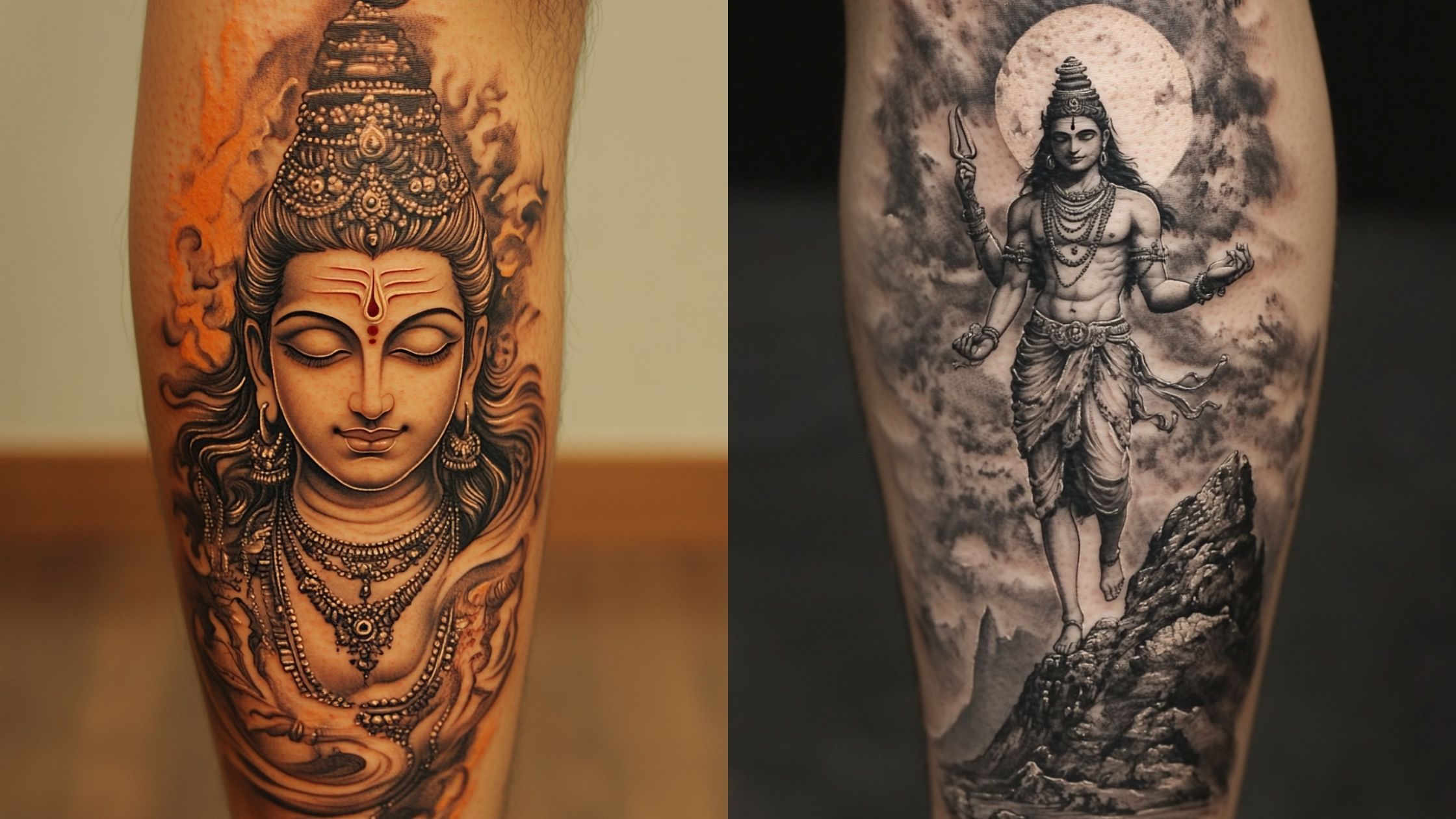
This is the version most people picture: the serene face, matted jata, crescent moon, and the closed third eye across the forehead.
The portrait lives or dies on the eyes. Half-closed lids read as meditation; wide-open lids read as confrontation, and there is very little middle ground once the ink settles.
In my experience these need at least five inches of height to hold detail. Anything smaller and the facial features blur together within a few years as the linework spreads.
Black and grey is the safer choice here. Colour portraits of deities can look striking on day one, but the reds and oranges in flame or tilak detail tend to fade faster than the greywash around them.
2. Shiva Tattoo Designs for Men
Most of the men I have spoken to about this want scale — an upper arm, a chest panel, or a half sleeve rather than a single small piece.
The composition that works most reliably is Shiva’s face at the top of the arm with the trishul running down the outer bicep. It follows the muscle rather than fighting it.
Bold outlines age far better than fine detail on high-movement areas. The outer arm flexes constantly, and hairline stippling there rarely survives a decade in the condition it started.
If you are building outward from a single Shiva piece, plan the whole arm before the first session. My guide to half sleeve tattoo ideas for men covers how to leave room for the filler you will want later.
3. Shiva Tattoo Designs for Women
The requests I see from women skew toward softer linework and more open negative space — often Shiva paired with Parvati, or with lotus and moon elements rather than flames.
Forearm, upper back and thigh are the placements that come up most, and all three give enough flat surface for a balanced composition.
Fine-line work on a deity portrait needs an artist who specialises in it. A heavy-handed application of thin lines will blow out under the skin and the face loses definition permanently.
If you like the devotional theme but want something gentler in tone, Buddha tattoos for women sit in a similar spiritual register with less visual weight.
4. Mahakal Shiva Tattoos
Mahakal — literally ‘great time’ — is Shiva as the force that outlasts time itself. It is the most requested variant I encounter and also the most demanding to execute.
These designs usually include the damaru, a heavy serpent, the third eye open, and a dense smoke or ash background.
Mahakal pieces need real estate. Every artist I have asked has said the same thing: below about ten inches, the background detail collapses into a grey smudge and the whole point is lost.
Budget for multiple sessions. A full-back Mahakal is commonly quoted as a three- to five-sitting project, and rushing it in one marathon day usually produces worse healing.
5. Angry Shiva and Bhairava Designs
The fierce aspect — often rendered as Rudra or Bhairava — is furrowed brow, bared teeth, open third eye and flames rising from the hair.
I find these work best when the anger is contained rather than exploding across the whole panel. A tight composition reads as controlled force; a sprawling one just reads as noise.
Expression is the hardest thing to tattoo well. Ask any prospective artist for healed photos of faces specifically, not fresh ones, because fresh ink flatters everyone.
Placement on the outer thigh or ribs gives the vertical space these need without competing with an existing sleeve.
6. Small and Minimalist Shiva Tattoos
Not everyone wants a portrait. A small trishul, a damaru, or a three-line depiction of the crescent and third eye can carry the same meaning at two inches.
These are the pieces I most often recommend for a first tattoo. They heal in a normal one-to-two week surface window, they cost a fraction of a large panel, and they are easy to build on later.
Simplicity is what keeps a small tattoo legible. Cramming a full face into a two-inch circle nearly always ends in a cover-up conversation a few years down the line.
For technique guidance on this scale, fine line tattoo ideas covers what holds up at small sizes and what does not.
7. Shiva With Sacred Symbols
The trishul, the damaru, the om, the rudraksha bead and the serpent all function as standalone tattoos, and they combine cleanly.
A stacked vertical arrangement — om at the top, trishul through the centre, damaru at the base — is a composition I have seen work on forearms and spines repeatedly.
Symbols are the safest route if you are unsure about tattooing a face at all. They carry the devotion without the risk of a portrait that ages badly.
The third eye in particular has its own visual tradition well beyond Shiva imagery — worth seeing third eye tattoo ideas before you settle on how to draw it.
Variations and Alternative Compositions
If none of the seven above is quite right, these four directions change the mood without changing the subject.
Shiva Silhouette Tattoos
A solid black silhouette against a moon or a tree removes all facial detail and keeps only the posture.
This is the most forgiving Shiva design to age. Solid black shapes hold their edges far longer than shaded faces, and there is nothing fine enough inside them to blur.
Shiva With Flowers and Lotus
Lotus, datura and marigold all appear in Shaivite imagery, and they soften a portrait without diluting it.
Datura is the traditionally accurate choice — it is genuinely associated with Shiva in devotional practice — but lotus reads more clearly as a tattoo. If you want the floral framing done properly, lotus mandala tattoo ideas shows how the geometry is usually built.
Shiva With a Temple
Adding a shrine, a shikhara dome or a ghat step turns the tattoo into a place as much as a figure — often chosen by people marking a specific pilgrimage.
These read best vertically, which makes the spine, the outer thigh and the full back the natural homes for them.
Shiva on the Mountain
Mount Kailash is Shiva’s traditional abode, so layered peaks behind a meditating figure are both scenic and iconographically correct.
Landscape backgrounds are where cheap tattoos give themselves away. Gradient greywash across mountains needs a steady hand; banding in the sky is the tell.
Shiva With Nandi the Bull
Nandi, the bull who serves as Shiva’s mount and gatekeeper, stands for loyalty and steady strength.
Pairing the two gives a composition with two focal points, which needs more width than a solo portrait — the upper back and the outer thigh handle it best.
Practical Advice Before and After the Session
Bring reference images of healed work, not fresh work. Fresh photos are taken minutes after the needle comes out and every tattoo looks its best in that hour.
Eat properly beforehand and expect the session to run long. A detailed deity portrait is rarely a two-hour job, and low blood sugar four hours in is the most common reason people cut a sitting short.
Follow your artist’s aftercare instructions rather than advice from the internet, including mine. Wrapping choice, washing frequency and moisturiser all vary by artist and by film type — my tattoo aftercare guide explains the general principles, but your artist’s specific plan takes priority.
If you see spreading redness, increasing pain after the third day, pus, or a fever, stop treating it as normal healing and see a doctor. Tattoos can become infected or trigger allergic reactions, and the Mayo Clinic’s tattoo safety overview sets out the risks plainly. Never attempt to treat, remove or rework a tattoo yourself.
Common Mistakes and What to Do If You Are Still Not Sure
The mistake I see most often is going too small for the level of detail requested. A face needs room, and no artist can add room later.
The second is choosing an artist by price rather than by portfolio. Deity portraiture is a specialism, and a generalist who is excellent at traditional flash may not be the right hands for it.
The third is treating the iconography casually. Shiva imagery is actively sacred to a great many people; if you are outside the tradition, it is worth reading a serious source such as Britannica’s entry on Shiva and being able to explain what your tattoo means.
If you are drawn to the devotional theme but not committed to Shiva specifically, look sideways before you book. Ganesha tattoo ideas cover a related but very different energy, and comparing the two usually settles the question quickly.
Frequently Asked Questions
Is it disrespectful to get a Shiva tattoo?
Opinions differ, and there is no single ruling that covers everyone. Many practising Hindus see a respectful Shiva tattoo as devotional, while others object to sacred imagery on the body at all, and some hold that it should never sit below the waist. In my experience the people who are happiest with their piece are the ones who spoke to someone within the tradition first. If the imagery matters to you, treat it as sacred rather than as aesthetic.
How much does a Shiva tattoo cost?
It depends almost entirely on size, detail and your artist’s hourly rate, which varies enormously by city. A small trishul is typically a shop minimum job, while a full-back Mahakal is a multi-session project priced in the thousands. Ask for a total estimate and a session count up front rather than an hourly figure alone. Any artist worth booking will give you both.
Where is the best place on the body for a Shiva tattoo?
Forearm, upper arm, calf, upper back and outer thigh are the placements I recommend most, because they offer flat surface and reasonable pain levels. Vertical compositions with temples or mountains suit the spine and the full back. Many people within the tradition prefer to keep deity imagery above the waist. Avoid high-friction spots like the palm or the side of the foot for detailed work.
How long does a Shiva tattoo take?
A small symbol can be finished in under an hour. A detailed forearm portrait usually runs four to six hours, and a full-back Mahakal is commonly spread across three or more sittings. Larger pieces are also broken up for healing reasons, not just endurance. Your artist will pace it once they see the final design.
Should a Shiva tattoo be in colour or black and grey?
Black and grey is the more common choice and generally the more durable one, since greywash holds its structure as it softens. Colour can work beautifully for flames, tilak marks and floral elements, but reds and yellows tend to fade sooner and need touch-ups. If you want colour, put it in the supporting elements and keep the face in greyscale. That combination has aged best in the healed work I have seen.
Quick Summary
- Decide on the aspect of Shiva first — meditative, Mahakal, or fierce Bhairava — because it changes everything downstream.
- Give portraits room: roughly five inches minimum for a face, ten or more for a Mahakal with background detail.
- Choose black and grey for the face; save colour for flames, flowers and tilak detail.
- Pick placement for pain and flat surface, not just for visibility — forearm, calf, upper back and outer thigh are the reliable choices.
- Vet your artist on healed portrait photos specifically, not fresh work.
- If you want the meaning without a portrait, the trishul, damaru and om work perfectly as small standalone pieces.
- Follow your artist’s aftercare plan, and see a doctor for spreading redness, worsening pain, pus or fever.
- Learn what the symbols mean before you commit — you will be explaining them for the rest of your life.