If you are searching for a Mahadev tattoo, you are almost certainly after more than a nice picture on your arm. A Mahadev tattoo works best when the design is built around one clear idea — the meditating face, the trishula, the silhouette on Kailash — instead of trying to carry every symbol at once.
Mahadev, or Lord Shiva, holds together things that should not fit together: destruction and renewal, stillness and fury, the ascetic on the mountain and the dancer at the centre of the cosmos. That range is exactly why the tattoos are so varied.
I have spent a lot of hours going through Shiva pieces with artists and with people bringing in reference photos, and the same pattern shows up every time. The tattoos that still look good five years in are the simple ones. The busy ones blur. If you want a wider view of the deity’s imagery first, my Shiva tattoo ideas guide covers more of the classical forms.
Below are 40+ Mahadev tattoo designs grouped by how they are actually built, with honest notes on what each style costs you in healing, detail and touch-ups.
Which Mahadev Tattoo Style Is Right for You?
Style matters more than subject here. The same Shiva portrait behaves completely differently in fine line versus heavy blackwork, and that difference shows up in year three, not week one.
| Style | Best suited to | Typical size | What to expect long term |
|---|---|---|---|
| Black and grey realism | Portraits of Shiva, Mahakal faces | Palm-sized and up | Holds well if shading is layered properly; poor work goes flat and muddy |
| Blackwork silhouette | Meditating figure, Kailash scenes, Nandi | Small to large | The most forgiving option; shape stays readable for decades |
| Fine line | Trishula, Om, delicate portraits | Small to medium | Softens and spreads; plan on a touch-up within a few years |
| Ornamental and dotwork | Mandala frames, third-eye focal pieces | Medium to large | Ages gracefully; dot density needs an experienced hand |
| Neo-traditional | Nataraja, symbol stacks, bold outlines | Medium to large | Strong outlines keep it legible; colour may need refreshing |
What Mahadev Tattoos Actually Represent
Shiva is worshipped in both aniconic form, as the lingam, and anthropomorphic form, usually as an ascetic, according to Britannica’s entry on Shiva. That split is the reason two Mahadev tattoos can look nothing alike and still be the same devotion.
The attributes carry specific meanings. The third eye is perception beyond the ordinary senses. The crescent moon in the matted hair marks time and cycles.
The Ganga flowing from his locks is the river brought safely to earth. The serpent around the neck is fear held calmly rather than destroyed.
The trishula — the trident — is usually read as the three gunas or the three states of experience, and the damaru drum is the sound the cosmos is built from. Every artist I have asked about Shiva work says the same thing: clients who know what these mean end up with better tattoos, because they can tell the artist what to prioritise.
Mahadev tattoos also sit in a broader tradition of devotional ink. If your interest is faith more than iconography, the faith tattoo ideas collection approaches the same instinct from a different angle.
40+ Mahadev Tattoo Ideas
1. Classic Lord Shiva Portrait
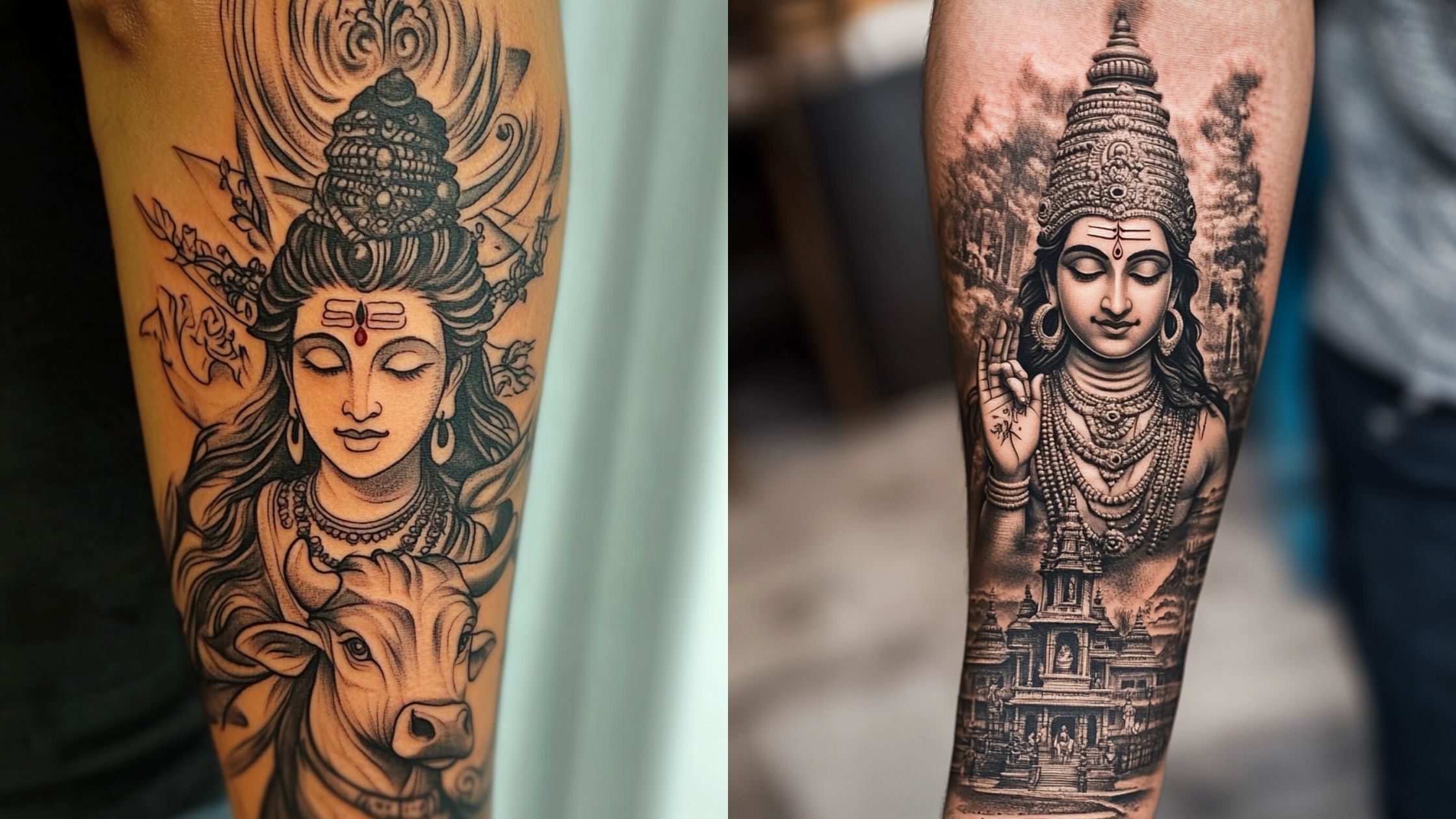
This is the design most people picture first: Shiva’s face in calm meditation, third eye open, crescent moon set into the hair.
It works because it is a portrait with a built-in focal point. The eye goes to the third eye and stays there, which is exactly what you want on a piece that will be seen from two metres away.
When I have watched artists tackle this, the make-or-break detail is the brow. Too heavy and the serene face reads as angry; too light and the whole portrait goes soft. In my experience the ones that hold up allow generous space between the eyes and the hairline, so the shading has somewhere to go.
Best placements are the outer forearm, upper arm and calf — flat-ish areas where the face will not distort when you move.
2. Mahadev Tattoo Designs for Men
Larger canvases open up options that simply do not fit on a wrist: full Nataraja poses, chest pieces, back panels.
The Nataraja — Shiva as lord of the cosmic dance, ringed by fire — is the most ambitious of these. It is also the one I would most strongly steer toward an experienced artist, because the ring of flame and the raised limbs need to stay separated as the ink spreads.
A simpler alternative that reads just as strongly: Shiva with the trishula and damaru, composed vertically down the arm. The trishula gives the piece a spine.
If you are going large, book a consultation before you book the session. Every good artist I know would rather redraw a stencil twice than fix a rushed chest piece afterwards.
3. Mahadev Tattoo Designs for Women
Smaller and softer does not mean less serious. Some of the most considered Shiva work I have seen has been fine line pieces on the inner forearm and shoulder blade.
Two approaches dominate here. The first is a delicate portrait with light grey shading. The second is a symbolic composition — trishula, moon, lotus — with no face at all.
The second ages better. Fine facial detail on a small scale is the first thing to blur, and I have seen plenty of three-year-old fine line portraits that need a full rework.
Placement is worth thinking about honestly: inner forearm and upper back stay easy to cover, ribs and sternum do not, and both hurt more than people expect.
4. Mahakal Shiva Tattoo Design
Mahakal is Shiva as lord of time and death — the form that outlasts everything, including time itself.
These designs lean dark. Heavy black and grey, deep contrast, the tripundra ash lines across the forehead, often a skull motif or a smoky background.
What separates a good Mahakal tattoo from a muddy one is restraint in the darkest areas. When the artist blacks out too much of the background, the face loses its edges within a couple of years.
In my experience, Mahakal pieces want space. The upper back, the outer thigh, or a full upper arm give the contrast room to breathe.
5. Angry Shiva / Rudra Tattoo
Rudra is the fierce aspect — the storm form. These tattoos trade serenity for intensity.
The design hinges almost entirely on the brow and the eye line. Everything else is supporting detail.
Flames behind the head are common and do add movement, but they also add surface area, which means a longer session and a longer heal. If you want the drama without the healing cost, ask for the flames as open line work rather than solid fill.
This one benefits from being large. Compressed fury on a two-inch piece just reads as a scowl.
6. Small Mahadev Tattoos
A plain trishula is the smallest Mahadev tattoo that still reads instantly — on the wrist, behind the ear, on the inner bicep.
Small silhouettes of Shiva seated in meditation work too, as long as the artist keeps them as solid shapes rather than outlines with interior detail.
The honest trade-off with small work: single-needle lines soften over the years, and anything with interior detail under about an inch will close up. If you want small and permanent, go simpler than feels necessary. The minimalist tattoo ideas guide has more on designing for that constraint.
7. Mahadev Symbol Tattoos
Trishula, damaru, Om, crescent moon, serpent, rudraksha beads — these can be combined into a composition with no figure at all.
The rule I would apply: one element dominates, the rest support. A stack of five equally sized symbols has no focal point and the eye slides off it.
Vertical arrangements suit the forearm and the spine. Circular arrangements suit the shoulder and the back of the hand.
These work particularly well in fine line styles, because the shapes are geometric enough to survive some line softening.
8. Mahadev Silhouette Tattoos
If I had to recommend one Mahadev tattoo style for someone who wants it to look identical in twenty years, this is it.
A solid black silhouette of Shiva in meditation — sometimes inside a circle representing the moon or the sun — has no fine detail to lose.
Solid shapes are the most durable thing you can put in skin. Every artist I have asked ranks blackwork silhouettes above realism for long-term legibility, and it is not close.
It also scales. The same design works at three inches on a forearm or twelve inches down a calf.
9. Mahadev and Flower Tattoos
Lotus is the obvious pairing, and for good reason — it carries its own meaning of emergence from murky water.
Datura is the more interesting choice. The flower is traditionally offered to Shiva, so it is a reference rather than decoration.
Practically, florals give the artist somewhere to fade the piece out. A portrait that ends abruptly at the jawline looks unfinished; a portrait that dissolves into petals does not.
Keep the flowers lighter than the figure. When the botanicals are shaded as heavily as the face, the composition fights itself.
10. Mahadev and Temple Tattoos
Temple scenes place Shiva or the lingam inside architecture — steps, pillars, a shrine, sometimes a whole ghat.
These need real space. Anything smaller than a hand span and the architecture collapses into texture.
Straight architectural lines are also unforgiving. They show every wobble, and they distort noticeably on curved placements like the inner bicep. Flat panels — outer thigh, back, ribs — treat them better.
The version I would push people toward is the silhouetted temple against a light sky. It carries the same atmosphere with a fraction of the detail to maintain.
11. Shiva on Mount Kailash
Kailash is Shiva’s abode, and the meditating figure on the snow-covered peak is one of the most peaceful designs in the whole category.
Composition-wise this is a landscape, which means it wants a long placement: the outer arm, the calf, the side of the ribcage.
The snow effect comes from restraint — leaving skin bare where the light hits rather than adding white ink, which tends not to last.
Adding the Ganga descending from the sky ties the mountain and the figure together and gives the piece a natural top edge.
12. Mahadev with Nandi
Nandi — the bull — is Shiva’s vahana and gatekeeper, and in temples he faces the shrine.
If you want this design, ask specifically for Nandi rather than a generic cow. The horns, the hump and the seated posture are what make the reference land.
Nandi kneeling before a lingam is the most compositionally satisfying version I have seen, because it mirrors the actual temple layout.
The horns give the piece a strong silhouette, which means it stays readable from across a room — something surprisingly few detailed tattoos manage.
Other Mahadev Tattoo Variations Worth Considering
A few designs come up less often but are worth knowing about before you commit.
Neelkanth — the Blue Throat
Shiva swallowed the poison churned from the ocean and held it in his throat, which turned blue. It is a design about absorbing harm so others do not have to.
The only Mahadev tattoo where a spot of colour is genuinely justified, though blue over black-and-grey needs an artist comfortable with both.
Ardhanarishvara
The half-Shiva, half-Parvati form, split vertically down the centre. It is a demanding design because the two halves must feel like one figure.
Best on the spine or the centre of the back, where the body’s own symmetry supports it.
Rudraksha Band
A simple band of rudraksha beads around the wrist, forearm or bicep. Quiet, wearable, and easy to extend later.
This is the design I most often suggest to people who want something Shiva-related but are not ready for a portrait.
Trishula with Om
A trishula with an Om worked into the shaft is compact, symmetrical and reads clearly at small sizes.
If you like the geometry of that approach, the unalome tattoo family works on a similar principle of a single meaningful line.
Placement, Pain and Aftercare
Mahadev tattoos tend to be detailed, which means longer sessions than people plan for. A full black-and-grey portrait is usually multiple sittings, not one heroic day.
Pain varies enormously by placement. Ribs, sternum and inner bicep are consistently reported as harder than outer arm or thigh — the tattoo pain chart is a reasonable starting point, though your own experience may differ.
Aftercare is where good tattoos are lost. Keep it clean, keep it out of the sun, do not pick, and follow whatever protocol your artist gives you over anything you read online, including this. There is more detail in the tattoo aftercare guide.
On risk, be realistic rather than anxious. Mayo Clinic lists allergic reactions, skin infections, granulomas, keloids, bloodborne infection from unsterile equipment, and MRI complications as the recognised risks. If a tattoo shows spreading redness, heat, pus or fever, that is a doctor’s visit, not a forum question. Nothing here is medical advice, and no tattoo should ever be done at home.
Common Mistakes — and What To Do If You Are Still Not Sure
The most common mistake is cramming. People arrive with a reference of a full Nataraja and ask for it at four inches, and the artist either says no or delivers something that will not last.
The second is choosing an artist by price rather than portfolio. Shiva portraits are technically demanding; ask specifically to see healed black-and-grey work, not fresh photos. Fresh tattoos all look good.
The third is treating the symbolism casually. Shiva’s imagery carries specific meanings, and getting the attributes wrong — a cow instead of Nandi, a random trident instead of a trishula — is noticeable to anyone who knows.
Still undecided? Sit with it. If you want to compare the same devotional instinct in other forms, the praying hands tattoo designs are worth a look, and if you are weighing a large piece, what a sleeve actually costs will help you plan realistically.
Frequently Asked Questions
Is it disrespectful to get a Mahadev tattoo?
Views differ within Hindu communities, and there is no single ruling. Many practitioners see a Mahadev tattoo as devotion made permanent; others feel sacred imagery should not sit on the body at all, or should not go below the waist. If it matters to you, the honest step is to ask someone within your own tradition rather than a tattoo blog. In my experience, people who have that conversation first end up more settled about the tattoo afterwards.
Which Mahadev tattoo design lasts the longest?
Solid blackwork silhouettes, by a clear margin. They have no fine interior detail to blur and no delicate shading gradients to flatten. Fine line portraits are the opposite end — beautiful fresh, but usually the first to need touch-up work. Every artist I have asked has ranked them in roughly that order.
Where is the best placement for a Mahadev tattoo?
It depends on the design. Portraits and Mahakal faces want flat, generous areas: outer forearm, upper arm, calf, upper back. Landscape designs like Kailash want long placements. Small symbol work suits the wrist, inner bicep or behind the ear. Avoid heavily curved or high-friction spots such as the inner wrist crease and the side of the hand for detailed pieces, since they tend to lose definition faster.
How long does a Mahadev tattoo take?
A small trishula or silhouette can be under an hour. A detailed black-and-grey Shiva portrait on the forearm is usually several hours, often split across sittings. Full back or chest pieces run to multiple sessions spaced weeks apart. Your artist’s estimate is the one to trust, because it accounts for their own line speed and your skin.
Can a Mahadev tattoo be done in colour?
Yes, though most of the strong work in this category is black and grey. The exception people most often make is the Neelkanth blue throat, where colour carries actual meaning. If you do want colour, ask to see healed colour work from that specific artist, and be aware that some pigments — red in particular — are more associated with allergic skin reactions than others.
Quick Summary
- Build a Mahadev tattoo around one clear focal point — the third eye, the trishula, or the silhouette — rather than every symbol at once.
- Blackwork silhouettes are the most durable option; fine line portraits are the least.
- Portraits and Mahakal designs need flat, generous placements: outer arm, calf, upper back.
- Know your attributes — third eye, crescent moon, Ganga, serpent, trishula, damaru — so you can tell the artist what to prioritise.
- Temple and Kailash scenes require real size; small versions collapse into texture.
- Ask specifically for Nandi rather than a generic bull or cow if you want that pairing to read correctly.
- Judge an artist on healed black-and-grey work, not on fresh photographs.
- Follow your artist’s aftercare instructions, and see a doctor — not a forum — for spreading redness, pus or fever.