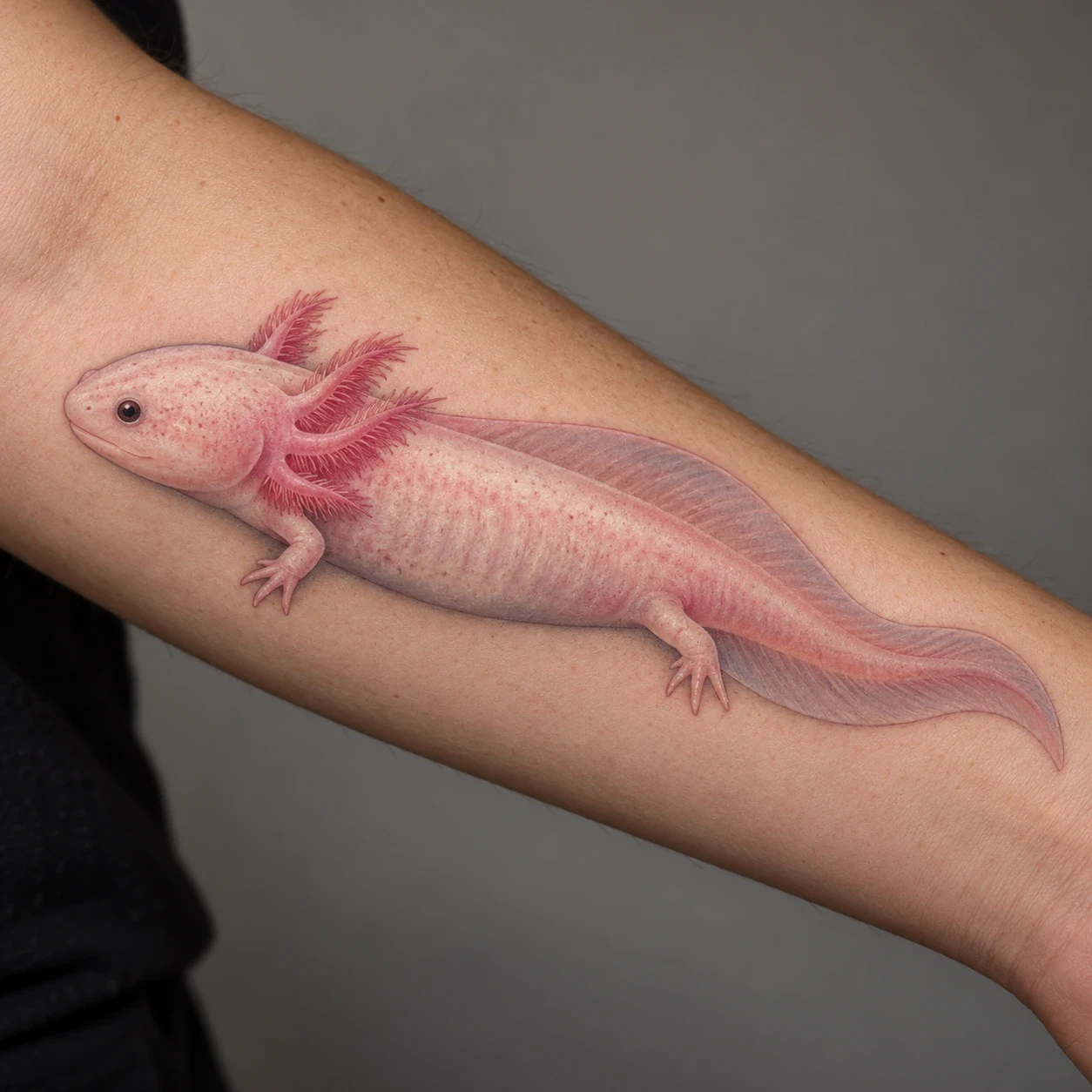
Axolotl tattoo ideas can be playful, softly shaded or sharply graphic. Their broad heads, frilly gills and long tails give an artist several recognizable shapes to work with. These 16 original concepts compare animal-only drawings, botanical scenes, fantasy colors and frames so you can decide what you want the tattoo to emphasize.
Start with the silhouette and pose before choosing accessories. A long swimmer, a compact curl and a character peeking from a cup ask for different proportions. Choose two or three references and explain which features you like, rather than asking an artist to combine every detail in the collection.
About the images: All 16 design images and the separate forearm hero are AI-generated concepts. They are not photographs of real or healed client work, ready-made stencils or wildlife photographs. Fantasy scenes and colors are artistic choices. Your artist should independently redraw the anatomy, linework and placement for your body.
Keep the recognizable features in the brief
The San Diego Zoo's axolotl profile identifies the animal as a salamander that keeps juvenile characteristics into adulthood, including external gills and a finned tail. It remains aquatic. Those gills and the broad head are useful reference features to preserve even when the tattoo is heavily stylized. The zoo also describes natural dark coloring and lighter color variations, so pink is an option, not the only way to depict the animal.
Choose whether you want a recognizable animal, an imaginative character or a more detailed natural-history treatment. Blue palettes, star patterns, mushrooms and teacups below are fantasy choices. A cute expression does not make an image an anatomical reference, and a detailed drawing still needs an artist's review.
| Your preference | Concepts to compare | Main question for the artist |
|---|---|---|
| The animal itself | Pink, black-and-grey or bold outline | Which pose keeps the silhouette clearest? |
| A softer color treatment | Watercolor or botanical frame | What structure remains beneath the color? |
| A fantasy character | Blue, stars or teacup | Which invented details matter most? |
| A defined outer shape | Droplet or diamond | How much room does the animal need inside? |
1. A softly shaded pink axolotl
Start with the animal as the whole subject. The pale body, darker gills and gently curved tail create enough contrast without a frame or background. This is a useful reference if the broad head and frilly silhouette are what first attracted you to axolotls, rather than a particular fantasy theme.
Ask your artist how the pale body will be described on your skin: outline, soft shading and open areas may matter more than copying the paper color. Keep the gills separate from the front legs in the redraw, and decide whether the expression should be playful or closer to a natural animal.
2. Black and grey with a longer silhouette
A horizontal pose gives the tail more room and changes the emphasis from a cute face to the shape of the whole animal. Stippled shading distinguishes the body from the fin and gills without using pink. Compare this direction if your existing tattoos are monochrome or you prefer a natural-history drawing to a colorful character.
The long outline may suit a different placement from a compact front-facing pose. Ask your artist to identify the head, body and tail first, then decide how much texture the chosen size can support. Dense dots should contribute to the form rather than filling every open area simply because the reference contains shading.
3. A bold outline with warm accents
This version uses heavier contours and larger blocks of color. The curved body makes it more compact than the long black-and-grey drawing, while the pink gills and warm body accents keep the head easy to find. It is a modern, traditional-inspired treatment rather than a claim that this axolotl is a historical flash design.
Discuss the balance of black linework and color before adding other objects. The gills, limbs and tail still need clear separation inside a bold style. If you already wear strong outlined tattoos, show the artist those pieces so they can discuss a compatible drawing rather than treating this single concept in isolation.
4. Watercolor around a clear animal outline
Loose pink and lavender washes change the atmosphere without replacing the animal's structure. A clear outline carries the head, legs and tail, while the color adds a softer edge around them. This is worth comparing if you like a painted effect but still want the axolotl to remain recognizable before someone notices the splashes.
Ask which lines and dark areas will organize the actual tattoo, and which washes are optional decoration. A generated paint texture is not a prediction of ink on skin. Our watercolor tattoo ideas can help you compare that broader style, but the artist should develop the final palette and structure for this particular animal.
5. A blue fantasy axolotl
Blue and lavender make this a deliberately imagined color scheme. The broad head, external gills and finned tail still identify the subject, so the fantasy palette does not need extra accessories to explain itself. This is a useful starting point for someone who likes the animal's form but wants a color story of their own.
Tell your artist that the blue is an artistic choice rather than a request for a natural-history illustration. Ask how they would separate the body, gills and fin using both color and value. If all three sit close together tonally, the outline will need to do more of the work.
6. An open botanical frame
Two plant sprigs make a loose oval around the axolotl without turning the entire image into an underwater landscape. Their curved stems echo the tail, and the open gaps leave the animal as the focal point. The frame can be adjusted independently of the creature, which gives your artist room to shape the whole piece for a placement.
Ask for clear separation between leaves, gills and toes. Those smaller forms can become visually confusing when they overlap. You can also choose one plant sprig instead of two if the available area is narrow; preserving the animal's outline is more useful than forcing a complete wreath into every version.
7. A water lily above the swimmer
A flower and lily pad add a second layer to the scene, with the axolotl below them. The white blossom provides a different shape from the feathery gills, while the green pad gives the upper part a broad outline. Treat this as a stylized aquatic composition, not a documentary picture of a particular wild location.
Decide whether the flower or the axolotl should be larger. If the animal is the reason for the tattoo, give its head and gills enough room to remain clear. Ask the artist to separate the underwater figure from the surface elements rather than letting the pad appear to grow from the animal's body.
8. A crescent moon over a curved tail
The moon provides a simple celestial accent above an otherwise open design. The curved axolotl can lead the eye back toward it without the two shapes touching. This option changes the setting while keeping the number of elements low, which is useful if you like a dreamy theme but do not want a full night sky.
Choose whether the moon is part of a personal story or simply a shape you enjoy. The pairing has no fixed meaning imposed by this article. Ask your artist to check the gap between the crescent and the gills, and avoid adding so many tiny stars that the animal stops being the main subject.
9. A dark, star-speckled character
A navy body and lavender gills turn the axolotl into an openly fantastical character. Pale speckles within the body and a few separate stars connect the color scheme to the surrounding space. This is a different brief from a natural dark animal: the star pattern is decorative, not a biological feature.
Ask how the pale marks will be expressed in the tattoo and how much of the body should stay dark. The stars need room around them to read as separate shapes. If you prefer a quieter version, reduce the surrounding stars before shrinking the animal or compressing its gills.
10. A small heart beside the curl
A separate heart makes the design feel affectionate without replacing any part of the animal. The open curve of the axolotl gives the heart somewhere to sit, while keeping a clear distinction between the tail and the added symbol. It can mark a personal attachment, but it does not have to stand for a particular relationship.
Check that the heart remains its own shape. Turning the tail into a heart can be another valid brief, but it requires a different redraw and should not happen accidentally. Decide whether you want a colored heart, an outline or no accent at all before adding initials or dates.
11. A storybook scene with mushrooms
The mushrooms make this an intentional storybook fantasy. Their caps frame the broad head, and the differing heights create a small scene rather than a plain animal portrait. Axolotls are aquatic salamanders; a dry woodland mushroom setting should be understood as imagination, not an illustration of how they naturally live.
Ask your artist to make the stems and the animal's legs distinct. Too many small forms meeting along one baseline can obscure the creature. If the scene needs to become smaller, one mushroom and one clearly drawn axolotl may be a better new composition than squeezing all the original parts together.
12. An axolotl inside a water droplet
The droplet supplies a single enclosing outline with a pointed top and rounded base. A pale blue wash suggests water while leaving the pink animal easy to distinguish. Compared with a diamond frame, this shape feels softer and gives the tail a curved boundary to follow.
The full animal should have space inside the border. Ask the artist to check that the gills and tail do not accidentally merge with the droplet edge. A frame can help organize a design, but it should not dictate a size so small that the animal loses the details that make it recognizable.
13. Two axolotls in one paired design
A pink and a charcoal axolotl create a paired composition without making the bodies overlap. Their different tones help you follow each head and tail. This counts as one design in the collection: the relationship between the two animals is the idea, rather than two unrelated pictures placed side by side.
If this is a matching-tattoo reference, review how each animal would work alone as well as together. For one larger tattoo, leave a clear gap between the figures. Ask the artist to check each animal independently so that a limb or tail is not mistakenly borrowed from its neighbor in the redraw.
14. A tall diamond frame
A geometric border gives the soft-bodied animal a sharper outer shape. The axolotl curves within it, while the long axis of the diamond offers a different starting point for a vertical placement. The contrast comes from the frame and creature together, so there is no need to fill every corner with another motif.
Check all four corners on the intended area before settling on the proportions. A diamond drawn flat may need adjustment around the curve of a limb. Keep the animal separate from the border unless you specifically want it to cross the frame; that should be a deliberate design choice.
15. A pixel-art axolotl
Square edges and a limited palette turn the animal into a game-sprite-inspired character. The challenge is to preserve the broad head, gills and tail with fewer shapes, rather than reproducing the shading of a smooth illustration. Choose this if the pixel treatment itself is part of what you want to wear.
Ask your artist whether their portfolio includes crisp block-based designs, and review the proposed grid at the actual tattoo size. Tiny isolated pixels can be a different practical brief from larger connected blocks. This concept is an original character reference, not an image from a named game or franchise.
16. A character peeking from a teacup
The teacup hides most of the body and makes the face and gills the focus. Two front feet resting on the rim explain the pose without needing to show the rear legs or tail. It is a whimsical character illustration; it is not a suggestion for housing or handling a real axolotl.
Check how the feet meet the rim and where the handle connects to the cup. Those contact points make the drawing feel coherent. You can change the small cup decoration with your artist, but keep it simple enough that it does not compete with the animal's eyes or frilly head outline.
Choose placement around the pose
A long swimming pose and a wide front-facing character should not be forced into identical proportions. Bring your preferred outline to an artist and ask how it would sit on the actual area. A vertical frame might suit one part of a limb, while a horizontal animal may need a different position or a new drawing.
Ask to see the proposed stencil with your body relaxed and the nearby joint moving. The gills, tail and any frame should remain part of a coherent composition from the angles that matter to you. If the design wraps around a limb, check the less visible side as well as the front view.
There is no universal minimum size that preserves every detail in these images. Ask which gill branches, toes, dots or plant leaves your artist would simplify. For another animal with a very different silhouette, compare our frog tattoo ideas. For a broader treatment comparison, our tattoo style guide can help you describe the linework you prefer.
Anatomy and composition checks before tattooing
- One coherent animal: Follow the body from head to tail. Watch for duplicate tails, disconnected legs or features borrowed from a neighboring figure.
- Clear gills: The frilly structures should read separately from ears, horns, plants and front feet.
- Leg positions: Check that each visible limb has a sensible connection to the body. Hidden legs need not be drawn through a cup or another object.
- Frame spacing: Leave a deliberate gap around the gills and tail unless crossing the border is part of the design.
- Actual color choices: Paper white and watercolor textures do not translate automatically to ink. Discuss open skin, shading and healed examples with the artist.
For a painted treatment, compare the broader approaches in our watercolor tattoo ideas. Ask what keeps the animal readable before deciding how much loose color or background texture to add.
Plan for skin care
Ask your artist for written aftercare instructions and a doctor or pharmacist about individual health concerns. The American Academy of Dermatology notes that UV light can fade some tattoo inks. Its sun-protection advice includes broad-spectrum, water-resistant SPF 30 or higher, applied 15 minutes before going outdoors and reapplied at least every two hours. Ask when sunscreen is appropriate for a new tattoo; this is not a fresh-tattoo wound-care routine. A skin reaction or change in tattooed skin should be discussed with a dermatologist.
Axolotl tattoo questions
Does an axolotl tattoo have a fixed meaning?
No meaning is imposed by this collection. You might choose it because you like the animal, a particular character style or a personal association. Explain that association to the artist rather than assuming everyone will read the same story from the image.
Does the tattoo have to be pink?
No. Pink is one treatment here, alongside black and grey and deliberately fantastical colors. If you want a natural-history reference, use a reliable animal source and tell the artist which appearance you want. A blue or star-speckled version is an artistic invention.
Can an axolotl tattoo be small?
A simplified version may suit a smaller area, but ask the artist which details they would remove at the actual size. Keeping the head, gills and tail clear is a better starting brief than insisting that every branch and toe from a large image survives unchanged in miniature.
Are the mushroom and teacup scenes realistic?
No. They are character illustrations. Axolotls are aquatic animals; these props are fantasy settings, not instructions for real animal care. Keep that distinction clear if you want to turn one of the concepts into a tattoo.
Can two axolotls become a matching tattoo?
Yes. Decide whether each person wants a complete animal or whether both figures belong in one tattoo. Review each drawing on its own body and check the pose independently. Related tattoos can share a palette or curve without needing to be exact duplicates.
Sources checked October 24, 2026: San Diego Zoo, Axolotl; American Academy of Dermatology, Caring for tattooed skin. Design and placement comparisons are editorial suggestions for a tattoo-artist consultation.