The strongest gaming tattoo ideas usually begin with a specific memory: the controller you shared with a friend, a world you kept returning to, or the small object that made an adventure feel like yours. These 16 designs explore those connections through retro hardware, fantasy objects and pixel-inspired scenery.
All 17 images are AI-generated concepts: 16 distinct design images and a separate forearm placement mockup. They are not photographs of real tattoos or healed client work. Bring a favorite concept to an artist as a starting point for an original drawing adapted to your placement.
Choose a memory before choosing an icon
Pick one part of gaming that you would still care about without the title or logo beside it. It might be a handheld from childhood, a late-night cooperative session, a love of exploration, or the satisfaction of finding a hidden route. A clear personal connection makes it easier to choose between a controller, a landscape and a fantasy object.
Videogames offer more visual material than characters alone. The V&A’s Design/Play/Disrupt exhibition explored game design through work including concept art and prototypes. That wider view is useful for tattoo planning: look at objects, environments, shapes and color choices as well as familiar faces. Source checked October 28, 2026.
The examples below use original, unbranded designs. If you want a reference to a particular game, show your artist exactly what matters about it instead of assuming that a generic sword, heart or portal identifies one title.
1. A controller with a clear silhouette
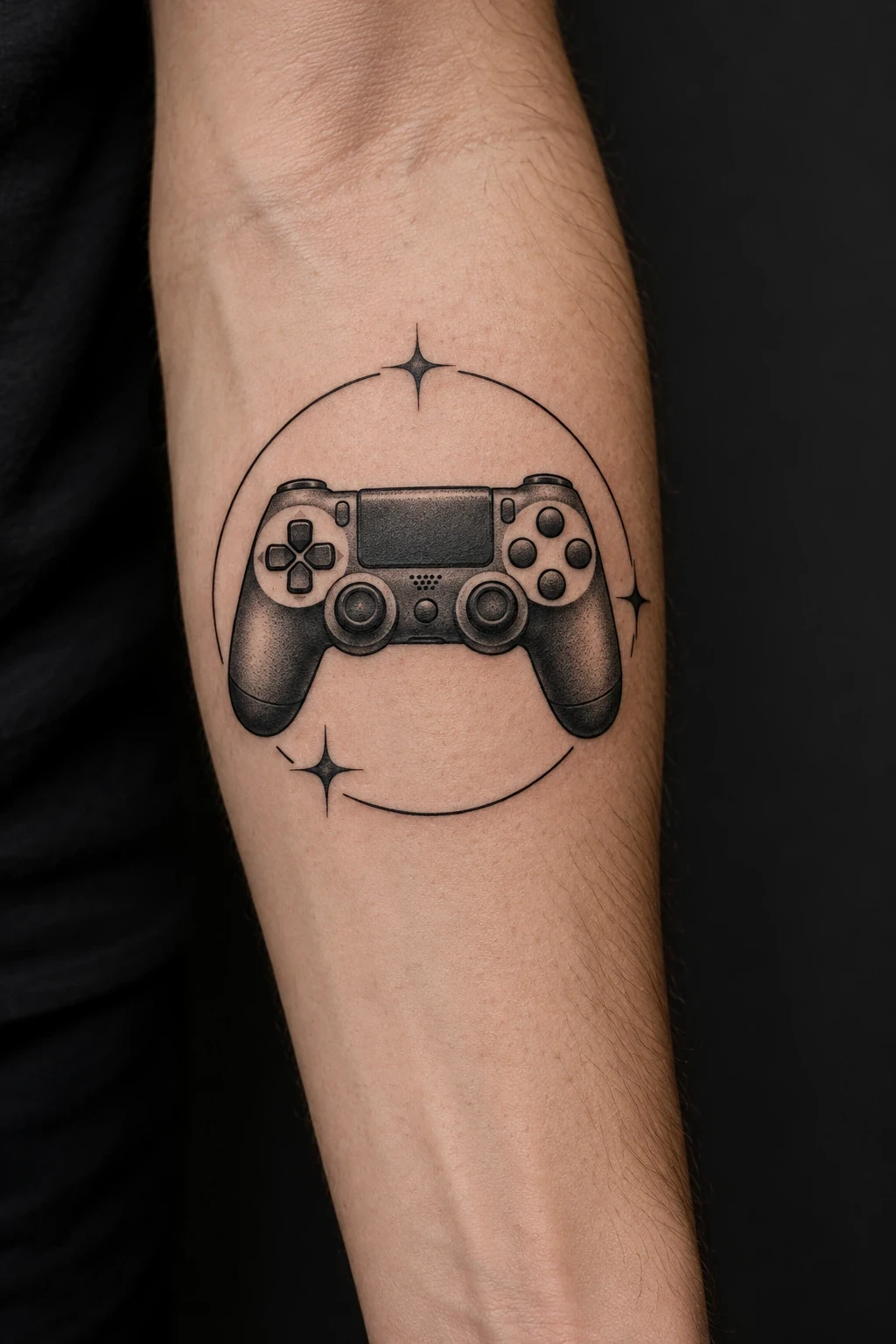
A two-handled controller makes gaming the main subject immediately. This black-and-grey design gives the handles a solid shape and keeps the directional cross, thumbsticks and face buttons visible. The blank space around it leaves the object readable without a banner or a collection of extra icons.
Choose whether you want the hardware remembered accurately or interpreted loosely. If the button layout is personal to you, bring photographs of the specific controller. Ask the artist to compare a simpler silhouette with the detailed version at your proposed size; the reference image alone cannot establish the right amount of detail.
2. A handheld with a miniature world
The handheld device turns a piece of hardware into a frame for a small mountain-and-sun scene. Muted teal gives the outer shell a little color while the screen remains the focal point. It suits someone whose connection is to portable play, journeys or quiet time with a favorite game.
The screen can carry a personal reference, but it does not need to reproduce an entire screenshot. Choose one horizon, landmark or simple shape. Keep enough separation between that screen image and the physical buttons so the device does not become a dense stack of unrelated marks.
3. An arcade cabinet in three-quarter view
An upright arcade cabinet brings a different scale and shape to a gaming tattoo. The angled side panel and control deck make the object feel dimensional, while the star screen avoids adding tiny characters. Red trim picks out the cabinet edge without coloring every surface.
Think about the cabinet as a tall shape before deciding on its screen art. A narrow placement may favor a front view; a broader area may give the side panel room. If you remember a specific arcade, a small color choice or cabinet shape can carry that association without adding a full room around it.
4. A fantasy sword inside an open circle
A short sword framed by an incomplete circle gives the design a clear center and a clean outside boundary. The blade points down, with a small sparkle near the tip. It can suggest adventure or a favorite character role, but that interpretation is personal rather than a fixed meaning.
Have the artist check the relationship between the guard, grip and blade at the actual size. The circle should support the sword rather than run awkwardly through its most important details. This is also a useful direction to compare with the more decorative approaches in our minimalist tattoo ideas.
5. A single red pixel heart
A stepped outline turns a familiar heart shape into a pixel-inspired design. The red center and small white highlights keep the visual language simple. This is a compact starting point for someone who wants a gaming connection without a device, a character portrait or a large scene.
Decide how literal you want the square steps to be. Show the artist the heart at the size you are considering and ask them to review the corners and highlight shapes. If you add more hearts later, plan their spacing as a group rather than squeezing extra symbols into the remaining gap.
6. A violet potion bottle
The potion bottle uses a rounded glass shape, a cork and violet liquid to suggest a fantasy inventory item. Two small sparkles provide movement without requiring a large surrounding scene. Glass highlights and the curved liquid line are the details to compare when choosing a simpler or more shaded treatment.
You could personalize the liquid color around a memory or a favorite role, but explain the association in your brief. A colored bottle does not identify a particular game by itself. Keep the stopper, neck and main belly distinct, and ask the artist which highlights are worth preserving at the chosen scale.
7. A red-ball joystick
The tabletop joystick focuses on the physical action of play: one stick, a broad base and two buttons. Its red ball top becomes the strongest color accent. Bold outlines make this feel different from the fine-line handheld even though both designs begin with gaming hardware.
Use the perspective deliberately. A slightly angled base shows the controls clearly, while a flatter view can make the silhouette more compact. If you want an exact vintage device, bring its reference photographs; this concept is an original generic joystick rather than a documented model.
8. A castle on a floating island
Three towers and a small arched gateway sit on a floating rock platform. The detached island gives this castle a fantasy setting without adding a whole landscape. It offers a destination to imagine: a place to explore, return to or finally reach after a difficult part of a game.
Keep the architectural hierarchy simple. The towers, gateway and island should each have a clear role rather than competing with dozens of windows. If you prefer nature to architecture, compare the shape with the open scenery in our river tattoo ideas before settling on a framed miniature world.
9. A blue portal in a stone ring
The blue swirl draws the eye into an oval ring of stone segments. Dark edges give the portal a firm outline, while the color stays concentrated in the opening. This design can be a personal reference to discovery, travel between worlds or a particular shared adventure.
Check the oval as one continuous structure before adding more effects. The stones need enough definition to read as a frame, but the opening should remain the focal point. You can ask for a quieter swirl or a darker ring depending on how it will sit beside existing tattoos.
10. An original space-exploration craft
A small winged spacecraft points diagonally upward with a short orange exhaust trail. It offers a gaming design for someone drawn to exploration rather than fantasy equipment. The limited palette makes the flame an accent, while the cockpit and wings define the craft itself.
Choose the direction with the body area in mind. An upward diagonal can be compared against the relaxed position of an arm or leg, rather than copied from a flat page. If a particular ship matters to you, provide accurate references and say which features are essential; this is an invented craft.
11. An adventure map with one route
A curled parchment map carries a dotted route between a mountain and a star. It suggests the pleasure of exploring and finding something without relying on a title screen. Sepia shading keeps the paper distinct from the darker route marks and gives the small scene a warm tone.
Limit the map to a few landmarks. Tiny place names and a complicated route would change the balance of this design substantially. You could choose a meaningful starting point and destination, then let the artist decide how the paper folds and route can remain clear together.
12. A teal crystal on a rock cluster
The crystal concept puts one tall faceted shape above a smaller rock base. Teal is concentrated in the main crystal, and a small sparkle provides a light counterpoint. It can reference collecting, crafting or a favorite imaginary environment without imitating a specific inventory icon.
The main design decision is the facet pattern. Ask the artist to keep a clear direction to the light and a limited number of internal divisions. If the crystal will sit near other work, compare its long vertical shape and strong color with the neighboring pieces before fixing its angle.
13. A quiet campsite as a save-point concept
A planted sword, stone ring and small fire create a compact fantasy campsite. The scene is an original save-point-inspired idea, not an illustration of a documented mechanic from one title. The warm flame is the color focal point, with the upright sword giving the composition height.
Keep the emotional reference specific in your brief: a pause, a safe place, a shared rest or a completed stage. Those are possible personal readings, not universal meanings. Have the artist compare the sword and fire as separate readable shapes before adding smoke, scenery or more equipment.
14. A gaming headset with a microphone
A headset can represent the social part of gaming as much as the games themselves. This black-and-grey concept focuses on the curved headband, cushioned earcups and one short microphone boom. It suits a memory of regular sessions with friends without needing portraits or a list of names.
Check the attachment points carefully in the final drawing. The microphone should clearly belong to one earcup, and the headband should join both sides coherently. If you want to honor a group, a shared color or a separately planned small motif may work better than filling the earcups with tiny text.
15. An open treasure chest
The treasure chest gives the design a simple reveal: an open lid and a visible pile of gold coins. Wood panels and metal bands establish the structure, while brown and gold keep the color concentrated around the object. It is a playful choice for someone who enjoys discovery or collecting.
An open chest needs room for both the lid and the contents. Compare a more frontal drawing with this angled view if the proposed placement is narrow. Ask the artist to simplify the coins and wood grain together so the main opening remains clearer than the surface texture.
16. A pixel-inspired mountain landscape
Stepped peaks, pine trees and a square sun turn a landscape into a gaming reference through shape rather than hardware. The small gold sun gives the monochrome scenery one point of color. It is a useful option if you want the connection to gaming to be quieter.
Choose how much of the frame you want to keep. A partial border can give the scene an edge without enclosing every tree and mountain. For a collection of smaller gaming pieces, our patchwork tattoo layout ideas can help you think about the space between this landscape and future designs.
Match the design to the available space
Bring a photograph of the body area and any existing work to your consultation. A controller is broad, an arcade cabinet is tall, and a map has a different footprint again. The motif you like most may need a different view or a simpler outline to suit the space.
- For a broad object: compare the controller or headset at the proposed size before adding an outer frame.
- For a vertical idea: look at the sword, crystal or cabinet, and check its direction with the body relaxed.
- For a small starting piece: compare the heart or a simplified potion rather than shrinking a whole scene.
- For several references: plan a collection with gaps instead of forcing every item into one crowded image.
Check the details that make it yours
Write a short list of details that must be accurate: controller layout, a device’s shape, the outline of a particular object, or a scene’s defining landmark. Separate those essentials from optional effects such as sparkles, frames and background shading. Give your artist clear reference images for any exact game or hardware reference.
For pixel-inspired work, compare the stepped edges and corners carefully in the artist’s final drawing. For hardware, check symmetry and the way handles, sticks or earcups attach. For fantasy objects, check the blade, bottle neck, hinges or crystal facets before considering extra decoration.
Prepare a useful artist brief
A helpful brief names the memory, the main motif, the intended placement and the details you want to preserve. For example: “A handheld device that reminds me of travel with my brother, with a simple mountain scene on the screen; keep the device readable and use one teal accent.” Leave the final drawing and scale open to the artist’s judgment.
These concepts do not establish an appropriate line weight, session plan or level of detail for your skin. Ask your artist to review the actual drawing and provide aftercare instructions. Keep the generated image as a discussion reference, and photograph the approved drawing separately if you want a record of the final design decisions.
Gaming tattoo questions
Does a gaming tattoo need a character or logo?
No. Hardware, objects, landscapes and a personal reference to a shared session can all carry a connection. Choose the element that matters to you rather than adding a recognizable face solely to explain the subject.
Can I combine several games in one tattoo?
Yes, but decide what unites the references. A consistent palette or illustration treatment can help. Ask the artist to show a version with fewer elements so you can compare the main shapes before committing to a crowded composition.
What is a useful first gaming tattoo idea?
Start with one motif you like independently: a heart, a controller, a potion or a small landscape. Bring two or three references and ask how the subject could fit your intended placement.
Are these images exact designs from existing games?
No. They are original AI-generated gaming concepts, including invented hardware and fantasy objects. If an exact reference matters, show it to your artist and review the final drawing for that specific detail.