Lightning storm tattoo ideas can be sharp and graphic, soft and atmospheric, or built around a place that matters to you. The useful starting choice is the composition: one small cloud, a branching channel against dark shading, or a landscape with room for the weather. These 16 concepts compare those directions without treating every storm as the same symbol.
All 17 images are AI-generated: 16 distinct storm design concepts plus a separate forearm placement mockup. They are not photographs of real tattoos or healed client work. Use them as references for an artist’s original drawing adapted to your body and existing tattoos.
Decide what the storm is doing in the design
A storm can be the whole subject, the background to a landscape or one small part of a larger story. Choose which role matters before adding extra scenery. A lone cloud needs a clear outline; a mountain scene needs enough open sky for the lightning to remain separate from the ridges.
For natural-looking references, the National Weather Service distinguishes lightning within clouds from cloud-to-ground flashes. A tattoo does not need to diagram those processes, but choosing a reference can help you decide between a glow in the cloud, a branching channel and a deliberately simplified zigzag symbol. Source checked October 28, 2026.
You might associate the design with energy, uncertainty, change, a memorable landscape or simply weather you find visually striking. Those are possible personal readings, not a universal meaning. Tell the artist what you want the image to express, and what you want it to look like independently of that explanation.
1. A small cloud with one branching channel
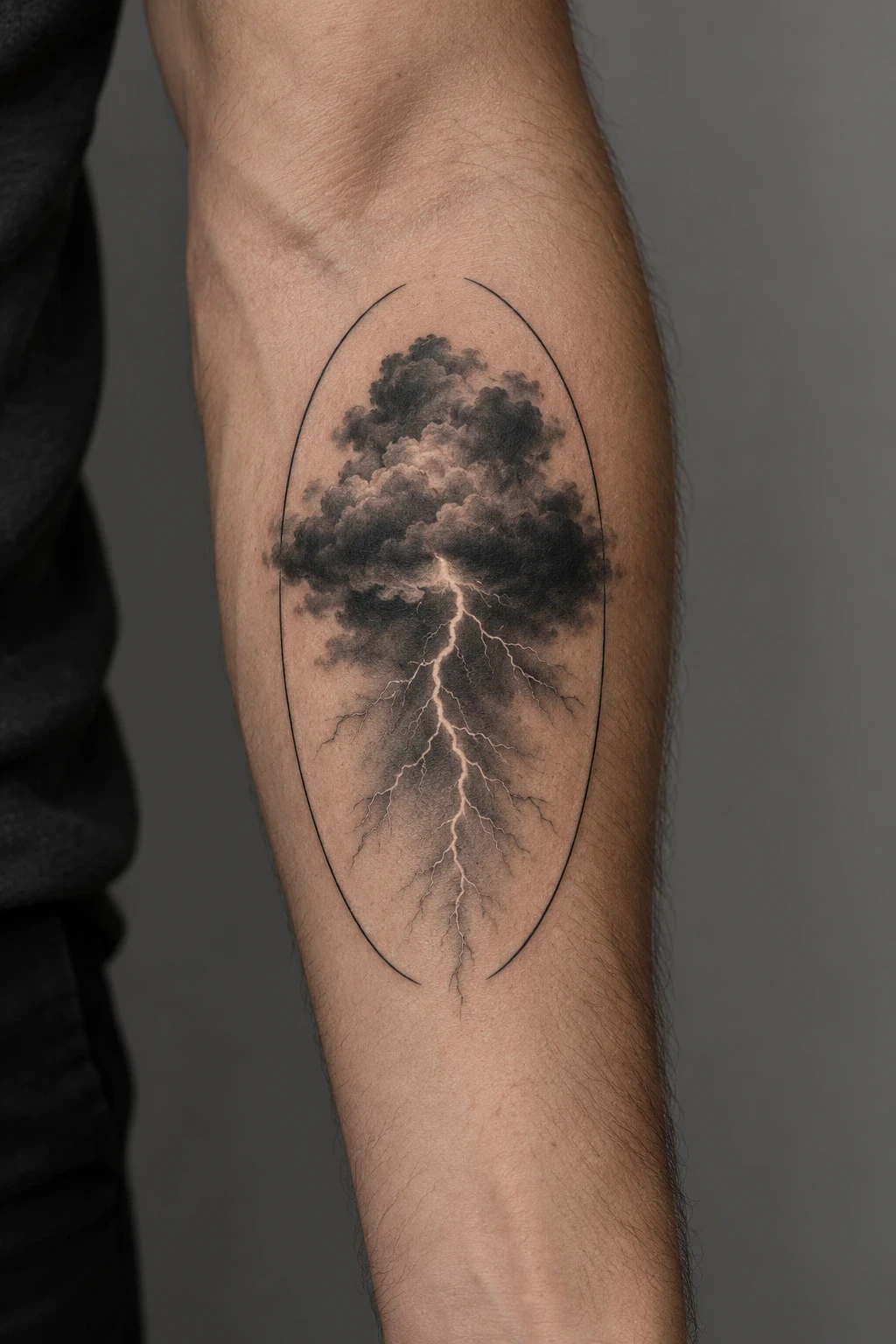
A compact shaded cloud gives the lightning a clear starting point. This design keeps the surrounding space open and uses a branching channel rather than a solid graphic bolt. The contrast comes from the dark cloud and the thin line below it, without rain or a separate landscape competing for attention.
Start by comparing the cloud’s width with the length of the channel. Ask the artist to show the concept at your proposed size and review the small branches together. If you want a quieter outline, our minimalist tattoo ideas offer useful comparisons in how much detail to leave out.
2. Lightning above a mountain ridge
The mountain scene creates a strong lower edge for the storm. Jagged peaks and branching lightning use related angular shapes, while the dark sky separates the pale channel from the landscape. It suits a memory of a particular place as easily as an imagined outdoor scene.
Choose which peak shape matters before adding more texture. A specific mountain needs accurate reference photographs; this generated ridge is invented. Keep a clear stretch of sky between the cloud, channel and peaks so the design does not depend on every small line being visible at once.
3. A storm over a curling wave
A circular frame holds the wave, cloud and lightning together as one small weather scene. Slate-blue accents give the water a different role from the dark cloud. The curling wave provides movement at the base, balancing the thinner lightning channel above it.
Decide whether the wave or sky should be the main subject. If both are equally dense, the circular design can feel crowded. Compare the water treatment with our Japanese wave tattoo ideas, while asking the artist to develop an original composition rather than treating all wave styles as interchangeable.
4. A lone pine beside an open storm sky
The tall pine gives this scene a vertical anchor. The lightning sits in the open sky beside the tree, leaving each silhouette distinct. A small ridge is enough to establish the setting without adding a full forest or a busy lower border.
The gap between tree and lightning is the important part to preserve. Show the artist which silhouette should remain strongest and whether the landscape refers to a real place. The concept depicts an intact tree and a distant storm, not a record of a particular strike or event.
5. A desert storm in an arched frame
Cacti, low mesas and an arched boundary make the desert scene different from a mountain storm. A muted ochre accent warms the lower area while the cloud and lightning keep the sky dramatic. The tall frame gives the artist a clear outside shape to adapt.
Keep the cactus shapes deliberate rather than scattering many small plants across the ground. If the location matters, bring references for its actual vegetation and landforms. This is an imagined desert composition, so it should not be presented as a geographically exact scene.
6. A lighthouse with distant lightning
The lighthouse provides a built structure against the loose shapes of a storm. Its lantern beam and the lightning have separate directions and roles. The rocky shore gives the tower a believable base, while the sky leaves room for a thin branching channel.
Ask the artist to compare the beam and lightning in the final drawing so neither looks accidentally attached to the other. You might read the lighthouse as guidance or a familiar coast, but explain that personal association rather than assuming the image carries one fixed message.
7. A bold cloud with rain and a gold bolt
This concept deliberately uses a graphic lightning symbol. A broad dark cloud, diagonal rain marks and a muted gold zigzag create a bolder, more illustrative treatment than the natural-looking channels elsewhere in the article. The small palette keeps the design focused.
Choose whether you prefer the strong icon-like outline or a softer cloud. The gold here is an illustrated color choice, not a promise of metallic tattoo ink. Ask your artist how they would translate the palette and rain marks into a drawing for the actual placement.
8. A crescent moon beside the storm
A narrow crescent sits in open space beside a rolling dark cloud. The lightning extends below the cloud, leaving the moon as a separate shape. It creates a night-sky concept without adding a full field of stars or a heavy enclosing border.
Look at the crescent and cloud together at the proposed size. If they overlap too much, the moon can stop reading as an independent shape. Decide whether the moon is a personal reference or simply part of the composition before adding further celestial details.
9. A red rose beneath a storm cloud
A red bloom adds a second subject with a very different texture from the cloud and lightning. Bold contours hold the rose together, while the channel passes beside it. The limited red, green and black palette makes the flower the strongest color accent.
Keep the path of the lightning separate from the petal edges so the shapes remain intentional. The pairing can carry a private association or simply combine two subjects you like. It does not establish a universal story of hardship, recovery or transformation.
10. A storm seen through a window frame
The simple window boundary turns the weather into a view. A distant horizon keeps the lower part quiet, while dark clouds and a branching channel occupy the sky. With no crossbars or room interior, the arched outer frame supplies structure without adding another detailed scene.
Choose the frame proportions for the body area rather than copying them blindly. A tall window gives the channel more length; a wider window leaves room for the cloud bank. If you want to include a meaningful view, identify its essential horizon before adding buildings or small landmarks.
11. Negative-space lightning through a dark cloud
A pale branching channel cuts through a tall dark ink-wash shape. The cloud becomes the main mass, and the lightning is defined by the space within it. This direction depends more on light-dark contrast than on a detailed outdoor setting.
Have the artist review the channel width and the surrounding dark area as one design. The generated white line is an illustration of the concept, not a guaranteed healed result. Ask how the negative-space approach could be adapted at the proposed scale and beside any existing work.
12. Blue and violet watercolor edges
Smoky grey gives the cloud its center, while blue and violet soften the outside edge. A pale channel remains the clearest internal shape. The color is atmospheric rather than a claim about how lightning must appear in nature.
Compare a restrained color version with one that has more wash around the cloud. The outer splashes should support the subject rather than become the only thing you notice. Ask the artist to explain their own approach and show relevant work when discussing this treatment.
13. A geometric storm inside a diamond
Angular cloud facets and an upright diamond frame make this a graphic interpretation of weather. A pale zigzag sits inside the darker shapes. It offers a different rhythm from rounded cloud lobes and can work as one distinct piece in a larger collection.
Check that the frame and channel do not compete at their intersections. The artist may adjust the angles so the lightning remains the focal point. If you are planning nearby pieces, our patchwork tattoo layouts can help you compare the space around a strong geometric boundary.
14. Two channels over a wide prairie
A low grassy ridge leaves most of the composition to the sky. Two separated channels give the wide cloud bank more than one focal point without adding trees or buildings. The horizontal format feels different from the tall single-cloud and crystal-like geometric designs.
Decide whether both channels are necessary in the final drawing. One could become the main line while the other stays lighter or is removed. If the prairie is personal, bring a photograph of the horizon you remember; the generated scene is not an exact location.
15. A small storm inside an hourglass
The hourglass contains the cloud and lightning in its upper bulb, with a small sand pile below. The glass outline gives the scene a firm boundary and introduces an object whose shape matters as much as the storm. It is a more narrative direction than a standalone cloud.
Check the narrow neck, glass curves and top and base before adding more internal detail. Time or change might be your personal reading, but the design does not require that interpretation. Keep enough open glass for the cloud and channel to remain distinct from the object’s outline.
16. A sky changing from storm to sunlight
A circular landscape brings dark storm clouds and lightning to one side, with open sky and a small sun on the other. The low hill leaves the sky as the subject. A soft transition across the center avoids making the design feel like two unrelated panels.
You can use this as a personal reference to changing conditions, or choose it for the balance of dark and light alone. Decide how much contrast you want between the sides. For another landscape-based direction, compare the open horizons in our river tattoo ideas before choosing a fixed circular frame.
Choose the format before the placement details
Compare the footprint of the design with the actual available area. A wide prairie scene, a circular wave and a tall hourglass need different proportions. Bring a photograph of the area and nearby tattoos, then ask the artist to compare the design with the body relaxed and turned.
- Small and spare: start with one cloud and one channel rather than shrinking a detailed landscape.
- Tall and narrow: compare the pine, window or hourglass and keep the main line readable.
- Broad and scenic: reserve enough room for sky, horizon and one clear weather focal point.
- Part of a collection: review the outside shape and darkness beside the existing pieces.
Keep the lightning distinct from the background
Look for places where branches, ridges, rain marks and cloud edges meet. Too many equally strong lines can make the weather harder to read. Ask the artist to compare a simpler version with the detailed drawing so you can decide which parts carry the design.
For a photographic reference, say whether you want the shape of a particular channel or the broader atmosphere. For a graphic symbol, say that the clean zigzag is intentional. Neither choice needs to imitate every feature of an actual storm.
Bring a brief that describes both image and intention
A useful brief names the setting, drawing treatment, intended placement and one or two details that matter most. For example: “A black-and-grey storm above an invented mountain ridge, with one clear branching channel and open sky; no text or extra symbols.” If a real place or event matters, bring reliable references and explain the difference.
These concepts do not establish an appropriate line weight, session plan or level of detail for your skin. Ask your artist to review the final drawing and provide aftercare instructions. Generated paper illustrations and placement mockups do not show healed outcomes.
Lightning storm tattoo questions
What does a lightning storm tattoo mean?
It can have a personal association with energy, change, weather or a place, or simply be an image you enjoy. There is no single meaning that applies to every wearer or every composition.
Should the lightning be a zigzag or a branching channel?
A zigzag gives a graphic symbol; a branching channel can suggest a more natural-looking scene. Compare both treatments with the cloud and available space, rather than choosing the lightning shape on its own.
Can a detailed storm design be made small?
Ask the artist to simplify it at the proposed size. A single cloud may be a better starting point than reducing mountains, rain, branches and shading together.
Do these images show real tattoos?
No. Every image is an AI-generated concept or placement mockup. Use a concept to discuss an original drawing, then review your artist’s own work and the final layout separately.