A Sagittarius tattoo works best when it commits to one idea — the glyph, the constellation, or the archer — instead of trying to carry all three at once.
I have been writing about zodiac tattoos for years, and Sagittarius is the sign people most often overcomplicate. It has the richest visual vocabulary of the twelve, which is exactly the problem.
Born between roughly November 22 and December 21, Sagittarius is a mutable fire sign ruled by Jupiter, symbolised by the Archer. That gives you an arrow, a centaur, a bow, a planet, a star pattern, and a fire element to choose from.
Below I have set out the designs that actually hold up on skin, the ones that need a large canvas, and the practical questions — placement, cost, healing — that decide which one is right for you. If the star-map route appeals, my guide to constellation tattoo ideas goes deeper on that specific style.
Which Sagittarius Design Is Right for You?
This is the comparison I sketch out for anyone who asks me where to start. Sizes are the smallest I have seen hold detail well — go under them and lines tend to merge as the tattoo settles.
| Design | Smallest size that works | Best placement | Typical session | How it ages |
|---|---|---|---|---|
| Glyph (arrow) | 2–3 cm | Wrist, ankle, behind ear, inner arm | Under 30 minutes | Excellent — almost nothing to blur |
| Constellation | 6–8 cm | Forearm, spine, shoulder blade, ribs | 45–90 minutes | Good if dots are kept generous |
| Bow and arrow | 8–12 cm | Forearm, calf, collarbone, spine | 1–2 hours | Very good — long clean lines |
| Archer / centaur | 15 cm and up | Thigh, upper back, outer arm | 3–6 hours, sometimes two sittings | Depends heavily on artist skill |
| Blackwork glyph | 5 cm | Upper arm, calf, sternum | 1–3 hours | Excellent, but hardest to remove later |
| Celestial composition | 10 cm | Forearm, thigh, back | 2–4 hours | Good — easy to extend over time |
What the Sagittarius Symbols Actually Mean
Getting the meaning straight before you book matters, because a lot of Pinterest boards mislabel these motifs.
The glyph is an upward arrow crossed by a short bar. It is the arrow leaving the bow — aim, momentum, forward motion. It is also the only Sagittarius symbol that is unambiguous at tiny sizes.
The Archer is Chiron in most tellings: a centaur, half horse and half man, drawing a bow. The duality is the point — instinct and intellect in one body.
Jupiter, the ruling planet, stands for expansion and optimism. Its own glyph looks a little like a stylised number four and is sometimes tucked into the design as a small secondary mark.
The constellation is genuinely striking as a shape. Most people know it by its central asterism, the Teapot, and that region of sky contains the centre of our galaxy — Britannica’s entry on the constellation is a reliable place to check the star layout before you hand a reference to your artist.
Every artist I have asked prefers a client who arrives with one of these four chosen, rather than a folder of all four.
The Sagittarius Tattoo Designs That Hold Up
1. The Bare Glyph
This is the design I recommend most often, and it is the one people underrate.
Two strokes and a crossbar. There is no detail to blur, no shading to fade, and it stays legible at two centimetres — which means the wrist, the ankle, the ribs under the arm, or behind the ear are all genuinely on the table.
The mistake I see is going too thin. A hairline needle looks perfect the week it heals, then softens as ink settles into the skin over the following years. Ask for a slightly heavier line than looks right on paper; your artist will know the weight that survives.
If you like the pared-back approach generally, the same logic runs through my minimalist tattoo ideas collection.
2. The Constellation Map
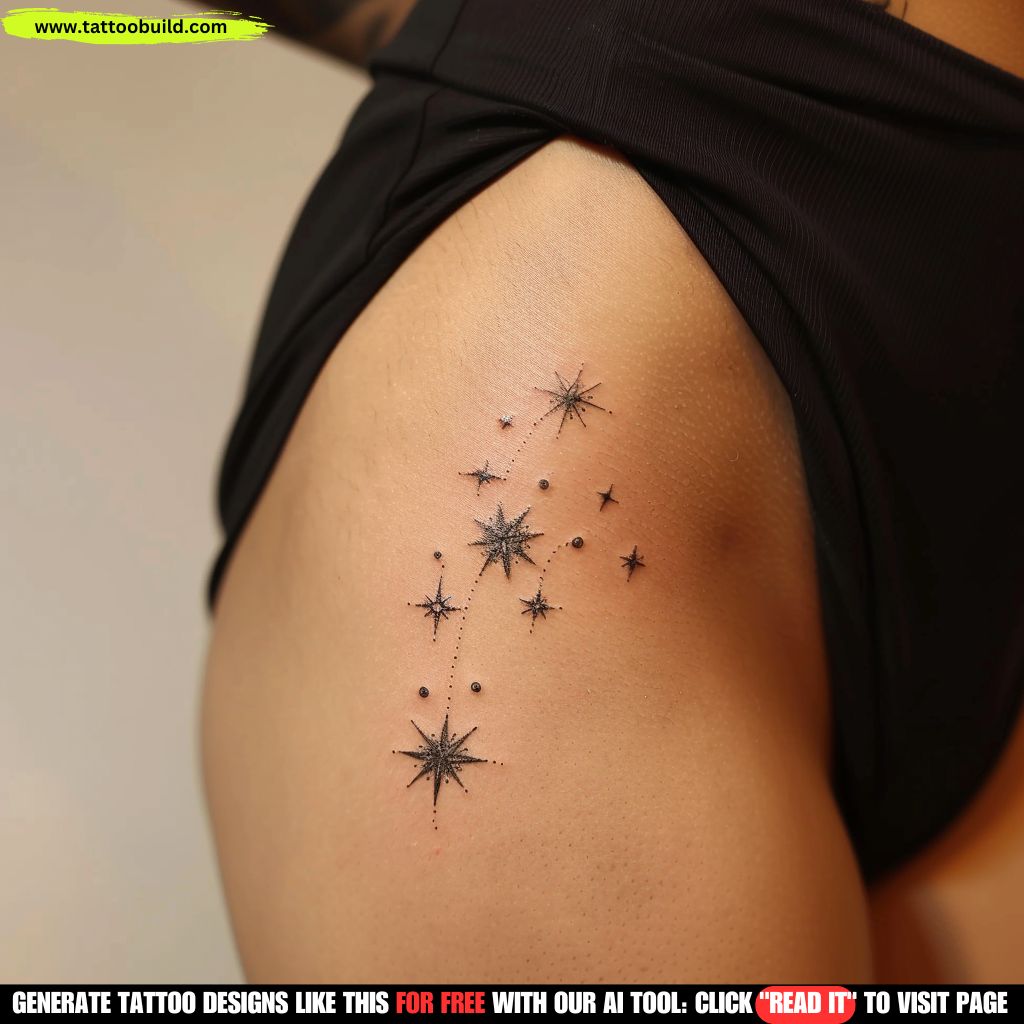
Dots for stars, hairline strokes connecting them. It reads as astronomy rather than astrology, which is exactly why a lot of people who dislike obvious zodiac ink still like this one.
Two things decide whether it survives. First, the dots need to be a real size — pinpricks close up over time. Second, the layout needs breathing room, so a forearm, spine or shoulder blade beats a wrist here.
Ask your artist to keep the dot spacing wider than the reference image. Skin spreads ink slightly in every direction, and a design that looks correctly proportioned on paper can come out crowded.
When I tested a small constellation piece against a larger one on a friend’s forearm over three years, the larger version was still crisp while the small one had softened noticeably at the dot edges.
3. The Archer or Centaur
The most ambitious option and the one that goes wrong most often.
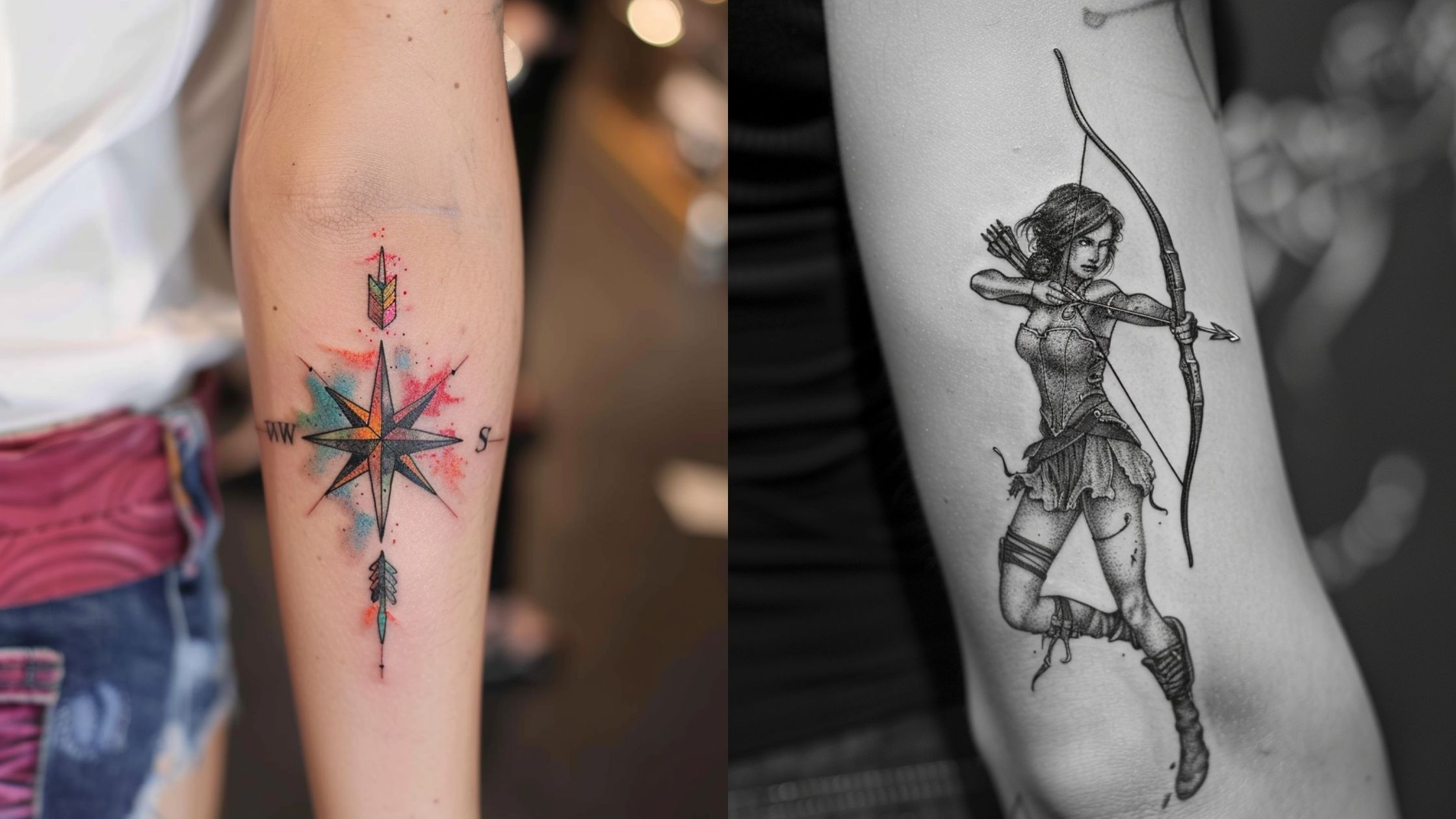
A centaur drawing a bow is a full illustrative piece — anatomy, muscle, tension in the bowstring. Below about fifteen centimetres the face and hands turn to mush, and no amount of touch-up work fixes that.
This is a thigh, upper back or outer arm tattoo. Expect three to six hours, sometimes split across two sittings, and expect to pay for an artist who specialises in illustrative or neo-traditional work rather than whoever has the soonest opening.
In my experience, the portfolios worth trusting here are the ones showing healed photographs, not fresh ones. Fresh work always looks sharp.
4. Bow and Arrow
A middle path: more visual interest than the glyph, none of the risk of the centaur.
The strength of this design is its shape. A drawn bow is a long, gently curved form, and long curved forms sit beautifully along a forearm, a calf, a collarbone or the spine — they follow the body instead of fighting it.
It also ages unusually well. Clean sweeping lines with space between them have very little to smudge into.
If you want the arrow without the zodiac reading, the treatments in my guide to minimalist arrow tattoos work the same way visually.
5. Fine-Line and Single-Needle Work
Fine-line is the dominant style for zodiac tattoos right now, and for good reason — it suits delicate glyphs and star maps.
But it comes with an honest caveat that a good artist will give you unprompted: fine-line generally needs touch-ups sooner than bolder work, particularly on high-friction spots like fingers, hands and feet.
That is not a flaw, it is a maintenance schedule. If you are happy to sit for a small refresh every few years, fine-line is wonderful. If you want to tattoo it once and forget it, go heavier.
There is more on style-specific longevity in my fine-line tattoo ideas guide.
6. Floral and Botanical Pairings
Wrapping the glyph or the constellation in botanical linework is the most common way people soften a zodiac tattoo.
Narcissus and carnation are the flowers usually tied to December birthdays, but I would not treat that as binding — a plant that means something to you personally reads better than a symbolically correct one you feel nothing about.
The design risk here is competition. If the florals are as detailed as the glyph, neither wins. Ask for the botanical element to sit clearly in a supporting role — lighter line weight, less shading.
7. Blackwork and Bold Traditional
The opposite instinct: heavy black, thick outlines, high contrast.
Blackwork is the most durable choice on this list. Solid fields of black hold their edges for decades and stay readable from across a room.
Two honest trade-offs. It is a longer, more uncomfortable session because of the packing involved, and it is significantly harder to laser off or cover later. Choose it when you are certain.
Bold traditional sits between the two — heavy outlines with limited colour, the American traditional approach, which has a very long track record of ageing gracefully.
8. Celestial Compositions
The Sagittarius glyph set among moon phases, scattered stars, or a thin planetary ring.
The practical advantage of this route is that it is extendable. Start with the glyph and a few stars, and you can grow it into a half sleeve or a full spine piece years later without the original looking bolted on.
Because the constellation sits toward the galactic centre, some people include a small dense star field in the design as a nod to that — a nice detail that does not need explaining to anyone.
My celestial tattoo ideas post has more compositions built this way.
Variations Worth Considering
If none of the eight above is quite it, these are the directions people usually land on next.
Jupiter’s Glyph Instead
Quieter than the arrow and almost nobody recognises it on sight, which is the appeal for some. It carries the expansion and optimism side of the sign without announcing your birthday.
Watercolour Backing
Soft colour washes behind a black glyph. Beautiful fresh, but be realistic — watercolour work without any black anchoring underneath tends to soften faster than most other styles. Ask for a solid line structure beneath the colour.
Geometric Framing
The constellation inside a thin circle, hexagon or triangle. It gives an otherwise loose scatter of dots a defined edge, and it makes placement on a round area like a shoulder much easier to balance.
Matching or Complementary Pieces
Sagittarius pairs visually with the neighbouring signs. If you are getting inked alongside someone, the Capricorn glyph or a Leo design sit comfortably next to an arrow without clashing, since all three rely on simple linear marks.
Placement, Cost and Healing
The design conversation is the fun half. This is the half that determines whether you are happy in five years.
Placement first. Forearms, outer arms, thighs and shoulder blades are the friendliest spots — stable skin, moderate discomfort, low sun exposure if you cover up. Ribs, sternum, spine, feet and hands are all harder on both pain and healing. There are more layout options in my forearm tattoo ideas guide if that is the area you are considering.
Cost. Small glyphs usually fall at or near a studio’s shop minimum, while illustrative archer pieces are priced by the hour and run into several sittings. Rather than quote figures that vary wildly by city, I have broken the variables down in how much a small tattoo costs.
Healing. Follow the aftercare your artist gives you, not a routine from the internet — they know their ink and their technique. Broadly it means keeping it clean, keeping it lightly moisturised, and leaving it alone.
Sun is what actually fades tattoos. Once healed, sunscreen on the piece does more for its lifespan than any aftercare product. The American Academy of Dermatology’s guidance on caring for tattooed skin is a solid reference.
One safety note I will not soften: if you see spreading redness, swelling that worsens after the first few days, pus, or you develop a fever, contact a doctor rather than asking online. Infections and allergic reactions to pigment do happen, they are treatable, and they get worse when ignored. The FDA’s tattoo fact sheet covers the known risks plainly. Never attempt to tattoo or remove a tattoo yourself.
Common Mistakes — and What to Do If You Are Still Unsure
The four errors I see repeatedly, in order of how much they cost to fix.
Cramming every symbol in. Glyph plus centaur plus constellation plus Jupiter in one small tattoo produces visual noise. Pick one lead element; let anything else support it.
Sizing down to save money. Shrinking an illustrative design below what it needs does not give you a smaller version of it, it gives you a blurry one in three years.
Choosing the artist before the style. Find someone whose healed portfolio matches the style you want, then wait for their calendar. A fine-line specialist and a blackwork specialist are not interchangeable.
Skipping the healed-work check. Ask any artist for photos of their work one to two years on. The good ones are pleased you asked.
Still weighing it up? Compare how other signs handle the same problem in my guides to Scorpio tattoo ideas and Aries star sign tattoo ideas — the design logic transfers directly.
Frequently Asked Questions
What is the best placement for a small Sagittarius tattoo?
The inner forearm, outer upper arm and shoulder blade are the most forgiving spots for a small glyph. The skin there is stable, discomfort is moderate, and the area is easy to keep out of direct sun while it heals. Wrists and ankles work too but sit closer to bone, so they tend to sting more. Fingers, hands and feet look great initially but wear faster than anywhere else on the body.
Will a fine-line Sagittarius tattoo fade quickly?
Fine-line work generally softens sooner than bolder styles, though how fast depends on placement, sun exposure and your skin. A fine-line glyph on an inner forearm can look sharp for many years; the same design on a finger may need attention much sooner. Most artists build the possibility of a touch-up into the conversation, and some include the first one. Ask about their policy before you book.
Can I combine my Sagittarius sign with a partner’s zodiac sign?
Yes, and it is one of the more common requests artists get. The cleanest approach is to keep both glyphs in the same line weight and style so neither dominates, either side by side or on matching placements. Intertwining two glyphs into a single mark can work, but it often makes both harder to read. Take the reference to an artist and let them redraw it as one balanced composition.
How long does a Sagittarius tattoo take to complete?
A simple glyph is usually done in under half an hour, including stencil placement. A constellation runs roughly forty-five to ninety minutes, and a bow-and-arrow design one to two hours. A full illustrative archer is a different scale entirely — commonly three to six hours, and frequently split across two appointments so neither you nor the artist is working past your limit.
Is the Sagittarius glyph the same as a plain arrow tattoo?
They are close but not identical. The Sagittarius glyph is an arrow with a distinct crossbar through the shaft, and that crossbar is what marks it as the zodiac symbol rather than a decorative arrow. If you want the astrological meaning to be legible, make sure your artist keeps the bar clear and well separated from the arrowhead. If you would rather it stay ambiguous, a plain arrow gives you that.
Quick Summary
- Pick one lead symbol — glyph, constellation, bow, or archer. Combining all four is the most common mistake.
- The glyph is the safest small tattoo: legible at 2–3 cm, almost nothing to blur, and it fits nearly anywhere.
- Constellations need room. Generous dot spacing and a forearm-or-larger canvas, not a wrist.
- The centaur archer needs 15 cm and a specialist in illustrative or neo-traditional work.
- Bow-and-arrow designs age best because long, well-spaced curved lines have little to smudge into.
- Fine-line is beautiful but has a maintenance schedule. Blackwork lasts longest but is hardest to remove.
- Judge artists on healed photos, one to two years old — not fresh work.
- Sunscreen preserves tattoos better than anything else, and any sign of infection is a question for a doctor, not the internet.