A tarot-card tattoo can center on a card you return to, a symbol you enjoy or an original framed scene with personal meaning. These 22 tarot card tattoo ideas combine Major Arcana-inspired emblems with the four suit Aces, using different subjects within a simple card-shaped border.
All images are AI-generated tattoo mockups on fictional adults. The artwork is original and card-inspired, rather than a reproduction of a particular deck. The examples omit printed titles and numbers; they show design possibilities, not real client tattoos or healed results. The numbered sections are gallery order, not tarot-card numbers.
Choose a card, then decide what makes it yours
The V&A's history of tarot cards describes tarot's origins as a card game and the variety of imagery used across historical decks. It also outlines the familiar structure of 22 Major Arcana cards and 56 Minor Arcana cards. The artwork and later interpretations have changed over time. Source checked 24 November 2026.
For a tattoo, decide whether you want a recognizable card scene, a simplified emblem or a more personal reinterpretation. A lantern can stand in for the Hermit's reflective atmosphere; two flowers can create an original Lovers composition. Those choices express your relationship with the imagery rather than claiming one meaning that applies to every wearer.
Bring the artist the card name and explain which details matter. A favorite deck can help you communicate the subject or mood, while an original drawing gives the artist room to build a piece for your placement. If you prefer spare symbols and plenty of open skin, compare our minimalist tattoo ideas.
1. The Fool: a new path
A clothed traveler on a winding path gives this Fool-inspired design a sense of movement. You might connect it with starting something new or being open to experience. The forearm suits the tall scene; keep the figure and path readable before adding small objects or a detailed background.
2. The Magician: tools and intention
A table of simple objects turns the Magician into a compact still life. The upper-arm example uses the cup, coin and wand as the main features. It could become a personal reminder of skills or intention, with the exact objects chosen for what you want the design to express.
3. The High Priestess: book and crescent
A book, pillars and crescent create a quieter High Priestess-inspired composition. The calf gives the vertical frame room around those separate shapes. You might choose the image for reflection, learning or mystery, but the tattoo does not need to claim a single authoritative interpretation.
4. The Empress: crown and wheat
A crown and wheat offer an object-based Empress interpretation. The forearm layout leaves the motifs as the focus rather than adding a crowded royal portrait. Discuss which plant shapes matter to you and how much detail the artist would keep at your intended size.
5. The Emperor: a stone throne
An empty throne makes structure and stillness the visual center of this Emperor-inspired card. The upper arm gives the frame and chair a broad setting. It may reflect your own ideas about responsibility or boundaries; decide that personal context before adding extra symbols.
6. The Hierophant: crossed keys
Crossed keys beneath an arch offer a simplified Hierophant emblem. On the calf, the tall structure leaves space around the key shapes. You might use it to think about learning, tradition or access, while discussing any specifically religious interpretation with the artist if that is part of your intention.
7. The Lovers: paired flowers
Two intertwined flowers reinterpret the Lovers without copying a familiar human scene. The forearm arrangement gives each blossom its own space. It could celebrate connection, a choice or a shared interest; the floral treatment leaves room for your own story rather than predicting a relationship's outcome.
8. The Chariot: a carriage motif
An empty carriage reinterprets the Chariot as a motif of forward movement. The upper-arm frame keeps the vehicle as a single clear object. Ask the artist to simplify the wheels and canopy together so it reads as a coherent design instead of a collection of tiny mechanical details.
9. Strength: lion and rose
A lion and rose create a Strength-inspired pairing with two different textures. The calf offers room for the face and flower to remain separate. You could connect the design with patience or resolve, but choose the expression and composition because they fit your own interpretation.
10. The Hermit: lantern and mountains
A lantern above mountains makes this Hermit-inspired scene calm and spacious. The forearm frame lets the light source remain the focal point. It may mark a period of study or reflection; the background can be adjusted around a landscape that matters to you.
11. Wheel of Fortune: a turning wheel
A turning wheel gives the Wheel of Fortune idea a simple geometric anchor. The upper arm provides room for the rim, spokes and surrounding accents. You might use the image to represent change or cycles, without treating the tattoo as a promise about luck or future events.
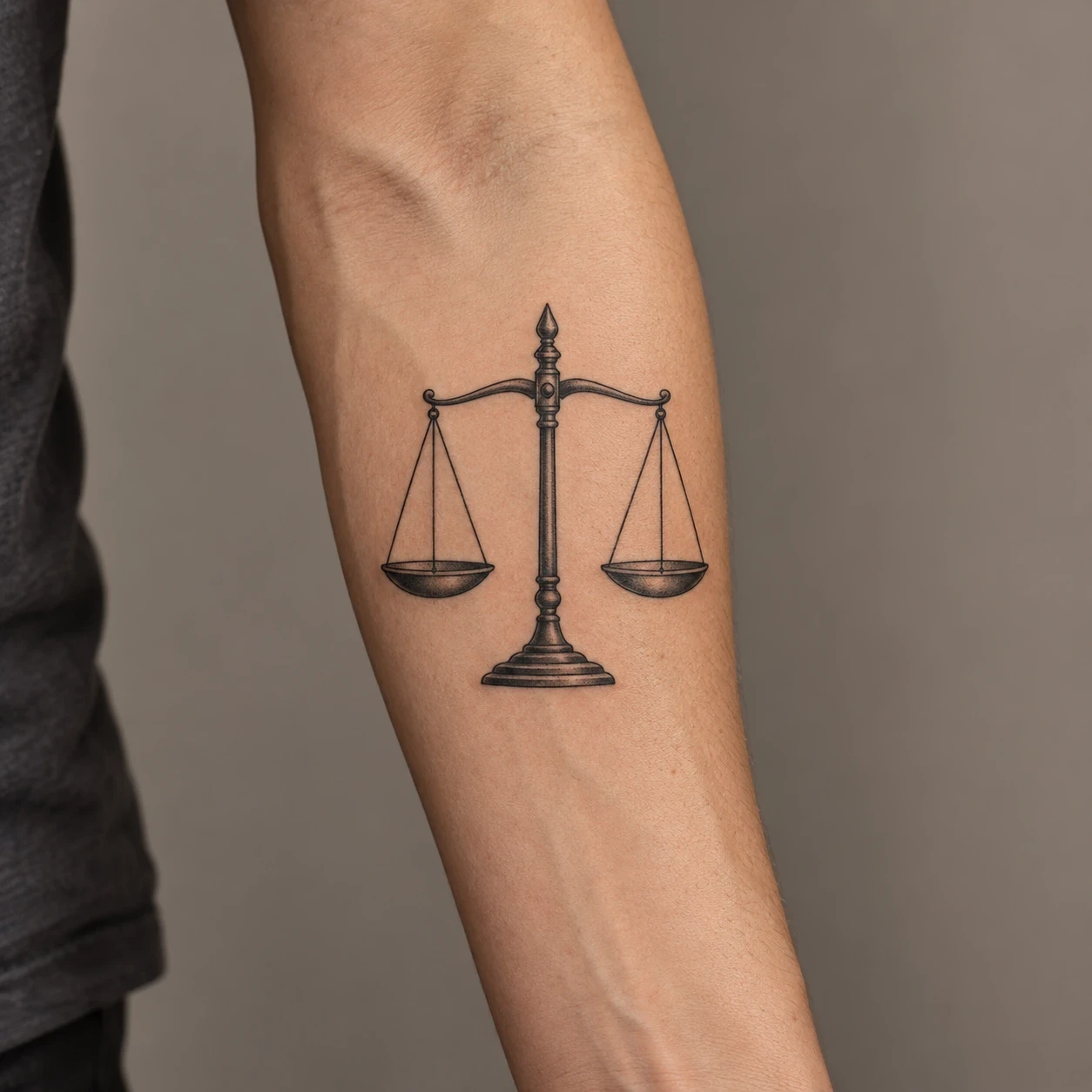
12. Justice: balanced scales
Balanced scales and a separate sword give Justice a compact object-based treatment. The calf suits the vertical arrangement. The alignment of the scales matters visually, so review the drawing at the size you plan to wear it and keep nearby lines from becoming crowded.
13. Death: skull and flowers
A clean illustrative skull and flowers give the Death-inspired card a still-life treatment. The forearm leaves room around each shape. If you choose it for an ending, transition or renewal, explain that to the artist; the tattoo is a personal symbol, not a prediction of anyone's death.
14. The Tower: lightning and stone
An empty tower beneath lightning uses a strong vertical silhouette. The upper-arm example keeps people and a complicated disaster scene out of the composition. You might relate the image to a change in perspective or a turning point, with the drawing focused on architecture and contrast.
15. The Star: light over water
A star above water gives the Star-inspired card a clear light source and a quiet base. The calf offers room for the ripples beneath it. Choose how much empty space you want around the star before the artist adds decorative details that could compete with its shape.
16. The Moon: a night landscape
A crescent above a winding path creates a night landscape for the Moon-inspired design. The forearm suits the tall towers and route between them. It can express your own association with dreams or uncertainty, while remaining an imaginative scene rather than a literal map.
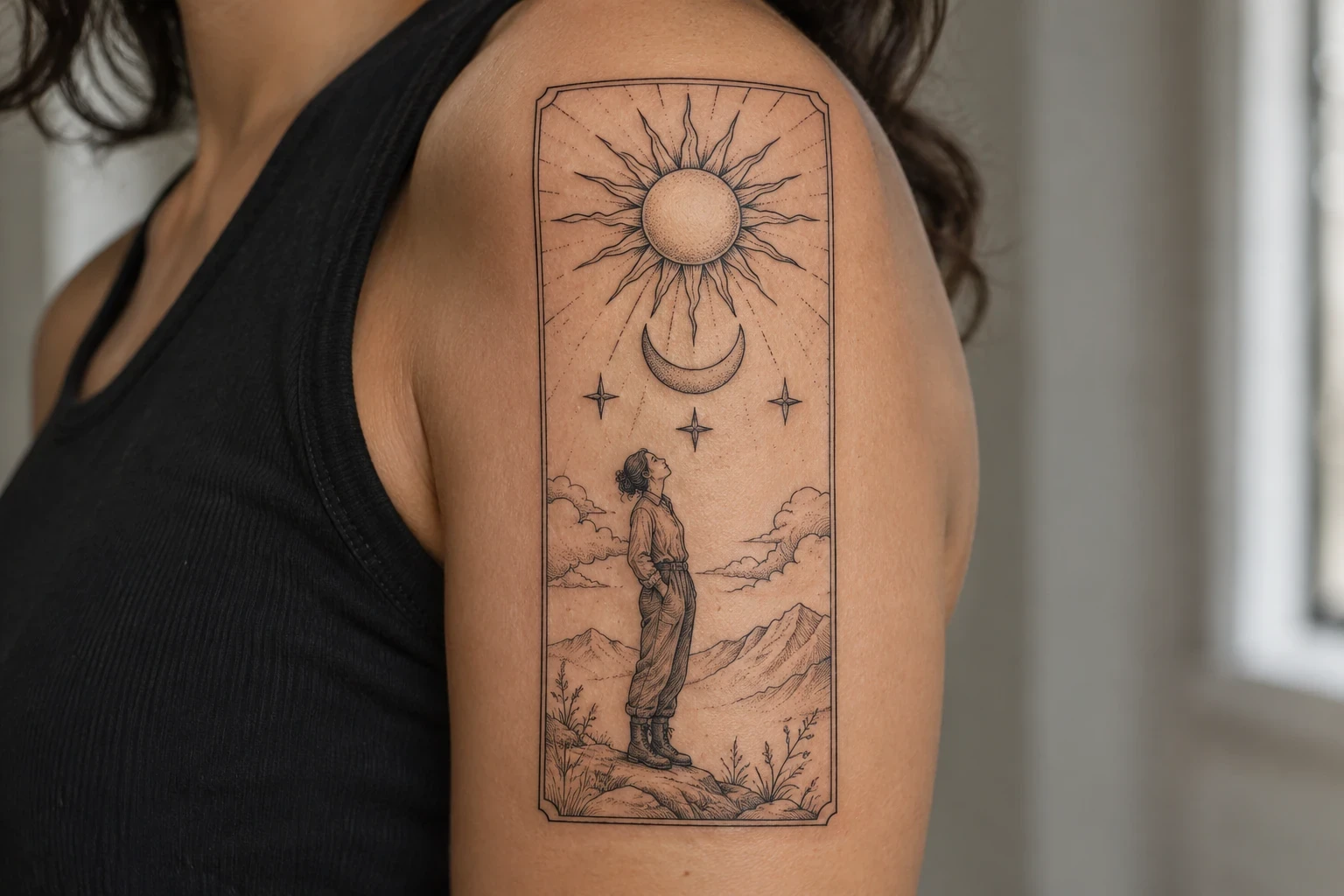
17. The Sun: radiant disk
A radiant disk and sunflowers give the Sun-inspired card a bright visual language in black and gray. The upper-arm layout makes the rays the main shape. You might connect it with warmth or a valued memory, without needing a face, lettering or a detailed human figure.
18. The World: wreath and globe
A globe inside a wreath gives the World-inspired card a contained circular motif within the rectangular border. The calf provides a long frame around it. Ask the artist to keep the globe and leaves distinct, especially if you want a smaller version with fewer grid lines.
19. Ace of Cups
A single cup and water motif create a simplified Ace of Cups. The forearm lets the cup sit above the lower accents without filling the frame. It can hold a personal association with feeling or connection, but the shape and spacing should guide the drawing as much as the interpretation.
20. Ace of Swords
One vertical sword gives the Ace of Swords a clear vertical axis. The upper-arm example uses a leafy accent to soften the outline. If you add a crown or lettering later, plan that extra space in the initial sketch rather than fitting it into the narrow gaps.
21. Ace of Wands
A leafy branch gives the Ace of Wands a natural subject with a simple silhouette. The calf offers room for the leaves to sit apart from the border. You might relate it to a new idea or project, with the artist choosing a branch shape that works at the proposed size.
22. Ace of Pentacles
A star-marked coin makes the Ace of Pentacles a compact emblem. The forearm frame provides space around the circle and small botanical accents. Check the star's points and the surrounding border in the drawing; if the symbol has a particular spiritual meaning to you, make that intention clear.
Make the card border part of the plan
A rectangular frame can help a tattoo read as a card, but it also sets a boundary for the scene. Decide whether the subject sits fully inside it, overlaps an edge or appears without a complete border. The examples use a frame to keep the concepts easy to compare; your artist can draw a version that fits the body area.
Review the sketch at the actual tattoo size. A detailed throne, small face or elaborate scale needs a different amount of room from one star or a leafy wand. Ask the artist which lines they would remove or enlarge. A clear, simplified emblem can communicate the idea without reproducing every feature of a printed card.
If you want a title, a number or a short phrase, supply the exact text and compare it with your chosen reference. Check spelling, orientation and the number before approving the stencil. These mockups deliberately omit that text, so adding it may change the proportions of the frame.
For a more celestial direction, explore our Neptune tattoo ideas for planet-and-star compositions. To prepare an artist brief and discuss how design revisions work, use our tattoo consultation guide.
Tarot-card tattoo questions
Does a tarot tattoo have one fixed meaning?
No. Interpretations differ between decks, readers and wearers. Explain what the card or motif means to you, and choose the artwork around that intention. This gallery offers design ideas and possible personal associations, not readings or predictions.
Do I need to use the artwork from a deck?
You can ask for an original card-inspired illustration. Bring a reference to explain which card you mean, then identify the features you want to preserve. An artist can work from the subject, composition or mood while creating a new drawing for your placement.
Which cards suit a smaller tattoo?
A simple sun, star, cup, coin or leafy wand is a useful starting point because it can be reduced to a few clear shapes. Ask the artist how much space the border and any lettering need. A small rectangle does not automatically make a detailed scene readable.
Does the card need a name or number?
No. A framed symbol can work without text. If identification matters to you, discuss the title and number as part of the composition rather than adding them at the end. Use your selected card reference for the final check.
Are all 22 designs Major Arcana cards?
No. This gallery combines Major Arcana-inspired designs with the Aces of Cups, Swords, Wands and Pentacles. It is a selection of tattoo concepts rather than a complete deck or a guide to card reading.
Are these real tattoos?
No. They are AI-generated tattoo mockups on fictional adults. They can help you discuss a visual direction, but they do not show healed results or establish what an artist's finished tattoo will look like.