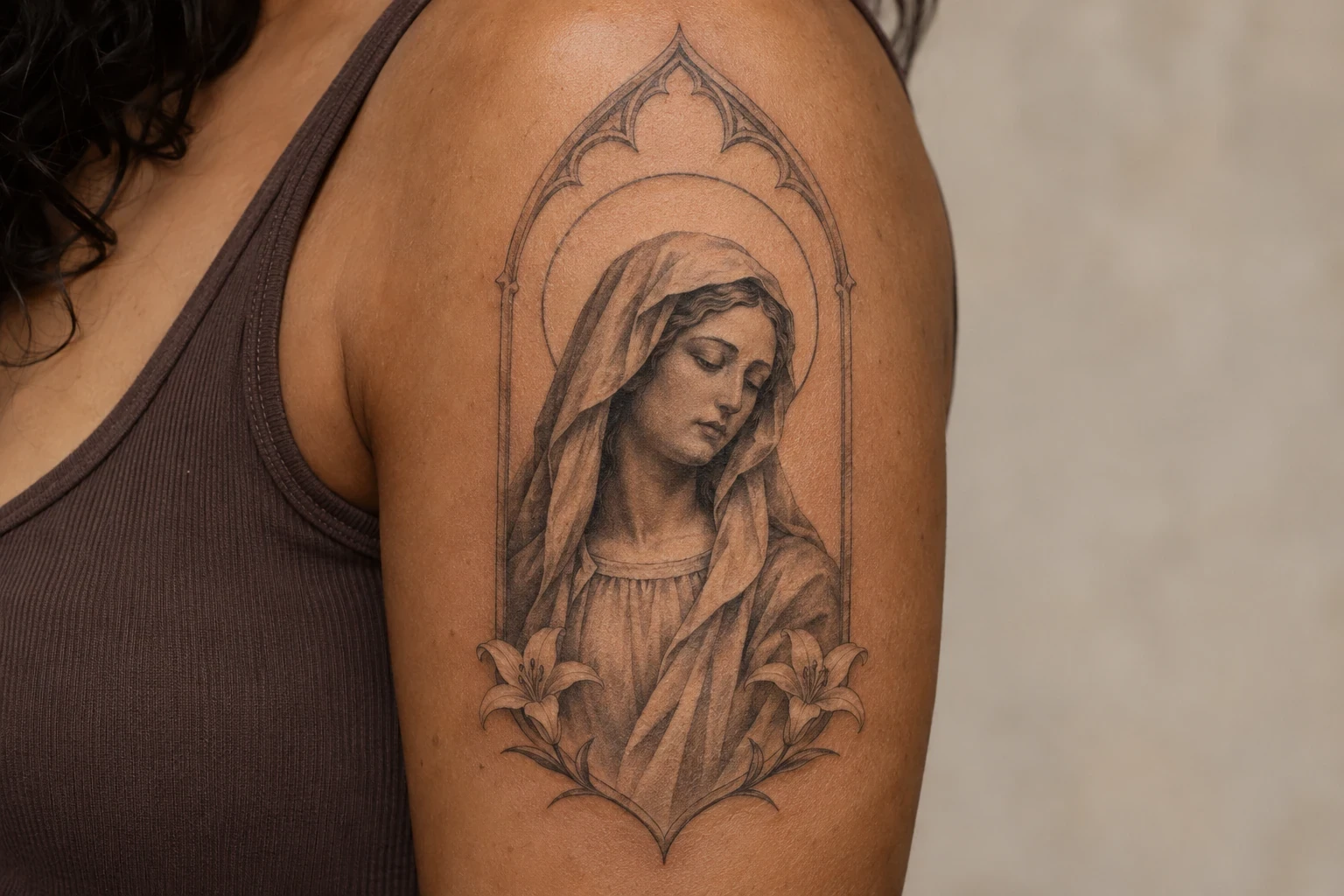
A Virgin Mary tattoo can be as simple as a bowed profile and a halo, or as detailed as an image from a family altar. If you’re drawn to a particular devotion, start with the details that identify it: the starry mantle and crescent of Our Lady of Guadalupe tell a different story from the white veil and blue sash of Our Lady of Lourdes.
The 17 ideas below show what those choices look like at different sizes and placements. All images are AI-generated tattoo mockups on fictional adults. Use them to discuss composition with your artist and ask for healed examples from their portfolio.
1. Fine-line veil and halo
The open space inside the halo gives this slim profile room to breathe. On the inner forearm, place the stencil so the curve of the veil stays visible when your arm rests at your side.
2. Mary with hands in prayer
Here the bowed head and joined hands share the focus. Give the fingers and cuffs enough space to read clearly, especially if you want to wrap the piece toward the back of the upper arm.
3. American traditional Mary and rose
A rose makes a strong base for a portrait with a bold outline. If you like the traditional look, use a small palette and keep the shading around the face quiet so the rose and portrait each hold their own.
4. Stained-glass window
The pointed frame gives this design the shape of a church window. Keep the divisions between panes broad and simple; the color blocks can suggest glass without needing to reproduce every line of a real window.
5. Oval cameo portrait
A profile naturally suits an oval frame. Try the stencil with your arm relaxed and turned slightly in each direction. If the oval looks crowded near the elbow, move it up before adding more detail to the rim.
6. Madonna and Child
The two faces are the key to this composition. The Met’s Madonna and Child by Duccio is one example of how overlapping halos can bring the two figures together. Leave a clear space between their faces in a tattoo.
7. Star above a folded veil
For a compact wrist piece, give the star its own space above the veil. A few well chosen contours can carry the image without trying to squeeze in an expression or individual folds.
8. Lily beside Mary
One lily gives the portrait a vertical line to work against. On the shoulder, ask your artist to turn the flower and face toward the same viewing angle so the pairing stays readable from the side.
9. Moon beneath a standing figure
A slim crescent makes a clear base under a standing figure. If you mean this as a general Marian image, the crescent can stay simple. If you mean Guadalupe specifically, bring a reference for the mantle, the rays and the figure beneath her feet.
10. Our Lady of Guadalupe
The Vatican’s account of the image in the Basilica of Our Lady of Guadalupe describes the starred mantle, crescent and supporting angel. Leave enough space for those elements if it’s important to you that the image is recognizable as Guadalupe.
11. Our Lady of Lourdes
In Bernadette’s account shared by the Sanctuary of Lourdes, the figure wears white with a blue sash and a rose on each foot. Use open skin for some of the fabric and ask your artist how they’d keep the sash and roses easy to see at your chosen size.
12. Crowned Marian portrait
Open space above the crown keeps the tops of its points visible. For an upper-back piece, bring the shirt or tank you usually wear so you can see where its neckline will meet the design.
13. Sorrowful Mary with one sword
A single sword across a heart emblem can evoke the sword image in Luke 2:35. Keeping the emblem below the face makes the gesture quiet and gives the two parts of the design separate silhouettes.
14. Woodcut Mary beneath an arch
Dark parallel marks give this piece the look of a print. Ask your artist to reserve lighter spaces where the face meets the veil and where the veil meets the arch, so the lines don’t all run together.
15. Blue mantle and stars
A few widely spaced stars can make a blue mantle stand out without filling the whole piece with tiny dots. Decide whether the main feature is the blue fabric or the face, and put the strongest contrast there.
16. Open hands and a circle of rays
The open hands widen the lower half of this design. Give them room on either side of the figure and keep the ring of rays narrow enough that it doesn’t pull attention from the gesture.
17. Negative-space Marian silhouette
The recognizable shape comes from uninked skin inside the dark disk. Look at the stencil from a few steps back: the forehead, nose and drape should be visible before you can see any fine detail.
How to choose a Virgin Mary tattoo
Decide what has to be recognizable from across a room. For a small piece, that might be the line of the veil. For a larger one, it might be Mary’s expression or the complete almond of rays around Guadalupe. Bring a reference from your own tradition if a gesture, article of clothing or emblem matters to you. Ask the artist to show you two sizes on your skin, then look at both with your arm or leg relaxed.
For more ways to frame a sacred figure, see our American traditional religious tattoo ideas and Saint Michael tattoo ideas. If you’re leaning toward a small design, compare the amount of open skin in our fine line tattoo ideas.
Common questions
What does a Virgin Mary tattoo mean?
It can mark a devotion, a memory of someone who prayed with you, or a connection to an image you grew up seeing. A child, flowers or a specific Marian title can give the piece a more personal reference. The tattoo alone doesn’t tell you what the wearer believes.
Do I need color for a Guadalupe or Lourdes tattoo?
Both can work in black and gray. If you leave color out, give the identifying details more weight: the mantle, crescent and surrounding rays for Guadalupe, or the sash and roses at the feet for Lourdes. If you want the design to be faithful to a particular image, show your artist that reference before they simplify it.