Freya tattoo ideas can center on a goddess portrait or use a smaller motif such as cats, a necklace or a feathered garment. The strongest starting point is a detail you can explain: choose the story or association first, then decide how much of a figure and background you want. These 16 concepts range from fine line to woodcut, geometric shading and contemporary fantasy.
All 17 images are AI-generated: 16 distinct design concepts plus a separate placement mockup. They depict imagined figures and jewelry, not historical artifacts, authenticated portraits, real tattoos or healed client work. Your artist should adapt the reference into an original drawing for the chosen size and placement.
Freyja references and modern interpretation
Freya is a common spelling of Freyja. In the Prose Edda, translated by Rasmus B. Anderson, Gylfaginning sections 24 and 35 associate her with a carriage drawn by two cats, a necklace and tears of red gold. Section 24 also connects her with love and a share of those killed in battle. These are literary starting points, not a prescribed tattoo vocabulary.
In Þrymskviða, or The Lay of Thrym, Loki borrows Freyja’s feather garment. A feather-cloak design can refer to that episode without depicting wings growing from a woman’s body. Sources checked October 26, 2026.
The faces, costume cuts, necklace shapes and decorative frames below are invented for these concepts. Moon crescents, northern lights, flowers and star-patterned cloaks are modern artistic additions here. If you approach Freyja through a living religious practice, let your own understanding guide the choice; the article does not define a universal devotional meaning.
For the wider visual context, compare our Norse mythology tattoo ideas. A focused Freyja brief will be clearer than combining every Norse motif in one small piece.
1. Fine-line Freyja portrait
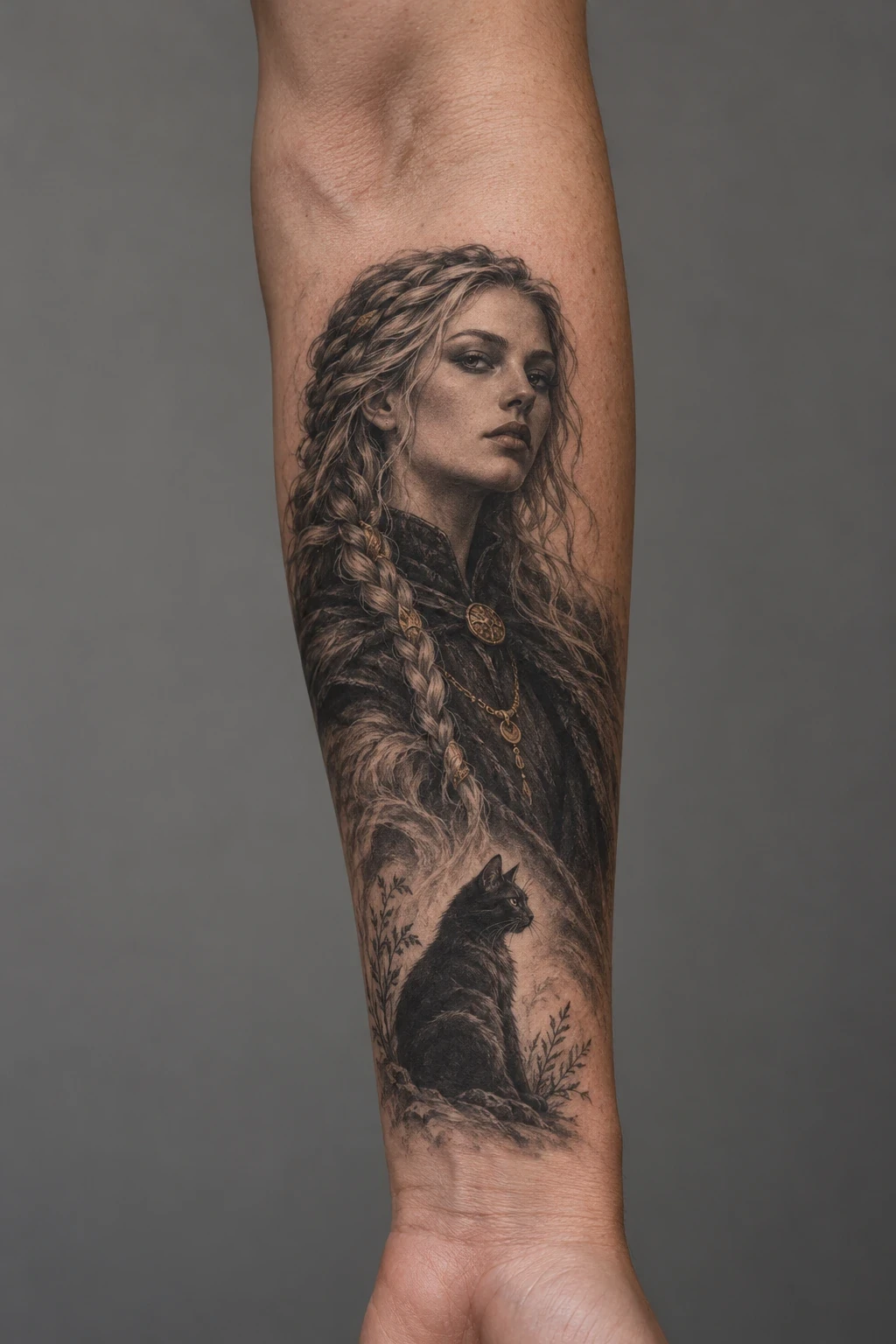
A braid, calm expression and small gold pendant keep this portrait restrained. The face carries the composition, while the garment gives it a clear stopping point at the shoulders. It is an imagined portrayal of the goddess, not a claim about her historical appearance.
Consider a forearm or upper-arm placement with enough room for the eyes and hairline. If you prefer a smaller piece, ask the artist to simplify the braid and pendant before shrinking the entire drawing. Keep the neck and hair from becoming one dense cluster of lines.
2. Two cats and a medallion
A pair of cats offers a Freyja reference without a large human portrait. Their separate tails and contrasting coats make the animals easy to distinguish. Gold collars, floral branches and a small portrait medallion turn this version into an ornate contemporary emblem; those details are decorative additions, not excavated objects.
Ask your artist to leave a visible gap between the cats and keep each tail readable. You could echo the markings of cats you know while preserving the balanced arrangement. For more animal-led approaches, see our cat tattoo ideas.
3. Freyja in a feathered cloak
The garment creates a strong full-figure silhouette, with feather shapes building out from the shoulders. A small brooch gives the eye somewhere to settle before following the cloak downward. This treats the borrowed feather garment as an artistic costume rather than a literal anatomical transformation.
A calf or larger forearm panel suits the vertical figure. Keep the hands and clasp clear, and use fewer, larger feather groups if the design needs simplification. The garment should still read as a cloak when you view the stencil from a few steps away.
4. Portrait with a gold tear
One gold tear gives a shaded face a precise focal point. The detail can hold a personal association with sorrow, endurance or remembrance if you choose, while its literary reference comes from Freyja’s tears in Gylfaginning. That does not make every gold-tear tattoo mean the same thing.
The tear needs a clean boundary beside the eye so it does not look like an accidental mark. Keep other gold accents subdued if the tear is the reason for the design. Gold here describes the color in the concept, not reflective metal or a promised metallic finish on skin.
5. Botanical Freyja portrait
Leaves and small white flowers soften the outline around this bust. They are a contemporary framing choice in this design, not flowers claimed as a fixed attribute of the goddess. The open frame lets the hair and expression remain the main subject.
Choose a plant that matters to you if you want a personal layer. Avoid placing stems across the eyes or necklace. An oval composition can work on an upper arm or calf, with the artist adjusting the amount of foliage to the available space.
6. Cloaked silhouette under northern lights
A back-facing cloaked figure, two tuft-eared cats and an aurora create an atmospheric scene. It combines a Freyja-inspired figure with a modern northern landscape, without claiming that the aurora or a particular cat species is her exclusive symbol. The sky provides movement while the group below anchors the composition.
Use a larger placement if you want the figure, ridge and sky to remain separate. A narrow strip of colored light may be enough; filling the whole background can overpower the silhouette. Tell the artist whether the mood or the figure’s identity matters more.
7. Brísingamen-inspired necklace
An imagined necklace can become a complete tattoo on its own. The linked collar, hanging forms and central red accent give this concept a jewelry-like rhythm. The name Brísingamen provides the reference; the specific leaf shapes and gemstone arrangement are modern invention.
Try the curved design on the upper arm or as a compact chest or back motif rather than assuming it must sit exactly like a real necklace. Have the artist check every link and pendant connection. For a smaller version, simplify the hanging elements and let one central shape lead.
8. Woodcut Freyja beside a cat
Hatching, a long robe and a single cat make a compact engraved-style scene. The figure’s face does not need photographic detail for the composition to work. The cat is placed at her feet so the two subjects remain easy to separate.
This suits someone who likes black ink with a printmaking character. Give the robe enough open space that it does not turn into a solid dark wedge. A larger calf or upper-arm panel allows the artist to balance the cat, hands and cloak folds.
9. Geometric goddess portrait
Angular shadow planes give the portrait a different rhythm from soft realism. The braid and pendant anchor the subject while the facets describe the cheeks, hair and cloak. This is a contemporary graphic treatment, not an ancient Norse visual style.
Keep the face readable before adding more triangles. A few larger planes may suit your chosen size better than a dense mesh. Ask the artist to show which areas will be solid black and which will stay open so the eyes and mouth do not disappear.
10. Freyja within a crescent frame
The crescent works as a border around the hair and shoulders, with two stars providing a light upper accent. This is deliberately a fantasy composition. The moon is a modern framing choice here, not presented as proof that Freyja was universally understood as a moon goddess.
Choose whether the portrait or the crescent should dominate before adjusting the size. A thin border can support a detailed face; a heavy one can make the whole piece feel like an emblem. Leave a clear break between the hair and the inner curve.
11. Modern warrior interpretation
Armor and a spear give this portrait a firmer, more martial mood. It is a modern interpretation that draws on the broader battle association discussed above, not a reconstruction of a documented costume or a universal depiction of Freyja. The composed expression keeps it from needing an action scene.
Keep the spear beside the figure rather than crossing the face. Check the shaft, point and shoulder line at stencil stage so the shapes do not merge. Decide whether the armor should stay plain or echo linework already used in nearby tattoos.
12. Cat, feather and pendant emblem
This combines three small objects into a portrait-free design. The cat makes a dark central shape, while the feather adds height and the pendant provides a warm accent. It is a contemporary arrangement of references, not a traditional seal or protective sign.
Use only as much feather detail as the final size allows. The pendant needs its own small pocket of space beside the paws. For other ways to make a dark cat silhouette readable, compare our black cat tattoo ideas.
13. Portrait in an interlace frame
An oval interlace border contains a portrait, a tuft-eared cat and a falcon. The animals are contemporary illustrative companions rather than a claim about a documented scene. The newly drawn knot pattern is decorative, not a specific archaeological pattern or a symbol with a guaranteed meaning.
Ask the artist to trace each ribbon through the border and check the over-and-under sequence. If the frame overwhelms the face, remove a crossing rather than compressing every gap. An upper arm can provide room for both the portrait and the surrounding linework.
14. Freyja in a star-patterned cloak
A dark blue cloak, scattered gold stars and two lynx companions make a dramatic full-figure design. The triangular garment shape does much of the work, with the face and brooch staying distinct. This is modern celestial fantasy: the cloak pattern and choice of cat species are not presented as descriptions from the Eddas.
Decide how much blue you want before adding a background. The cloak already provides a large color area. Keep the hands and braids separate from its darkest folds, and ask the artist which stars to retain so the pattern has enough space.
15. Minimal cat beneath a necklace
This smaller emblem leaves out the face, landscape and feather detail. The curved necklace and seated cat form two simple levels, making the subject easier to adapt when you prefer a compact reference. It is a personal Freyja-inspired composition rather than a named historical sign.
Try the stencil with different spacing between the cat and necklace. A clean gap is more useful than squeezing them into contact. You could use black ink throughout, keeping the gold-colored line as an optional accent rather than an essential feature.
16. Freyja profile with a mountain landscape
Trees and a distant ridge grow out of the lower edge of the portrait, combining a face study with a landscape. The scene is a modern artistic addition. It can carry your own connection to a place without requiring a myth about that particular mountain.
Keep the trees below the face so the profile remains clear. A larger forearm or calf panel gives the artist room to manage the transition from hair to branches. Ask for a simpler version if the mountain, braid and necklace compete for the same small area.
Choose placement by the composition
- Forearm: consider a portrait, a feathered figure or a tall cat-and-pendant emblem.
- Upper arm: an oval frame or a wider bust has room to balance the face and surrounding detail.
- Calf: full-length robes, a spear or a landscape can use the long vertical space.
- Chest or upper back: a necklace-led or symmetrical two-cat design can suit a wider layout; have the artist adapt it to the body rather than simply stretching the image.
Print or stencil the design at the proposed size. Look at the eyes, hands, cat faces and necklace connections from normal viewing distance. If they become hard to separate, simplify the composition before committing to a smaller version.
Keep the reference specific
Choose one or two attributes you actually want. Cats and a feather garment may be enough to explain your Freyja reference; extra symbols can weaken it. The designs here use no runic inscriptions. If you add lettering or runes, decide what language and writing system you intend, then have the complete wording checked independently before the stencil is finalized.
Do not treat a generated braid, brooch or knot border as evidence of Viking-age dress or tattooing. Bring source material if historical interpretation is central to your brief. Our Viking tattoo ideas provide a broader visual comparison, while the Edda references above explain the particular literary details used here.
Build a useful artist brief
Give your artist the selected concept, the intended body area and a short explanation of the detail that matters most. For example: “Keep the cat and necklace reference, remove the portrait, and use black ink.” That leaves room for the artist to improve the anatomy, spacing and line weight rather than copying a generated image mechanically.
Ask for aftercare instructions for the finished tattoo. These images cannot show how a design will heal on your skin or establish which amount of fine detail is appropriate for your placement.
Freya tattoo questions
Are Freya and Freyja the same subject here?
Yes. This article uses Freya in the title and Freyja when discussing the Norse literary figure. If you add a written name to the tattoo, decide the spelling deliberately with your artist.
What does a Freya tattoo mean?
It can express an interest in Norse mythology, a personal association with a story or a devotional connection. The meaning depends on the wearer and design; the article does not assign one meaning to every portrait or emblem.
Does the necklace concept show the real Brísingamen?
No. It is an imagined jewelry design inspired by the named necklace. Its links, pendants and gemstone arrangement are not an archaeological reconstruction.
Can I use a cat motif without a goddess portrait?
Yes. The two-cat, cat-and-feather and minimal necklace concepts offer different ways to build a reference without a face. Explain the intended association in your artist brief so the composition stays focused.