A ladies sleeve tattoo is not one big tattoo — it is a plan. That single shift in thinking is the difference between an arm that looks composed and an arm that looks collected.
I have sat through enough consultations to notice the pattern. The women who end up happiest with their sleeve tattoos for women walked in with a theme and a rough shape, not a folder of forty saved images.
When I first started saving sleeve references myself, I made the same mistake everyone makes: I picked individual pieces I loved and assumed an artist would stitch them together. A good artist can, but the result is always stronger when the pieces were chosen to live beside each other from the start.
So this guide is organised the way a sleeve is actually built — style first, then placement, then the practical realities of sitting for it. The forty-plus ideas below are grouped by theme so you can find the direction that fits you and stop scrolling.
Which Sleeve Format Is Right for You?
Before style comes coverage. Most of the women I have spoken to underestimate how much this one decision drives everything else — cost, sessions, and how easily the work can be covered at a job.
| Format | Coverage | Typical Commitment | Best If You Want | Trade-off |
|---|---|---|---|---|
| Full sleeve | Shoulder to wrist | Many long sessions over months | One unified statement piece | Hardest to cover, highest cost |
| Half sleeve (upper) | Shoulder to elbow | Several sessions | Impact you can hide under a t-shirt | Awkward stopping point if you extend later |
| Lower half sleeve | Elbow to wrist | Several sessions | Work you actually see every day | Most visible, fades fastest from sun |
| Quarter sleeve | Shoulder to mid-bicep | One to two sessions | A low-risk starting point | Can look unfinished on its own |
| Patchwork sleeve | Built up over years | Open-ended | Freedom to add as you go | Needs discipline to stay cohesive |
What Actually Decides How Your Sleeve Turns Out
Style gets all the attention, but in my experience four unglamorous factors decide whether a sleeve still looks good in ten years.
The first is the artist’s specialism. An artist who tattoos fine botanical linework every week will beat a generalist at fine botanical linework, every time. Ask to see healed photos, not just fresh ones — fresh work always looks sharper than it will in a year.
The second is your budget and pacing. Sleeves are usually charged by the hour or the session, and rushing to finish is the most common regret I hear. It is worth reading up on what a sleeve tattoo actually costs before you book, so the pacing is a choice rather than a surprise.
The third is your skin and your sun habits. Arms get more direct sunlight than almost anywhere else on the body, and unprotected sun exposure is the fastest way to dull line and colour work.
The fourth is design flow. A sleeve has to read from the front, the side and the back, because people see your arm from all of them. Elements that ignore the arm’s natural curve tend to look pasted on once healed.
Ladies Sleeve Tattoo Ideas by Style
These are the directions that keep coming back — not because they are trendy, but because they suit the shape of an arm.
1. Floral and Botanical Sleeves
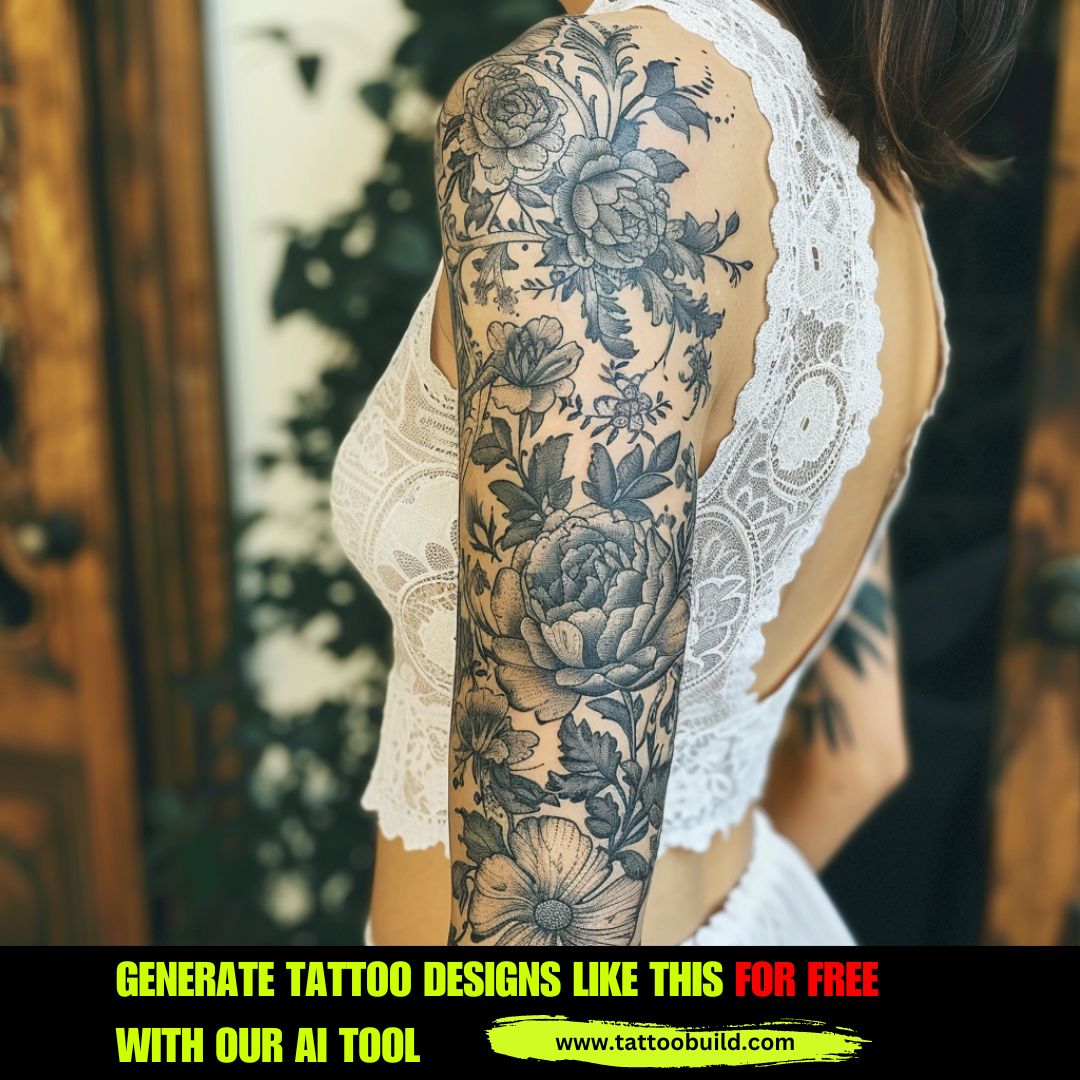
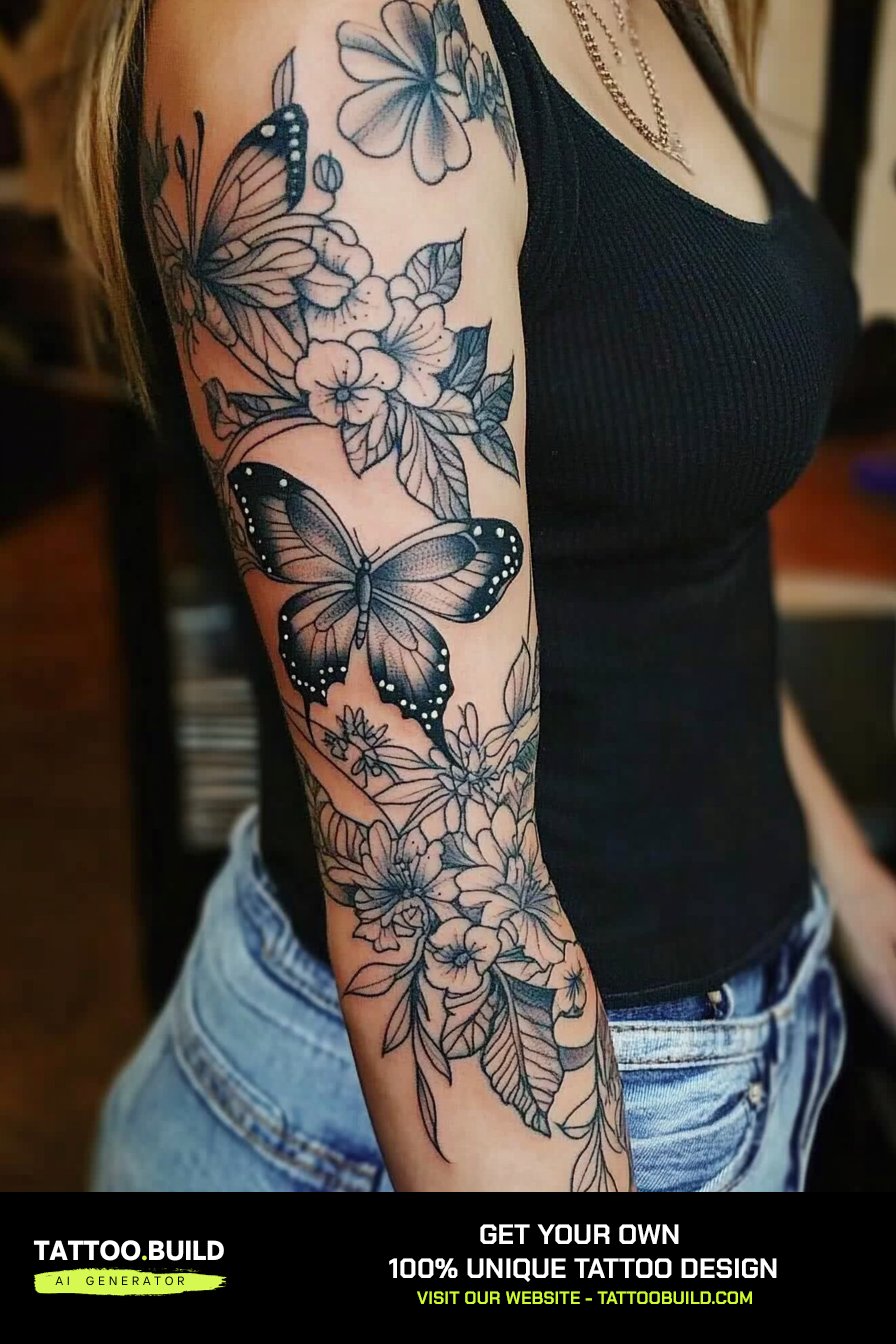
Florals are the most requested ladies sleeve theme I encounter, and for a practical reason: flowers, stems and leaves are naturally good at filling irregular space.
The strongest floral sleeves pick two or three blooms and repeat them at different scales rather than cramming in one of everything. Peonies, roses and magnolias hold up especially well because their petals give an artist room for real shading. A floral half sleeve on the forearm is a good place to test the idea before committing to the whole arm.
If you want it to stay delicate, ask for open skin between clusters. Fine botanical work packed edge to edge tends to blur into a grey mass as it settles, which is exactly the outcome most people were trying to avoid.
2. Forest, Tree and Woodland Sleeves
A tree is one of the few single subjects that can carry an entire sleeve on its own. The trunk follows the forearm, the branches spread across the upper arm, and the roots give you a natural ending near the wrist.
Every artist I have asked about tree sleeves says the same thing: bark texture is slower than it looks. Expect it to take more than one sitting, and expect the fine texture to soften as it heals.
Woodland scenes work best when you commit to one light source. Mixed lighting across a forest sleeve is the single most common reason these pieces look flat.
3. Ocean and Marine Life Sleeves
Waves are the ideal sleeve element because they are designed to wrap. Traditional Japanese water in particular was developed to move around a limb, which is why it still gets borrowed constantly.
I have seen simple compositions outperform complicated ones here more often than anywhere else — a single boat riding a wave usually reads better at arm’s length than a crowded reef scene. There are more directions in our roundup of ocean tattoo ideas.
If you want colour, blues and teals are among the more forgiving palettes on most skin tones, but ask your artist how they will look on your skin specifically rather than on the reference photo.
4. Japanese and Irezumi-Inspired Sleeves
Traditional Japanese sleeves are the oldest solved problem in tattooing. The whole system — bold outlines, a defined subject, wind and water bars filling the background — exists specifically to make an arm read as one piece.
That background is not filler; it is the structure. Skipping it to save time is the reason many Japanese-style sleeves never quite cohere.
If you are drawn to this style, it is worth learning what the motifs mean before choosing. Dragons, koi and hannya masks all carry specific associations, and an artist who works in the tradition will happily explain them.
5. Wildlife and Animal Sleeves
Animal work lives or dies on contrast. Fur, feathers and eyes need real dark values to stay legible once the tattoo settles and softens.
Birds are the most flexible option for a sleeve because they can be placed mid-flight to fill gaps between heavier elements without demanding their own space.
In my experience, the most successful animal sleeves choose one hero subject and let everything else support it. Two competing focal animals on one arm almost always fight each other.
6. Fine Line and Blackwork Sleeves
These two sit at opposite ends of the same spectrum, and it is worth being honest about the trade.
Fine line sleeves look extraordinary healed at six months and require the most maintenance after that. Thin lines placed close together spread over time, especially on the inner arm.
Blackwork and dotwork ask more of you in the chair — solid black is genuinely uncomfortable over large areas — but they hold their shape for far longer. If low-maintenance matters more than delicacy, this is the safer bet.
7. Colour Realism and Neo-Traditional Sleeves
Colour realism is the most technically demanding sleeve style and the most dependent on the individual artist. There is very little room to hide a weak gradient.
Neo-traditional is the more forgiving cousin: bold outlines with rich colour inside them. The outline does the structural work, so the piece stays readable even as the colour softens.
Either way, budget for touch-ups. Every colour artist I have asked expects to revisit saturated work at some point, and says so up front.
8. Cultural and Heritage Sleeves
Norse, Celtic, Slavic and ornamental traditions all translate well to arms because they were often designed for exactly that shape.
Do the research before the consultation. Some imagery is genuinely open, and some is closed to people outside a specific culture — the distinction matters, and a respectful artist will tell you where a design sits.
Ornamental and mandala-style patterning is a strong middle path: it borrows the geometry without borrowing meaning that is not yours to wear.
9. Celestial, Abstract and Geometric Sleeves
Moons, stars and orbital rings are popular for a simple reason — circles sit naturally on a cylindrical limb.
Geometric sleeves are the least forgiving of sloppy execution. Line spacing has to be exact, because the eye picks up an uneven gap instantly. Our guide to geometric tattoo designs covers what to look for in a portfolio.
Abstract work is the wildcard. It can be the most personal option on this list, but it needs an artist who genuinely designs rather than one who copies references well.
If a Full Sleeve Feels Like Too Much
Not every arm needs to be filled. Three formats give you most of the visual payoff with far less commitment.
The Upper Half Sleeve
Shoulder to elbow is the most cover-friendly option on the arm. It disappears under a short-sleeved shirt, which still matters in plenty of workplaces. Our collection of classy half sleeve tattoos shows how much range this format has.
The one thing to plan for is the stopping point. Ask your artist to design an ending that could later extend past the elbow, even if you never do it.
The Lower Arm Sleeve
Elbow to wrist is what you actually look at all day. That is the appeal, and also the catch — it is the most sun-exposed section of the arm. A lower arm sleeve for women rewards consistent sunscreen more than any other placement.
Inner-forearm skin is softer and takes fine detail beautifully, but it also tends to spread thin lines faster than the outer forearm does.
The Patchwork Approach
Building a sleeve from separate tattoos over several years is now a legitimate style rather than a compromise. The trick is constraint: one artist where possible, or at least one consistent palette and line weight.
Leave deliberate gaps. The patchwork sleeves that fail are the ones where every early piece was placed without thinking about what comes next.
Sitting for a Sleeve: Practical Advice
Eat a real meal beforehand and bring something sugary. Long sessions drain you far more than a small tattoo does, and lightheadedness usually turns out to be low blood sugar rather than nerves.
Aftercare is where most of the outcome is decided. Follow your artist’s specific instructions rather than generic internet advice, keep the area clean, and resist picking at flaking skin. The American Academy of Dermatology publishes plain-language guidance on caring for new tattoos and protecting healed ones.
Take infection and allergic reaction seriously. Persistent redness, swelling, heat, pus or a rash that develops days or weeks later is a reason to contact your artist and a doctor — not something to wait out. Both the Mayo Clinic and the U.S. Food and Drug Administration document these risks and the signs worth acting on. Nothing in this article is medical advice, and no tattoo should ever be done at home or with unsterile equipment.
Then protect the investment. Broad-spectrum sunscreen on the arm once it is fully healed does more for the long-term look of a sleeve than any product marketed specifically at tattoos.
Still Not Sure Where to Start?
The mistake I see most often is booking the artist who is available rather than the artist whose portfolio matches the style you want. Waiting three months for the right person is almost always the better decision.
The second is designing for a photo instead of an arm. Something that looks perfect flat on a screen can sit badly on a curved, moving limb.
If you are not ready to commit to a full arm, start smaller and see how you feel about the placement. Our guides to forearm tattoo ideas for females and classy arm tattoos for women are both good places to find a first piece that could grow into something larger.
Frequently Asked Questions
How long does a full ladies sleeve tattoo take?
Most full sleeves are completed across multiple sessions spread over months rather than in one sitting. The exact number depends on the density of the design, the style, and how long you can comfortably sit. In my experience, artists often work in sessions of a few hours at a time and space them out to allow healing in between. Ask your artist for their estimate at the consultation, and treat it as a range rather than a promise.
Do sleeve tattoos hurt more than smaller tattoos?
The pain is not usually more intense at any given moment, but it lasts far longer, which is its own challenge. Bony and thin-skinned areas — the inner elbow, the wrist and the inner bicep — are widely reported as the most uncomfortable parts of an arm. Fatigue tends to matter more than sharpness by hour three. Breaks are normal and any good artist will offer them.
Can I combine different styles in one sleeve?
Yes, but it needs planning rather than improvisation. Mixing styles works when one element unifies them — a consistent line weight, a single palette, or a shared background. Without that thread, a mixed-style sleeve usually reads as several unrelated tattoos on the same arm. A skilled artist can design the connective tissue if you raise it early.
Will a sleeve tattoo affect my job?
That depends entirely on your industry and employer, and attitudes vary widely. If visibility is a concern, an upper half sleeve that stops above the elbow can be covered by a standard short-sleeved shirt. It is worth checking your workplace policy before booking rather than after. Lower-arm work is the hardest to conceal.
How do I keep my sleeve looking sharp over the years?
Sun protection is the single most effective thing you can do, followed by keeping the skin moisturised. Fine line and colour work generally need touch-ups sooner than bold blackwork does. Expect some softening of fine detail over time; that is normal ageing, not a mistake by your artist. If something looks genuinely wrong rather than settled, go back to the artist who did it.
Quick Summary
- Decide the format first — full, half, lower arm, quarter or patchwork — because it drives cost, sessions and coverability.
- Pick a theme, not a folder of favourites; two or three repeated motifs beat one of everything.
- Match the artist to the style, and judge them on healed photos rather than fresh ones.
- Florals, trees, waves and Japanese motifs all suit sleeves because they were built to wrap a limb.
- Fine line looks best early and needs the most upkeep; blackwork holds its shape longest.
- Leave deliberate negative space so the arm still reads clearly from a few steps away.
- Follow your artist’s aftercare instructions, and contact a doctor about persistent redness, swelling or a rash.
- Sunscreen on a healed sleeve does more for its longevity than any tattoo-specific product.