I have tattooed, and been tattooed alongside, enough kitchen people to notice a pattern: a chef tattoo almost never starts as a design decision — it starts as a scar, a station, or a mentor you cannot stop thinking about.
The knife comes later. First there is a reason.
That matters, because the chef tattoos that age well are the ones tied to something specific: the blade you actually own, the ingredient your grandmother kept in the window, the burn on your wrist from the salamander. The generic ones — a stock cleaver copied off a search results page — tend to get covered within a few years.
Below are the designs I keep coming back to, grouped by subject rather than by style, with honest notes on what holds up. If you want a wider sweep of layouts, the companion piece on chef tattoo ideas and designs covers more full-arm compositions than this one does.
Which Chef Tattoo Style Is Right for You?
Style matters more than subject for longevity. The same knife will look completely different — and age completely differently — depending on how it is drawn.
| Style | Best for | How it ages | Watch out for |
|---|---|---|---|
| Fine line | Small tools: whisk, spatula, rolling pin, toque | Softens noticeably; thin lines widen over the years | Detail packed too tightly will blur into a smudge |
| Black and grey | Knives, garlic, produce, portraits of dishes | Reliable, though light grey wash can fade first | Needs an artist who shades smoothly, not just outlines |
| American traditional | Daggers, cleavers, banners with a kitchen motto | The most forgiving of the four; bold lines hold shape | Limited palette, and the look is unmistakably retro |
| Micro-realism / colour | A signature dish, sushi, plated food | Highest maintenance; may want a touch-up eventually | Sun and hot kitchens are hard on saturated colour |
If you cannot decide, I usually push people toward black and grey with confident outlines. It sits between the two extremes and survives a career spent under hot lights.
What Actually Makes a Chef Tattoo Work
The best kitchen tattoos I have seen share one quality: they are specific enough that another cook recognises the reference instantly.
A gyuto with a wa handle reads differently from a German chef knife. A honing steel says something a knife does not. The specificity is the whole point.
The second thing is scale. Kitchen tools are long and narrow, which is why so many of these pieces land on the forearm — the shape of the limb matches the shape of the object.
Third is line weight. Kitchen work means constant hand washing, glove sweat and sunlight through pass windows, and thin lines take that harder than heavy ones.
And finally, restraint. In my experience, the cooks happiest with their ink ten years later chose one clear object rather than a crowded collage of every tool in the drawer.
Chef Tattoo Ideas by Subject
1. Chef Knife Tattoos
The knife is the default, and for good reason — it is the one tool that is genuinely yours.
My advice is always the same: tattoo the knife you actually cook with, down to the handle shape, the rivets and the wear on the spine.
A vertical knife along the inner forearm is the cleanest layout. The blade points down toward the wrist, the handle sits below the elbow crease, and the whole piece reads at a glance.
Two versions are worth comparing. A fine, tapered black and grey blade feels modern and quiet; a heavier traditional dagger silhouette feels older and will hold its shape far longer.
If you want the knife smaller, the outer forearm carries a three-to-four inch blade comfortably — there are more layouts in the guide to small forearm tattoo ideas.
2. Small Tool Tattoos: Whisk, Spatula, Steel and Pin
Not everyone wants a blade on their arm, and honestly the small tools often make better tattoos.
A balloon whisk is my favourite of these. The design is almost entirely negative space, and the wire spacing does the work — which means it stays legible as the lines soften.
A fish spatula reads well on the inner arm where the skin stays soft and the shape has room to run.
A honing steel is the sleeper pick. Everyone tattoos the knife; almost nobody tattoos the thing that keeps it sharp, which makes it a quieter and more personal choice.
A rolling pin at wrist size is the smallest genuinely readable chef tattoo I have seen work. Anything below about an inch tends to lose its silhouette.
These pieces all suit fine line work, and they stack well later if you decide to build outward.
3. Ingredient Tattoos: Garlic, Chili and Herbs
Ingredients are where chef tattoos get personal, because everyone has one they cook with more than the rest.
Garlic is a beautiful tattoo subject. The papery layers give an artist something to shade, and the bulb shape sits naturally on the curve of a shoulder or upper arm.
Chilies are the other common pick, and they work at almost any size. A single small chili above the wrist is about as low-commitment as a meaningful tattoo gets.
Herbs — rosemary, thyme, lavender — suit pure blackwork better than grey wash, because the leaf clusters need contrast to stay separated. Heavier blackwork designs tend to hold that separation longest.
One honest limitation: very fine botanical detail is the first thing to blur. If you want an herb sprig, ask your artist to open up the spacing between leaves more than looks necessary on paper.
4. The Toque, the Apron and the Uniform
Uniform pieces are the most direct way to say chef without drawing a weapon.
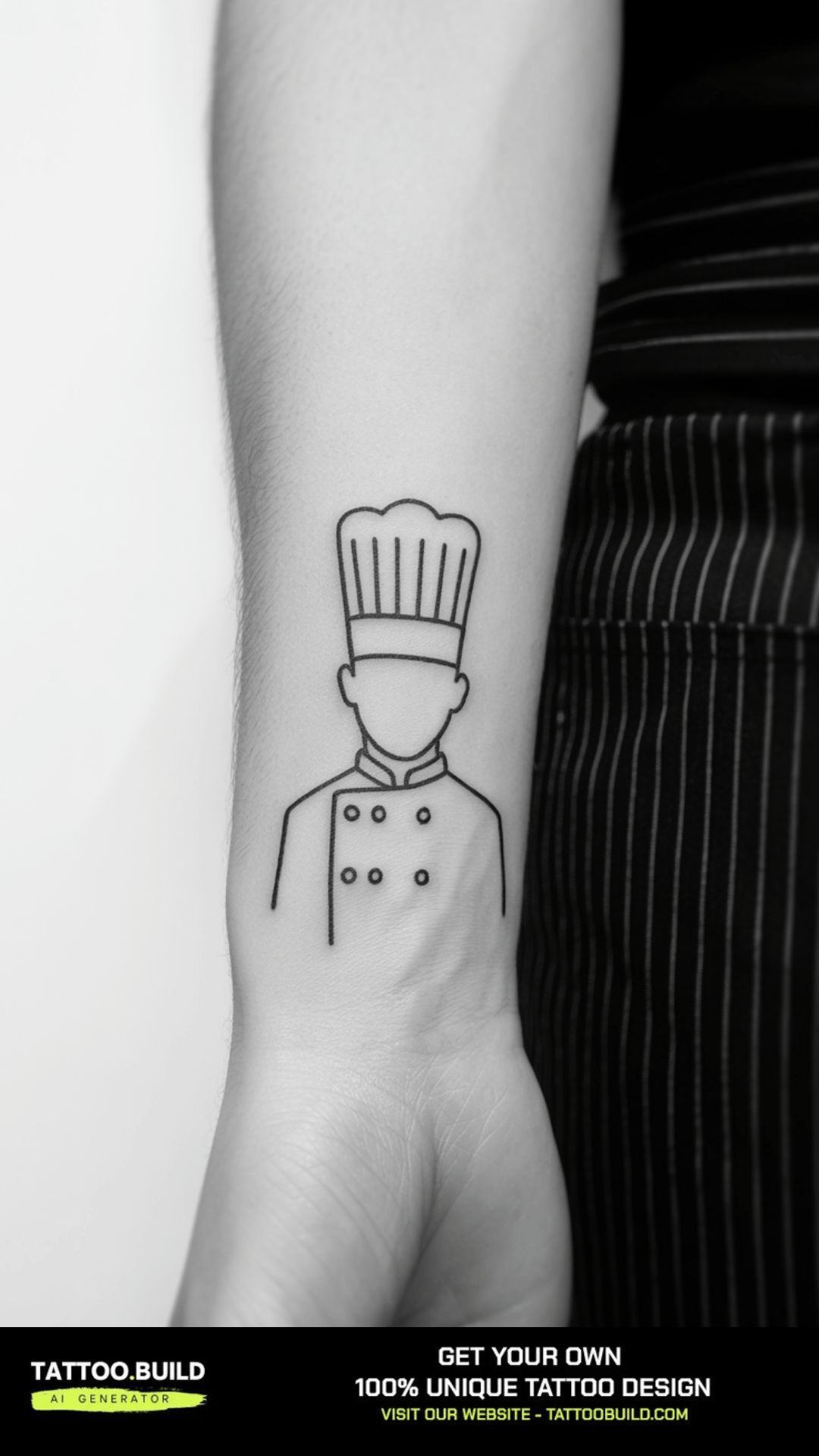
A toque outline is nearly universal shorthand, and it is small, fast and cheap to sit for — often a single short session.
Garment tattoos work the same way. An apron, a jacket, even a dress rendered in fine line reads as a keepsake rather than a job title, which some people prefer.
These are the pieces I recommend to people who want the meaning without the visible statement, because they sit comfortably on the inner bicep or the back of the arm.
5. Cutting Boards and Prep Station Pieces
A cutting board is an unusual choice, and that is exactly why it works.
The shape is simple, the hanging hole gives it a focal point, and a suggestion of wood grain adds texture without adding detail that can blur.
I have seen these done as a base layer with knives, herbs and a mise en place added around them over several sessions — a good approach if you are building slowly.
If that is the plan, look at sleeve filler ideas early, because the negative space you leave now decides what is possible later.
6. Dish Tattoos: Sushi, Pasta and Plated Food
Tattooing a finished dish is the most technically demanding option on this page.
Micro-realism nigiri is the classic example. The rice grains are what make it convincing, and they take a steady hand at that scale.
Pasta, dumplings and pastry all work on the same principle: one recognisable item, rendered properly, rather than a plated composition squeezed onto a forearm.
Be realistic about maintenance. Saturated colour and tight realism are the styles most likely to want a touch-up down the line, and a kitchen is not a gentle environment for either.
If you cook in a Japanese kitchen, it is worth reading about Japanese tattoo designs before committing, both for the visual language and for the etiquette around visible ink.
7. Flames, Heat and the Line
Fire is the one abstract idea that translates cleanly into a kitchen tattoo.
A burner ring, a flame licking around a pan edge, or a simple gas flame silhouette all reference the line without needing a single tool in the frame.
Traditional flame styling reads better than realism here, because real fire has no outline and small realistic flames tend to go muddy.
I have seen flames used well as a connector, too — the element that ties a knife on the forearm to an ingredient piece higher up the arm.
8. Quotes, Mantras and Kitchen Lettering
Kitchen language is short, blunt and made for tattooing: oui chef, mise en place, behind, heard.
Lettering succeeds or fails on the script choice, not the words. A confident hand-drawn script will outlast a typed font every time.
Keep it short. Two or three words hold their spacing as the ink spreads; a full sentence at small size closes up.
Have a native speaker check any phrase in another language before it goes on skin. It is the single most common regret I hear about lettering, and there are more options in the roundup of quote tattoo ideas.
Alternatives and Variations
If none of the above fits exactly, these variations cover most of what is left.
Front of House and Bar Versions
A cocktail shaker, a jigger, a corkscrew or a coupe glass all follow the same design logic as chef tools — long, narrow, recognisable in silhouette.
Bartenders and servers often want the same tribute without the chef signalling, and these read correctly to anyone in hospitality.
Pastry and Baking Pieces
Rolling pins, piping bags, whisks and wheat stalks form a coherent set that looks intentional together rather than random.
Wheat in particular sits beautifully along the forearm, and it carries a second meaning — harvest, patience — that most viewers will read without being told.
Butcher, Fishmonger and Farm Pieces
A cleaver, a butcher’s diagram, a whole fish or a set of shears all belong to the same family and suit heavier traditional styling.
These tend to want more space than a small tool piece, so plan for the upper arm or calf rather than the wrist.
Hands, Fingers and Very Small Placements
Tiny knives on fingers and hands are common in kitchens, and they are also the fastest-fading placement on the body.
Go in expecting touch-ups — the guide to hand tattoo ideas is honest about what that placement costs over time.
Healing a Tattoo While You Are Working the Line
This is the part most chef tattoo articles skip, and it is the part that actually matters, because a professional kitchen is close to a worst-case healing environment.
Heat, steam, constant hand washing, sanitiser, glove sweat and long shifts all work against a fresh tattoo. Surface healing commonly takes around two to three weeks, with the deeper skin settling over a couple of months.
The practical fix is timing: get tattooed at the start of your longest stretch off, and if you can, take a placement that a long sleeve or a glove will not rub all shift.
Follow the aftercare your artist gives you rather than advice from the internet, keep the area clean and unscented, and do not pick. General guidance from the American Academy of Dermatology is a reasonable baseline if you want a second reference.
If you see spreading redness, heat, swelling, pus or a fever, that is a doctor’s call and not something to ride out through service. Allergic reactions to pigment are also possible, sometimes months later — the FDA’s tattoo safety page and its fact sheet on tattoos and permanent makeup explain what to watch for.
None of this is medical advice, and I am not a doctor. Ask your artist about aftercare and a physician about anything that looks like an infection or a reaction.
Common Mistakes, and What to Do If You Are Still Not Sure
The mistake I see most often is copying a stock design instead of a real object. Bring your artist a photo of your own knife, your own station, your own hands.
The second is going too small for the detail. A dish rendered in realism at two inches will not hold; the same subject at four inches will.
The third is planning nothing beyond the first piece. If a sleeve is even a possibility, say so at the first consultation — and get a sense of the numbers from the breakdown of what a sleeve tattoo costs before you start.
If you are undecided between subjects, my honest suggestion is to start with the smallest true thing: a single ingredient, a single tool, on an easy placement. It gives you a real answer about how you heal and how you feel about visible ink.
Frequently Asked Questions
What is the most popular chef tattoo?
The chef knife is far and away the most common, usually placed vertically along the forearm. Whisks, toques and chili peppers come next, largely because they are small, quick and instantly readable. In my experience the knife stays popular because it is the one tool a cook genuinely owns rather than shares. If you want something less expected, a honing steel or a cutting board carries the same meaning with far less repetition.
Where is the best place for a chef tattoo?
The forearm suits most kitchen tools because long, narrow objects match the shape of the limb. The inner bicep and back of the arm are good choices if you would rather the tattoo not be visible in whites. Hands and fingers are common in kitchens but fade fastest and need touch-ups. Consider your workplace dress code before choosing a placement you cannot cover.
How long should I wait before working after getting tattooed?
Most artists will tell you to keep a fresh tattoo clean, dry and unrubbed for the first several days, which is difficult in a working kitchen. Where possible, get tattooed at the start of your longest run of days off. If you must work, ask your artist directly about protecting the area during a shift rather than improvising. Any sign of infection means seeing a doctor, not pushing through service.
Do chef tattoos have to be black and grey?
Not at all, but black and grey does tend to age most predictably, especially in a hot, sunlit environment. Colour works beautifully for produce, plated food and traditional flash, and simply asks for more upkeep. American traditional colour, with its bold outlines, generally holds up better than soft watercolour styles. Talk to your artist about how their colour work has aged on past clients.
Will a visible chef tattoo affect my career in kitchens?
In most professional kitchens today, visible ink is unremarkable, and plenty of respected chefs have hand and neck work. That said, policies still vary by employer, by country and by the formality of the room, and some front-of-house or hotel roles remain conservative. If you move between jobs often, a placement you can cover with a sleeve keeps your options open. It is worth asking directly rather than assuming.
Quick Summary
- Start with a reason, not a design. The chef tattoos that last are tied to a specific knife, station, ingredient or mentor.
- Match style to subject. Fine line suits small tools, black and grey suits knives and produce, traditional suits daggers and banners, micro-realism suits a signature dish.
- The forearm is the natural home for kitchen tools, because long narrow objects follow the shape of the limb.
- Go bigger than feels necessary for anything detailed — realism and fine botanical work are the first things to blur.
- Consider the quiet options: a honing steel, a cutting board, a toque outline or an apron say chef without a blade.
- Plan the space if a sleeve is a possibility, and raise it at your first consultation rather than the third.
- Time the tattoo around your schedule. Heat, steam, sanitiser and glove sweat make a kitchen a hard place to heal.
- Treat infection and reactions as medical issues — ask your artist about aftercare and a doctor about anything that looks wrong.