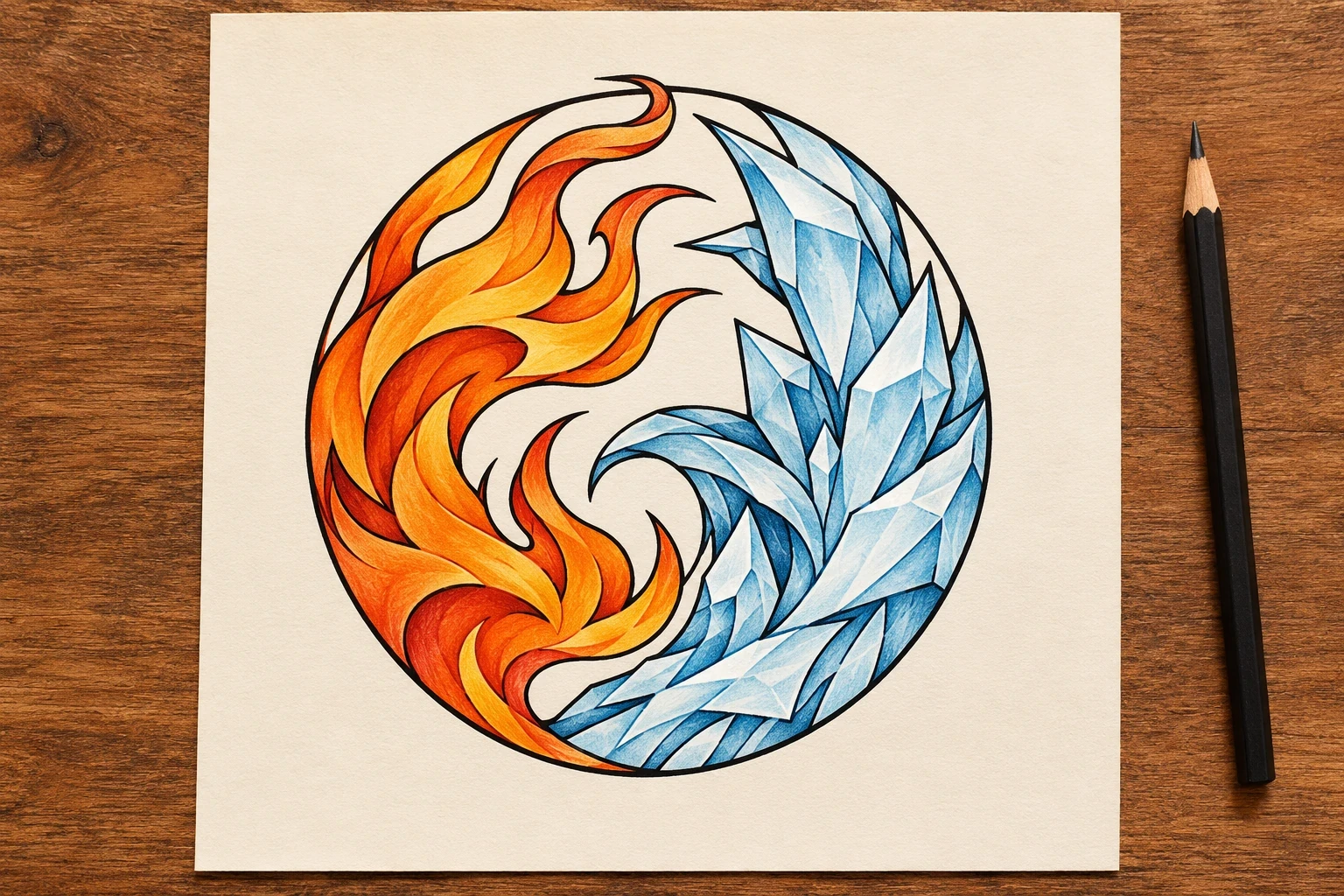
Fire and ice tattoo ideas work through contrast: flowing orange flames against angular blue crystals, or one familiar subject treated in two different ways. The concept can be bold without filling every gap with sparks, smoke and shards. Start with a shape you would still like if the color were removed, then decide where the warm and cool elements belong.
These 17 distinct designs explore portraits, flowers, objects, landscapes and abstract forms. Each uses fire and ice differently rather than repeating one split emblem. A separate hero makes 18 images in total.
Every image is an AI-generated concept, not real or healed client work and not a ready-to-use stencil. Have an artist create an original drawing and check the structure, color choices and placement on your body before tattooing.
Decide what the contrast means to you
You might use fire and ice to express energy and restraint, change and stillness, or two different parts of a relationship. Those are possible personal interpretations, not universal definitions. The design can also be a purely visual choice: soft curves next to sharp facets, warm color next to cool color.
Explain the connection in one sentence before collecting references. “I want two different elements to share one outline” gives an artist a different brief from “I want the elements to remain separate.” Neither requires a claim about your personality or a symbol borrowed from a particular tradition.
Make the contrast readable before adding detail
Choose a dominant outline, then give each element its own visual treatment. A flame can use curved, tapering shapes while ice uses planes and clear angles. If both sides contain the same dense texture, the color may end up doing all the work.
Ask the artist to show a simple black-and-grey version of the arrangement as well as the color drawing. You are checking whether the main subject still reads, not predicting how a particular pigment will heal. Discuss the palette using the artist's healed work on skin tones relevant to yours. The ivory background of a generated image is a design surface, not a promise of that same brightness on skin.
1. Flame curling around a crystal
One flame and one crystal keep the contrast focused. The outer flame supplies a curved silhouette while the tall crystal gives the center a firmer axis.
Keep a clear edge between the two elements. Ask the artist to preserve the main crystal facets before adding smaller sparks or shards.
2. Heart divided between fire and ice
A familiar heart outline contains the two treatments. The warm and cool halves can refer to a personal contrast without requiring a second object.
Check that the outer heart remains balanced. The dividing line should feel intentional rather than like two unrelated drawings pressed together.
3. Rose with warm petals and frost
The flower uses color and surface treatment within one bloom. Orange petals provide a warm focal area while blue outer forms create a cooler boundary.
Ask the artist to organize the petal groups first. Frost accents should remain secondary to a rose that can be followed from center to outer edge.
4. Butterfly with contrasting wings
A central body gives the two palettes one shared structure. The warm side uses flame-like shapes while the cool side uses angular facets.
Count and trace all four wings in the stencil. Keep the wing attachments and antennae clear before deciding how much internal pattern to retain.
5. Wolf framed by flame and ice
The wolf face remains the subject while the outer ruff carries the effects. That division gives the artist room for contrast without rebuilding the muzzle out of crystals.
Check the eyes, ears and muzzle against an animal reference. Keep the main facial features readable together from the intended viewing angle.
6. Two koi with warm and cool accents
Two curving fish let the elements sit beside each other rather than divide one object. An open center can keep the arrangement lighter than a filled circular badge.
Trace each fish from its head through its body to its own tail. Bring fish references and let the artist correct the fins and curves rather than copying generated details literally.
7. Volcanic ridge beside a glacier
A landscape gives the elements separate areas within one scene. A warm streak across rock contrasts with a cooler faceted slope.
Treat this as an imagined landscape unless you supply a real location. Decide whether the ridge, warm streak or glacier should be the strongest focal area.
8. Sword bordered by both elements
A straight blade supplies a firm central line. Curved flames and angular ice can flank it while the guard and grip provide a clear lower endpoint.
Check that the tip, blade, guard and handle stay aligned. Effects should not make the sword edge look accidentally broken or split into extra blades.
9. Hourglass with fire and ice
The hourglass puts a fantasy contrast inside a contained object. Its broad ends and narrow waist give the composition a recognizable outer structure.
This is symbolic imagery, not a model of a functioning device. Keep both glass bulbs and the frame coherent before adding more interior effects.
10. Feather with two treatments
A single quill can hold a long sequence of warm curves on one side and cool angles on the other. The tapered outline gives the concept a natural direction.
Follow the central quill from base to tip. Ask which small barbs should be simplified so the feather remains one connected form at stencil size.
11. Alternating geometric rosette
Repeated points arrange the contrast into a decorative pattern. Alternating flame and crystal forms give the artist a way to control symmetry and density.
Check the point count and spacing in the final drawing. Keep the central opening deliberate instead of filling it merely to add more detail.
12. Phoenix with contrasting wings
A single bird gives the two wings a shared body and direction. Warm feather forms and cooler faceted feathers can remain different while the overall pose stays balanced.
Trace both wing attachments and the tail. Ask for an original fantasy bird drawing with a coherent head and body rather than treating every generated feather as essential.
13. Lotus with flame and crystal petals
Layered petals offer a contained way to compare flowing and angular forms. Warm central petals can pull attention inward while the cool outer layers open sideways.
Keep the petal groups separate in the stencil. If you intend a specific cultural or religious reference, explain it to the artist rather than assuming this decorative treatment supplies one.
14. Comet with two trails
One core and two trailing treatments create a strong direction of motion. The warm trail can curve while the cool trail breaks into clearer facets.
Agree on the direction before placing the stencil. Keep the core identifiable and avoid making the shards look like unrelated objects scattered around it.
15. Open elemental spiral
Two curved forms revolve around a generous central gap. This gives the contrast room to breathe without a face, object or landscape inside it.
Check the open center and the separation between the arcs. Decide whether the ends should approach each other or remain visibly apart.
16. Tree with contrasting branches
One trunk unifies a crown that changes treatment across its width. Flame-shaped leaves and frosted forms can express contrast while remaining connected to the same structure.
Follow the branches back to the trunk. Ask the artist to preserve that structure before increasing the density of leaves, crystals or roots.
17. Flame inside an icy lantern
A small flame gives the center warmth while ice sits on the outside frame. The lantern provides a clear boundary between the two elements.
Check the top loop, glass panels and lower frame as one object. Keep the ice from hiding the parts that make the lantern recognizable.
Choose placement around the outer shape
| Design shape | Useful directions to compare | Stencil check |
|---|---|---|
| Long and tapered | Sword, feather or comet | The main axis follows the intended placement without squeezing the ends |
| Broad and balanced | Butterfly, phoenix or rosette | Both sides can be seen together from the main viewing angle |
| Contained panel | Mountain scene, lantern or hourglass | The border and interior shapes remain separate |
| Open curves | Spiral, paired koi or flame around crystal | The central gap stays deliberate rather than becoming a crowded join |
These are starting comparisons, not fixed placement rules. Ask the artist to put the stencil on the actual area and view it with your body relaxed. Tell them if you might expand the tattoo later; a closed panel creates a different boundary from a loose flame or branch.
For lower-leg proportions, compare our calf tattoo ideas. If you prefer a simpler structure, our minimalist tattoo ideas offer examples of open spacing. Use either collection to describe the shape you want, regardless of the audience named in a title.
Build an artist brief that leaves room to redraw
- Choose the subject. Pick the heart, animal, object or abstract form before choosing a long list of effects.
- Explain the relationship. Should fire wrap around ice, divide the subject, or sit alongside it?
- Name the essential details. A face, blade or flower must remain coherent after the elemental effects are added.
- Set the color priorities. Ask which areas should be warm, cool, dark or open. Review the artist's healed portfolio.
- Check the final stencil. Trace every wing, fish body, petal group or frame edge at the actual size.
For a bird-led direction, compare our phoenix tattoo designs. For a more contained decorative shape, browse our geometric tattoo ideas. An artist can combine the visual principles without copying a finished tattoo or treating a generated drawing as a technical plan.
Plan care alongside the color discussion
Ask for written aftercare instructions and tell the artist about clothing or equipment that will touch the placement. Direct any skin reaction, healing concern or medical question to a clinician. A colorful concept image cannot tell you how your skin will respond to tattooing.
For established tattooed skin, the American Academy of Dermatology notes that UV light can fade some tattoo inks and recommends broad-spectrum, water-resistant SPF 30 or higher sunscreen when in the sun. Ask your artist or clinician when products are appropriate on a fresh tattoo. Source checked November 6, 2026.
Frequently asked questions
What does a fire and ice tattoo mean?
It can express a contrast the wearer chooses, such as movement and stillness or two different sides of a relationship. It can also be an aesthetic preference. There is no single meaning that every fire and ice tattoo shares.
Does it need to be red and blue?
No. The warm-and-cool palette makes the idea explicit in these concepts, but curved flames and angular crystal forms can also be explored in black and grey. Ask the artist to keep the elements visually distinct.
Can a small tattoo include both elements?
It can be explored with fewer shapes, such as one flame around one crystal. Let the artist choose a size that preserves the important gaps. A detailed wolf or landscape may need a different approach from a simple emblem.
Are fire and ice designs only for matching tattoos?
No. One piece can combine both elements. Two people could also use related shapes while choosing different subjects or placements. Decide whether the shared reference matters more than identical artwork.
Can these concepts become part of a sleeve?
They can be starting points for a larger composition. Tell the artist about future work before closing the design inside a frame or adding a dense background. The transitions between pieces deserve their own plan.
Personal interpretations and composition advice are editorial suggestions. Images are AI-generated concepts.