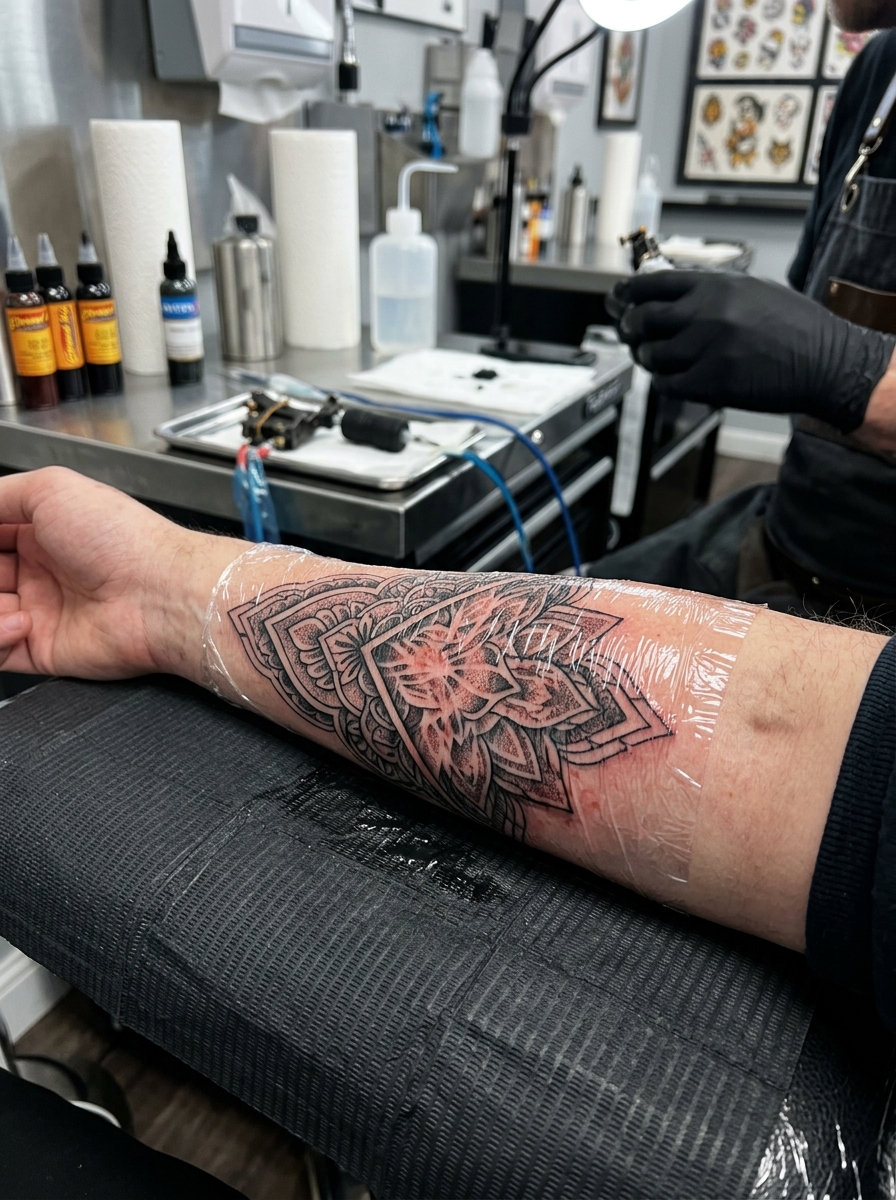
Most tattoos stay wrapped for somewhere between two hours and seven days, and the reason that range is so wide is that it depends entirely on what your artist wrapped you in.
Cling film and adhesive second-skin film are not the same product, and they are not on the same schedule.
I have walked out of studios with plain plastic wrap taped at the corners, with breathable adhesive film sealed edge to edge, and once with a gauze pad that soaked through before I got to my car. Each one came with different instructions, and following the wrong set is the single most common aftercare mistake I see.
This guide walks through each wrap type, how long it actually stays on, what to do the moment it comes off, and the warning signs that mean you should stop reading blogs and call a professional. If you want the wider picture first, our full tattoo aftercare guide covers the whole healing arc.
Which Wrap Are You Actually Wearing?
Before you time anything, identify the material. If you cannot tell what is on your arm, message your artist and ask — every studio I have been to answers that question within the hour.
| Wrap Type | How to Recognise It | Typical Wear Time | Re-Wrap After? |
|---|---|---|---|
| Plastic cling film | Loose, crinkly, taped at the edges, not stuck to skin | 2–6 hours | No, unless your artist says so |
| Adhesive second-skin film | Thin, clear, sticks flat to skin like a giant plaster | First piece ~24 hours | Often yes, one more piece |
| Second-skin, second piece | Applied by you after cleaning | 3–6 more days | No, that is the last one |
| Sterile gauze and pad | Opaque, absorbent, held with tape or mesh | 1–4 hours, change if soaked | Sometimes overnight only |
| No wrap at all | Artist sent you out bare, common for small work | n/a | No — dry heal from the start |
The rest of this article expands each of those rows. Where the table and your artist disagree, your artist wins — they saw the piece, the placement and your skin, and this page did not.
Why a Fresh Tattoo Gets Wrapped at All
A new tattoo is an open wound. Thousands of needle passes have broken the skin barrier, and until that barrier starts to close, anything that lands on it can get in.
The wrap does three jobs at once: it blocks bacteria, it stops fabric and furniture from dragging across raw skin, and it contains the plasma and excess ink that weep out in the first several hours.
That third job is the one people underestimate. A fresh tattoo leaks more than you expect, and it will stain a car seat, a bedsheet and a good shirt without hesitation.
The American Academy of Dermatology’s guidance on caring for tattooed skin makes the same basic point: keep the fresh work covered as your artist instructed, then keep it clean and moisturised once it is uncovered.
What the wrap is not doing is healing the tattoo. It is buying time for your own skin to start doing that, which is why leaving cling film on far past its window works against you rather than for you. Our breakdown of the tattoo healing stages shows what should be happening underneath it.
How Long to Keep Your Tattoo Wrapped, Wrap by Wrap
Plastic Cling Film: Two to Six Hours
Ordinary cling film is a transport wrap. It gets you home without bleeding on anything, and that is the whole of its job.
Because it does not breathe, plasma and ink pool underneath it. Left on for hours past the window, that warm, damp, sealed pocket becomes a far friendlier environment for bacteria than open air.
In my experience most artists using cling film say two to four hours, and a few stretch it to six for a piece that is weeping heavily. I have never had an artist using plain cling film tell me to sleep in it.
When you take it off, do it in the bathroom with lukewarm water already running. Peeling dry film off a fresh tattoo pulls at tacky plasma; a bit of water under the edge makes it lift cleanly.
Adhesive Second-Skin Film, First Piece: Around 24 Hours
Adhesive medical films — Saniderm, Dermalize, Tegaderm and the studio-brand equivalents — are a different category entirely. They are breathable, waterproof and designed to stay sealed to the skin for days.
The first piece still comes off early, though, and the reason is fluid. That initial 12 to 24 hours is when the tattoo weeps hardest, and the film fills with a cloudy plasma-and-ink mixture that looks alarming and is completely normal.
Every artist I have asked put the first piece somewhere in the 8-to-24-hour range, with the earlier end reserved for pieces that are filling up fast. Saniderm’s own recommended instructions follow the same two-stage pattern.
Take it off sooner if the seal breaks. A lifted edge lets fluid out and everything else in, and a leaking bandage is worse than no bandage. Our guide to Saniderm tattoo healing walks through application and removal in more detail.
The Second Film: Three to Six More Days
After the first piece comes off, you wash the tattoo, dry it completely, and apply a fresh sheet. That second piece is the one that carries you through most of the surface healing.
Three to six days is the usual span, and total wear across both pieces is generally kept to about a week. Past that, the adhesive starts irritating skin that is already sensitised.
The second piece should stay much clearer than the first. A little fluid is fine; a pocket that is filling up again means you should take it off, wash, and switch to open-air healing.
Do not re-apply a third piece unless your artist specifically told you to. By day seven the tattoo usually wants air and lotion far more than it wants another seal.
Sterile Gauze and Pad Dressings: Hours, Not Days
Some artists, particularly for heavy blackwork or large solid fills, send you out with an absorbent pad rather than film. These soak through fast.
Check it after an hour or two. If the pad is saturated, change it — a wet dressing sitting against a wound is doing the opposite of protecting it.
The risk with gauze is that dried plasma glues the fibres to the tattoo. When I have had to remove one that stuck, running lukewarm water over it for a minute before lifting made the difference between a clean removal and a painful one.
Never dry-rip a stuck gauze pad off a fresh tattoo — you can pull ink and scab with it and end up needing a touch-up.
Re-Wrapping Overnight: Only in Specific Cases
The most common question I get after “how long” is “should I put it back on to sleep?” For cling film, the default answer is no.
Sealing a washed tattoo under non-breathable plastic for eight hours traps moisture with nowhere to go. Most artists would rather you slept on an old dark sheet.
There are exceptions. Very large pieces that are still weeping heavily on night one, or work in a spot that will be pressed against bedding all night, sometimes get a loose overnight re-wrap on the artist’s instruction.
If you are re-wrapping, it should be because your artist told you to, with a clean sheet of film, and it comes off first thing in the morning.
Why Placement and Size Change the Answer
A two-inch piece on a forearm and a full back panel are not on the same timeline, even under the same product.
Larger areas weep more and for longer, so the first film often comes off nearer the early end of the range simply because it fills faster.
High-movement spots — elbow ditch, back of the knee, ribs, hands — break the adhesive seal early because the skin folds and stretches constantly. I have had a knee piece lift at the crease inside twelve hours.
Placement drives a lot of the aftercare experience, the same way it drives the sitting itself — our most painful tattoo spots guide covers which areas give you the most trouble both during and after.
Where the Wrap Sits in the Wider Healing Timeline
It helps to remember that the wrap covers only the opening act. Surface healing usually takes two to three weeks; the deeper layers keep settling for a couple of months.
So the wrap question is really about days one through seven at most, and the other 95 per cent of healing happens with nothing on the tattoo but clean hands and a thin layer of lotion.
Getting the wrap stage right mostly buys you a cleaner start, not a faster finish.
If you want the full arc mapped out week by week, see how long a tattoo takes to heal.
Variations on the Standard Wrap Routine
If Adhesive Film Irritates Your Skin
Some people react to the adhesive rather than the ink. The tell is a red border following the exact outline of the film, with clear skin inside it.
If that happens, remove the film and switch to open-air healing with a light lotion. Persistent itching, blistering or a spreading rash is a reason to speak to a doctor rather than tough it out.
Dry Healing With No Wrap at All
Small fine-line pieces and single-needle work are sometimes sent out bare, because the trauma is minimal and there is very little weeping to contain.
That is a legitimate approach when the artist chooses it. It is not something to decide for yourself after a four-hour colour session.
Wrapping for Work, Not for Healing
If you work somewhere dusty, greasy or genuinely dirty, a fresh tattoo needs covering during shifts well past the normal wrap window.
Tell your artist before the appointment. In my experience they will either put you on the two-piece film schedule or give you a covering plan for the days you are on site — and it comes off the moment you are home.
The Gym, the Pool and the Bath
Second-skin film is waterproof enough for showers, but that is not the same as being safe to submerge.
Pools, lakes, hot tubs and long baths all stay off the list until the tattoo has closed over — usually two to three weeks, not two to three days. There is more detail in our guide on how long after a tattoo you can swim.
What to Do the Moment the Wrap Comes Off
Wash your hands first, properly, before you touch anything. This is the step people skip and it is the one that matters most.
Then wash the tattoo itself with lukewarm water and a fragrance-free liquid soap, using clean fingertips only. No cloths, no loofahs, no scrubbing — you are lifting off plasma, not exfoliating.
Pat it dry with a clean paper towel and give it ten minutes of air before anything goes on it. Applying ointment to a still-damp tattoo traps moisture and is a reliable way to end up with a bumpy, irritated heal.
Then a thin layer of unscented aftercare product — thin enough that the tattoo looks matte, not glossy. Twice or three times a day is plenty. Our roundups of the best lotion for tattoos and of Aquaphor for tattoo healing cover what to reach for and how much is too much.
Common Wrapping Mistakes — and When to Get Help
The mistakes I see most often are leaving cling film on overnight, re-wrapping a washed tattoo in the same used film, and pulling a stuck dressing off dry.
Close behind those: applying second-skin film to skin that is still damp, so it never seals properly, and panicking at the cloudy fluid under a film that is behaving exactly as designed.
Some symptoms are not aftercare questions at all, and this article is not medical advice. Spreading redness that grows rather than fades, heat radiating from the area, pus, a foul smell, a fever, or pain that worsens after day two all warrant a call to a doctor — not another wrap.
Mayo Clinic’s overview of tattoo and piercing risks lists the infection and allergy signs worth knowing before you need them.
For anything that is cosmetic rather than clinical — patchy spots, a line that healed light — go back to your artist first. Most reputable studios expect that, and our guide to how often tattoos need a touch-up explains what is normal to ask for.
Frequently Asked Questions
Can I sleep with my tattoo wrapped?
With plain cling film, usually not — it traps moisture against the wound for eight hours with no ventilation. With adhesive second-skin film you sleep in it as a matter of course, because that product is designed for multi-day wear. If your artist specifically asked you to re-wrap overnight for a large or awkwardly placed piece, use a clean sheet of film and remove it in the morning. When in doubt, message the studio rather than guessing.
What does the cloudy fluid under my film mean?
That is plasma mixed with excess ink, and it is the normal output of a fresh tattoo in its first day. It often looks murky, sometimes almost black, and it can pool visibly under second-skin film. What is not normal is thick yellow or green fluid, a bad smell, or the pocket refilling heavily days later. If the film has lifted at an edge and fluid is escaping, take it off, wash the area, and either re-apply a fresh piece or let it heal open.
What happens if I left my wrap on too long?
In most cases, nothing dramatic. Take it off, wash the tattoo gently with lukewarm water and fragrance-free soap, pat dry, and carry on with normal aftercare. The reason to avoid it is that a sealed, damp environment past its window raises the risk of irritation and bacterial growth. Watch the area more closely for the next couple of days, and see a doctor if redness spreads, heat builds, or pain increases rather than settles.
Can I shower with second-skin film on?
Yes — that waterproof seal is one of the main reasons artists use it. Keep showers reasonably short and avoid blasting the film directly with hot water at close range, which can loosen the adhesive at the edges. Pat the outside of the film dry afterwards. Submerging is a different matter: baths, pools and hot tubs stay off the list until the tattoo has fully closed over.
My artist’s instructions differ from this article — who do I follow?
Your artist, every time. They know which product they used, how heavily the piece was worked, where it sits on your body and how your skin took it. Aftercare guidance online is necessarily general; theirs is specific to the tattoo on you. If their instructions are unclear or you have lost the card, ask them to repeat it rather than defaulting to a stranger on the internet.
Quick Summary
- Identify the wrap first — cling film and adhesive second-skin film run on completely different schedules.
- Plain cling film usually comes off in two to six hours and is not slept in.
- The first piece of second-skin film typically comes off around the 24-hour mark, sooner if it fills or lifts.
- A second film piece carries you another three to six days, keeping total wear to roughly a week.
- Gauze pads are hours-only and must be softened with water before removal, never dry-ripped.
- Wash with lukewarm water and fragrance-free soap, air-dry ten minutes, then a thin layer of lotion.
- Cloudy plasma under the film is normal; pus, spreading redness, heat or fever means call a doctor.
- Where this guide and your artist disagree, follow your artist.