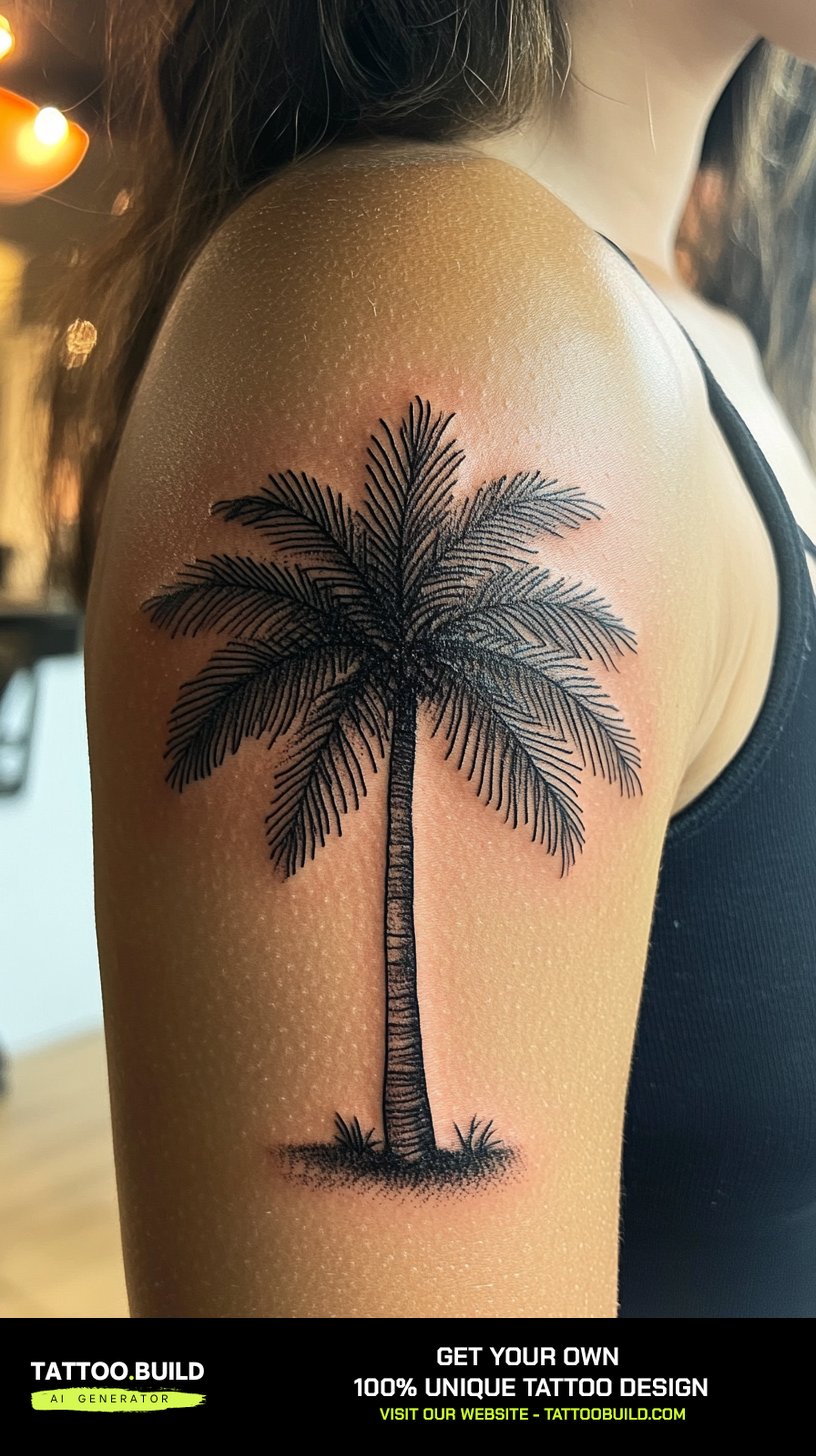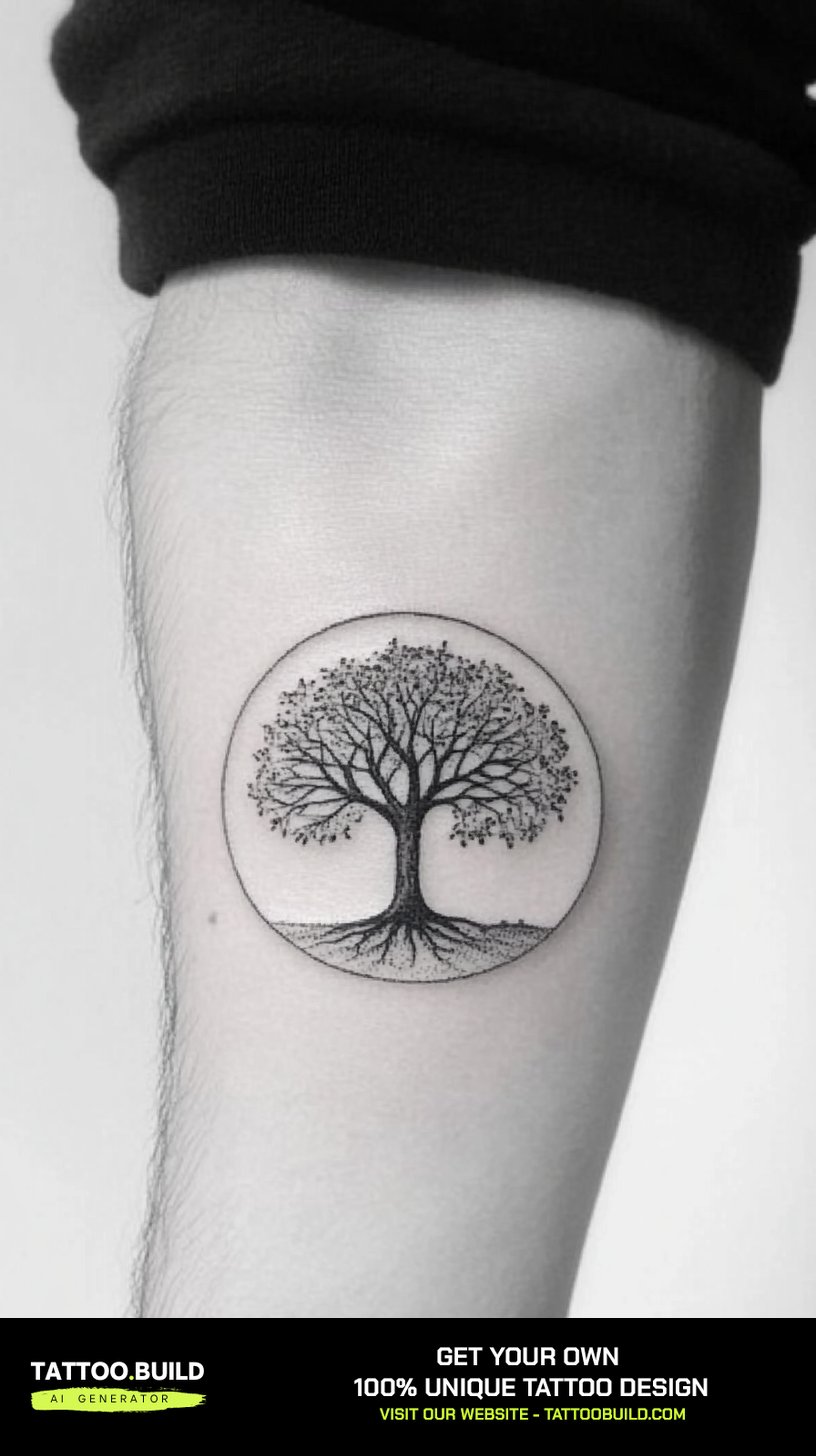
I have drawn more trees in sketchbooks than any other tattoo subject, and I still find them the hardest to get right. A tree tattoo drawing lives or dies on the spaces between the branches, not on the branches themselves.
Every artist I have asked says the same thing in different words: pack the canopy too tightly and it heals as one grey blob after five or six years.
So this guide is organised the way I actually think about tree drawings — by structure. Bare branches, knotwork roots, geometry, conifers, and the symbolic add-ons like hearts, moons and hourglasses.
There are 32 designs below, all of them drawings rather than healed photographs, which is deliberate: a drawing shows you the linework a stencil is built from. If you want a broader look at the format first, I have a wider collection of tree tattoo drawing references to browse alongside this one.
Which Tree Tattoo Style Is Right for You?
This is the comparison I sketch out for anyone who tells me they want “a tree” and nothing more specific.
| Style | Smallest size that works | How it ages | Best for |
|---|---|---|---|
| Fine line | About 4 in / 10 cm tall | Softens fastest; thin twigs can fade or merge | Forearm, ribs, anyone wanting a light, airy tree |
| Blackwork / tribal | About 3 in / 8 cm tall | Holds shape longest; solid black just gets softer at the edges | Calf, outer arm, high-contrast designs |
| Dotwork / stipple | About 5 in / 13 cm tall | Dots spread slightly and blend into soft grey | Canopies, shading behind a moon or sun |
| Geometric / mandala | About 5 in / 13 cm tall | Well, if the straight lines are spaced; crowded geometry blurs | Chest, back, symmetrical placements |
| Realistic grey wash | About 6 in / 15 cm tall | Needs the most size and the most careful shading | Back, thigh, half sleeve |
| Celtic knotwork | About 4 in / 10 cm tall | Very well when the weave is drawn with visible gaps | Shoulder, inner forearm, heritage pieces |
Why Tree Tattoos Age Differently Than Almost Anything Else
Most tattoo subjects have one or two areas of fine detail. A tree has hundreds of them, all clustered at the top of the design.
That cluster is the problem. Ink spreads a little in the skin over the years, and when twigs sit closer than roughly a needle-width apart, they eventually touch.
In my experience the drawings that still read well after a decade are the ones where you can see daylight through the canopy in the original sketch — not just in the stencil, but on paper.
Roots have the opposite issue. They are usually thicker, so they hold, but a root system drawn as a symmetrical fan tends to look stiff once it wraps around a limb.
None of this is a reason to avoid detail. It is a reason to talk to your artist about which details are structural and which are decoration, because the decoration is what gets simplified when the piece is scaled to your body.
32 Tree Tattoo Drawing Ideas, Grouped by Structure
I have sorted these by how the drawing is built rather than by mood, because that is the decision that actually changes your stencil.
1. Bare-Branch Trees With Exposed Roots
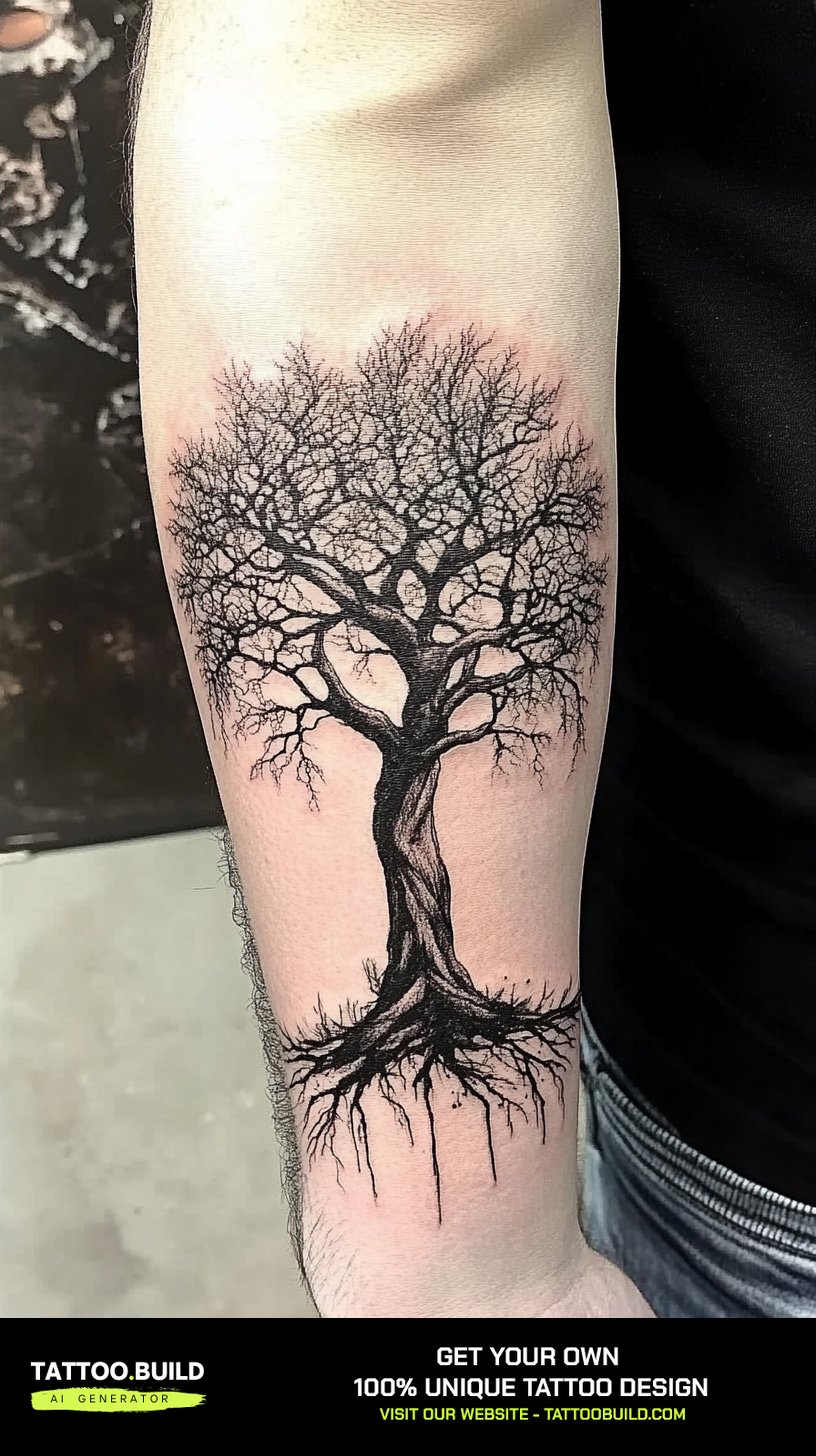
Bare trees are the honest starting point. With no leaves to hide behind, every line has to earn its place.
These age better than almost any other tree drawing because the branches are individually drawn and individually spaced, rather than implied by a mass of foliage.
The three below show the range: one with spiralling decorative twigs, one in soft graphite shading, and one with a heavy black trunk that twists before it splits.
When I tested a bare-branch design on my own forearm, the artist thickened every branch by about 20 percent from the drawing. It looked wrong on paper and correct on skin.
2. Mandala and Geometric Tree Drawings
Geometry gives a tree a frame, and a frame is what stops an organic shape from drifting on the body. If you like the structured look generally, the wider geometric tattoo designs collection covers the same logic applied to other subjects.
Two of the drawings here put a mandala where the ground would be, so the roots spill over an ornamental disc rather than into empty space.
The third uses sacred-geometry framing — a circle, stacked triangles and a rayed sun — which turns a small tree into a full composition without making the tree itself bigger.
The trade-off is precision. Straight lines next to organic ones expose any wobble, so this is not the style to hand to an artist who mostly does traditional work.
3. Celtic Tree of Life and Knotwork Roots
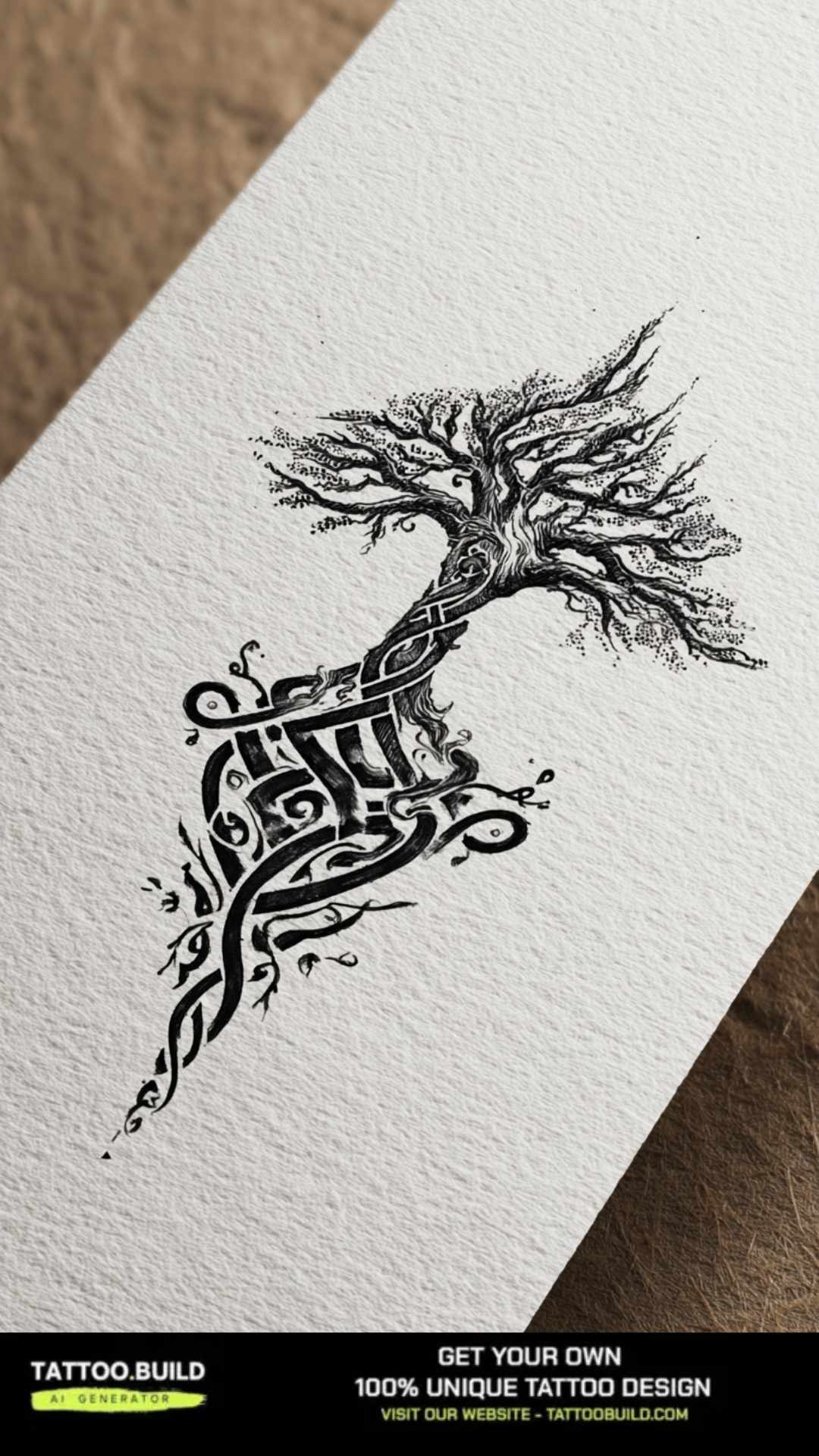
The tree of life shows up in Celtic, Norse and several other traditions, usually as a single unbroken line that has no start and no end.
That unbroken weave is the whole point of the symbol, so I would not let an artist simplify it away. There is more on the motif in this tree of life tattoo guide.
Knotwork roots also solve a practical problem: they give the bottom of the design a definite edge, which is useful on a shoulder or a calf where a fading root system would look unfinished.
If you want a Norse framing instead, the world tree Yggdrasil is the usual reference point — Britannica has a short primer if you want the mythology before the tattoo.
4. Fine-Line Leafy Trees
Fine-line trees are the most requested version I see, and the most frequently drawn too delicately. The general rules in this fine line tattoo ideas guide apply here too.
The two windswept drawings below are effectively a matching pair, which is why they turn up as couple or sibling pieces.
Leaves should be drawn as individual marks, not as a texture. Every artist I have asked prefers fewer, larger leaves over a cloud of tiny ones for exactly this reason.
Expect a fine-line tree to need a touch-up sooner than a blackwork one. That is not a flaw in the design; it is the cost of the look.
5. Pines, Spruce and Full Forest Scenes
Conifers behave differently from broadleaf trees. Their silhouette carries the design, so they stay readable at sizes where an oak would turn to mush.
That makes them the safest choice for a small piece, and the reason they pair so naturally with peaks — see mountain and tree tattoo designs for that combination.
A treeline reads as a place; a single pine reads as a feeling. Deciding which one you want is worth doing before the consultation, not during it.
The six drawings here run from a single minimal spruce to a full blackwork stand of trees, plus versions with a moon or sun set behind the canopy.
6. Trees Growing From an Anatomical Heart
This one has become a modern classic, and it works because the heart does a job: it replaces the root ball with something that has its own visual weight.
The risk is competition. A fully rendered anatomical heart and a fully rendered canopy will fight each other, so one of the two has to be the quieter element.
In both drawings below the heart carries the shading and the branches stay in clean line work, which is the balance I would recommend.
Birds leaving the branches are optional. They add movement, but they also add small isolated marks that need their own space to survive.
7. Sun, Moon and Sky Trees
Adding a celestial body behind a tree is the cheapest way to give a drawing depth, because the disc creates instant negative space.
Position matters more than size here. A moon tucked behind the canopy reads as depth; a moon floating above it reads as two separate tattoos.
The bonsai-style drawing below is my favourite of the three — the sun sits directly on the canopy rather than behind it, so the two shapes interlock.
Dotted or rayed sunbursts are also a good place to hide the transition between a tree and open skin, which helps on placements with no natural border.
8. Time-Themed Trees: Clocks and Hourglasses
A pocket watch built into a trunk, or a tree growing out of an hourglass, is usually about a specific date rather than about nature.
These need size. A watch face with roman numerals under about 3 inches will lose the numerals within a few years, and the piece stops making sense.
If you are marking a loss, tell the artist that up front. It changes how much weight they give the object versus the tree, and it is worth being direct about.
9. Tribal, Blackwork and High-Contrast Trees
Solid black is the most durable thing you can put in skin, which is why bold tribal work outlasts almost everything else. The blackwork tattoo designs guide goes deeper on that.
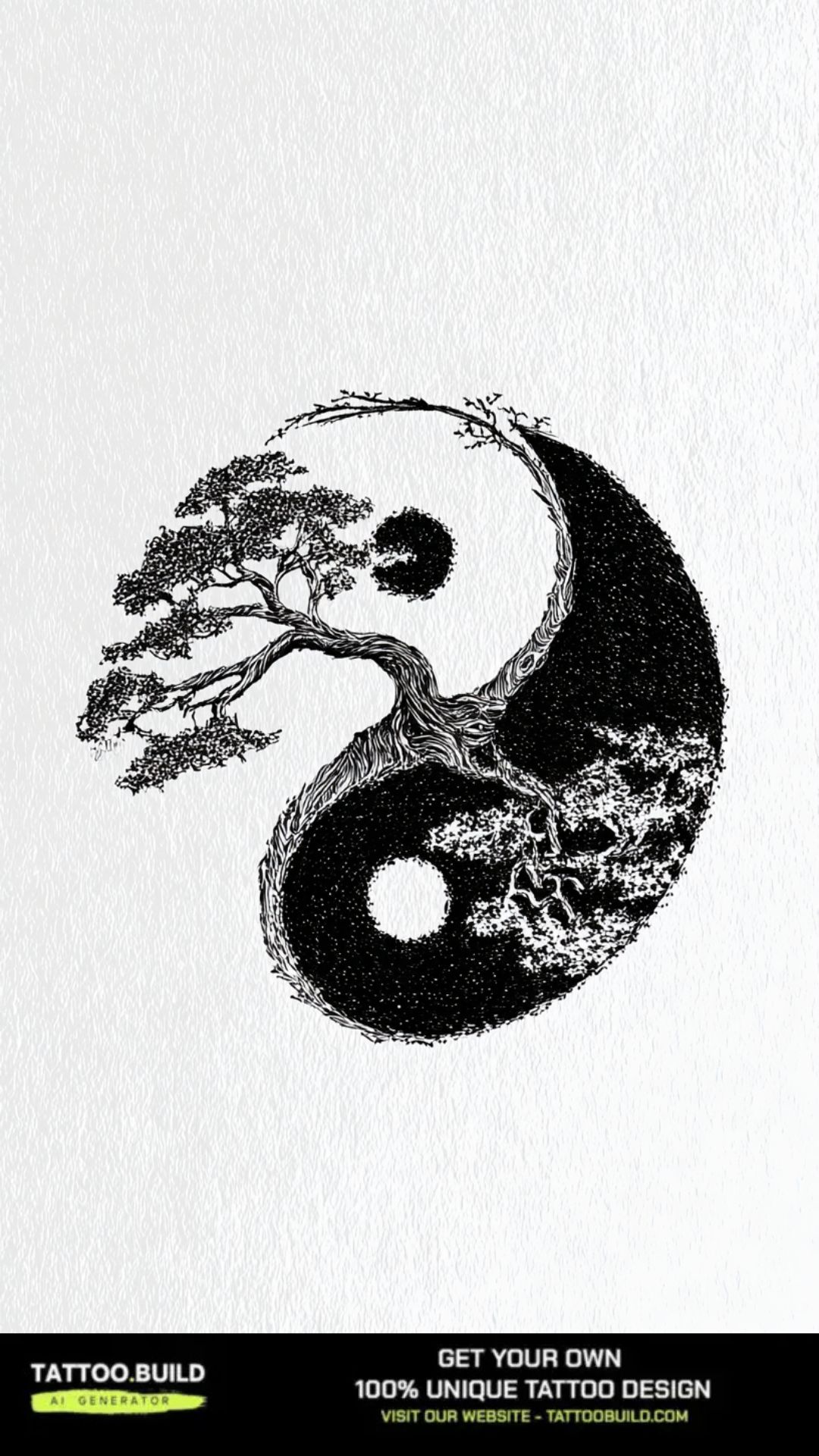
The yin and yang tree below is the smartest use of black on this page — one half is solid, one half is negative space, and the design would still read from across a room.
The tribal palm and the dreamcatcher tree are less flexible. Both are strongly styled, so they suit people who already know they want that visual language.
10. Broad Oaks and Family Trees
A wide, round canopy is the shape most people picture when they say “tree,” and it is the one that most often needs to be scaled up.
Two of these carry lettering — a single word in one, names woven into the canopy in the other. If that is the direction you are going, the memorial tattoo ideas collection is worth reading first.
Lettering inside a canopy is a long-term commitment in a way the tree is not. Branches can be added later; names are much harder to remove or rework.
The third drawing swaps realistic roots for decorative curls, which is a good compromise when the tattoo needs a defined bottom edge on a flat area of skin.
Placement Changes the Drawing More Than the Style Does
The same sketch becomes three different tattoos depending on where it lands, and most of the redrawing happens for this reason rather than for aesthetics.
Forearm and Inner Arm
The forearm is a rectangle, so tall narrow trees — pines, spruce, slender bare trunks — need the least reworking. Browse forearm tattoo ideas for a sense of the proportions that work there.
Round oaks usually have to be flattened or cropped, and that is where a lot of the original drawing gets lost.
Spine and Centre Back
A spine placement lets the roots run down naturally, which suits the tree-and-hourglass or tree-and-heart compositions particularly well.
It is also one of the more uncomfortable placements, so plan for a longer session or split it across two.
Calf, Thigh and Shoulder
These give you a curved canvas, which is generous with round canopies and unkind to strict geometry.
If you have picked a mandala tree, the shoulder blade or the centre of the chest will hold the symmetry better than a calf will.
Turning a Drawing Into a Tattoo That Lasts
Bring the drawing, but bring it as a starting point. In my experience the artists who change the most on paper are the ones whose work still looks sharp years later.
Ask specifically how the design will be simplified at your chosen size — not whether it will be, because it always is.
On healing, follow the aftercare your artist gives you rather than anything you read online, including here. If something looks infected, swells, or is still painful after a few days, see a doctor rather than waiting it out; Mayo Clinic’s overview of tattoo risks is a reasonable place to understand what is and is not normal.
Ink reactions are uncommon but real, and they are not something to self-treat. The FDA’s consumer guidance on tattoo inks covers what to watch for. And to be blunt: never let anyone tattoo or attempt to remove a tattoo outside a licensed, sterile studio.
Still Not Sure? The Mistakes I See Most
Going too small is the big one. A tree at 2 inches is a shrub-shaped smudge in five years, and no artist can rescue it later.
Second is copying a drawing exactly. These sketches are references for structure and mood, not stencils, and a good artist will want to redraw them for your body.
Third is picking the tree before the meaning. If it is really the outdoors you are drawn to, nature tattoo ideas might fit better than a single specimen tree.
And if you are after something warmer and more graphic than a temperate tree, the palm tree tattoo collection is a completely different mood built from the same basic parts.
Frequently Asked Questions
How big should a tree tattoo be?
For a detailed broadleaf tree with a full canopy, I would not go under about 6 inches / 15 cm tall. Conifers and bold blackwork trees can work at 3 to 4 inches because the silhouette carries them. The deciding factor is not the tree, it is how many separate marks sit inside it. Ask your artist to show you the stencil at actual size before committing.
Do tree tattoos hurt more than other designs?
Not because they are trees. Pain depends almost entirely on placement, session length and your own tolerance. That said, tree tattoos are often long, vertical pieces on the spine, ribs or forearm, which means longer sessions in sensitive areas. Splitting a large tree across two appointments is normal and worth asking about.
What does a tree tattoo actually mean?
Most commonly growth, roots, family and endurance, though the meaning shifts with the version. A tree of life in Celtic or Norse form carries a specific mythological weight, while a tree growing from a heart or an hourglass is usually personal and about a particular event. Nothing forces you to adopt the traditional meaning. In my experience the pieces people are happiest with are the ones where they picked the meaning first and the style second.
Will a fine-line tree tattoo blur over time?
It will soften, yes — all tattoos do, and thin lines show it soonest. How fast depends on placement, sun exposure and how densely the canopy was drawn. Trees on hands, feet and inner forearms tend to change fastest. A touch-up every several years keeps a fine-line tree crisp, and most artists expect that.
Can I combine a tree with a portrait or lettering?
Yes, and names woven into a canopy is one of the oldest versions of this tattoo. Just decide which element is the focus, because a fully rendered face and a fully rendered tree will compete. Lettering is also much harder to change later than branches are. If there is any chance the names might change, keep them separable from the tree.
Quick Summary
- Space beats detail — a canopy you can see through is what still reads in ten years.
- Conifers survive small sizes; broad oaks and grey-wash realism need 6 inches or more.
- Blackwork and Celtic knotwork are the most durable structures on this page.
- Fine-line trees look best on day one and need touch-ups soonest. Both things are true.
- Add-ons like hearts, moons, watches and hourglasses should be quieter than the tree, or the tree should be quieter than them.
- Placement rewrites the drawing: tall narrow trees for forearms and spines, round canopies for chest, back and thigh.
- Bring the sketch as a reference, not as a stencil, and expect your artist to redraw it.
- For healing questions, infection or any reaction to the ink, talk to your artist and a doctor rather than the internet.