An infinity tattoo only works when the two loops are given enough room to stay open — everything else about the design is negotiable.
I have lost count of how many infinity pieces I have looked at closely, and the ones that still read well years later almost always share that one trait.
The symbol itself is old. The mathematician John Wallis introduced the lemniscate (∞) as a sign for infinity back in 1655, and tattooing borrowed it much later as shorthand for endless love, memory and continuity. If you like small symbolic work generally, our guide to minimalist tattoo ideas covers the same design logic.
What follows is a practical walk through the versions that hold up — plus the ones that quietly disappoint people two years in.
Which Infinity Tattoo Style Is Right for You?
There is no single best version. There is only the version that matches your placement, your pain tolerance and how much upkeep you are willing to accept.
| Style | Best for | Typical size & spot | Ageing & upkeep |
|---|---|---|---|
| Classic bold loop | A first tattoo, or anyone who wants zero fuss | 4–7 cm, wrist or inner forearm | Best of the group; usually decades before a touch-up |
| Fine-line micro | Discreet placements and hidden meaning | 2–4 cm, wrist, ankle, behind the ear | Softens fastest; expect a refresh in roughly 5–8 years |
| Floral or botanical | Anyone who wants a larger, decorative piece | 12–25 cm, upper back or outer forearm | Good, if the artist leaves negative space between petals |
| Symbol mash-up (crown, paw, butterfly) | Marking a specific person, pet or milestone | 5–9 cm, forearm or calf | Depends entirely on the added element’s detail level |
| Ribbon or 3D shaded | People who want the symbol to look sculptural | 8–15 cm, forearm or calf | Grey wash lightens; the outline is what saves it |
| Thorn or barbed | A harder edge without changing the symbol | 10–18 cm, nape or upper back | Strong, provided the thorns are not micro-fine |
What Actually Decides Whether an Infinity Tattoo Ages Well
Ink spreads slightly under the skin over years. That is normal biology, not bad work.
The practical consequence is simple: whatever gap you leave between two lines today will be narrower in a decade. On an infinity symbol, the crossover point in the middle is where those lines sit closest together.
When I have compared healed pieces, the ones that turned muddy were nearly always tiny designs where the loops were drawn with hairline strokes only a millimetre or two apart.
Placement matters almost as much. Hands, fingers and feet see constant friction and sun, and in my experience they are the placements people come back to touch up first.
Sizing up by even a centimetre often solves both problems at once. Most artists I have asked will suggest it themselves if you let them.
Infinity Tattoo Designs Worth Considering
These are grouped by how they actually behave on skin, not just by how they look on a screen.
The Classic Loop
This is the version most people picture, and it is still the one I would recommend to someone getting their first tattoo.
A single continuous line, slightly thicker at the outer curves and tapering toward the crossover, gives the shape movement without any added elements.
Bold beats delicate here. A 2–3 mm line will hold its shape long after a hairline version has softened into a grey smudge.
The inner wrist and inner forearm are the two placements where I see this design look best, mostly because the skin there stays relatively protected.
Fine-Line and Micro Versions
Small infinity tattoos are popular for a reason — they are quick, affordable and easy to hide.
They are also the least forgiving. Every artist I have asked about micro work says the same thing: the smaller the design, the sooner you will be back for a touch-up.
If you want one anyway, ask for the loops to be drawn slightly more open than the reference image. It looks marginally less dainty on day one and considerably better on year eight.
The same trade-off applies across all small work, which we get into in our fine-line tattoo ideas guide.
Floral Infinity Tattoos
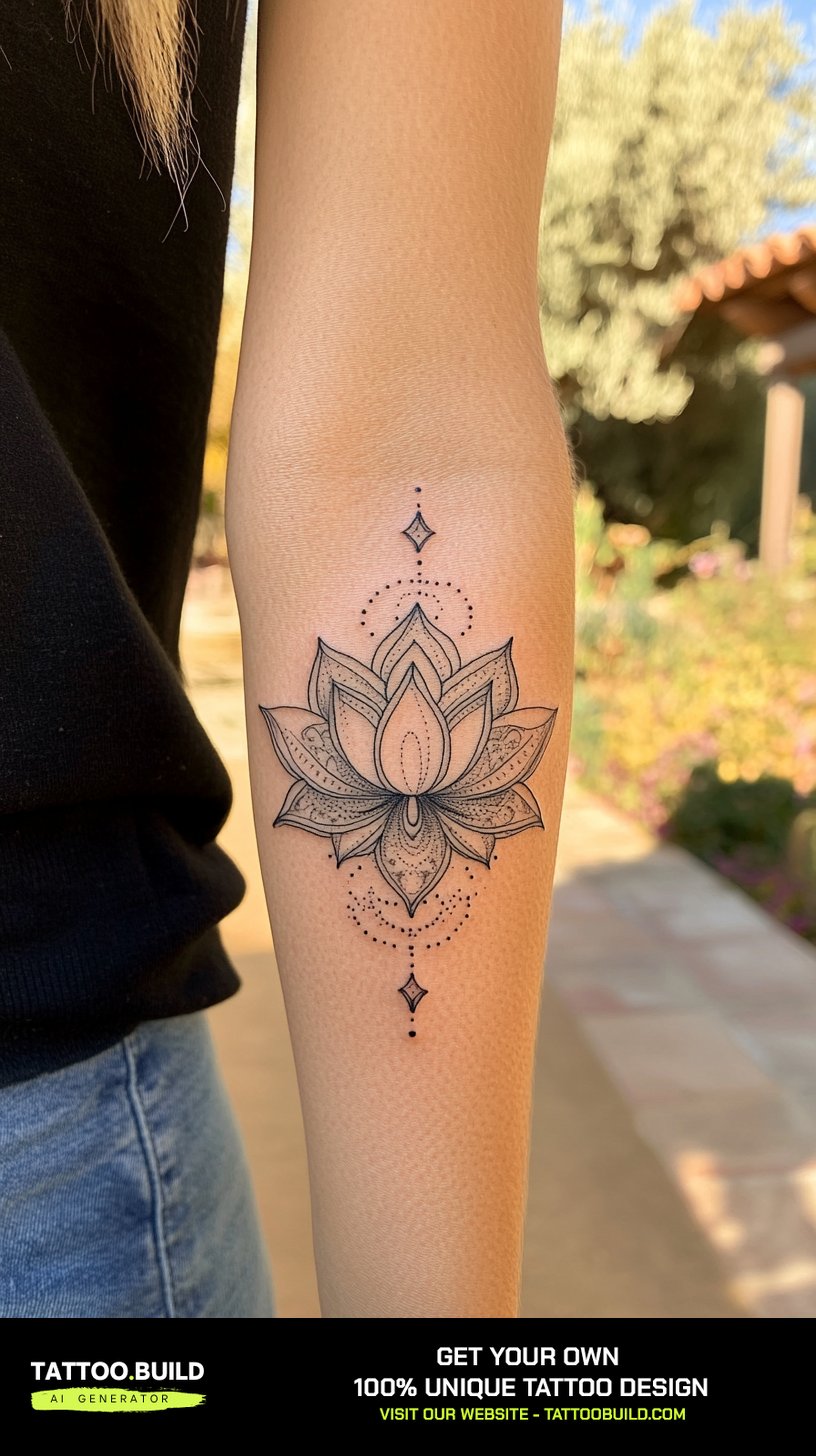
Adding flowers turns a two-inch symbol into a genuine piece of body art, and it is the direction I see most often on backs and shoulders.
Peonies and roses fill space quickly; smaller blooms like hibiscus or cherry blossom keep things airier.
Ask for negative space between the petals. Densely packed florals look spectacular fresh and can lose definition as they settle.
Colour is optional. Of the pieces below, only one uses red, and the black-and-grey versions arguably read more clearly from across a room.
Back placements let the design breathe, and the spine gives the symbol a natural centre line to sit on.
They are also easy to cover for work, which is part of why I think they are underrated compared to wrist pieces.
Vines, Leaves and Botanical Linework
Vine versions trade flowers for foliage, which usually means less black in the design overall.
Turning the symbol vertical is the trick that makes these work on a forearm — the loops follow the limb instead of cutting across it.
Leaves are the first detail to soften with age, so a few larger leaves generally outlast a scattering of tiny ones.
I have seen these done as cover-ups over older script tattoos too, since the trailing ends can be extended to hide unwanted linework.
Birds, Butterflies and Winged Add-Ons
Butterflies and birds are the two most requested additions I come across, usually tied to transformation or to a specific person.
Stacking works better than overlapping. Putting the butterfly above the loop keeps both silhouettes intact, whereas crossing them tends to muddle the middle.
Two birds instead of one is a common way to represent a pair of people without printing a name on your arm.
Wing detail is where these age unevenly. Solid bodies with simpler wing patterning hold up better than heavily stippled versions.
Crowns, Paws and Hearts
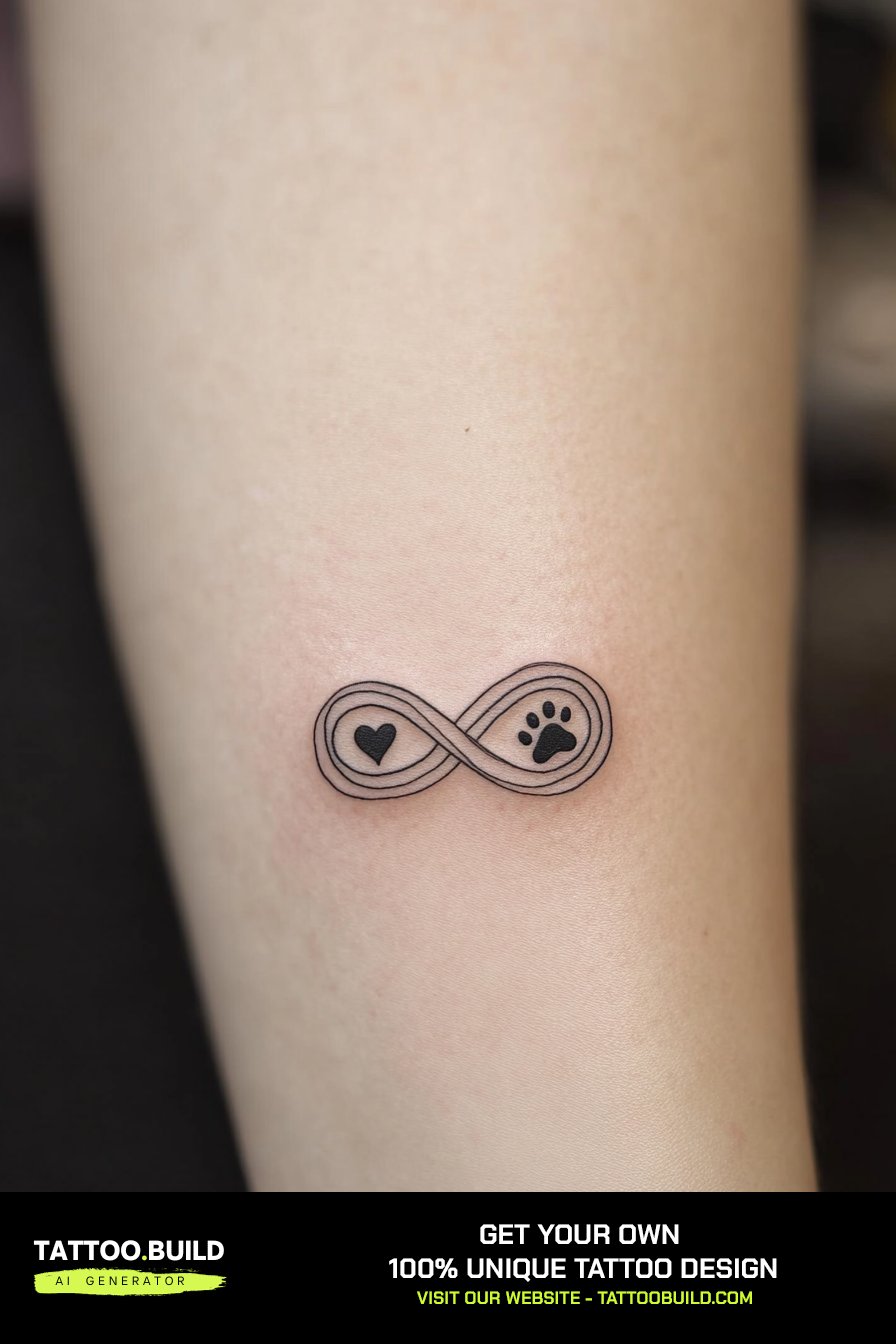
This is the personalisation category — the add-on carries the meaning and the infinity loop carries the “forever” part.
Crowns tend to be chosen for self-worth or for family, and a simpler crown outline scales down to the wrist far better than an ornate one.
Paw prints are almost always about a pet, and I think they are one of the better quiet memorials — no dates, no name, no explaining it to strangers.
If you are marking a person rather than an animal, look at memorial tattoo ideas before committing to a symbol.
Ribbon, Rope and 3D Shaded Versions
Shading turns the flat symbol into something that looks twisted through space, like a ribbon caught mid-turn.
These take real time. A properly rendered ribbon infinity is a two to three hour sitting in most studios, not a walk-in flash piece.
The outline is what saves these long term. Grey wash lightens over the years, and a piece built purely from shading with no defining line can lose its edges.
Ask to see a healed photo of similar work from your artist. Fresh shading always looks good; healed shading is the honest test.
Thorn and Barbed Variations
If the standard symbol feels too soft, thorns are the easiest way to change its tone without abandoning the shape.
The nape and upper back suit these because the design needs a bit of scale for the thorns to stay legible.
Keep the thorns chunky. Micro-fine barbs blur into a fuzzy outline much sooner than people expect.
Ankle and Wrist Placements
Placement changes an infinity tattoo more than most people assume, because the symbol is horizontal and limbs are not.
Around the ankle, letting one loop trail into a longer line helps the design wrap with the bone rather than sit flat against it.
Shoe rub and sun are the two enemies here. For more on this area specifically, see our female ankle tattoo ideas.
Alternatives if the Infinity Symbol Feels Too Common
It is a popular symbol. If that bothers you, there are ways to keep the meaning and lose the familiarity.
A Continuous Single-Line Drawing
One unbroken line that forms a face, a mountain or an animal carries the same “endless” idea without the ∞ shape.
These have their own considerations, which we cover in single line tattoo ideas.
A Knot Instead of a Loop
Celtic knots, sailor knots and the Möbius strip all encode continuity, and none of them read as “infinity tattoo” at a glance.
A knot also handles curved placements like the outer forearm more comfortably than a wide horizontal symbol.
Split or Matching Designs
Half the loop on one person, half on another, is a well-worn idea — and it is worth thinking through before you commit.
I generally suggest matching pieces that each look complete alone. Our matching tattoo ideas for couples guide walks through the same reasoning.
A Date or Word Woven Into the Line
Turning part of the loop into handwriting keeps the shape but makes it unrepeatable.
Script has its own ageing rules, especially at small sizes — name tattoo ideas covers those.
Sizing, Placement and Aftercare Tips
Bring a reference image, but bring your reasoning too. Telling an artist why you want the design usually produces a better drawing than handing over a screenshot.
Let the artist stencil it on and walk to a mirror before the needle starts. An infinity symbol that looks level on paper can sit crooked once it is wrapped around a wrist.
For aftercare, follow whatever your artist tells you — their instructions account for the ink, the technique and your skin. Broadly, that means keeping it clean, keeping it lightly moisturised and keeping it out of the sun while it heals.
Some redness and light scabbing in the first few days is typical. Spreading redness, swelling, heat, pus or a fever is not, and that is a same-day call to a doctor rather than a question for a tattoo forum. The FDA fact sheet on tattoos and permanent makeup and Mayo Clinic’s tattoo safety guidance both cover the warning signs clearly.
Nothing here is medical advice, and no article can assess your skin. A licensed artist and, where relevant, a doctor are the people to ask.
Common Mistakes I See With Infinity Tattoos
The first is going too small for the amount of detail. A crown, a name and a butterfly do not fit inside a three-centimetre symbol, however good the artist is.
The second is copying a photo exactly. Reference images are usually fresh tattoos shot in perfect light, and they say nothing about how that piece looks healed.
The third is ignoring placement flow. A horizontal symbol on a vertical limb needs an angle, a tilt or a trailing line — the same problem discussed in our women’s wrist tattoo ideas guide.
The fourth is rushing the decision because the design seems simple. Simple does not mean low-stakes; browsing small meaningful tattoos for a week costs nothing and often changes the plan.
And the last one: choosing the symbol because it is popular rather than because it means something to you. If that is the case, family tattoo ideas may be a better starting point than the infinity loop.
Frequently Asked Questions
How much does an infinity tattoo cost?
Cost depends far more on your artist and city than on the symbol itself. A small, simple loop is usually a shop-minimum job, which is the lowest price a studio will charge for any tattoo regardless of size. Larger floral or shaded versions are priced by the hour and can run several sittings. Ask for a quote based on the actual drawing rather than a general estimate.
Do infinity tattoos hurt?
It depends on placement more than design. Fleshy areas like the outer forearm and calf are generally the most tolerable, while the wrist, ankle bone, ribs and nape sit over bone or thin skin and tend to sting more. Most small infinity tattoos are finished in well under an hour, so the discomfort is short-lived. Pain tolerance varies a lot between individuals, so treat any ranking as a rough guide.
What does an infinity tattoo actually mean?
There is no fixed meaning. Most people choose it for endless love, an unbroken bond, memory of someone who has died, or a commitment to keep going through something difficult. Added elements usually carry the specific meaning — a paw print for a pet, a crown for self-worth, a date for a milestone. Whatever you decide it means is the meaning that counts.
How long does an infinity tattoo take to heal?
The surface generally looks settled within about two to three weeks, while the deeper layers of skin usually continue repairing for a couple of months. Small line-work pieces tend to be at the quicker end of that range. Healing speed varies with placement, aftercare and your own health. Follow your artist’s aftercare instructions and contact a doctor if you see signs of infection.
Can an infinity tattoo be covered up or removed later?
Usually yes, and it is one of the easier symbols to work with. Because it is mostly line and open space, a cover-up artist has room to build a larger floral or botanical design over it. Laser removal is also an option but takes multiple sessions over months and should only be done by a qualified professional. Never attempt removal at home — DIY removal methods risk scarring and infection.
Quick Summary
- Keep the two loops open — the crossover point is where a small infinity tattoo goes muddy first.
- Bolder lines age better than hairline ones, especially under 5 cm.
- Inner wrist and inner forearm are the safest placements; hands, fingers and feet fade fastest.
- Florals and vines suit the back and shoulder, where the design has room to breathe.
- Add-ons like crowns, paws and butterflies carry the personal meaning — keep them simple if the piece is small.
- Ribbon and 3D versions need a defining outline, or the shading loses its edges over time.
- Ask to see healed photos of your artist’s work, not just fresh ones.
- Follow your artist’s aftercare, and see a doctor rather than a forum if healing looks wrong.