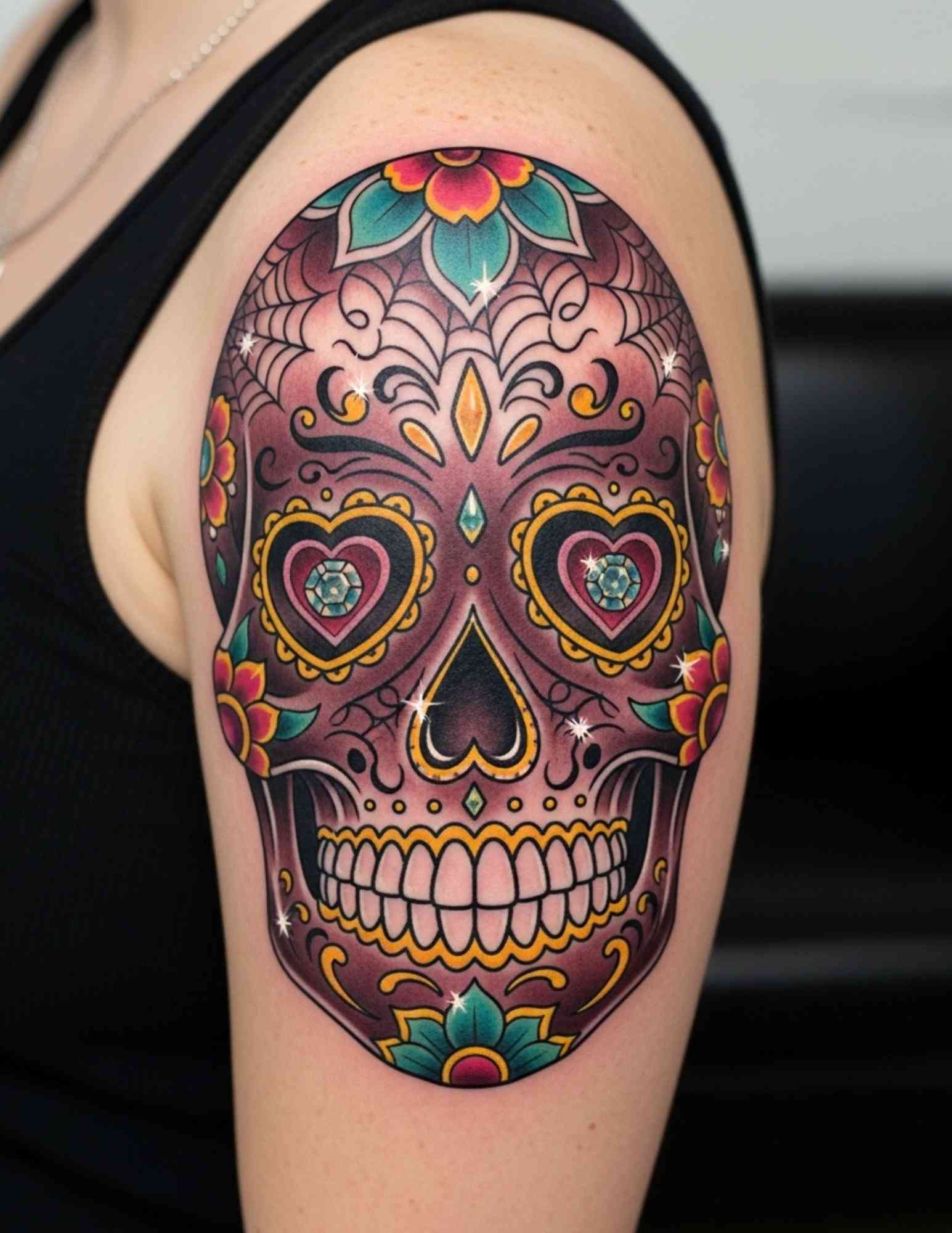
A skull rose tattoo drawing works because the two shapes solve each other’s problems: the skull gives the rose structure, and the rose gives the skull somewhere soft to land.
I have sketched this combination more times than any other pairing, and the version that fails is almost always the one where the artist drew a skull, drew a rose, and set them side by side without deciding which one is in front.
The good ones commit. A stem through the socket, petals swallowing the temporal bone, a jaw resting in the leaves — something that makes the overlap deliberate rather than accidental.
This guide walks through the styles that translate cleanly from paper to skin, the drawing choices that decide how the piece looks in ten years, and where the design tends to sit best. If you want the wider category first, the collection of skull and flower tattoo designs covers the same territory with other blooms.
Which Skull Rose Style Is Right for You?
Style choice matters more than subject here. The same skull and rose drawing behaves very differently depending on line weight and how the tone is built.
| Style | Line & Shading | Best Size | What to Expect Long Term |
|---|---|---|---|
| American Traditional | Heavy outlines, flat solid colour, whip shading | Palm-sized and up | Holds its read the longest of any style here |
| Black & Grey Realism | Little or no outline, smooth grey wash | Forearm length or larger | Softens over time; usually needs a touch-up eventually |
| Neo-Traditional | Varied line weight, layered colour, ornament | Medium to large | Ages well if the line weight was not pushed too fine |
| Fine Line | Single-needle outlines, light stipple | Small to medium | Most likely to blur; plan for fewer details, not more |
| Blackwork / Etching | Solid fill or dense hatching, negative space | Medium to large | Very durable; hatching can close up if packed too tight |
Why the Skull and Rose Pairing Keeps Working
The contrast is not just visual. The skull has been shorthand for mortality in Western art for centuries, and painters built entire still-life compositions around exactly that tension — the vanitas tradition placed skulls next to cut flowers on purpose.
A cut rose is already dying. Putting it against bone makes the point twice, which is why the pairing reads as meaningful to most people without any explanation.
There is a practical reason too. A skull is all hard angles and cavities; a rose is all curves and layered soft edges. Each one makes the other more legible.
In my experience the designs that clients keep coming back to are the ones with a clear tonal hierarchy: one element dark and heavy, the other lighter and more open. When both compete for attention, the tattoo turns into a grey blob at conversation distance.
Meaning is personal, and I would not push anyone toward a fixed reading. Some people get it for a loss, some for a sober anniversary, and plenty just like how it looks — all of which are fine reasons.
Skull Rose Tattoo Drawing Ideas That Translate to Skin
Every idea below is one I have either drawn, watched go on, or had an artist talk me out of for a good reason. They are ordered roughly from most forgiving to most demanding.
1. Rose Growing Through the Eye Socket
This is the version most people picture, and it is popular because the composition solves itself: the socket gives the stem a natural entry point and an obvious depth cue.
Draw the stem entering one socket and exiting near the jaw or the opposite temple. That single line does more for the sense of three dimensions than any amount of shading.
Keep the bloom off-centre. A rose sitting dead centre over the face flattens the skull into a background texture, and the whole reason the design works is that the skull still reads as a solid object.
It scales well. I have seen it work at four inches on a forearm and at full back size, which is not true of most of the ideas further down this list.
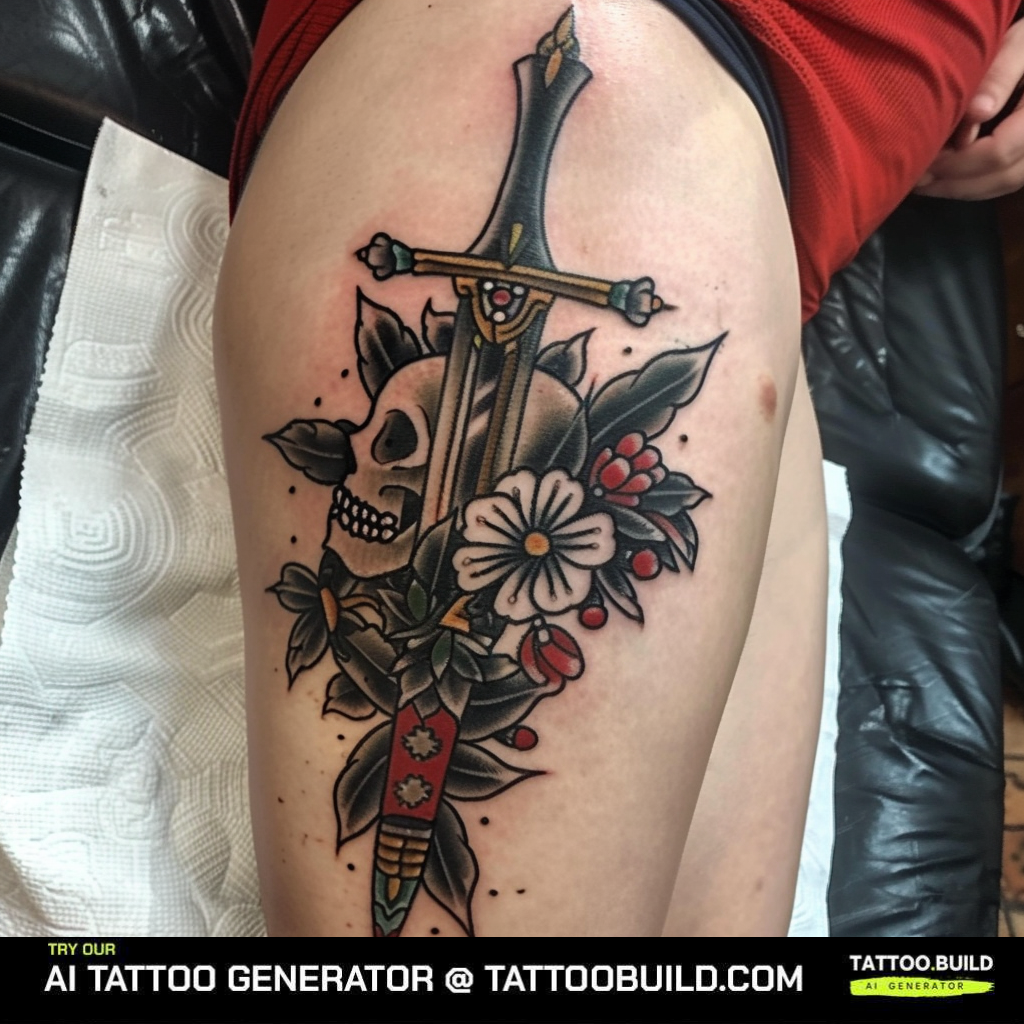
2. American Traditional Skull and Rose
If you want the tattoo to still look like the drawing in fifteen years, this is the safest style on the page. Bold outline, limited palette, plenty of open skin.
The traditional approach uses a three-quarter skull rather than a straight-on one. The angled jaw gives the rose somewhere to sit without the two shapes fighting.
Colour is usually red petals, green leaves, black outline, and a bit of yellow ochre in the bone. Every artist I have asked about longevity says the same thing: fewer colours, more contrast.
Banners, daggers and small filler stars all belong to this vocabulary. They add story without adding fine detail, which is exactly the trade you want. For more of this look, the skull tattoo gallery has a lot of traditional work.
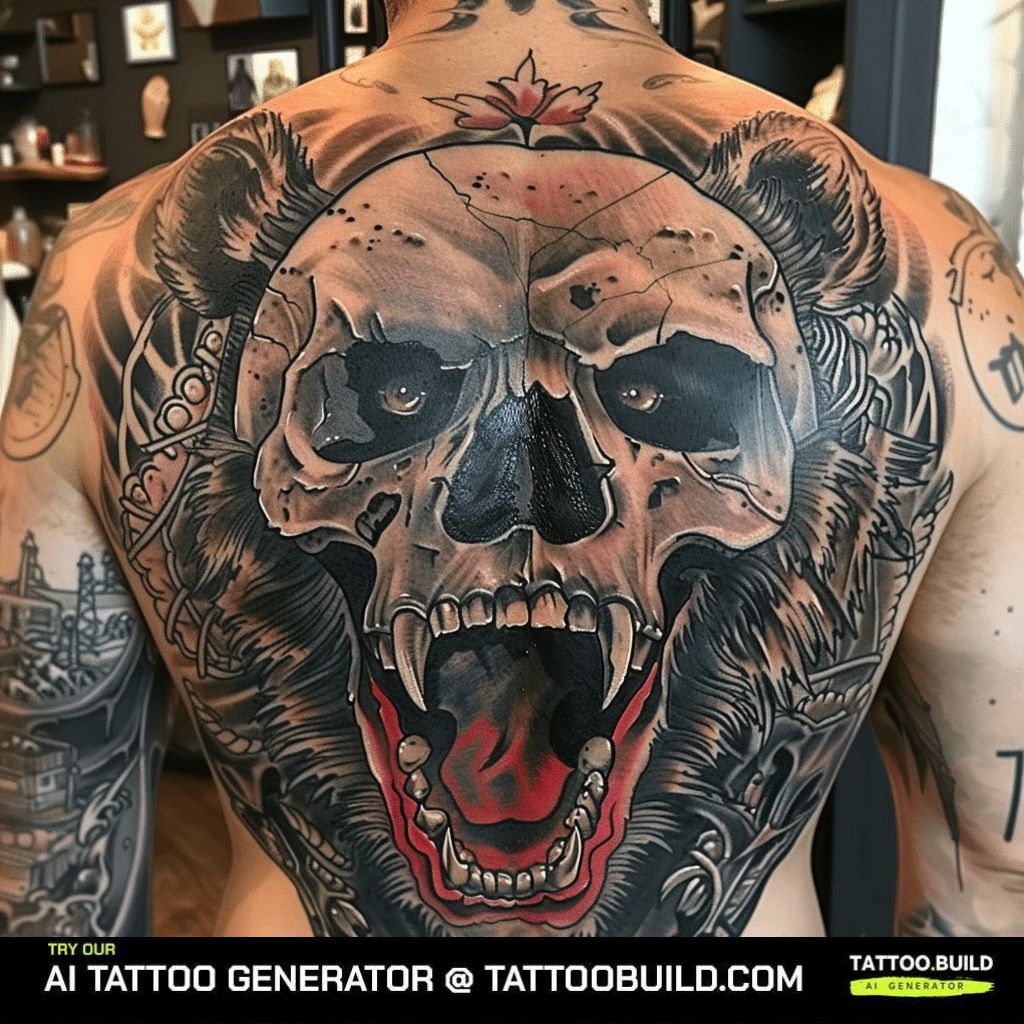
3. Black and Grey Realism
Realism turns the drawing into a rendering problem. There is often no outline at all — the edges come from where the grey stops.
When I tested this on paper, the hardest part was not the skull but the petals: a realistic rose needs at least three tonal values per petal or it collapses into a cabbage.
Give it room. Below roughly five inches, realistic detail packs together and blurs within a few years, so most artists will steer you toward a bigger placement rather than a smaller version.
Ask to see healed photos, not just fresh ones. Black and grey looks spectacular the day it is done; healed work is the only honest preview.
4. Neo-Traditional with a Crown of Roses
Neo-traditional keeps the confident line weight of traditional work but allows deeper colour blending and decorative ornament around the subject.
The crown arrangement — roses circling the top of the cranium — is my favourite version of this. It reframes the skull as something being honoured rather than something threatening.
Expect longer sessions. The layered petals and background ornament mean more passes over the same skin, and that usually means more than one sitting.
Line weight is the thing to watch. Neo-traditional works when the outer line stays heavy and the interior detail stays lighter; reverse that and it just looks muddy.
5. Fine Line Skull and Single Rose
Fine line is the most requested style I hear about and the one that needs the most honesty up front.
Thin single-needle lines spread slightly as the skin heals and continue to soften over years. That is normal, not bad work, but it means the drawing has to be built with gaps you are willing to lose.
The version that holds up is a simplified skull — sockets, nasal cavity, a suggestion of teeth — with one rose rather than three. Detail you can barely see on paper will not exist on skin.
Add roughly 20 percent more space between lines than the sketch looks like it needs. Every fine line artist I have asked gives some version of this advice. More on the style in the fine line tattoo guide.
6. Blackwork and Etching Style
Blackwork treats untattooed skin as a colour. A solid black skull with negative-space petals is one of the most durable ways to draw this design.
Etching style is its close relative: tone built from directional hatching lines rather than smooth grey. It borrows directly from old engraving, and it suits skulls unusually well.
The failure mode is over-packing. Hatching lines placed too close together heal into solid black and lose the whole effect, so the drawing has to leave more white than feels comfortable.
It also holds up well on a wide range of skin tones, since the design depends on contrast between filled and unfilled areas rather than on subtle greys. The blackwork tattoo collection shows the range.
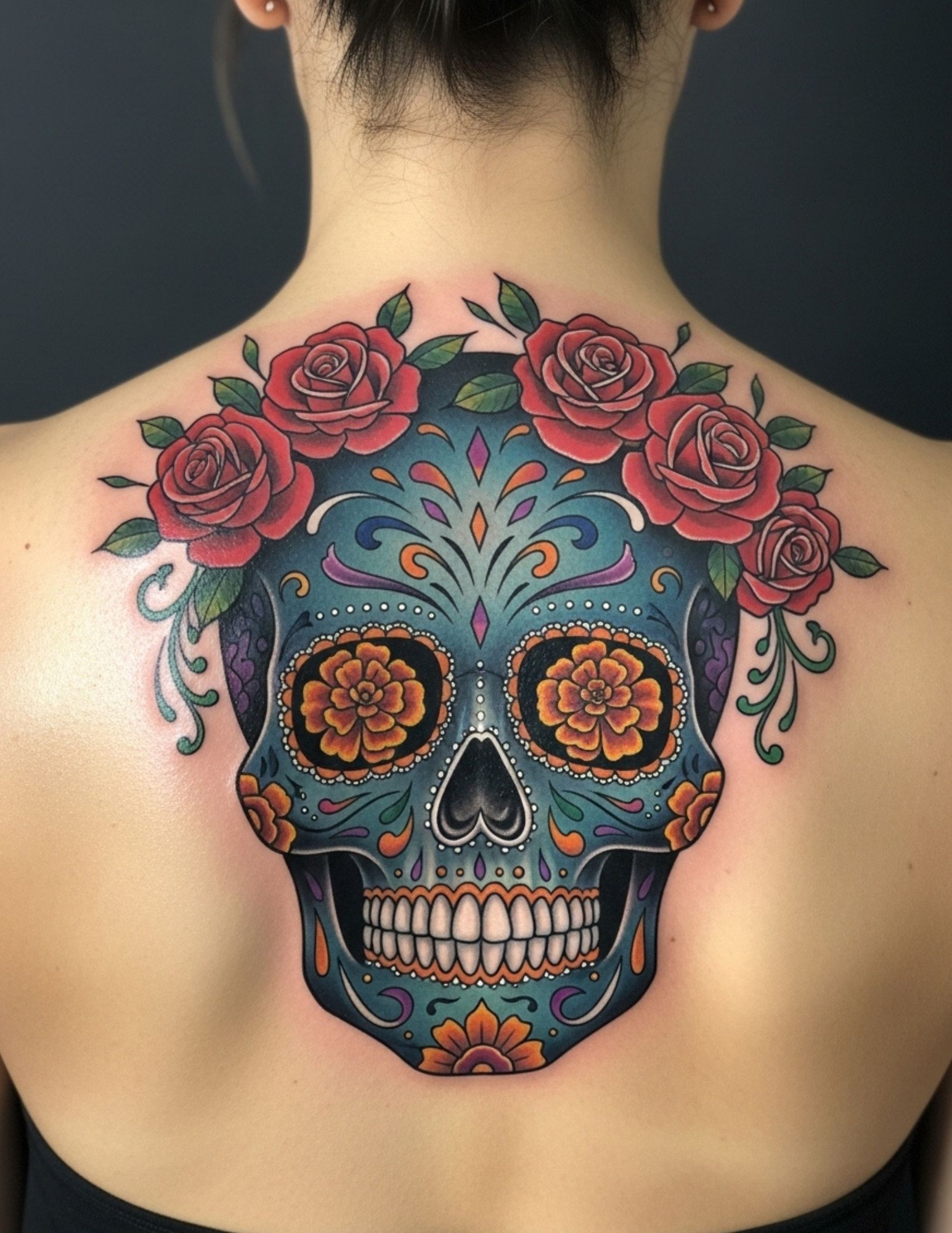
7. Sugar Skull with Roses
The sugar skull is a different tradition entirely — it comes from Mexican Day of the Dead observance, where decorated skulls honour the dead rather than warn about death.
Drawing-wise, it swaps anatomical accuracy for symmetry and pattern: scrollwork on the forehead, petals in the sockets, dots along the jaw.
Roses are the standard flower here, usually framing the jaw so the composition does not stop abruptly at the chin.
If the cultural background matters to you, it is worth reading about the tradition before committing, and there is a fuller sugar skull tattoo guide if you want to go deeper.
Variations Worth Sketching Before You Commit
If the straight skull-and-rose feels too familiar, these are the adjustments I see most often, and each one changes the composition rather than just decorating it.
Skull, Rose and Dagger
A dagger driven through the cranium introduces a hard diagonal, which stops a symmetrical design from feeling static. It is old traditional vocabulary and it still works.
Skull and Rose with a Snake
A snake coiling through the jaw is the most useful filler shape in tattooing — it bends to whatever gap you have. Worth browsing the rose and snake designs before deciding.
Roses Replacing the Cranium
Instead of a rose beside the skull, the top of the skull becomes flowers. It softens the whole piece and reads as growth rather than decay, which suits people who want the memorial reading without the menace.
Skull, Rose and Butterfly
Lighter and more delicate, usually done small. It shifts the tone toward transformation, and the butterfly gives you a second light element to balance the dark skull.
Rose Only, Skull Hidden
My favourite quiet version: the skull shape emerges from the arrangement of petals and shadow, visible once you notice it. It asks for a confident artist and a decent size, but nothing else on this list holds attention as well.
How to Draw a Skull Rose Design That Tattoos Well
Start with the skull as a box, not a skull. Block in a cube in the angle you want, then carve the brow, cheekbone and jaw out of it — this is the step that fixes most wonky-looking skulls.
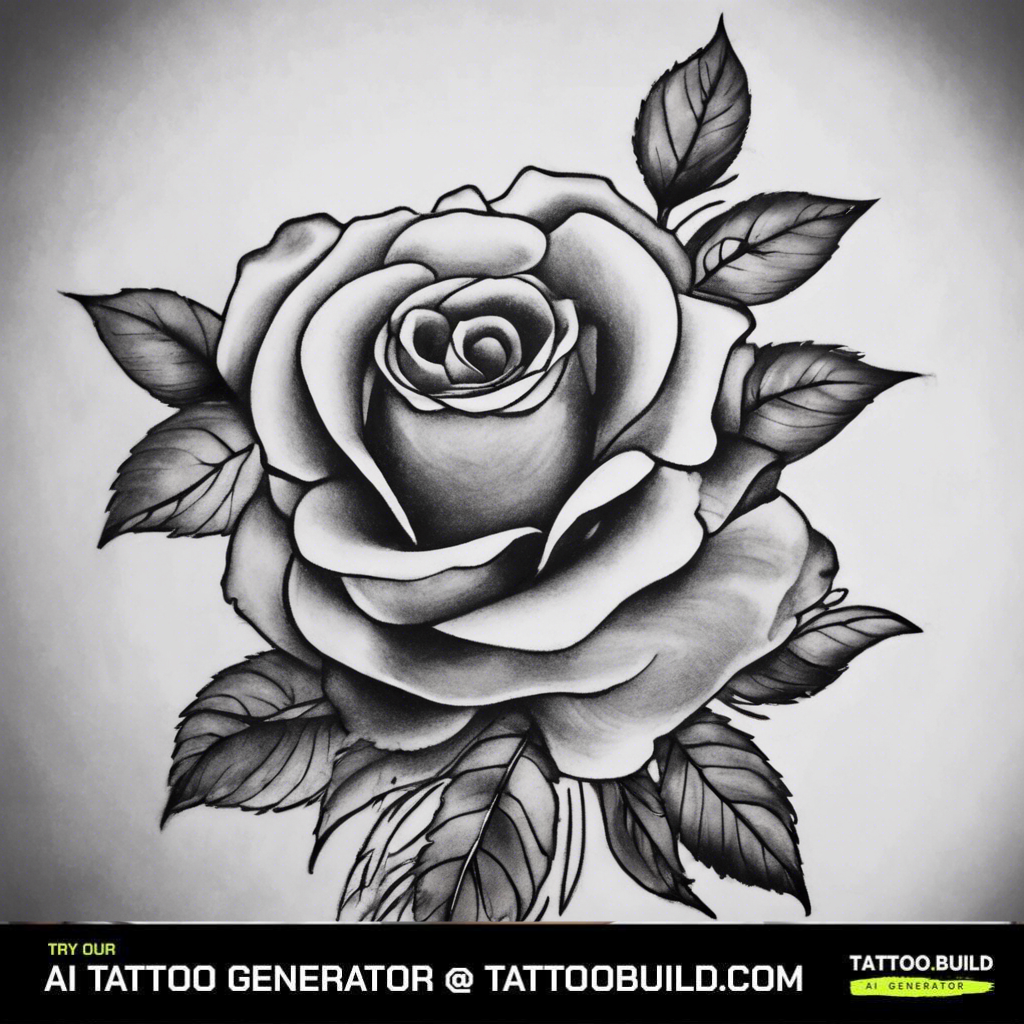
Build the rose from a spiral centre outward, adding petals in rings. Drawing individual petals first and hoping they assemble into a flower almost never works.
Decide overlap before rendering anything. Whichever element is in front should have unbroken edges; the one behind gets interrupted. Getting this wrong is the single most common problem I see in reference sketches.
Then squint at it. If the design still reads as two distinct shapes when the detail disappears, it will read on skin. If it turns into one grey mass, redistribute the darks before you take it to an artist.
Common Mistakes — and Still Not Sure Where to Start?
Cramming too much detail into too small a space is the mistake that costs people the most. Skin is not paper, and ink spreads for the life of the tattoo.
Choosing the placement before the design is another. A tall, narrow composition on a wide chest panel will always look stranded — work out the shape first, then find a body part it fits.
Picking an artist by price rather than portfolio is the third. Style specialisation is real: someone excellent at fine line may not be the right hands for black and grey realism.
If you are still weighing options, it helps to look sideways at related designs. The rose tattoo ideas gallery is useful for petal shapes, black rose tattoos show how the flower behaves in solid black, and memorial tattoo ideas are worth a look if the piece is for someone you lost.
On the health side: healing a tattoo is a wound-care process, and if you have a history of skin reactions or you are prone to keloids, talk to your artist and a doctor before booking rather than after. The FDA’s consumer guidance on tattoo safety and Mayo Clinic’s overview of tattoo risks both cover the realistic risks. Nothing here is medical advice, and any sign of infection — spreading redness, heat, pus, fever — is a reason to see a doctor promptly, not to wait it out.
Frequently Asked Questions
What does a skull and rose tattoo mean?
Most commonly it is read as the coexistence of death and beauty, or life and mortality held in the same image — a pairing that goes back to vanitas painting long before tattooing picked it up. That said, meaning is personal. I have met people who chose it for a specific loss, others for a recovery milestone, and plenty who simply liked the contrast of hard bone against soft petals. There is no obligation to attach a story to it.
How much does a skull rose tattoo usually cost?
It depends far more on size, style and your artist’s rate than on the subject. A small fine line version might be a single short session, while a black and grey realism forearm piece often runs across multiple sittings. Most shops quote by the hour or give a flat rate after seeing the design and placement. The honest answer is to send your reference to two or three artists whose portfolios you like and compare their quotes.
Where does a skull rose tattoo look best?
The forearm is the most forgiving placement because it is flat, relatively low friction and gives a natural vertical frame for the composition. Upper arm, shoulder and chest all work well for larger versions. In my experience hands, fingers and feet are the hardest places to keep this design crisp, since those areas fade faster and the fine detail in the skull is usually the first thing to go.
Should I choose colour or black and grey?
Black and grey suits realism and blackwork and tends to hold contrast well over time; colour suits traditional and neo-traditional, where flat saturated red against black outline stays punchy for decades. If you are undecided, ask your artist to mock up both. Bright colours can also behave differently on different skin tones, which is a conversation worth having with the artist before the stencil goes on rather than after.
How long does a skull rose tattoo take to heal?
The surface usually looks settled in about two to three weeks, while the deeper skin generally takes a couple of months to finish healing. Larger or heavily shaded pieces tend to sit at the longer end of that range. Follow whatever aftercare instructions your artist gives you, since they know what they put in your skin. If anything looks wrong — spreading redness, unusual heat, discharge, or a fever — see a doctor rather than searching for a home remedy.
Quick Summary
- Commit to the overlap. Decide which element sits in front before you render anything else.
- Pick style before subject. Traditional and blackwork age hardest; fine line ages softest.
- Build the skull from a box and the rose from a spiral centre outward.
- Leave more space than feels right — ink spreads for the life of the tattoo.
- Size to the style. Realism needs room; fine line needs restraint.
- Squint test the drawing. Two readable shapes at a distance means it will work on skin.
- Choose the artist by portfolio, and ask specifically for healed photos in your chosen style.
- Treat healing as wound care, and see a doctor for anything that looks like infection.