A star is the easiest tattoo to design badly and one of the hardest to design well. Five clean points look simple on paper, and that simplicity is exactly what exposes a weak drawing on skin.
I have spent a lot of hours going through star flash, and the pattern is always the same: the stars that still look good years later are the ones where the drawing did something beyond the outline.
The fifteen drawings on this page are the ones I kept coming back to, because each one solves that problem differently — with texture, with negative space, with weight, or with a second symbol tucked inside the shape.
If you want a broader sweep of finished pieces rather than drawings, my roundup of awesome star tattoo designs covers placement and healed results. This page is about the linework itself.
Which Star Style Is Right for You?
Every star drawing below falls into one of five broad approaches. This is the shorthand I use when someone shows me a screenshot and asks whether it will hold up.
| Style | Smallest size that works | How it ages | Best for |
|---|---|---|---|
| Bold tribal / blackwork | Around 2 inches | Excellent — solid black holds shape longest | Outer arm, calf, shoulder |
| Traditional nautical | Around 2 inches | Very good — heavy outline, flat fill | Forearm, chest, hand |
| Mandala / ornamental | 4 inches and up | Good if the artist leaves gaps between lines | Forearm, thigh, sternum |
| Fine line / floral | 1.5 inches | Softens noticeably — expect a touch-up | Wrist, ankle, inner forearm |
| Micro star clusters | A few millimetres each | Blurs fastest, especially on hands and feet | Collarbone, ribs, behind the ear |
None of these are rules. They are the trade-offs I would want explained to me before sitting down.
What Actually Makes a Star Drawing Work
A star is a closed shape with five sharp interior angles. Those angles are where ink tends to gather and spread over the years.
That is why the drawings that survive usually do one of two things: they thicken the points deliberately, or they open the interior with negative space so a little spread does not close the shape up.
The second thing that matters is contrast within the drawing itself. A star made entirely of hairline strokes has no visual hierarchy, so from a few feet away it reads as a grey smudge rather than a star.
Symbolism is the easy part. Stars have carried the idea of guidance, direction and hope across a lot of very different traditions, and almost any personal meaning you attach to one will feel earned.
Direction is worth thinking about too. A static five-point star sits still; a shooting star implies movement across the body, and that changes where on the arm or back it will look natural.
15 Star Drawings for Tattoos, Grouped by Approach
I have grouped these by what the drawing is doing rather than by shape, because that is how an artist will talk to you about them.
Heritage Knotwork and Heavy Blackwork
The Celtic knot star is the most technically demanding drawing on this page. Every strand has to alternate over and under correctly, and one mistake in the weave is visible to anyone who looks twice.
When I have watched artists work on knotwork, the drawing stage takes far longer than the tattooing stage. Ask to see the stencil before it goes on.
The bold tribal star is the opposite: almost no internal detail, just weight and shape. It is also, in my experience, the drawing on this list that looks the closest to its original form after a decade.
Both belong to a wider family of tribal tattoo designs where the negative space between the black is as important as the black itself.
Nature Fills: Honeycomb and Mountains
Filling a star with honeycomb is a smart move because the hexagon grid gives the eye something to read at any distance.
The dotwork bees around the edge do a second job: they break the hard silhouette so the star does not look stamped on.
The mountain star works through subtraction instead. The peaks are formed by the empty space rather than by ink, which is why it needs a confident artist and a decent size.
I would not put this one much under three inches. Below that the sky line and the star outline start competing for the same millimetre of skin.
Floral and Vine Wrapped Stars
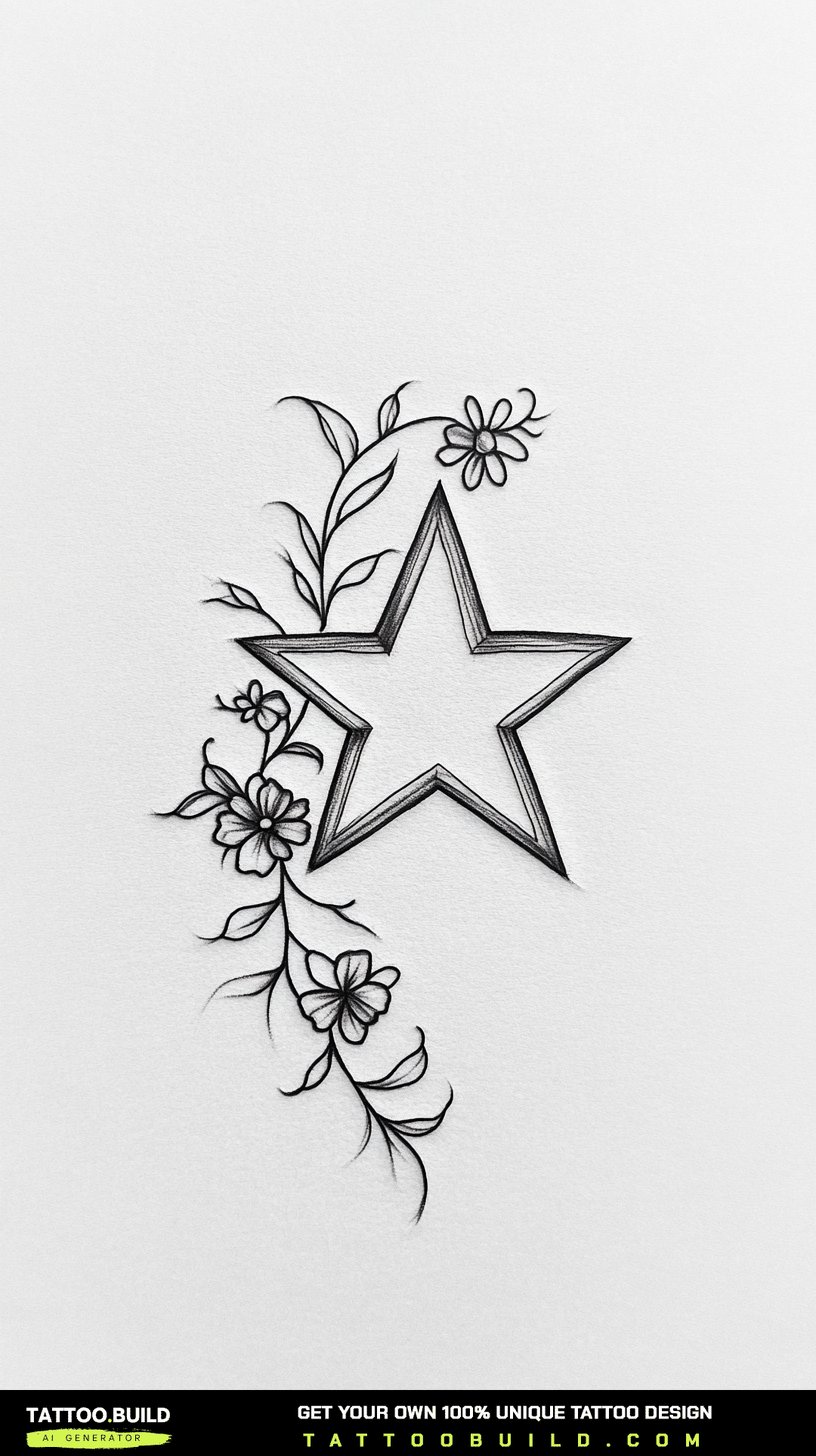
These two are the most requested version of a star drawing I come across, and for good reason — the vine softens the geometry without hiding it.
The key detail is that the vine crosses in front of the star in some places and behind it in others. That single decision is what stops it from looking like a sticker laid over a shape.
Fine line work like this does soften over time. Every artist I have asked has been upfront that a touch-up somewhere around the five-year mark is normal, not a failure.
Keep the flowers slightly larger than feels necessary. Petals with hairline internal detail are the first thing to blur.
Mandala Symmetry and Tribal Flame
A mandala star lives or dies on symmetry. The petals radiate from the star core, so any drift in spacing is obvious immediately.
Good ornamental artists build these with a compass and a centre point rather than freehanding them, and they will usually want to draw it directly on your skin so it follows the curve of the limb.
The flame version trades symmetry for momentum. The swirls wrap the points so the whole piece appears to lean in one direction.
That directionality matters when you place it — a flame star that flows towards your wrist looks very different from one that flows towards your elbow.
Spiritual, Memorial and Time Themes
The winged star with a halo is the drawing people most often bring in as a memorial piece, and the wings are what carry it.
Feather detail needs room. Squeeze this into a two-inch space and the individual barbs merge into solid grey within a few years.
The clock star belongs to the same emotional territory — time, legacy, the things you cannot get back — but it is harder to execute.
Numerals and hands are small, high-contrast elements. If you like this one, look at how the numerals are handled in dedicated clock tattoo drawings before committing to a size.
Movement: Feathers and Wave Patterns
The feathered star replaces the hard points with soft plumes, which gives the shape motion without adding heavy black.
It is a good compromise if you want something that reads as a star from a distance but does not have the harsh geometry of traditional flash.
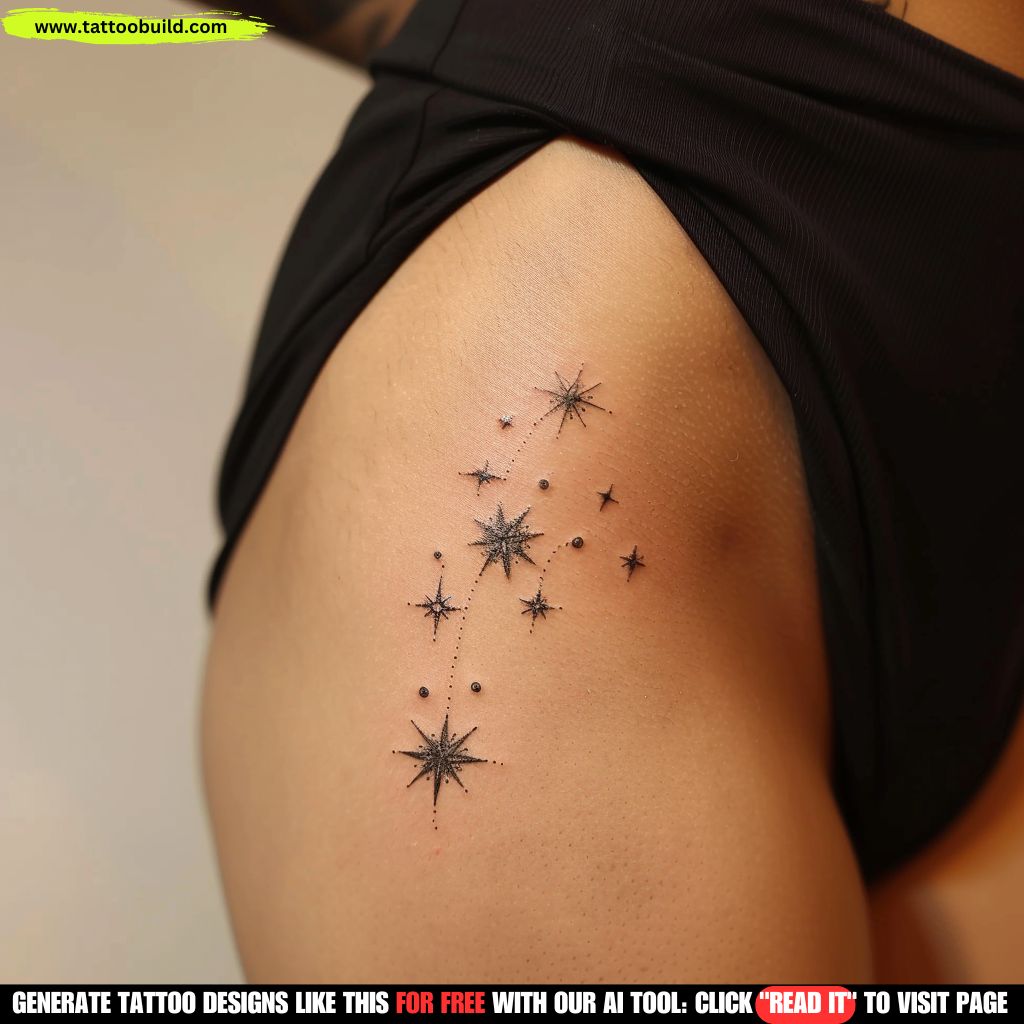
The wave pattern is not really one star at all — it is a scattered line of tiny stars arranged along a curve.
I like this one as a connector piece. It fills the space between two larger tattoos and follows the natural line of a forearm or calf rather than fighting it.
Celestial Clusters and Small Sentimental Stars
The moon phase star is the most versatile drawing on this page. Crescents and dots ring a bold centre, so it can be scaled up or trimmed down without losing its logic.
It also sits comfortably next to other celestial work, which is worth knowing if you are planning a sleeve around constellation tattoo ideas rather than a single piece.
The star-in-a-heart is the smallest and simplest here, and the honest note is that the scattered satellite stars are the part that fades first.
If you want it truly tiny, ask the artist to drop the satellites and keep the two main outlines. It will look better in ten years.
Variations Worth Asking Your Artist About
If none of the fifteen is quite right, these are the adjustments I have seen work most often.
Swap the Five-Point for a Compass Rose
A compass rose carries the same guidance symbolism but gives the artist eight points and a lot more room for shading.
It also solves the sizing problem — a rose reads clearly at a size where a detailed five-point star would already be crowded.
Go Outline-Only
Stripping a design back to its outline is underrated. It heals fast, it ages predictably, and it leaves room to build around later.
Add a Second Celestial Element
Pairing a star with a crescent is one of the oldest combinations in tattooing, and sun and moon designs show how much variety that pairing still has in it.
Cluster Instead of Centring
Three stars of different sizes, loosely grouped, almost always sit on the body better than one perfectly centred star. Asymmetry reads as natural.
Placement, Sizing and Aftercare
Pick the placement before you finalise the drawing, not after. A star drawn flat on paper will distort on a curved surface like a bicep or an ankle, and a good artist adjusts the stencil to account for that.
Hands, fingers and feet are the hardest places to keep a small star crisp. Skin there regenerates quickly and takes more friction, so fine detail tends to break up sooner than it does on an inner forearm.
For healing, follow the aftercare instructions your artist gives you over anything you read online, including this page. The American Academy of Dermatology publishes general guidance on caring for new tattoos that is worth reading alongside it.
If a healing tattoo becomes increasingly painful, hot, swollen or starts producing pus, or if you develop a rash or fever, contact a doctor rather than trying to manage it yourself. The US Food and Drug Administration also tracks ink safety and reaction reports, and reactions to specific pigments can appear weeks or even years after the session.
Common Mistakes — and What to Do Instead
The most frequent one is shrinking a detailed drawing to fit a small space. Detail does not scale down; it just disappears.
The second is bringing in a reference screenshot and asking for it exactly. Most artists draw better work when given the idea and left room to adapt it to your body.
The third is placing a star where it has no relationship to the tattoos already there. Stars are filler-friendly, and they look best when they follow the flow of existing pieces.
Still not sure a star is the right call? Browsing celestial tattoo ideas or a set of small meaningful tattoo ideas is a cheap way to test whether the symbolism or the shape is what you actually want.
Frequently Asked Questions
Do star tattoos hurt more than other designs?
Pain depends far more on placement than on the design itself. A star on the outer forearm or shoulder is generally described as very manageable, while ribs, sternum, feet and the inside of the arm are consistently reported as harder. Size matters too, since a larger piece simply means a longer session. If you are worried, start with a smaller star somewhere forgiving and see how your body handles it.
How small can a star tattoo be and still look good?
A plain outlined star can work at well under an inch, and micro stars a few millimetres across are common. The problem is not the first year but the tenth, because ink spreads slightly under the skin over time and tiny interior gaps eventually close. As a rough guide, if two lines in the drawing sit closer together than about a millimetre, ask your artist whether they will still be separate in a decade.
What do star tattoos actually mean?
Across many traditions stars have been tied to guidance, direction, hope and remembrance, which is why they read as meaningful without needing explanation. The nautical star in particular carries a long association with sailors and finding your way home. That said, there is no fixed dictionary here — most people I have talked to attach a personal meaning rather than a traditional one, and that is entirely legitimate.
Will a fine line star tattoo need touching up?
In most cases, yes, eventually. Fine line work uses very little ink per line, so it softens faster than bold work, and touch-ups somewhere in the three to seven year range are normal rather than a sign something went wrong. Many artists include one free touch-up within a set window after the original session. Ask about that policy before you book, not after.
Can a star tattoo be covered up or reworked later?
Stars are among the easier shapes to rework, because the points can be absorbed into petals, feathers, waves or ornamental patterns. Solid blackwork stars are harder to cover than outlined ones, since there is less light skin left to work with. Laser removal is an option for lightening a piece before a cover-up, but it should be discussed with a licensed practitioner or a dermatologist rather than attempted at home with any product sold for that purpose.
Quick Summary
- Simple star outlines are the safest bet long-term — solid black and clean shapes age best.
- Fine line and floral stars look beautiful early and will realistically need a touch-up.
- Detailed drawings like mandalas, clock faces and feathers need at least three to four inches to survive.
- Negative space is a design tool, not empty room — the mountain star relies on it entirely.
- Place the drawing on a flat or gently curving area if you want it to keep its geometry.
- Hands, fingers and feet blur fastest; collarbone, forearm and calf hold detail best.
- Bring the idea to your artist rather than a screenshot you want copied exactly.
- For any sign of infection or an ink reaction while healing, see a doctor rather than treating it yourself.