I have lost count of how many elephant references I have pulled for consultations, and one detail decides the whole mood of the piece before style or placement ever comes up. An elephant with its trunk raised reads as celebration and good fortune, while the same elephant with its trunk lowered reads as calm, grounded protection. Same animal, completely different tattoo.
That is why the trunk up version keeps winning. It is the pose people associate with luck being thrown into the air, and it gives an artist a natural upward line to build the rest of the design around.
Below are nine trunk up designs worth saving, plus the practical parts nobody mentions until you are already in the chair: how big it needs to be, which placements sit comfortably, and which styles still look like an elephant in twenty years. If you are still weighing the animal itself rather than the pose, the wider round-up of elephant tattoo ideas is a good place to browse first.
One note before the gallery: every piece here is somebody else’s finished tattoo. Use them for direction, not for tracing.
Which Trunk Up Elephant Tattoo Style Is Right for You?
Style is the decision that most people rush and most regret. Here is how the main options actually behave once they are on skin.
| Style | Best Size | Typical Sitting | How It Ages | Suits You If |
|---|---|---|---|---|
| Fine line | 2–4 inches | 1–2 hours | Lines soften; may need a touch-up in a few years | You want something quiet that reads as jewellery, not artwork |
| Black and grey realism | 6–10 inches | 4–8 hours, often split into two sessions | Holds well if the artist leaves enough contrast | You want the elephant to look like it could walk off the skin |
| Dotwork / stipple | 4–7 inches | 3–5 hours | Dots can blur together if placed too tightly | You like texture and a hand-drawn, illustrative feel |
| Geometric / mandala | 5–8 inches | 3–6 hours | Very stable; straight lines show any wobble, so artist choice matters | You want symmetry and a decorative, ornamental look |
| Traditional / bold line | 4–8 inches | 2–4 hours | The most forgiving over decades | You care more about it still reading clearly at 60 than about detail now |
| Watercolour | 4–8 inches | 3–5 hours | Fades fastest of the group; plan for touch-ups | You want colour and are happy to maintain it |
The sitting times above are typical ranges I have seen quoted for pieces at that size — your artist’s estimate for your specific design is the number that matters.
Why the Trunk’s Position Changes Everything
A raised trunk is not an artistic invention. Elephants genuinely lift their trunks to smell the air, to greet each other and during moments of excitement, which is why the gesture reads as alert and joyful even to someone who knows nothing about the symbolism.
That real behaviour is what gives the pose its energy. You are tattooing a moment rather than a portrait, and moments hold a viewer’s eye longer than a static side profile does.
The folk meaning grew out of the same observation. Across a number of cultures a trunk-up elephant is treated as a bringer of luck and blessing, which is why trunk-up figurines are sold as charms far more often than trunk-down ones.
In India the elephant carries additional weight through Ganesha, the elephant-headed remover of obstacles. If that association matters to you, say so at the consultation — it changes how an artist handles the face and the ornamentation.
And the practical point: the raised trunk adds vertical height to the design. That is genuinely useful on a forearm, calf or spine, and genuinely awkward on a wrist or an ankle where you run out of room fast.
9 Trunk Up Elephant Tattoo Ideas Worth Saving
Each of these solves the design problem differently. Read them for the approach, not just the picture.
1. Small Fine-Line Elephant on the Upper Back
The piece above is about as restrained as this subject gets. A single fine-line elephant, trunk lifted, sitting centred between the shoulder blades.
What makes it work is the restraint. There is no shading carrying the design, so the silhouette has to be correct — the dome of the head, the ear line, the taper of the trunk. When those three shapes are right, a two-inch elephant still reads instantly.
The centred upper back is a forgiving spot for a first tattoo. It is flat, it is easy to keep out of the sun while healing, and it is covered by almost any shirt.
One honest caveat: fine line at this scale is the fastest to soften. Every artist I have asked about longevity says the same thing — expect a touch-up eventually. If that bothers you, a bolder outline gives you the same simplicity with more staying power.
2. Standing Elephant With Trunk Up on the Calf
This one rears up on its hind legs with the trunk thrown high, and it uses the leg rather than sitting on it.
The shading is doing real work here. The heavier greys fall where the calf muscle curves away, so the elephant looks like it is wrapped around the limb instead of stamped flat on it.
That is a technique worth asking about directly. Bring the reference, and ask your artist how they intend to use your muscle shape — a good one will already be thinking about it.
A rearing pose needs vertical space, so the calf, the outer thigh and the upper arm all work. A forearm can take it too, but you lose some of the drama when the design has to compress.
3. Realistic Shoulder Piece With a Sunset Background
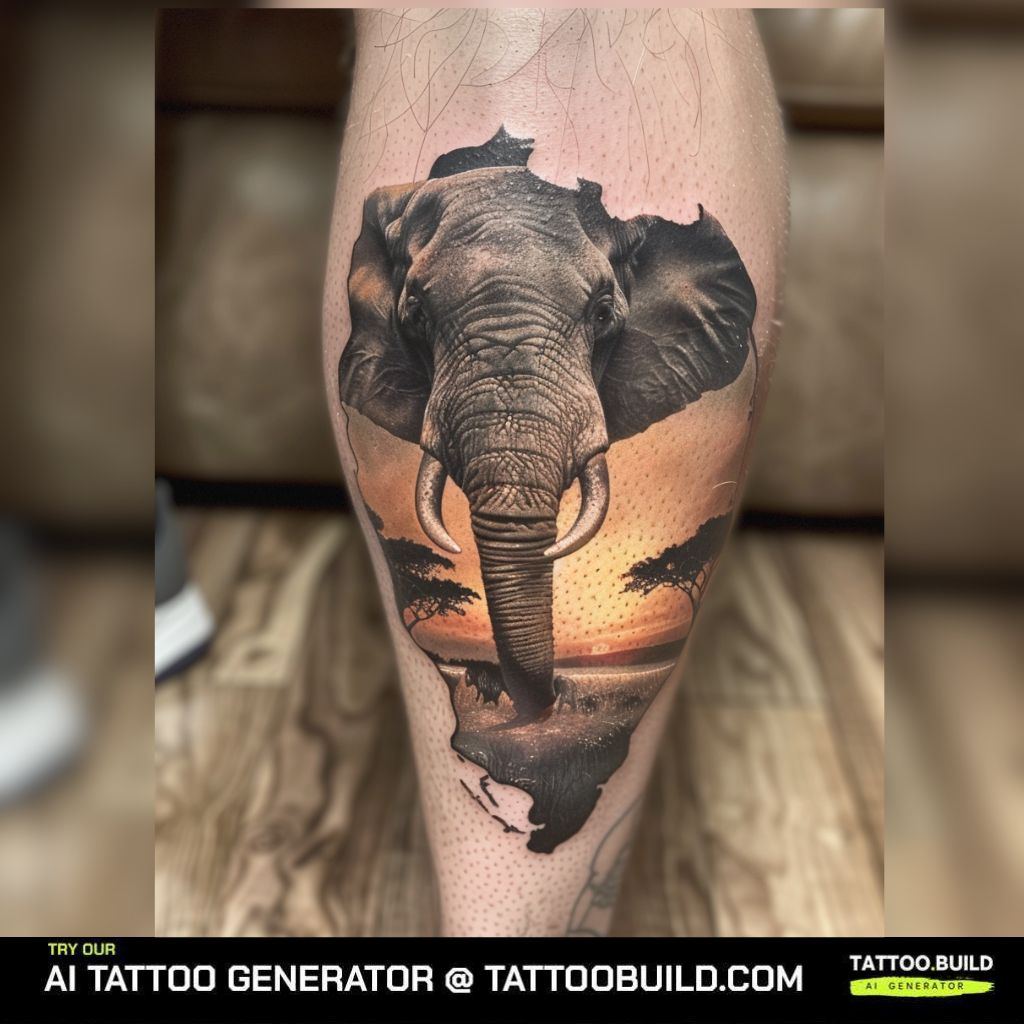
Here the elephant gets a world to stand in. Black and grey realism handles the animal, and a soft orange wash behind it suggests late light without turning the piece into a full colour tattoo. If the placement appeals, there are more elephant shoulder designs in that direction.
The background is the smart part. A wash costs far less time than a rendered landscape, but it lifts the elephant off the skin and stops it floating in white space.
Realism at this level is not a quick sitting. Expect the artist to want two appointments — one to lay in structure, one to build contrast — and expect them to say no if you ask for it smaller than the shoulder allows.
In my experience this is also the placement people are happiest with long term. It is easy to cover for work, easy to show when you want to, and the flat plane of the deltoid keeps the composition readable.
4. Detailed Black Ink Forearm Elephant
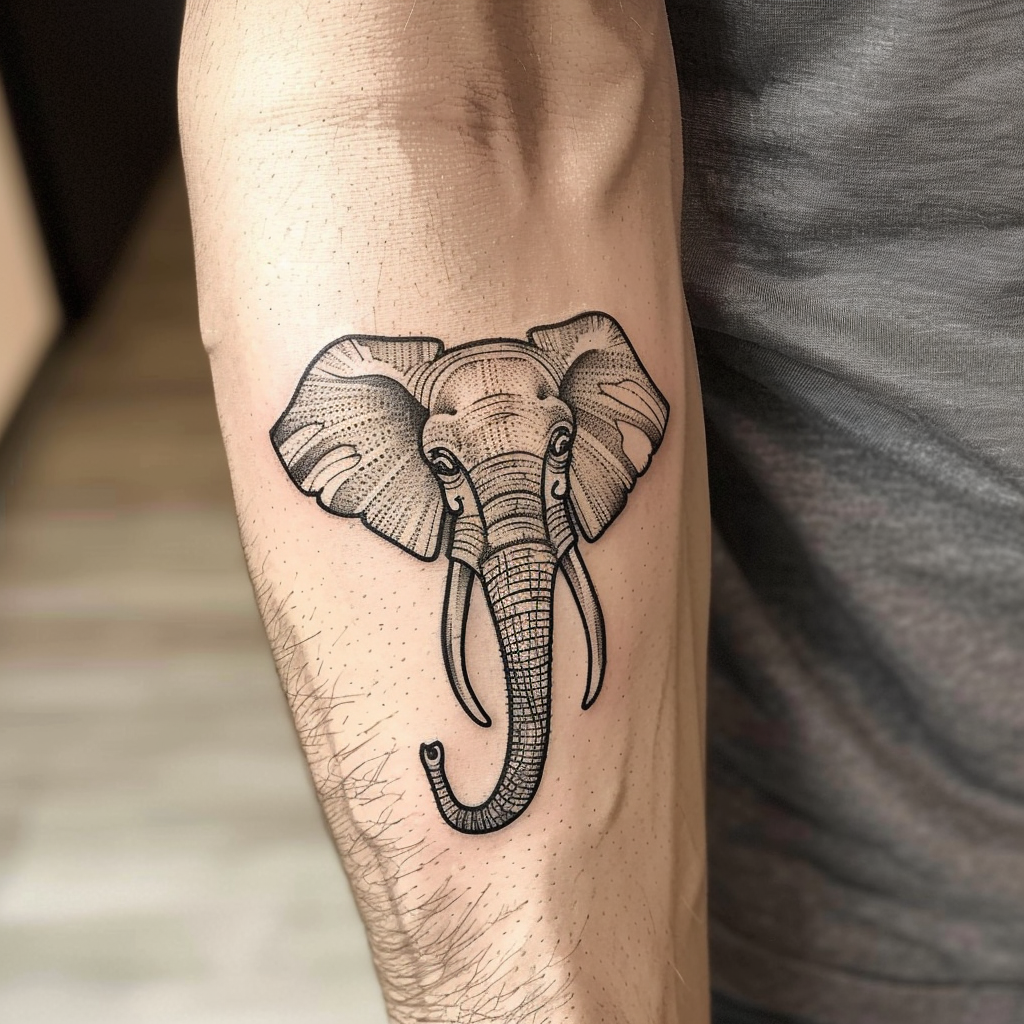
No grey wash, no colour — just black line and texture on the outer forearm.
The wrinkles carry this design. Elephant skin is deeply creased, and rendering those creases with line weight alone is harder than it looks, because the lines have to describe form as well as texture.
The forearm is one of the most practical placements on the body. It is flat, it heals easily, it is moderate on the pain scale, and you can see your own tattoo — which sounds trivial until you have one somewhere you never look. More options in the elephant arm tattoo collection.
If you work in an environment where visible ink is an issue, the inner forearm sits hidden with your arms down and shows when you turn your wrist.
5. Large Shaded Elephant on the Thigh
The thigh gives you the biggest uninterrupted canvas most people have, and this piece uses all of it.
Scale buys detail. At this size the artist can render the eye properly, build real depth into the skin folds and let the raised trunk sweep without cramping — none of which is available on a three-inch design.
It is also one of the more comfortable long sittings. There is muscle and fat under the skin, and you can sit or lie down for hours without your arm going numb.
The trade-off is healing. Thighs rub against clothing constantly, so loose trousers for the first week are not optional. It is also a placement that pairs well with larger leg compositions later on.
6. Playful Baby Elephant in Fine Line and Dotwork
A young elephant with its trunk flung up, built from fine lines and stippled dots rather than solid shading.
This is the friendliest reading of the trunk up pose. Where the realistic pieces say power, a calf with its trunk in the air says delight, and that shifts the whole tone of the tattoo.
Dotwork is the reason it stays light. Stippling creates the impression of shadow while leaving skin showing through, so the piece never gets heavy.
Ask to see healed dotwork before you book, though. Dots placed too close together can merge into a grey smudge over the years, and healed photos tell you far more than fresh ones.
7. Elephant Against a Tree Backdrop
This calf piece places the elephant in a scene — a tree behind it, ground beneath it, and restrained green and brown accents in an otherwise black and grey design.
Those small colour touches are doing a lot with very little. A hint of green in the foliage tells your eye the setting is a landscape, and the elephant stays the subject because it is left in monochrome.
Framing an animal inside an environment is also the most natural way to expand a tattoo later. The scene can grow up the leg without the elephant needing to be reworked.
If you want colour but not a colour tattoo, this is the compromise I would point you toward — accents only, everything structural in black and grey.
8. Geometric and Mandala Trunk Up Designs
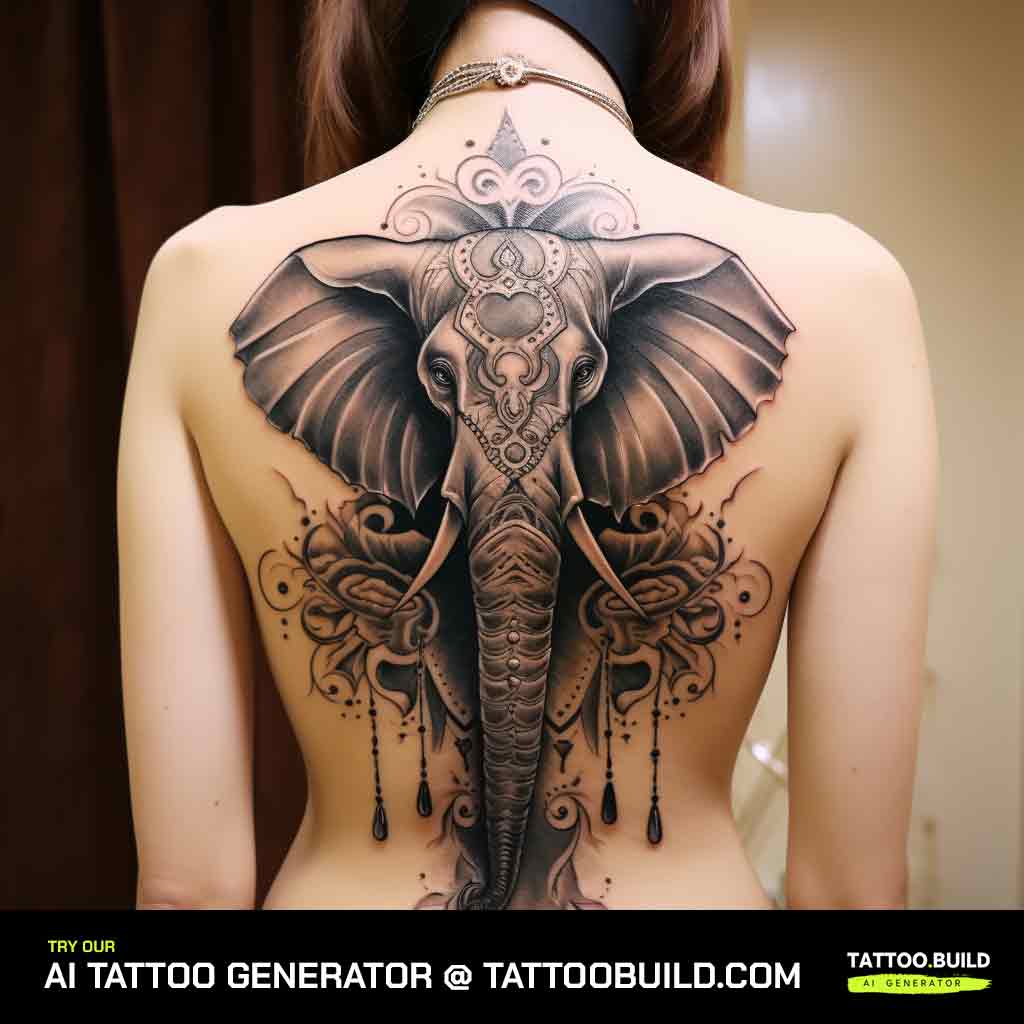
Instead of rendering the animal realistically, this approach builds it from shapes: facets across the head, a mandala filling the body, symmetry driving the composition.
It is the most decorative option, and it ages well because straight lines and defined shapes hold their edges better than soft gradients do.
The catch is that geometry is unforgiving. Any wobble in a straight line or any asymmetry in a mandala is visible forever, so this is one style where the artist’s portfolio matters more than their price. Browse geometric tattoo designs to see who does this well.
Symmetrical designs also need symmetrical placement. Centred on the spine, the sternum or the middle of the forearm — not floating off to one side.
9. Traditional Bold-Line Elephant
Heavy outlines, limited palette, simple shapes. Traditional tattooing has survived a century for a reason.
Bold line work is the most durable thing you can put on skin. When fine detail has softened and grey wash has lightened, a strong outline is still holding the image together.
It is also the fastest and usually the most affordable of the styles here, which makes it a sensible first tattoo. The American traditional elephant page collects the classic versions.
If you want a tattoo that will still read clearly across a room in thirty years, this is the honest answer. It gives up detail to get there, and that is a genuine trade-off, not a free win.
Variations Worth Considering
If none of the nine is quite it, these adjustments cover most of what people ask for next.
Mother and Calf
Two elephants, the calf tucked under the adult, one or both trunks raised. It is the most requested family variation I come across and it works because the size difference builds the composition for you.
It needs space, though. Two animals at a readable size want the thigh, back or upper arm, not a wrist.
Silhouette Only
Solid black fill, no interior detail, trunk raised. It is graphic, it is quick, and it is one of the most durable options on this page.
It also scales down better than any other approach. A silhouette still reads at two inches where a realistic piece turns to mush.
Ornamental and Cultural Detailing
Draped fabric, jewellery, patterned headpieces — decorative elements drawn from South and Southeast Asian traditions of adorning elephants.
If you go this direction, ask your artist to work from real reference and be thoughtful about what the ornamentation means rather than treating it as decoration.
Watercolour Splash
A black and grey elephant over loose colour washes. It looks striking fresh, and it is the fastest of these to fade — so go in expecting maintenance.
Placement, Sizing and Aftercare That Actually Matter
Size the tattoo to the detail you want, not to the space you are willing to give up. If you ask for visible skin texture and a rendered eye in three inches, a good artist will tell you it will not hold — and if they do not tell you, that is information about the artist.
Give the trunk room to breathe. The raised trunk is the whole point of the design, and cramping it against a joint or the edge of a placement is the most common way these pieces disappoint people.
For pain, the outer forearm, outer thigh and calf are generally the more manageable spots because there is tissue under the skin. Ribs, sternum and anywhere over bone are sharper — the pain by placement guide breaks it down properly. Eat beforehand and say something if you need a break; every artist I know would rather pause than have you go pale.
Aftercare is where the result is actually decided. Follow the instructions your artist gives you rather than advice from a comment section, keep it out of direct sun once healed, and read a proper aftercare guide before your appointment rather than after. If you see spreading redness, heat, swelling that worsens after a few days, pus or a fever, that is a doctor’s visit — not something to manage yourself. The American Academy of Dermatology has clear guidance on what normal healing looks like and when to seek help.
Still Not Sure? The Mistakes I See Most Often
Choosing the style before the artist. Find someone whose healed work in the style you want looks good, then design with them — not the other way round.
Going too small for the detail requested. This is the single most common regret, and it is entirely avoidable at the consultation stage.
Copying a tattoo exactly. Bring three or four references showing what you like about each, and let your artist build something for your body. If you need more to look at, the abstract elephant and elephant sleeve collections both cover ground this article does not.
And treating the symbolism as binding. Some people will tell you a lowered trunk is bad luck. It is a superstition, and it is not a reason to get a tattoo you like less. Elephants themselves are worth reading about — WWF has good background on the species and the threats they face.
Frequently Asked Questions
Does a trunk up elephant tattoo really mean good luck?
It is the most common reading, and it comes from folk belief rather than anything you can verify. The raised trunk is widely interpreted as scattering good fortune, which is why trunk-up elephant figurines are so often sold as lucky charms. That said, meaning in tattooing is mostly what you assign to it. In my experience, the people who are happiest with theirs years later chose it because of a personal association, not because a symbolism list told them to.
Is trunk up or trunk down better?
Neither is objectively better, but they read differently. Trunk up is usually taken as celebration, luck and upward momentum, while trunk down is often read as calm, grounding, patience and protection. Some artists will tell you trunk down is unlucky; that is a superstition, not a rule. Pick the one that matches the mood you want on your body every day.
How much does a trunk up elephant tattoo cost?
It depends far more on your artist’s hourly rate and your city than on the elephant itself. A small fine-line piece is usually a shop minimum or a single short sitting, while a detailed black and grey thigh or shoulder piece runs into multiple sessions. Always ask for a quote from the specific artist before booking, since rates vary widely between studios. Be wary of a price that seems unusually low for heavy realism work.
Where does a trunk up elephant tattoo hurt least?
The outer thigh, outer forearm and calf are generally among the more tolerable spots because there is muscle and fat under the skin. Ribs, sternum, inner arm and anywhere directly over bone tend to be sharper. Pain is personal, though, and the length of the sitting often matters more than the location. If you are nervous, a shorter first session on a forgiving spot is a sensible way to find out how you handle it.
Can a trunk up elephant tattoo be added to later?
Yes, and this is one of the reasons I like the subject. An elephant sits comfortably at the centre of a larger composition, so a standalone piece on the forearm or calf can later gain a landscape, botanicals, geometry or a background wash without being reworked. Tell your artist at the first appointment if you think you might extend it. They will place and size it so there is somewhere for the design to grow.
Quick Summary
- Trunk up is the celebratory pose — it is generally read as good luck, joy, momentum and blessing, while trunk down reads calmer and more protective.
- Meaning is yours to assign. The symbolism lists are a starting point, not a rulebook.
- Fine line suits small back, wrist and ankle placements; black and grey realism needs real estate like the shoulder, thigh or calf.
- Give the trunk room. Cramping the raised trunk into a tight space is the single most common way these designs go wrong.
- Forearm, outer thigh and calf are the easiest placements to sit through and the easiest to show or cover as you choose.
- Detail costs space. If you want visible skin texture and eye detail, plan for at least six inches.
- Bring reference photos of real elephants, not just other tattoos, so your artist has anatomy to work from.
- Follow your artist’s aftercare instructions, keep it out of the sun, and see a doctor rather than a forum if the skin looks infected.