I have watched more elephant designs go onto arms than almost any other animal, and there is a reason for that. An elephant arm tattoo works because the arm gives the animal the one thing it needs most — vertical room for the trunk and horizontal room for the ears.
Squeeze an elephant onto a wrist and the ears flatten into blobs within a few years. Give it a forearm or a bicep and the same design still reads clearly a decade later.
That is really the whole argument for this placement. Elephants are detail-heavy animals, and detail needs space, which is why elephant tattoos in general tend to look best on larger canvases.
Below are eight designs I keep coming back to, plus the practical stuff nobody tells you before you sit down — how each style ages, what it costs in chair time, and which ones need a specialist rather than a generalist.
Which Elephant Style Is Right for You?
This is the comparison I sketch out for people who know they want an elephant but have no idea which direction to go. Session times are typical ranges I have seen, not quotes — your artist’s speed and your arm size both move the number.
| Style | Best Arm Placement | Typical Chair Time | How It Ages |
|---|---|---|---|
| Fine line art | Inner forearm, inner bicep | 1–2 hours | Softens and thickens; may need a touch-up in 5–8 years |
| Bold traditional | Outer bicep, outer forearm | 2–4 hours | Excellent — heavy outlines hold shape longest |
| Black and grey realism | Outer forearm, full upper arm | 4–10 hours, often split | Good if sized generously; fine detail blurs if cramped |
| Ornamental / mandala | Outer bicep, wrapping forearm | 3–6 hours | Strong, provided the pattern gaps are wide enough |
| Watercolour / colour splash | Inner or outer forearm | 3–5 hours | Fades fastest; sun exposure is the main enemy |
| Minimal silhouette | Wrist, inner forearm, above elbow | 45 minutes–1.5 hours | Very well — less detail means less to lose |
What Actually Affects How an Elephant Arm Tattoo Ages
Every artist I have asked about animal tattoos says the same thing first: the gap between two lines matters more than the lines themselves.
Ink spreads slightly in the skin over years. If the wrinkle lines on an elephant’s trunk sit too close together, they eventually merge and the trunk turns into a solid grey tube.
That is why a six-inch realistic elephant often looks worse at year ten than a four-inch line drawing does. The realism was not the problem — the compression was.
Placement plays a part too. The inner arm sees less sun and generally holds pigment better, while the outer forearm takes daily UV and shows fading first. The American Academy of Dermatology’s tattoo safety guidance is worth reading before you commit, particularly the sun-protection section.
In my experience the single best thing you can do for longevity costs nothing: ask your artist to size the design up by about twenty percent from whatever you first pictured. Almost nobody regrets that. Plenty of people regret the opposite.
8 Elephant Arm Tattoo Ideas Worth Saving
Each of these is a different answer to the same question, so read them as directions rather than finished designs. Bring two or three to your consultation and let the artist tell you which one suits your arm.
1. Classic Elephant Line Art Tattoo
This is the safest starting point on the list, and I mean that as a compliment.
A single consistent line weight traces the tusks, the ear curve and the back, with nothing filled in. The whole animal is described in maybe thirty strokes.
Because there is no shading to blur, this style survives ageing better than almost anything else at the same size. When I have seen line art elephants revisited five or six years later, the outlines had thickened slightly but the shape was completely intact.
It suits the inner forearm particularly well, where the flat surface lets a long unbroken line stay smooth. If you like this direction, the elephant outline approach is worth studying before you book — the difference between a good and a mediocre one comes down entirely to where the artist chooses to break the line.
Expect a short sitting. Most artists knock one of these out in well under two hours.
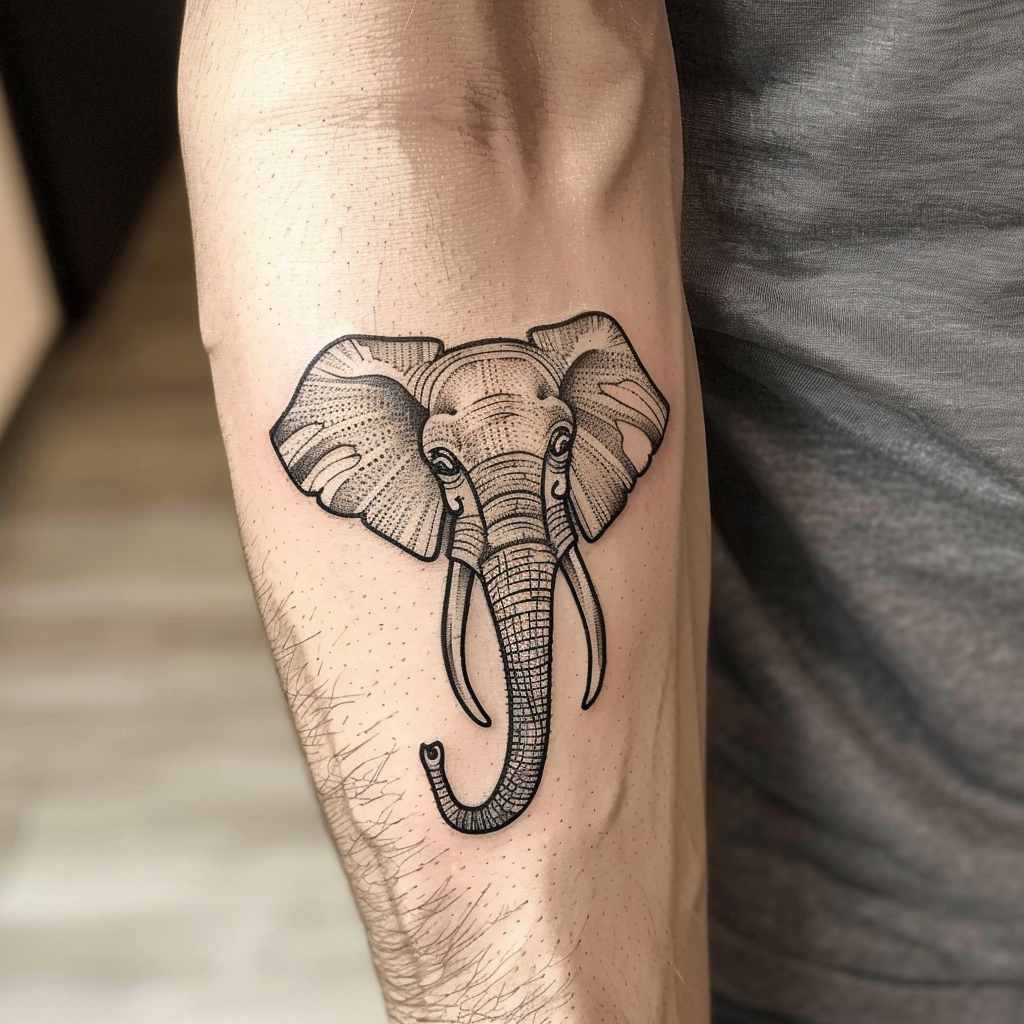
2. Elephant Head Portrait Tattoo
Cropping to just the head is the smartest trick in this whole category.
You get the ears, the tusks, the trunk and the eyes — every feature that makes an elephant recognisable — without needing the vertical space a full body demands.
The eyes are where these live or die. An elephant’s eye is small relative to its head and sits low, and artists who exaggerate it end up with something that reads as a cartoon rather than a portrait.
I usually suggest the outer bicep for a head study. The muscle gives a slight curve that flatters the ear line, and it is an area most people can cover or reveal at will.
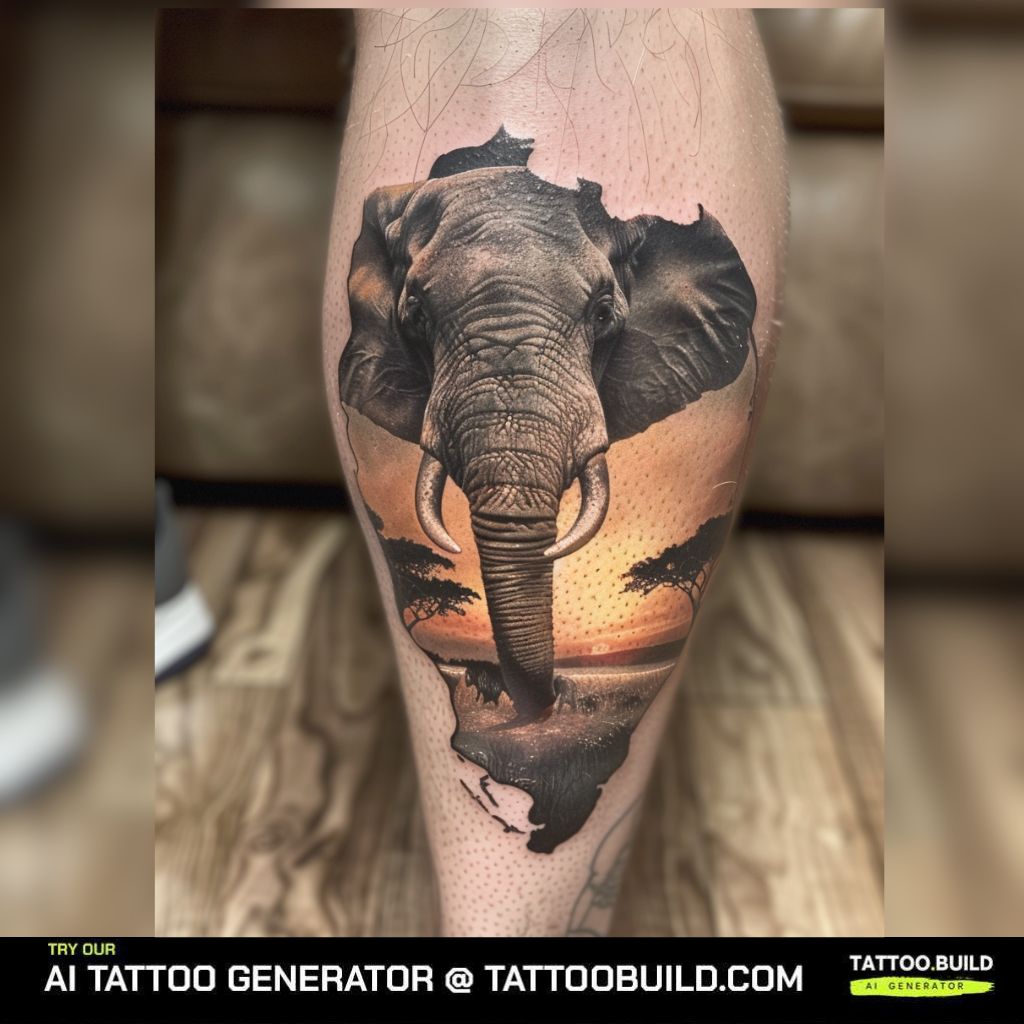
3. Realistic Elephant Arm Tattoo
Realism is the most demanding option here and the one most worth being honest about.
Done well, the wrinkled skin, the dust on the hide and the shadow under the ear look genuinely photographic. Done at the wrong size, it turns to mud.
My blunt advice: do not book realism with a generalist. Look through a portfolio for healed photos, not fresh ones — fresh black and grey always looks sharp, and healed work is the only honest test.
Plan for a large piece. Most realistic elephants I have seen work start around six to eight inches and run up the outer forearm or across the upper arm, and they are frequently split across two sittings.
If you already love the animal but want it bigger than one panel, an elephant sleeve is often the more sensible plan than cramming realism into a small window.
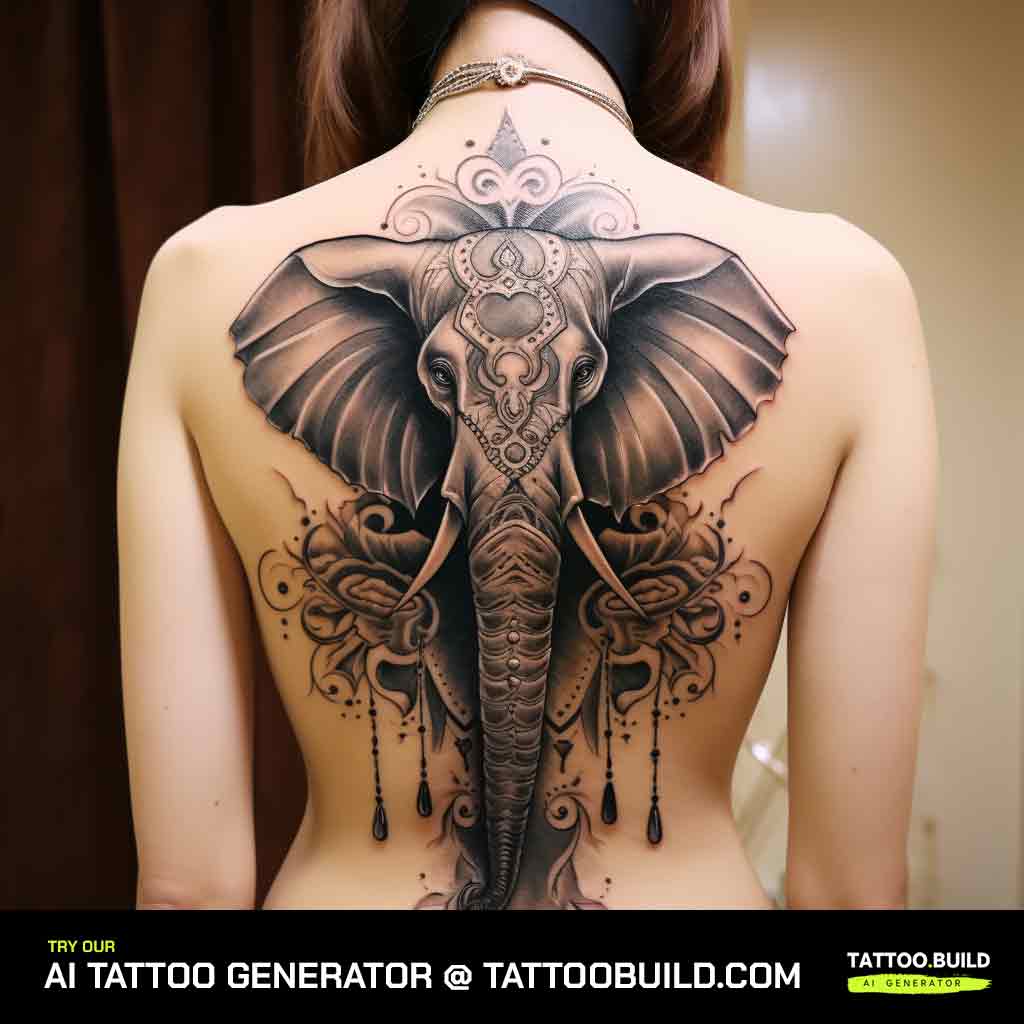
4. Ornamental Elephant with Patterned Trunk
This is the design that borrows from South Asian decorative traditions — a realistic or semi-realistic head with mandala work, dots and geometric patterning laid across the trunk and forehead.
It carries real cultural weight. The elephant-headed deity Ganesha is widely associated with removing obstacles and with new beginnings, and Britannica’s entry on Ganesha is a good short primer if you want the background before you wear the imagery.
Worth saying plainly: a decorated elephant is not the same as a depiction of Ganesha, and if you are drawn to the deity specifically, it is respectful to read about the figure first rather than treating it as pure ornament.
Design-wise, the trap is density. Patterns that look crisp on paper can close up in skin, so ask your artist to open the negative space more than the drawing suggests.
5. Elephant with Flowers
Adding florals is the easiest way to soften an elephant without making it childish.
Soft grey shading on the animal with muted pink or purple blooms around it gives you contrast in both colour and texture — hard hide against soft petals.
This pairing also solves a practical problem. Flowers fill awkward gaps around the elephant’s outline, so the finished piece sits on the arm as a shape rather than floating.
Pick the flower for meaning, not just for looks. Lotus, peony and marigold all have long-standing symbolic associations, and choosing one deliberately gives the tattoo a second layer that only you need to know about.
Colour fades faster than black, particularly in the pink and yellow range, so budget for a refresh somewhere down the line if you go this route.
6. Full-Body Strolling Elephant
A whole elephant mid-stride is the design that uses an arm best, because the arm is a long vertical rectangle and so is a walking elephant seen from the side.
The movement comes from the legs, not the trunk. When the front leg is lifted and the rear leg is planted, the animal reads as going somewhere. When all four legs are down, it reads as a diagram.
Shading around the shoulder folds and the belly is what sells the weight of the thing. Without it, a full-body elephant flattens into a sticker.
I would put this one on the outer forearm nine times out of ten. It runs with the limb, it is easy to view from your own eyeline, and it does not fight the elbow.
7. Minimal Elephant in a Heart Frame
Small, quiet, and far more popular than the internet suggests.
A simple elephant silhouette sits inside a dotted heart, sometimes with small stars or crosses filling the space around it. The whole thing might be two inches across.
What I like about this format is how honest it is about scale. It is not pretending to be a portrait, so nothing is lost when it is tiny.
The dotted frame is doing real work here — it gives the eye a boundary, which stops a small tattoo from looking like it drifted onto the arm by accident.
Good spots include the inner forearm, just above the wrist, or the inner bicep. If you are drawn to smaller placements generally, our forearm tattoo ideas guide covers how size and position interact.
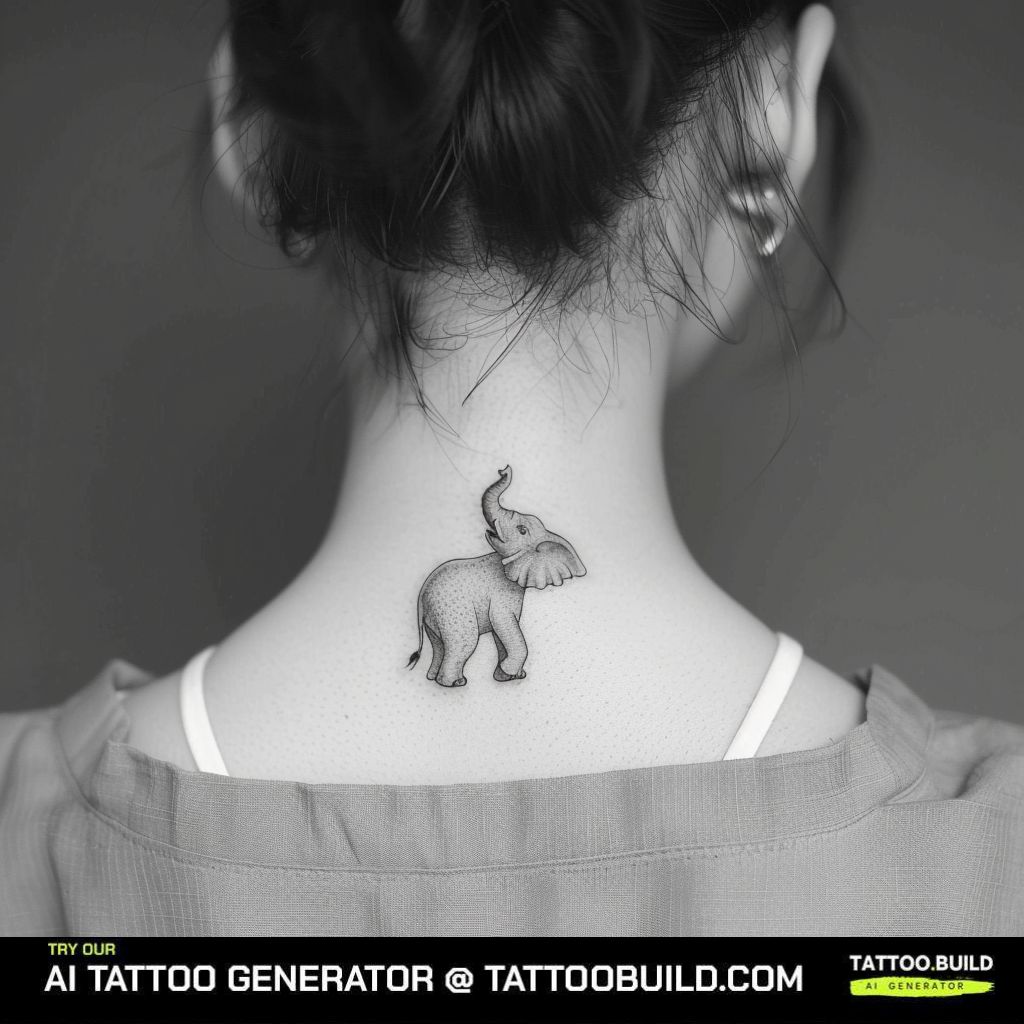
8. Baby Elephant Reaching for the Moon
The gentlest design on this list, and the one people most often get for someone else.
A small elephant stretches its trunk up toward a crescent moon, with a scatter of stars filling the gap between them. It is a composition about reaching rather than about the animal itself.
Parents get this one a lot. So do people marking a move, a recovery, or a fresh start — the upward trunk carries an optimistic read almost universally, which is also the idea behind the trunk-up elephant tradition.
Keep the moon simple. A thin crescent with a light wash of colour holds up; a heavily detailed moon competes with the elephant and neither wins.
Variations Worth Considering
If none of the eight above is quite it, these adjacent directions solve slightly different problems.
Geometric and Abstract Elephants
Breaking the animal into triangles, negative space or fractured planes gives you an elephant that reads as design first and animal second.
These age well because the shapes are large and separated. If that appeals, the abstract elephant approach is the natural next stop.
American Traditional Elephants
Heavy black outlines, a limited palette and flat colour — the style built for longevity above all else.
A traditional elephant will look essentially the same in twenty years as it does at three months, which is more than most styles can promise. The American traditional treatment is worth a look if you value durability over subtlety.
Moving Up to the Shoulder
If your design keeps growing during the sketch phase, the shoulder is usually the answer rather than shrinking the drawing.
The shoulder cap gives you a round canvas that suits a head study, and it flows naturally into a half sleeve later. Our elephant shoulder tattoo ideas cover how that transition works.
Mother and Calf Pairings
Two elephants — an adult with a calf tucked against its leg or trunk — is the standard way to represent family in this imagery.
It needs more width than a single animal, so the upper arm or the outer forearm suits it better than the inner. Keep the calf clearly smaller; artists sometimes size them too close together and the pairing loses its meaning.
Placement, Sizing and Aftercare Tips
Size up, then size up again. The most common regret I hear about animal tattoos is not the design, it is the scale — people ask for something small, and five years later the details have merged.
On placement, the inner arm hurts slightly more for most people but sees far less sun. The outer forearm and bicep are more comfortable to sit through and easier to show, at the cost of faster fading. Neither is wrong; just know which trade you are making.
For healing, follow whatever aftercare instructions your artist gives you rather than an internet consensus, because their protocol matches the products and technique they actually used. In general terms, that means keeping the area clean, avoiding soaking it, and staying out of direct sun until it is fully healed.
On safety, be straightforward with yourself: a new tattoo is an open wound. If you see spreading redness, increasing pain after the first few days, discharge, or you run a fever, that is a doctor’s call, not a forum’s. The FDA’s consumer guidance on tattoo safety covers reactions and ink concerns in plain language. Nothing in this article is medical advice.
Common Mistakes — and What to Do If You Are Still Not Sure
The mistake I see most often is choosing a reference photo instead of a design. A photograph of an elephant is not a tattoo; someone still has to decide what to simplify.
Second most common: booking a realism piece on price rather than portfolio. Black and grey realism is a specialty, and the gap between an artist who does it weekly and one who does it occasionally is enormous.
Third: ignoring the elbow. A design that starts on the forearm and creeps toward the elbow ditch needs planning, because that skin moves constantly and heals differently.
If you are still undecided, it usually means you like the animal more than any particular style. That is fine — browse tattoos that mean strength and courage for the symbolic angle, then come back and pick the style that carries that meaning best on your arm.
Frequently Asked Questions
Do elephant arm tattoos have a specific meaning?
Broadly, elephants are associated with strength, memory, wisdom, patience and family loyalty, and those readings are consistent across a lot of cultures. In South Asian traditions the elephant carries additional religious significance, particularly through Ganesha. There is no single fixed meaning, though, so most people I have spoken to pick the association that matters to them and let the rest go. If a specific cultural meaning is the reason you want it, read about that tradition properly before committing.
How much does an elephant arm tattoo cost?
It depends far more on time than on subject. A small line art elephant is usually a single short sitting, while a detailed realistic piece can run several hours or be split across two appointments. Most reputable artists work to an hourly rate or a flat day rate, and a consultation will get you a real number for your arm and your design. Be wary of quotes that come in dramatically below everyone else in your area.
Which arm placement hurts the least for an elephant tattoo?
In my experience the outer forearm and the outer bicep are the most tolerable spots, because there is more muscle and fewer nerve endings near the surface. The inner arm, the elbow ditch and anywhere close to the wrist tend to be sharper. Pain is genuinely individual, though, and people who expect the worst often report it was easier than they feared. If you are worried, book a shorter first session rather than a full day.
Will a small elephant tattoo still look good in ten years?
It can, but only if the detail level matches the size. A simple silhouette or a clean outline at two inches usually holds up well, whereas a highly detailed elephant squeezed into the same space will typically blur as the ink settles. The general rule artists repeat is to keep the space between lines generous. A touch-up somewhere down the line is normal, not a failure.
Can an elephant arm tattoo be extended into a sleeve later?
Yes, and this is worth raising at the first consultation even if a sleeve feels far off. An artist who knows you might expand later will position the elephant and leave background room accordingly, which makes the eventual join far easier. Retrofitting a sleeve around a piece that was centred with no margin is possible but usually involves more compromise. Tell your artist your long-term plan, not just your immediate one.
Quick Summary
- The arm suits elephants because it gives vertical room for the trunk and width for the ears.
- Line art is the most forgiving style over time; realism is the least forgiving at small sizes.
- Cropping to just the head gets you full recognisability without needing a large canvas.
- Ornamental and mandala patterning carries cultural weight — read about it before wearing it.
- Florals soften an elephant and fill awkward gaps, but colour fades faster than black.
- Full-body strolling designs belong on the outer forearm, where the shape matches the limb.
- Size up by roughly twenty percent from your first instinct; almost nobody regrets that.
- Follow your artist’s aftercare instructions, and see a doctor for any sign of infection.